Category: Research

  • How Dogs and Cats Drink

    How Dogs and Cats Drink

    We humans do our hands-free drinking via suction, using the shape of our lips and mouths to create low pressure that draws liquids in. Dogs and cats, on the other hand, have no cheeks and, therefore, no suction. Instead, both cats (top) and dogs (bottom) drink using adhesion, or the tendency of a liquid to stick to a surface. Both species flatten part of their tongue against the water surface, then pull it up rapidly. This draws a column of water up after their tongue, which they then snap their jaws closed around. Although they use the same method, cats are daintier drinkers than dogs, which sometimes leads to the misconception that the animals drink differently. (Image credits: NYTimes, source; research credit: S. Jung et al.)

  • Boiling Water in Oil

    Boiling Water in Oil

    Most people know that throwing water into hot oil is a bad idea. But, as dramatic as the results can be, the boiling of a water droplet submerged in oil is remarkably beautiful, as seen in the animations above. The initial water droplet expands as it shifts from liquid to vapor (top). At a critical volume, the expansion occurs explosively (middle), causing the bubble to overexpand relative to the pressure of the surrounding fluid. The higher pressure of the oil around it collapses the drop, which then re-expands, creating the cycle we see in the final two animations. This oscillation triggers a Rayleigh-Taylor type instability along the bubble’s interface, causing the surface corrugations observed. The vapor bubble will continue to rise through the oil, eventually breaking the surface and scattering hot oil droplets.  (Image credits: R. Zenit, source)

  • Shock Waves in Flight

    Shock Waves in Flight

    Schlieren optical systems have been used to visualize shock waves in labs for more than a century, but the technique did not translate well to photographing shock structures outside the lab. But now NASA’s Armstrong Research Center and Ames Research Center have developed a method that allows them to capture highly-detailed images of the shock waves around airplanes while they are flying. This is incredible stuff. Be sure to check out the high-resolution versions on this page, along with more description of the coordination necessary to pull off the photos.

    The light and dark lines you see emanating from the airplane are places with strong density gradients. The dark lines are mostly shock waves, with the strongest shock waves appearing black due to the large change in air density. Many of the light streaks are expansion fans, areas where the density and pressure drop as air speeds up.

    The goal of this research is to better understand shock wave structures around supersonic planes in order to reduce the noise supersonic aircraft cause when flying overhead. As you can see in the photos, the shock waves at the nose and tail of the aircraft persist far away from the aircraft; these are what cause the twin sonic boom heard when the plane flies by. (Photo credit: NASA; via J. Hertzberg)

  • Controlling Droplet Bounce

    Controlling Droplet Bounce

    Water repellent, or hydrophobic, surfaces are common in nature, including lotus leaves, many insects, and even some geckos. These hydrophobic surfaces typically gain their water-repelling ability from extremely tiny nanoscale structures in the form of tiny hairs or specially textured surfaces. But, while the nanoscale structures impart superhydrophobicity, researchers have found that larger macroscale structures can improve water-repellent characteristics by reducing a drop’s time of contact with the surface. A smaller contact time means less chance of contamination on self-cleaning surfaces. It’s also helpful in preventing water from freezing on contact to cold surfaces – valuable, for example, in protecting airplane wings’ leading edges from icing over. This combination of nanoscale and macroscale, water-repelling structures can be found in nature, too, such as on the wings of butterflies, which must quickly shed water in order to fly. (Image credits: K. Hounsell et al.A. Gauthier et al., source video)

  • Convection Cells

    Convection Cells

    This magnified photo shows Rayleigh-Benard convection cells in silicone oil. This buoyancy-driven convection occurs when a fluid is heated from below and cooled above. Inside the cells, fluid rises through the center and sinks along the edges; this motion is made apparent here thanks to aluminum flakes in the oil. The distinctive hexagonal shape of the cells is actually due to surface tension. Here, the upper surface of the fluid is left open to the air and this free surface boundary condition causes hexagonal shapes to form. If the fluid were instead covered by a solid surface, the convection cells that form would be shaped differently. (Image credit: M. Velarde et al.; via Van Dyke’s An Album of Fluid Motion)

    ——————

    LAST CALL: FYFD reader survey closes Wednesday! I’ve teamed up with researcher Paige Brown Jarreau to create a survey of FYFD readers. By participating, you’ll be helping me improve FYFD and contributing to novel academic research on the readers of science blogs. It should only take 10-15 minutes to complete. You can find the survey here.

  • Featured Video Play Icon

    Soap Bubble Coalescence

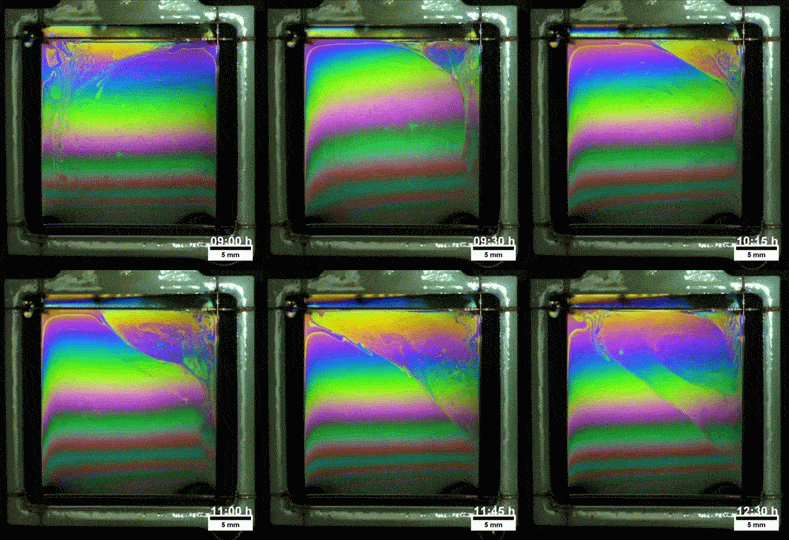
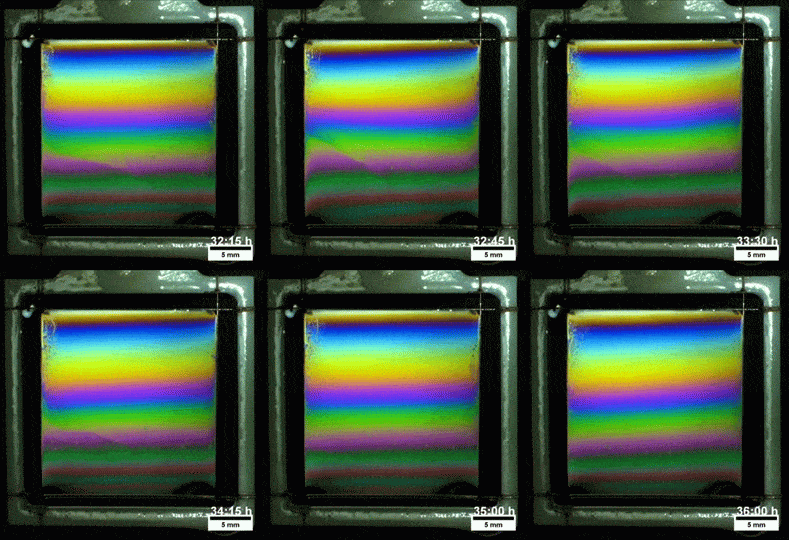
    Droplets falling onto a bath of the same liquid will sometimes coalesce via a series of increasingly smaller droplets in a process known as the coalescence cascade. Soap bubbles, it turns out, can exhibit a similar partial coalescence. When a bubble nears a soap film and the air between them drains away, coalesce can begin. If the the soap film beneath the bubble ruptures, some air from the inside of the bubble can escape. Part of the bubble coalesces with the soap film and a smaller daughter bubble is left behind. The researchers observed this process happen up to three times before the bubble coalesced completely. Alternatively, if the soap film did not rupture, the air inside the bubble had no escape, and the bubble would coalesce into a hemispherical lens atop the soap film. (Video credit: G. Pucci et al.; via KeSimpulan)

    ——————

    Don’t forget about our FYFD survey! I’ve teamed up with researcher Paige Brown Jarreau to create a survey of FYFD readers. By participating, you’ll be helping me improve FYFD and contributing to novel academic research on the readers of science blogs. It should only take 10-15 minutes to complete. You can find the survey here. Please take a few minutes to participate and share!

  • Featured Video Play Icon

    Suppressing Instability

    The Rayleigh Taylor instability is a common fluid phenomenon in which the interface between fluids of differing densities becomes unstable. It’s what’s responsible for all those awesome pictures of milk in ice coffee. For many years, fluid dynamicists theorized that the instability might be inhibited by rotation, which tends to suppress velocity changes along the axis of rotation. But actually creating an experiment demonstrating the effect was extremely difficult because any attempts to set a denser fluid over a lighter one before rotating it would kick off the instability. Recently, however, researchers succeeded in creating an experimental demonstration, seen in the video above. They did so by using magnetism. The initial set-up consists of two fluids of similar densities – a heavier, diamagnetic fluid on the bottom and a lighter, paramagnetic fluid floating on top. The tank was then spun up until both fluids were rotating like a rigid body. Then, the entire set-up was lowered into a vertically-oriented magnetic field. The paramagnetic fluid on top was attracted by the field while the diamagnetic fluid on the bottom was repelled. The end result is that the magnetic field created the effect of the upper fluid being heavier, thereby initiating the Rayleigh-Taylor instability. As you can see in the video, rotation does slow down–but not prevent–the instability. But it took some very clever and careful experimental design to show!  (Video credit: K. Baldwin et al.)

    ——————

    Don’t forget about our FYFD survey! I’ve teamed up with researcher Paige Brown Jarreau to create a survey of FYFD readers. By participating, you’ll be helping me improve FYFD and contributing to novel academic research on the readers of science blogs. It should only take 10-15 minutes to complete. You can find the survey here. Please take a few minutes to participate and share!

  • Featured Video Play Icon

    The Kelvin-Helmholtz Instability

    The Kelvin-Helmholtz instability is a pattern frequently found in nature. It has a distinctive shape, like a series of breaking ocean waves that curl over on themselves to create a string of vortices. The instability shows up when there is a velocity difference between two fluid layers. The unequal shear between the two layers magnifies any disturbance to their interface, which manifests in the fractal, overturning whorls seen in the numerical simulation above. You can find the Kelvin-Helmholtz instability in the lab, in the sky, in the oceanon Jupiter and Mars–even on the sun! For more information on the methods used to create the simulation above, check out the full paper. (Video and research credit: K. Schaal et al.)

  • Recreating Hurricanes

    Recreating Hurricanes

    Hurricane-related winds and storm surge cause massive damage every year. Understanding and being able to predict the impact of these storms on coastal structures can help save lives and properties. Until recently the most ferocious of hurricanes–category 5 storms that feature winds above 250 kph (150 mph)–could not be recreated in a laboratory scale. Now the University of Miami’s SUSTAIN (SUrge-STructure-Atmosphere INteraction) facility can produce category-5 equivalent winds, waves, and surge in a controlled environment. The massive test section measures 18 m x 6 m x 2 m and can be filled with over 140,000 liters of saltwater. The acrylic walls of the facility let researchers use optical flow diagnostics like particle image velocimetry (PIV) to measure flow anywhere in the test section. Some of their planned studies include experiments on how oil spills behave in storms and how strong aquaculture nets must be to maintain their catch through a storm. It will also be used to study interactions between buildings and storm surge. For more, check out their website or this video from the Weather Channel. (Image credits: Gort Photography, AFP/K. Sheridan, AP Photo/W. Lee; SUSTAIN Laboratory)

  • Cars Helping Cyclists

    Cars Helping Cyclists

    This year’s Tour de France opened with an individual time trial stage in which riders competed solo against the clock. But, according to numerical simulations, some riders may get an unfair aerodynamic advantage in the race if they have a following car. The top image shows the pressure fields around a rider with a car following 5 meters behind versus 10 meters behind. The size of the car means that it displaces air well in advance of its arrival. By following a rider closely, that car’s high pressure region can help fill in a cyclist’s wake, thereby reducing the drag the rider experiences. For a short time trial like the 13.8 km race that kicked off this year’s tour, a rider whose car follows at 5 meter could save 6 seconds over one whose car followed at the regulation 10 meter distance. (As it happens, the stage was decided by a 5 second margin.) Since not all riders get a team follow car, it’s especially important to ensure that those who do aren’t receiving an additional advantage. For more about cycling aerodynamics, check out our previous cycling posts and Tour de France series. (Image credit: TU Eindhoven, EPA/J. Jumelet; via phys.org; submitted by @NathanMechEng)