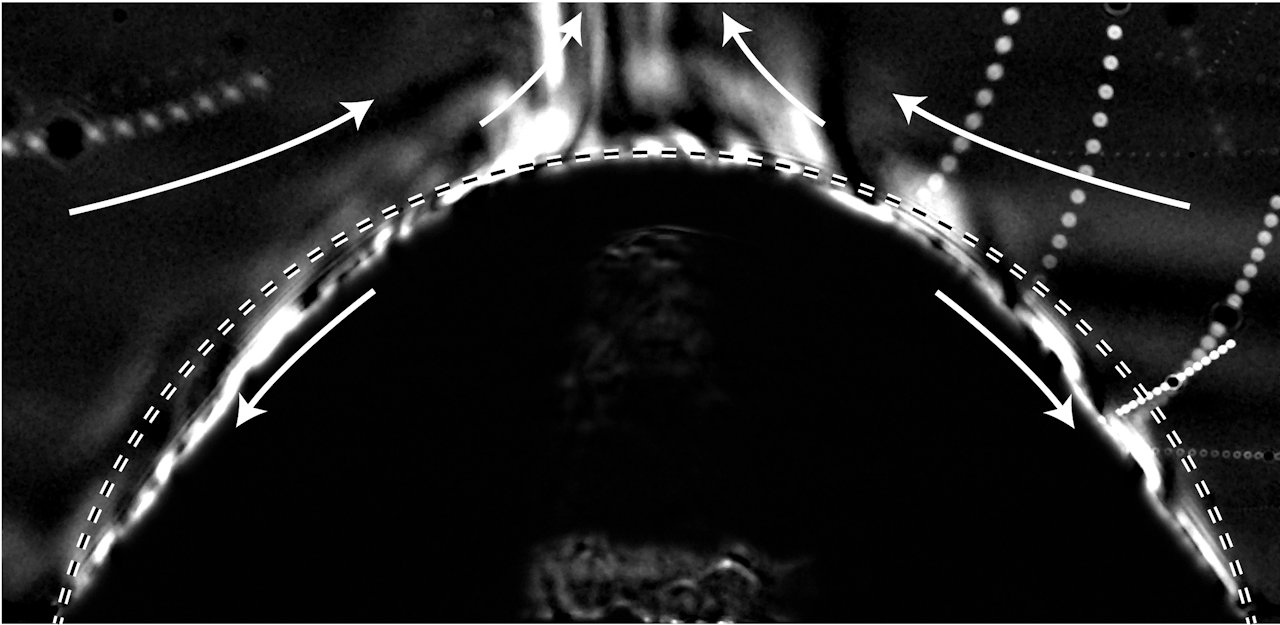
A thin layer of hydrophobic particles dispersed at an oil-water interface is strong enough to prevent a water droplet from coalescing. The researchers refer to this set-up as their granular raft. As the red-dyed water droplet gets larger (top row), it deforms the raft more and more, but the grains continue to keep the drop separate from the fluid beneath (middle row). When water is removed from the droplet, wrinkles form on the raft as the drop’s volume shrinks. This is because the contact line – where the droplet, grains, and air meet – is pinned. The grains already touching the drop are held there by adhesion. But since the drop is shrinking, the area on the raft has to shrink, too – thus wrinkles! (Photo credits: E. Jambon-Puillet and S. Protiere, original)
Category: Research

A Molecular View of Boiling

All matter is made up of molecules. But most of the time we treat fluids as materials with given properties – like density, viscosity, and surface tension – without worrying about the individual molecules responsible for those material characteristics. Now that we have much more powerful computers, though, we can begin to simulate fluid behavior in terms of molecules.
The animations above show some examples of this. In the top animation, we see a gas condensing into a liquid. As the temperature decreases, molecules start clumping together, and eventually settle into a droplet on the solid surface. The lower animation shows the opposite situation – boiling – in which bubbles of vapor nucleate next to the solid surface and grow as more liquid changes phase. To see more examples, including droplets pinching off, check out the full video. (Image credit: E. Smith et al., source; submitted by O. Matar)

Hairy Surfaces Keep Skin Dry
Big animals like whales and sea lions stay warm in cold waters by having thick layers of insulating blubber. But smaller mammals, like beavers and sea otters, have a different mechanism for staying warm – their thick fur traps air near their skin, keeping the cold water at bay. Researchers used flexible, 3D-printed “hairy” surfaces to see how hair density, diving speed, and fluid viscosity affected the amount of air trapped between hairs. This enabled them to build a mathematical model describing the physics, which can now be used to predict, for example, the characteristics needed for a hairy wetsuit that could keep surfers warm in and out of the water. For more on this research check out MIT News’ video, and for a closer look at sea otter fur – not to mention a healthy overdose of pure adorable – check out the video below. (Photo credit: F. Frankel; video credit: Deep Look; research credit: A. Nasto et al.)

The Law of Urination
Tonight is the 26th Ig Nobel Prize ceremony. As I’ve covered previously, the subject of fluid dynamics has been quite successful at winning these awards designed to “make people LAUGH, then THINK,” and last year’s ceremony was no exception. Georgia Tech researchers won the Physics Prize last year for explaining why mammals of very different sizes all urinate for roughly 21 seconds.
Urination is a gravity-driven process, and larger animals have longer urethras, which means that gravity will have more time to accelerate fluid flowing from the the bladder to, well, the exit. Thus, larger animals will have higher flow rates. This allows them to empty their bigger bladders in essentially the same amount of time as a smaller animal. Recognizing this pattern can be helpful to both veterinarians diagnosing problems in animals and to engineers designing systems to move fluids efficiently.
There’s no way to know whether fluid dynamics will win another Ig Nobel Prize tonight, but I can guarantee that subject will come up. I’ll be giving a 24/7 lecture on Fluid Dynamics during tonight’s Ig Nobel Prize ceremony. You can see me – and find out this year’s winners – by watching the ceremony webcast here starting at 5:40pm EDT. (Video credit: DNews; research credit: P. Yang et al.)

Inside a Humidifier
After this, you may never look at a humidifier the same way again. Ultrasonic humidifiers generate tiny droplets using piezoelectric transducers. When the humidifier is on, the ultrasonic vibrations of the piezoelectric transducer create a pressure wave that forces the water above into a hill with a string of liquid droplets extending upward. For a sense of the scale, the gray bars shown in each image above represent 1mm. The super-fine droplets the humidifier produces come from cavitation of these larger drops, as shown in image c). Image d) shows snapshots of the formation of the droplet string over a matter of milliseconds. (Image credit: S. J. Kim et al., original poster)

Shark Tooth Instability
Imagine that you partially fill a horizontal cylinder with a viscous fluid, like corn syrup or honey. If that cylinder is still, the fluid will simply pool along the bottom. On the opposite extreme, if you spin it very fast, that cylinder will become coated in an even layer of fluid that rotates along with the cylinder thanks to centrifugal force. Between those two extremes in rotational velocity, some interesting fluid behaviors occur. Start spinning the cylinder and some of the pooled fluid will be pulled up the sides, eventually forming a thicker film with a straight front along the bottom of the cylinder. Spin faster and that straight front starts to break down, forming sharper cusp-like waves known as shark teeth. (Image credit: S. Morris et al., source; research credit: S. Thoroddsen and L. Mahadevan)

Where Does the Sun End?
How do you define the edge of our sun? There’s a distinct surface to it, but our star is also surrounded by the corona, an even hotter region of plasma twisted by magnetic fields. The corona is sort of like the sun’s atmosphere. Farther out in the solar system, we receive a constant barrage of charged particles, known as the solar wind, that streams out from the sun. So where does the corona end and the solar wind begin?
Scientists have been studying the flow structure of the solar wind in search of an answer to this question, and they’ve found that there’s a clear transition point about 32 million kilometers from the sun. At this distance, the sun’s magnetic field weakens to the point where it no longer exerts the same hold on the solar particles and they begin to move turbulently, behaving more like a gas than a plasma. With special measurements and image processing, scientists were able to actually see this flow change in the solar wind! (Video/image credit: NASA; research credit: C. DeForest et al.; via FlowViz)


Making Droplets Stick
Lots of plants have evolved leaves that are superhydrophobic – that is, water repellent. For a plant, this makes a lot of sense. A superhydrophobic leaf will make water bounce and run off, draining down to where the plants roots can drink it up. But this same feature can be a frustration to farmers who spread pesticides by spraying plants. They need the pesticide to stick to the leaves if it’s to deter insects, and the superhydrophobicity of the leaves forces them to spray more pesticides in the hopes of getting some to stick. Researchers at MIT are looking to change this status quo with a few biodegradable polymer additives that can counter the leaves’ superhydrophobic tendencies and help droplets stick to the surface. This could reduce the amount of pesticides needed to protect crops. (Video credit: MIT)

Gunshot Back-Splatter
Today blood pattern analysis is an important forensic technique used in reconstructing the events at crime scenes. Many methods use straight-line trajectories to try to isolate the origin of blood splatters, but this discounts the effects of gravity and drag on flying droplets. A new theory models the back-splatter of a gunshot wound fluid dynamically.
Using characteristics of the bullet and gunshot, it estimates the initial conditions of blood drops leaving a wound, then models the break-up of the fluid as a Rayleigh-Taylor instability, where a denser fluid (blood) is accelerating into a less dense fluid (air). This results in a moving cloud of droplets and air whose trajectory and impact on a surface can be calculated. The ultimate goal is to create a physical model that can be used in reverse, where analysts can observe patterns and calculate their origin with confidence. For more, see the original paper or Gizmodo’s coverage. (Image credit: T. Webster; research credit: P. Comiskey et al.)

Where Jupiter’s Heat Comes From
Exactly what goes on in Jupiter’s atmosphere has confounded scientists for decades. Its upper atmosphere – essentially the only part we can observe – is hundreds of degrees warmer than solar heating can account for. Although it has bright auroras at its poles, that energy is trapped at high altitudes by the same rotational effects that create Jupiter’s stunning bands.
Observations of Jupiter’s Great Red Spot, a storm that’s lasted for hundreds of years, may provide clues as to where all the extra heat is coming from. Spectral mapping shows that the area over the Spot is over 1000K warmer than the rest of the upper atmosphere. Because of its isolated location, the best explanation for the Great Red Spot’s extra heat comes from below: scientists suspect that the raging storm is generating so much turbulence and such a deafening roar that these gravity and acoustic waves propagate upward and heat the atmosphere above. If so, a similar coupling mechanism to the clouds below may account for the widespread warmth in Jupiter’s upper atmosphere. (Image credit: NASA; research credit: J. O’Donoghue et al.)


