A water droplet deposited on a cold surface freezes from the bottom up. As anyone who has made ice cubes knows, water expands when it freezes. But watch the outline of the drop carefully. The drop isn’t expanding radially outward while it freezes. Instead the remaining liquid part of the drop forms what’s known as a spherical cap, a shape like the sliced-off top of a sphere. Surface tension creates that spherical shape, but the water still has to expand when it freezes. The result? The last bit of the drop freezes into a point! This means that surface tension maintains the drop’s spherical shape, for the most part, and all the expansion the water does takes place vertically. (Video credit: D. Lohse et al.)
Category: Research

Inside Cavitation






Cavitation bubbles live a short and violent life. It begins when a low-pressure void forms in a fluid–for example, when a liquid is accelerated so that the pressure drops below the vapor pressure, which can happen at the tips of a boat’s propeller or when striking a bottle. The bubbles that form expand and then collapse rapidly as the higher pressure of the liquid surrounding them squeezes them down. That collapse of the bubble is so violent that it heats the fluid inside the bubble to temperatures hotter than the surface of the sun, generating both a flash of light and a shock wave. It’s these shock waves that cause much of the damage associated with cavitation in engineering, but they can be used for good as well. Shock wave lithotripsy uses cavitation-induced shock waves to break down kidney stones. (Image credit: O. Supponen et al., source)

Water Bottle Flipping Physics

Water bottle flipping has become quite the craze, and in a recent video The Backyard Scientist presented his own take on the subject, testing whether you could flip a bottle with mercury rather than water. As it turns out, fluid dynamicists have studied this topic, too, by dropping partially-filled elastic spheres containing water, isopropyl alcohol, and glycerin. The key physics here comes from the sloshing of liquid inside the container. When the elastic ball bounces, energy that would otherwise go into the sphere’s rebound instead gets distributed into sloshing the fluid inside. The result is that the sphere bounces less on its subsequent impacts.
Interestingly, the researchers found that the properties of the fluid inside the ball made very little difference to its rebound height. Instead, the most important feature was the volume of fluid in the container. Balls filled to approximately 30% of their volume had the most damping – that’s totally consistent with the best water bottle flips, which use bottles about 1/3rd full.
The main difference between flipping a bottle and dropping a ball is what goes on in the first bounce. When a bottle hits a surface, the liquid inside has already been disturbed by the bottle’s rotation. For a ball being dropped, that first impact is what disturbs the fluid. So while a water-filled ball’s first rebound will reach nearly the same height as an empty ball, the spinning water bottle is, in effect, already on its second bounce. The motion of the fluid inside the bottle acts as a damper, allowing the bottle to stick the landing. (Image credit: Mercury Bottle Flip – The Backyard Scientist, source; Water Ball Bounce – The Splash Lab, source; research credit: T. Killian et al.)
Laser Goggles for Parrotlets


Many experimental techniques in fluid dynamics use lasers. One such technique, particle image velocimetry (PIV), introduces tiny particles into the flow and uses a laser to illuminate the particles. By taking pictures in rapid succession and comparing them, researchers can measure the velocity in different parts of the flow. This technique is incredibly powerful but it’s rarely used to study topics like animal flight, except using mechanical substitutes for live animals.
Part of the reason researchers don’t typically use live animals in this type of experiment is that these very powerful lasers can blind people or animals that aren’t properly protected. So to protect their test subject, Stanford researchers designed and built a special pair of laser safety goggles for their parrotlet. This let the bird fly safely despite the lasers and enabled the researchers to measure flow around realistic bird flight conditions. (Image credit: Stanford News, source, and E. Gutierrez; research credit: E. Gutierrez et al.; submitted by Simon H. via Wired)

Liquid Fragmentation
From spilling coffee to driving through puddles, our daily lives are full of examples of liquids fragmenting into drops. A recently published study describes how this break-up occurs and predicts what the distribution of droplet sizes will be for a given fluid. Viscoelasticity is the property that governs this droplet size distribution. Viscoelasticity describes two aspects of a fluid–its viscosity, which acts like internal friction, resisting motion–and its elasticity, the fluid’s ability to return to its original shape after stretching. Most fluids have a little bit of each of these properties, which makes them somewhat sticky, both in the sense of not-flowing-easily and in the sense of sticking-to-itself. These same properties cause viscoelastic fluids to wind up with a broader droplet size distribution, ultimately creating both more small droplets and more large droplets than a Newtonian liquid like water. (Video credit: MIT News; research credit: B. Keshavarz et al.; submitted by mrvmt)

Mixing Fresh and Salty
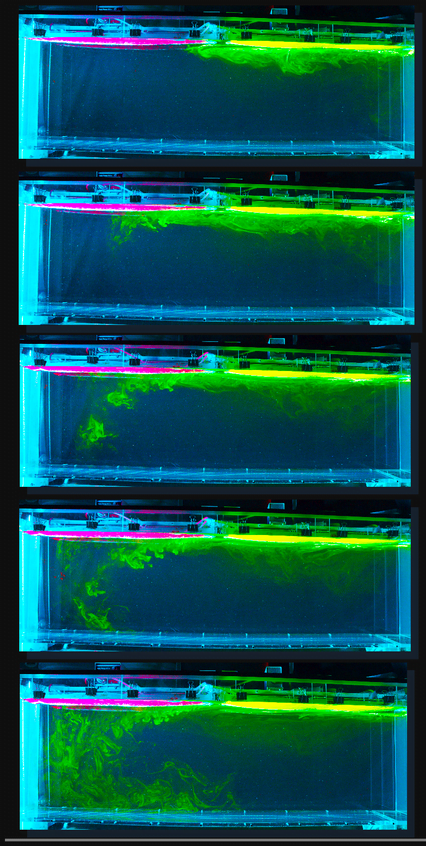
Earth’s oceans are a complex and dynamic environment, but fortunately, we can simulate some of their physics on a smaller scale in the laboratory. The time series of images above show how fresh and salty waters mix. On the right side of the image is fresh water with its top layer dyed green. On the left is salty water dyed pink. Initially, the fresh water spreads horizontally toward the salty region in a smooth and laminar fashion. As the fresh water picks up salt, it gets denser and starts sinking, ultimately forming a turbulent plume that will push all the way back across the tank. For more images, check out the full poster. (Image credit: P. Passaggia et al.)

Starfish Vortices
Starfish larvae, like other microorganisms, use tiny hair-like cilia to move the fluid around them. By beating these cilia in opposite directions on different parts of their bodies, the larvae create vortices, as seen in the flow visualization above. The starfish larvae don’t use these vortices for swimming – to swim, you’d want to push all the fluid in the same direction. Instead the vortices help the larvae feed. The more vortices they create, the more it stirs the fluid around them and draws in algae from far away. The larvae actually switch gears regularly, using few vortices when they want to swim and more when they want to eat. Check out the full video below to see the full explanation and more beautiful footage. (Image/video credit: W. Gilpin et al.)
Coarsening in a Soap Film
Flow in a soap film is driven by gravity’s efforts to thin the film and surface tension’s attempts to stabilize variations in thickness. Because evaporation guarantees that the soap film will eventually dry out, gravity typically wins the battle and causes a soap film to rupture. This video takes a close look at what happens in the film just before it ruptures. Black dots form in the thinnest region of the flow. These areas are not holes, but they appear black because they are thinner than any wavelength of visible light. Before rupture, the black dots begin coalescing with one another, first due to diffusion and later more rapidly due to convection in the soap film. Ultimately, the black dots are the harbingers of doom for the fragile bubble. (Video credit: L. Shen et al.)

Oil in Alcohol

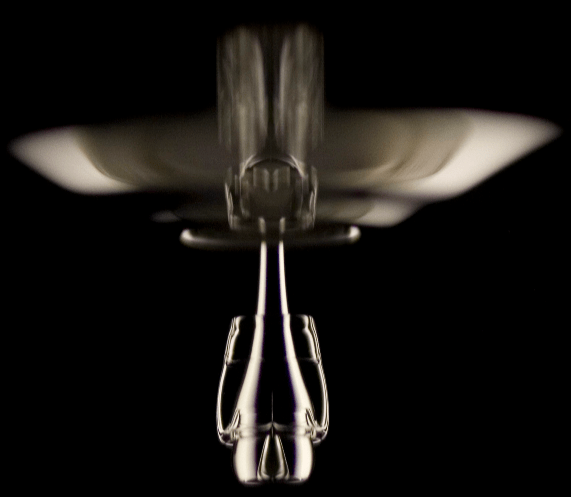
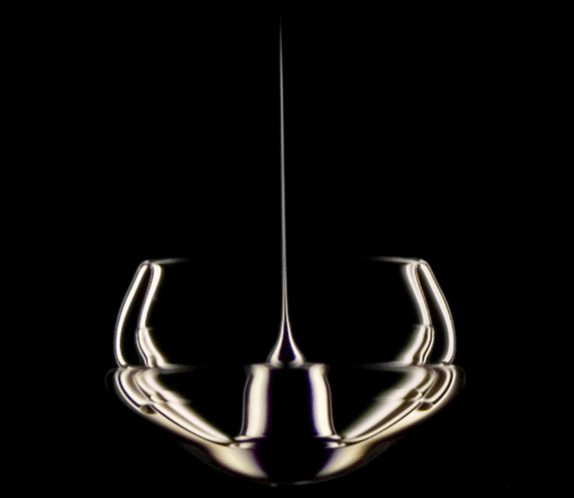
A drop of oil impacts and falls through a pool of isopropyl alcohol. Momentum, viscosity, and diffusion combine to deform the drop into a shape that is initially like an upside-down wine glass (top image). Because the oil is both denser than the alcohol and soluble in it, the drop sinks and dissolves as it falls. The drop expands rapidly outward, thinning and formed a concave shape around its denser, sinking core (bottom image). Ultimately, the droplet will deform and fragment as it dissolves into the alcohol. (Image credit: R. La Foy et al.)
The Blue Whirl
We wrote earlier this year about the discovery of a new type of fire whirl – the blue whirl – but now the authors have published video of the blue whirl in action! The blue whirl was discovered while investigating the use of fire whirls to more efficiently burn off oil spilled atop water. A tightly spinning yellow fire whirl produces less soot than a non-vortex burn; the blue whirl is even more efficient, producing little to no soot at all. Much remains to be learned about this new type of fire vortex, but in the meantime, enjoy some high-speed video of the blue whirl, particularly from 1:50 onward. (Video credit: M. Gollner et al.)