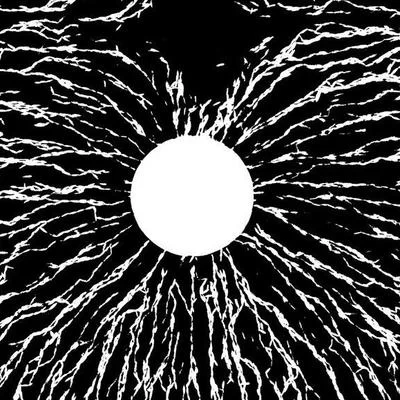
In December 2024, Parker Solar Probe made its closest pass yet to our Sun. In doing so, it captured the detailed images seen here, where three coronal mass ejections — giant releases of plasma, twisted by magnetic fields — collide in the Sun’s corona. Events like these shape the solar wind and the space weather that reaches us here on Earth. The biggest events can cause beautiful auroras, but they also run the risk of breaking satellites, power grids, and other infrastructure. (Image credit: NASA/Johns Hopkins APL/Naval Research Lab; video credit: NASA Goddard; via Gizmodo)
Category: Phenomena

Damping a Skyscraper
Wind forces on a skyscraper can set it swaying, so engineers design dampers to stop the motion and keep users comfortable. Some buildings use suspended solid mass dampers to counter a building’s motion, but others take a liquid approach. Whether by shifting water through specially shaped chambers or by sloshing it back and forth in a tank, a tuned liquid damper system can quickly bring a building back to rest. In this Practical Engineering video, Grady discusses the challenges of designing these systems and demonstrates how they work with a cool tabletop version. As a reminder, sloshing also helps in water-bottle flipping and stopping a bouncing ball. (Video and image credit: Practical Engineering)

Thawing Out
Lake Erie, the shallowest of the Great Lakes, can almost completely freeze over in winter. In this satellite image of the lake in March 2025, about a third of the lake remains ice-covered, while sediment — resuspended by wind and currents — and phytoplankton swirl in the ice-free zone. In recent decades, scientists discovered that diatoms, one of the phytoplankton groups found in the lake, can live within and just below Erie’s ice, thanks to a symbiotic relationship with an ice-loving bacteria. This symbiosis allows the diatoms to attach to the underside of the ice and gather the light needed for photosynthesis. Even in the depths of winter, an ice-covered lake can teem with life. (Image credit: M. Garrison; via NASA Earth Observatory)

How Particles Affect Melting Ice
When ice melts in salt water, there’s an upward flow along the ice caused by the difference in density. But most ice in nature is not purely water. What happens when there are particles trapped in the ice? That’s the question this video asks. The answer turns out to be relatively complex, but the researchers do a nice job of stepping viewers through their logic.
Large particles tend to fall off one-by-one, which doesn’t really affect the buoyant upward flow along the ice. In contrast, smaller particles fall downward in a plume that completely overwhelms the buoyant flow. That strong downward flow makes the ice ablate even faster. (Video and image credit: S. Bootsma et al.)

Baltic Bloom
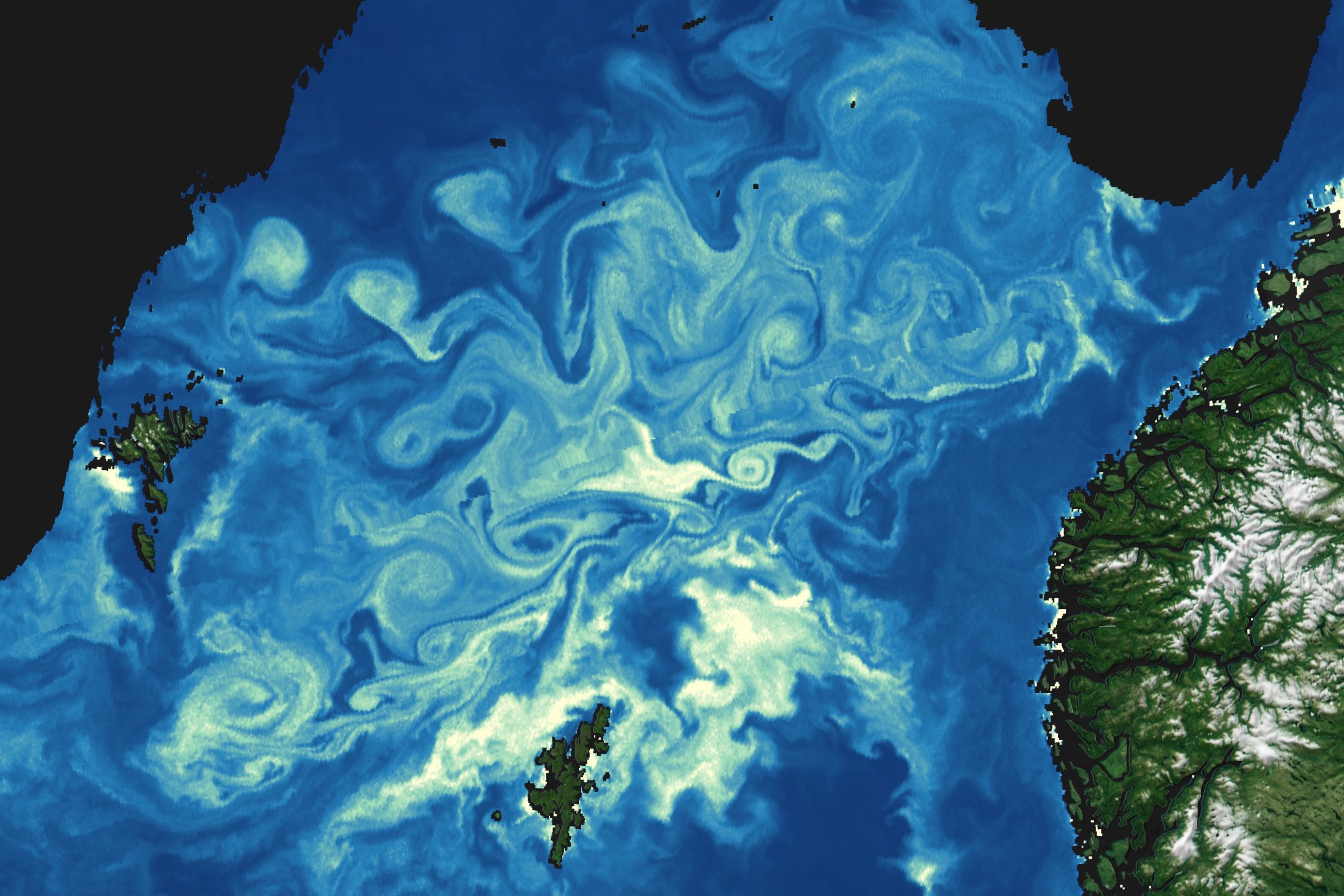
June and July brings blooming phytoplankton to the Baltic Sea, seen here in late July 2025. On-the-water measurements show that much of this bloom was cyanobacteria, an ancient type of organism among the first to process carbon dioxide into oxygen. These organisms thrive in nutrient- and nitrogen-rich waters. Here, they mark out the tides and currents that mix the Baltic. Zoom in on the full image, and you’ll see dark, nearly-straight lines across the swirls; these are the wakes of boats. (Image credit: M. Garrison; via NASA Earth Observatory)

Recycling Water
As regions are stressed by severe drought, communities considering how to stretch their water supply increasingly turn to the option of reclaiming wastewater. As Grady explains in this video, that idea faces both technological and psychological challenges. But neither, it turns out, is insurmountable. (Video and image credit: Practical Engineering)

Veil Nebula
These glowing wisps are the visible remains of a star that went supernova about 7,000 years ago. Today the supernova remnant is known as the Veil Nebula and is visible only through telescopes. In the image, red marks hydrogen gas and blue marks oxygen. First carried by shock waves, these remains of a former star now serve as seed material for other stars and planetary systems to form. (Image credit: A. Alharbi; via APOD)

Understanding Acoustic Dissonance
Dissonance — the discomfort we feel when two or more musical notes feel mismatched — is more than just a subjective measure. In this video, Henry of Minute Physics delves into some of the physics involved in dissonance, first with simple sine waves and then with musical instruments. Our ears — and our brains — seem most troubled when two notes (and their overtones) are close but not quite matching in frequency. And, as Henry explains, the peaks and valleys between those agreements lead to many of the musical systems we have today. (Video and image credit: Minute Physics)

Cutting Out Canyons
Over the millennia, the Colorado River has carved some of the deepest and most dramatic canyons on our planet. This astronaut photo shows the river near its dam at Lake Powell. The strip of white edging the lake is the “bathtub ring” that shows how the water level has varied over the years. The deep canyons — over 400 meters from the Horn in the center of the photo to the river beside it — throw shadows across the landscape. To reach these depths, the Colorado River incised its path into bedrock that was tectonically uplifted. (Image credit: NASA; via NASA Earth Observatory)

Crown Splash
When a falling drop hits a thin layer of water, the impact sends up a thin, crown-shaped splash. This research poster shows a numerical simulation of such a splash in the throes of various instabilities. The crown’s thick edges are undergoing a Rayleigh-Plateau instability, breaking into droplets much the way a dripping faucet does. On the far side, the crown has rapidly expanding holes that pull back and collide. The still-intact liquid sheet at the base of the crown shows some waviness, as well, hinting at a growing instability there. (Image credit: L. Kahouadji et al.)