A sprite, also known as a red sprite, is an upper-atmospheric electrical discharge sometimes seen from thunderstorms. Unlike lightning, sprites discharge upward from the storm toward the ionosphere. This particular one was captured by an astronaut aboard the International Space Station. That’s a pretty incredible feat because sprites typically only last a millisecond or so. The first one wasn’t photographed until 1989. (Image credit: NASA; via P. Byrne)
Category: Phenomena

A Variety of Vortices
Winds parted around the Kuril Islands and left behind a string of vortices in this satellite image from April 2025. This pattern of alternating vortices is known as a von Karman vortex street. The varying directions of the vortex streets show that winds across the islands ranged from southeasterly to southerly. Notice also that the size of the island dictates the size of the vortices. Larger islands create larger vortices, and smaller islands have smaller and more frequent vortices. (Image credit: M. Garrison; via NASA Earth Observatory)

Dancing Metal Droplets
Droplets of a gallium alloy are liquid at room temperature. When spiked with aluminum grains and immersed in a solution of NaOH, the droplets change shape and move in a random fashion. This video delves into the phenomenon, describing how a chemical reaction with the aluminum grains changes the local surface tension and creates Marangoni flows that make the droplets move. To get the droplet motion, you need to have the aluminum concentration just right. With too little, there’s not enough Marangoni flow. With too much, the hydrogen gas produced in the chemical reaction disrupts the droplet motion. (Video and image credit: N. Kim)

Inside Cuttlefish Suction
Cuttlefish, like many cephalopods, catch prey with their tentacles. Suction cups along the tentacle help them hold on. In this video, researchers share preliminary studies of what goes on inside these suction cups as they’re detached. The low pressures inside the suction cup cause water to vaporize, temporarily. As seen for both the cuttlefish and a bio-inspired suction cup, small bubbles form inside the attached cup, coalesce into larger bubbles, and then get destroyed in the catastrophic leak that occurs once part of the suction cup detaches. (Video and image credit: B. Zhang et al.)

La Grande Dune du Pilat
Southwest of Bordeaux in France stands Europe’s tallest sand dune, La Grande Dune du Pilat. Some 2.7 kilometers long and over 100 meters high, this dune took shape here over thousands of years. It moves inland a few meters every year as winds blowing from the Atlantic push sand up its shallow seaward side to the dune’s crest. There, sand will avalanche down the steeper leeward side, advancing the dune little by little. The dune’s accumulation has not been steady; during cooler and drier times, sand has collected there, but it took warmer and wetter climes to grow the forests that have helped stabilize the soil and build the dune higher. Humanity has played a role as well, at times introducing new tree species to stabilize the dune. (Image credit: W. Liang; via NASA Earth Observatory)

Bright Night Lights
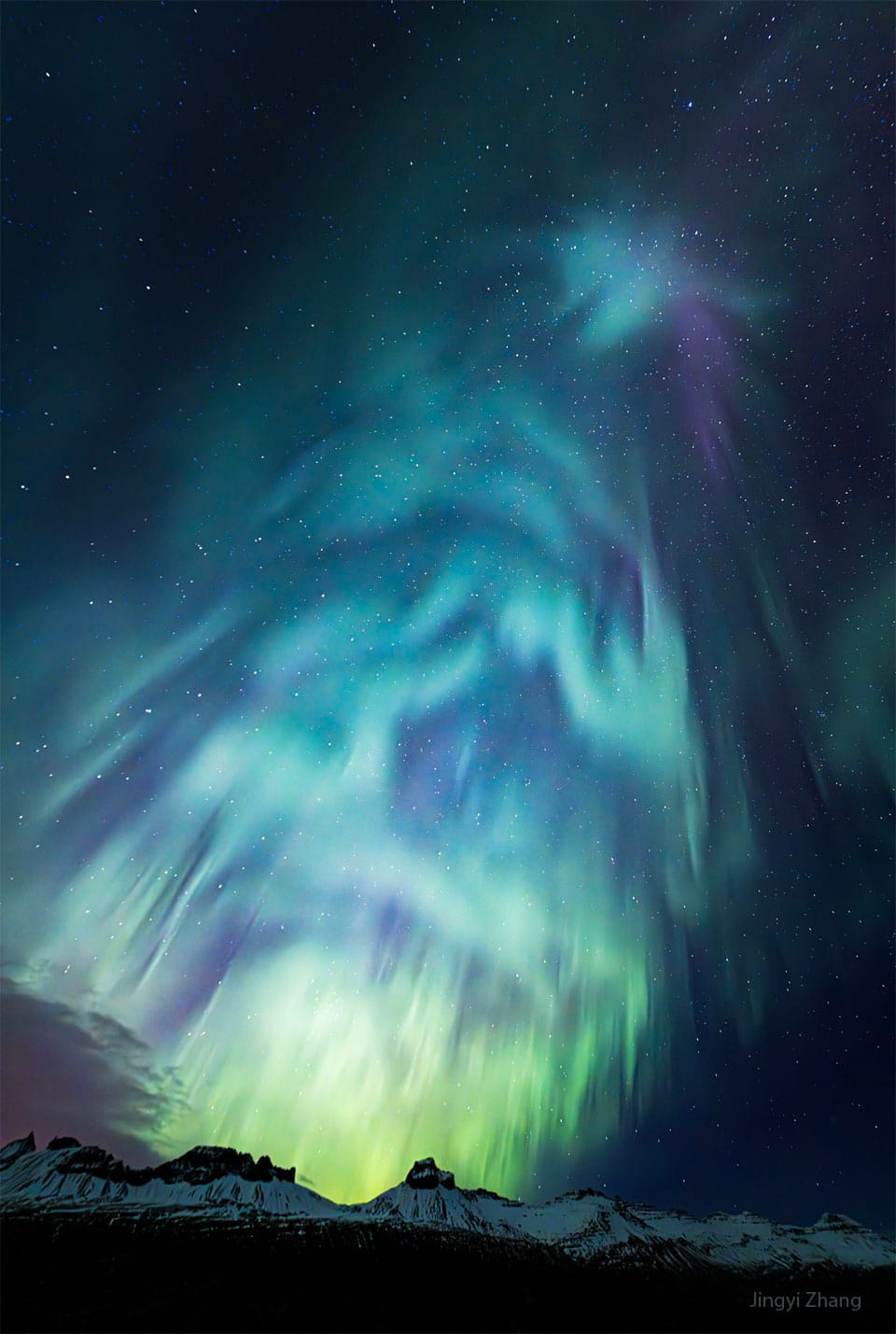
A coronal mass ejection from the Sun set night skies ablaze in mid-October 2024. This composite panorama shows a busy night sky over New Zealand’s South Island. A widespread red aurora was joined by a green picket-fence aurora and a host of other magnetohydrodynamic phenomena. To the left shines a bright Stable Auroral Red (SAR) arc. On the right near the Moon hangs the purple arc of a STEVE — strong thermal emission velocity enhancement. All of these auroras (and aurora-adjacent phenomena) take place when high-energy particles from the solar wind interact with molecules in our atmosphere. Which molecules they encounter determines the color of the aurora, and the shape depends, in part, on which magnetic lines the particles get funneled down. With strong solar storms like this one, auroras can reach far from the poles, and, as seen here, can show up in many varieties. (Image credit: T. McDonald; via APOD)


Bow Shock Instability
There are few flows more violent than planetary re-entry. Crossing a shock wave is always violent; it forces a sudden jump in density, temperature, and pressure. But at re-entry speeds this shock wave is so strong the density can jump by a factor of 13 or more, and the temperature increase is high enough that it literally rips air molecules apart into plasma.
Here, researchers show a numerical simulation of flow around a space capsule moving at Mach 28. The transition through the capsule’s bow shock is so violent that within a few milliseconds, all of the flow behind the shock wave is turbulent. Because turbulence is so good at mixing, this carries hot plasma closer to the capsule’s surface, causing the high temperatures visible in reds and yellows in the image. Also shown — in shades of gray — is the vorticity magnitude of flow around the capsule. (Image credit: A. รlvarez and A. Lozano-Duran)

South Island Sediments
In April and May late autumn storms ripped through Aotearoa New Zealand. This image shows the central portion of South Island, where coastal waters are unusually bright thanks to suspended sediment. We typically think of storm run-off as water, but these flows can carry lots of sediment as well. Here, the large amount of sediment is likely a combination of increased run-off from rivers and coastal sediment stirred up by faster river flows. (Image credit: W. Liang; via NASA Earth Observatory)

Listening for Pollinators
Can plants recognize the sound of their pollinators? That’s the question behind this recently presented acoustic research. As bees and other pollinators hover, land, and take-off, their bodies buzz in distinctive ways. Researchers recorded these subtle sounds from a Rhodanthidium sticticumย bee and played them back to snapdragons, which rely on that insect. They found that the snapdragons responded with an increase in sugar and nectar volume; the plants even altered their gene expression governing sugar transport and nectar production. The researchers suspect that the plants evolved this strategy to attract their most efficient pollinators and thereby increase their own reproductive success. (Image credit: E. Wilcox; research credit: F. Barbero et al.; via PopSci)

Seeing the Sun’s South Pole For the First Time
The ESA-led Solar Orbiter recently used a Venus flyby to lift itself out of the ecliptic — the equatorial plane of the Sun where Earth sits. This maneuver offers us the first-ever glimpse of the Sun’s south pole, a region that’s not visible from the ecliptic plane. A close-up view of plasma rising off the pole is shown above, and the video below has even more.
Solar Orbiter will get even better views of the Sun’s poles in the coming months, perfect for watching what goes on as the Sun’s 11-year-solar-cycle approaches its maximum. During this time, the Sun’s magnetic poles will flip their polarity; already Solar Orbiter’s instruments show that the south pole contains pockets of both positive and negative magnetic polarity — a messy state that’s likely a precursor to the big flip. (Image and video credit: ESA & NASA/Solar Orbiter/EUI Team, D. Berghmans (ROB) & ESA/Royal Observatory of Belgium; via Gizmodo)