Category: Phenomena

  • Featured Video Play Icon

    Un-Mixing a Flow

    This video demonstrates one of my favorite effects: the reversibility of laminar flow. Intuition tells us that un-mixing two fluids is impossible, and, under most circumstances, that is true. But for very low Reynolds numbers, viscosity dominates the flow, and fluid particles will move due to only two effects: molecular diffusion and momentum diffusion. Molecular diffusion is an entirely random process, but it is also very slow. Momentum diffusion is the motion caused by the spinning inner cylinder dragging fluid with it. That motion, unlike most fluid motion, is exactly reversible, meaning that spinning the cylinder in reverse returns the dye to its original location (plus or minus the fuzziness caused by molecular diffusion).

    Aside from being a neat demo, this illustrates one of the challenges faced by microscopic swimmers. In order to move through a viscous fluid, they must swim asymmetrically because exactly reversing their stroke will only move the fluid around them back to is original position. (Video credit: Univ. of New Mexico Physic and Astronomy)

  • Phytoplankton Bloom

    Phytoplankton Bloom

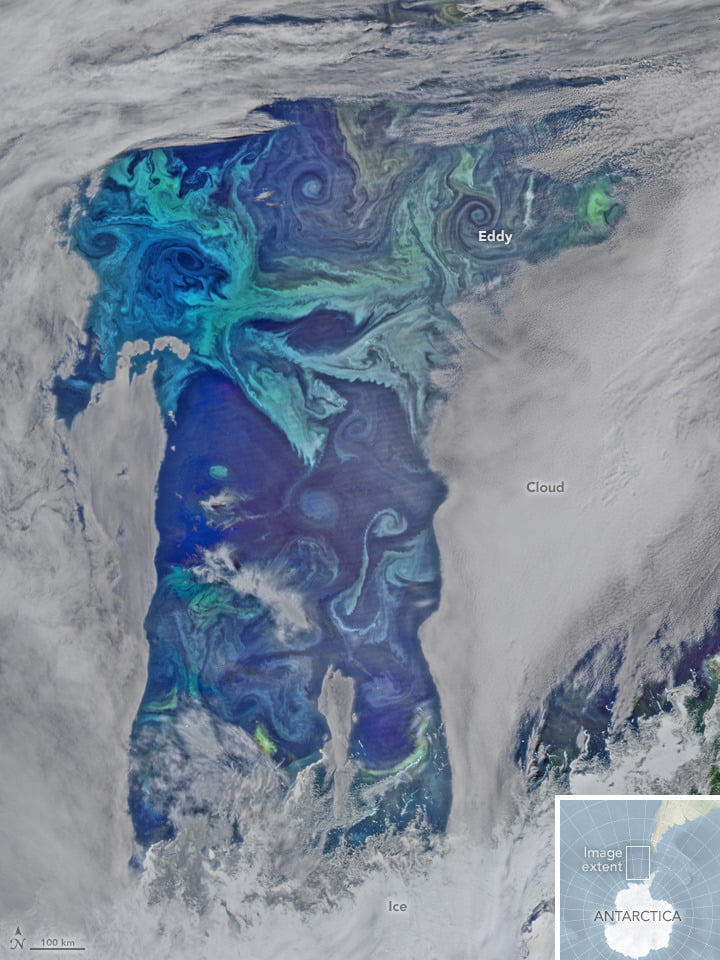
    This incredible false-color satellite image shows a cyanobacteria phytoplankton bloom in the Baltic Sea. The image is roughly 900 km across and is beautifully detailed. Check out the full resolution version. The tiny phytoplankton act like tracer particles in the flow, sketching out the massive whorls as well as the tiny lacy wisps that make up the turbulent sea. Beautiful as they appear from orbit, such massive blooms can be dangerous to animal life, depriving large areas of the oxygen other animals need to survive. In recent years more and more large phytoplankton blooms are happening around the world as agricultural and industrial run-off supply waters with excess nitrogen and other nutrients favored by the phytoplankton. (Image credit: NASA Earth Observatory)

  • Self-Pouring Fluids

    Self-Pouring Fluids

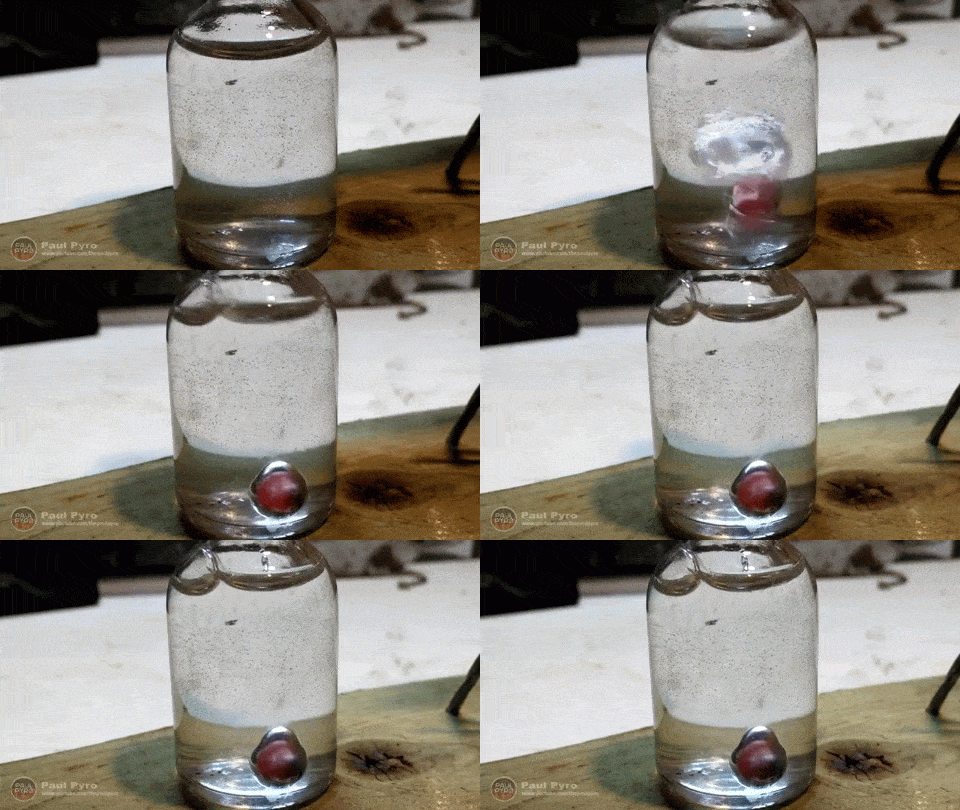
    Non-Newtonian fluids are capable of all kinds of counter-intuitive behaviors. The animations above demonstrate one of them: the tubeless or open siphon. Once the effect is triggered by removing some of the liquid, the fluid quickly pours itself out of the beaker. This is possible thanks to the polymers in the liquid. The falling liquid pulls on the fluid left behind in the beaker, which stretches the polymers in the fluid. When stretched, the polymers provide internal tension that opposes the extensional force being applied. This keeps the fluid in the beaker from simply detaching from the falling liquid. Instead, it flows up and over the side against the force of gravity, behaving rather more like a chain than a fluid!  (Image credit: Ewoldt Research Group, source)

  • Featured Video Play Icon

    The Inverted Glass Harp

    You may be familiar with the glass harp, the instrument created by rubbing the rim of a partially-filled wine glass. But did you know that you can create the same effect by immersing an empty glass in water? In this video, Dan Quinn explains the physics behind both types of glass harps and why the pitch changes as you add or remove water. Vibration is the driving factor (as with most sound), and the key to the shifting pitches has to do with the change in mass of the material being vibrated. For more great physics, also be sure to check out Quinn’s previous video on tears of wine.  (Video credit: D. Quinn)

  • The Angle of Repose

    [original media no longer available]

    Granular materials like sand tend to form heaps when poured. The steepness of the heap at rest is described by the angle of repose, which is determined by a balance between gravity, normal force, and friction on the grains. When a heap of grains is disturbed, it can trigger an avalanche. As can be seen in the video above, avalanches are a surface phenomenon, only moving the top few layers of grain while most of the heap remains stationary.  (Video credit: Peddie School Physics)

  • The Challenges of Micro Air Vehicles

    The Challenges of Micro Air Vehicles

    Interest in micro-aerial vehicles (MAVs) has proliferated in the last decade. But making these aircraft fly is more complicated than simply shrinking airplane designs. At smaller sizes and lower speeds, an airplane’s Reynolds number is smaller, too, and it behaves aerodynamically differently. The photo above shows the upper surface of a low Reynolds number airfoil that’s been treated with oil for flow visualization. The flow in the photo is from left to right. On the left side, the air has flowed in a smooth and laminar fashion over the first 35% of the wing, as seen from the long streaks of oil. In the middle, though, the oil is speckled, which indicates that air hasn’t been flowing over it–the flow has separated from the surface, leaving a bubble of slowly recirculating air next to the airfoil. Further to the right, about 65% of the way down the wing, the flow has reattached to the airfoil, driving the oil to either side and creating the dark line seen in the image. Such flow separation and reattachment is common for airfoils at these scales, and the loss of lift (and of control) this sudden change can cause is a major challenge for MAV designers. (Image credit: M. Selig et al.)

  • Vapor Cones

    Vapor Cones

    Vapor cones typically appear around aircraft flying in the transonic regime–near, but still below, the speed of sound. Air moving over the vehicle accelerates and decelerates as it moves around different parts of the plane; if it didn’t, the plane couldn’t generate lift and wouldn’t fly. When the local flow accelerates past the speed of sound, the accompanying drop in pressure and temperature can be enough to for conditions to fall below the dew point, causing the condensation we see. At the back of the airplane, a shock wave decelerates the airflow back to subsonic speeds and raises local conditions back above the dew point, thereby truncating the cone. (Image credit: C. Caine)

  • Fire Tornadoes

    Fire tornadoes, despite their name, are more closely related to dust devils or waterspouts than to true tornadoes. Though rarely documented, they are relatively common, especially in wildfires. The heat of the fire creates an updraft of warm, rising air that leaves behind a low-pressure region. Air from outside is drawn toward this low-pressure area, gets heated, and rises. As the outside air gets pulled in, any vorticity or rotation it had gets intensified via conservation of angular momentum–the same way a spinning ice skater speeds up when she pulls her arms in. The result is the tightly-spinning vortex at the heart of a fire tornado. (Video credit: C. Fleur; via NatGeo)

  • Featured Video Play Icon

    Bubbles and Hurricanes

    You may think of soap bubbles as a childhood plaything, but there’s a lot to be learned from them. In her newest video, Dianna of Physics Girl explores some of the fascinating research scientists use soap bubbles for and how you can recreate some of their experiments at home. Scientists have used bubbles to explore how atmospheric vortices behave, how to tie knots in fluids, how grass waves in the wind, and even how explosive detonations occur. Just modeling bubbles and foams can be incredibly complex. It turns out the humble bubble has quite a lot to teach us. (Video credit: Physics Girl/PBS Digital Studios)

  • Featured Video Play Icon

    Turbulent Ink

    Turbulence is found throughout our lives, but rarely is it as startlingly beautiful as in this Slow Mo Guys video. Here they show high-speed videos of ink being injected into water. The resulting plumes are turbulent from the very start, with innumerable folds and eddies billowing outward as the plume expands. The large difference in length scales–from the millimeter-sized curls to the meter-sized length of the plume–is one of the classic characteristics of turbulence and part of what makes turbulent flows so difficult to model computationally. Energy in these flows is generated at the large scales, but it’s dissipated at the very smallest scales through viscosity. This means that to properly model a turbulent flow, you have to capture the largest scales, the smallest scales, and everything in between in order to represent this energy cascade from large to small. It’s a problem that engineers, mathematicians, meteorologists, and physicists have struggled with for more than a century. But, here, at least, we can all just sit back and enjoy the beauty. (Video credit: The Slow Mo Guys)