As nocturnal hunters, owls are aerodynamically optimized for stealthy flying. This clip from BBC Earth demonstrates just how quiet a barn owl is in flight compared to a pigeon or a peregrine falcon. The owl’s large wingspan relative to its body size gives it enough lift that it does not have to flap often, allowing it to glide instead, but this is far from its only stealthy adaptation. Owl feathers feature a serrated leading edge that helps break flow over the wing into smaller, quieter vortices. Their fringe-like trailing edge breaks flow up even further and acts to damp noise from airflow. The downy feathers of the owl’s body also help muffle any noise from the bird’s movement, allowing the barn owl to fly almost silently. (Video credit: BBC Earth; via Gizmodo)
Category: Phenomena

The Bubble Nebula
This spectacular Hubble image shows the Bubble Nebula. The source of this nebula is the star seen toward the upper left side of the bubble. This massive, super-hot star has ceased to fuse hydrogen and is now fusing helium, powering its way to a likely end as a supernova. As it burns, the star emits a stellar wind of gas moving at over 6.4 million kilometers an hour. As the flow moves outward, it encounters colder dense gases that it pushes along as it expands; this is the blue bubble surface that we see. The asymmetry of the bubble with respect to its source star is caused by the variation in the surrounding gas’s density. The bubble’s front moves more slowly in areas with more gas, thus making the bubble appear lop-sided. (Image credit: NASA; via Gizmodo)

Striking Oobleck
Mixing cornstarch and water creates a fluid called oobleck that has some pretty bizarre properties. Oobleck is a shear-thickening, non-Newtonian fluid, which means its viscosity increases when you try to deform it with a shearing, or sliding, force. But as the Backyard Scientist demonstrates above, striking oobleck with a solid object produces some spectacular and very non-fluid-like results. The golf ball’s impact blows the oobleck into pieces that look more like solid chunks than liquid droplets. This solid-like behavior occurs because the impact jams the suspended cornstarch particles together, creating a solidification front that travels ahead of the golf ball. Imagine how a snow plow pushes a denser region of snow ahead of it as it drives; the cornstarch behaves similarly but only in a region near the impact. Once that impact force dissipates, the particles unjam and the mixture responds fluidly again. (Image credit: The Backyard Scientist, source; research credit: S. Waitukaitis and H. Jaeger, pdf)

Mediterranean Currents
Ocean currents play a major role in the weather and climate of our planet. This video shows a simulation of the surface ocean currents in the Mediterranean and Atlantic over an 11-month period. Each second corresponds to 2.75 days. You’ll see many swirling eddies in the Mediterranean and more flow along the coastlines in the Atlantic. One observation worth noting: near the end of the video, you’ll notice that flow through the Strait of Dover between England and France changes its direction, flowing back and forth depending on tidal forces. In contrast, flow through the Strait of Gibraltar is always into the Mediterranean (within the timescale of the simulation, at least). This net in-flow to the Mediterranean is due in part to the warm waters there evaporating at a higher rate than the cooler Atlantic. (Video credit: NASA; via Flow Viz; h/t to Ralph L)

A New Cloud
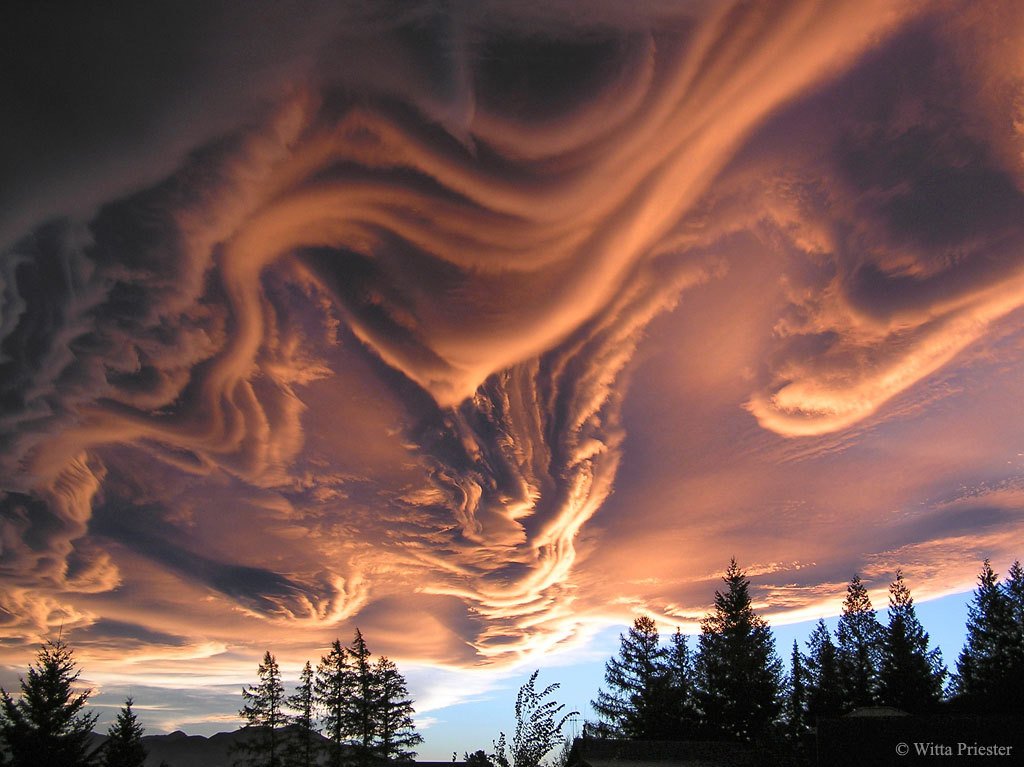
These unusual and spectacular clouds are known as undulatus asperatus. Though they have been proposed as a new type of cloud, they are as yet officially unrecognized. Despite their dramatic appearance, these clouds are not associated with storms. Instead, they’re thought to form in a process similar to mammatus clouds, where wind shear at the cloud level causes undulations to form. This wave-like structure is especially visible in the photo above thanks to a low sun angle illuminating the underside of the clouds. (Image credit: W. Priester; via APOD)

Coastal Upwelling
Cool temperatures and abundant nutrients make the waters off the western coast of North America especially biologically productive. This image is a composite of satellite data highlighting large phytoplankton blooms in the California Current. This current runs southward along the coastline, and, like other eastern boundary currents, it experiences strong upwelling, or rising of colder, nutrient-rich waters from lower depths. The upwelling is driven in part by Earth’s rotation. As the earth spins, Coriolis effects push the California Current out from the coast, allowing deeper waters to rise and fill the void. The cooler water provided by the upwelling is a major factor in the moderated climate along the West Coast. (Image credit: NASA/N.Kuring; via NASA Earth Observatory)
Auroras From Space
NASA has released a jaw-dropping new compilation of Earth’s auroras viewed from the International Space Station. It’s available in up to 4K resolution, and I heartily recommend watching it fullscreen at the highest resolution you can comfortably manage. (To paraphrase: this is ultra high definition – it’s better resolution than real life!) I don’t think I’ve ever seen aurora footage that so clearly showed the fluid behavior of auroras when viewed from space. This flow-like quality is to be expected since the auroras occur due to ionized particles from the solar wind exciting atoms in our upper atmosphere in a magnetohydrodynamic dance that never gets too old to watch. (Video credit: NASA; via Gizmodo)
Boston area FYFDers: I’m giving a talk at Harvard tomorrow afternoon on science communication – Wed. April 20th, 4pm, Maxwell Dworkin, G115.

Shock Waves in Flight

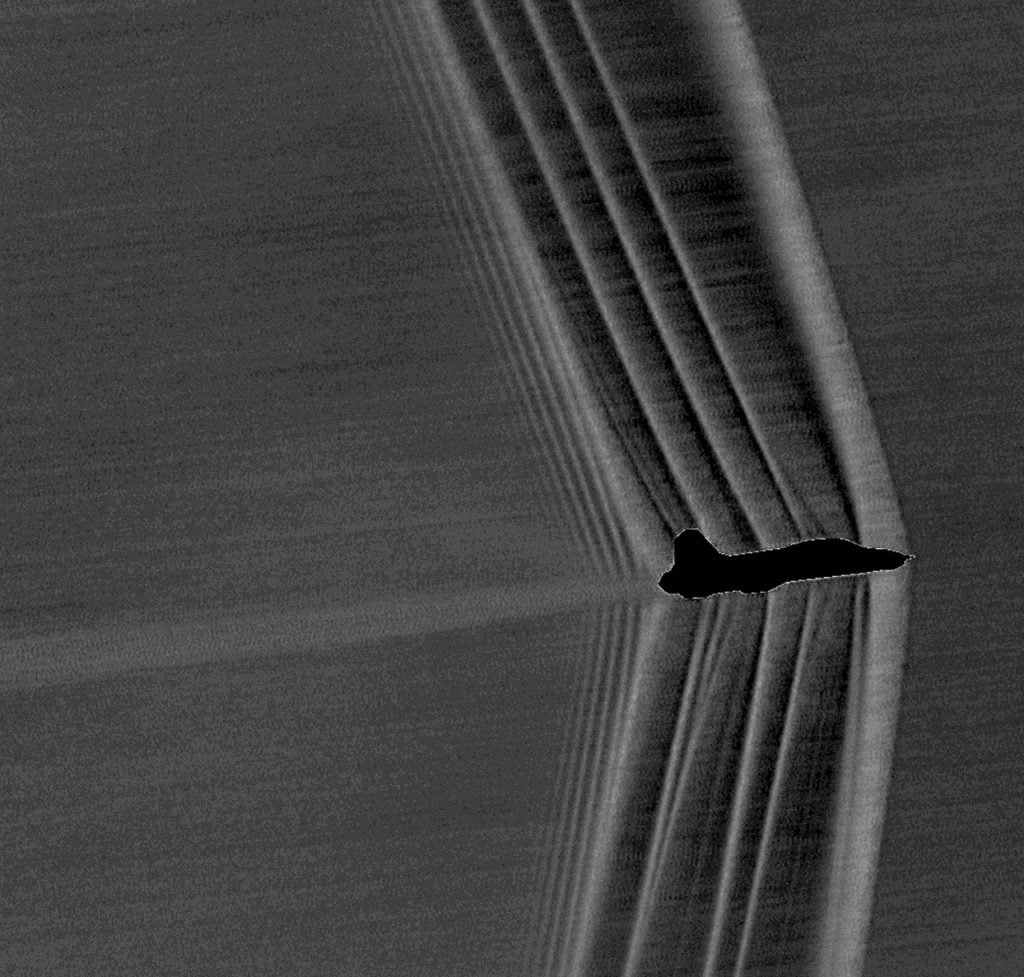
This week NASA released two new images of the shock waves surrounding T-38C jets in free flight. They’re the result of NASA’s new adaptations of the schlieren photography technique, which has let scientists visualize shock waves (in the lab, at least) for more than a century. To celebrate, I thought it would be fun to demonstrate some of the data engineers can extract from images like the one above. So I’m going to show you how to calculate how fast this plane was flying!
Shock waves depend a lot on geometry. This is not too surprising, really, since shock waves are nature’s way of quickly turning the air because there’s an object in the way. This leads to a very powerful observation, though: the angle of a shock wave depends on the geometry of the object and the Mach number of the flow. (The Mach number is the ratio of an object’s speed to the local speed of sound, so an object moving at Mach 1 is moving at the speed of sound.)
The reverse observation is also true: if we can measure the angle of a shock wave from a known geometry, then we can calculate the Mach number. Now, I don’t have any special information about the geometry of a T-38, so most of the shock waves in this picture can’t tell me much quantitatively.
But, it turns out, I don’t need to know anything about the geometry of the plane to figure out its Mach number. That’s because that very first shock wave over on the right is coming off a sharp probe mounted over the airplane’s nose. The probe is sharp enough, in fact, that I can treat it as though it’s a tiny point disturbance. That means that rightmost shock wave is a special kind of shock known as a Mach wave, and its geometry depends solely on the Mach number. It’s a pretty simple equation, too:

So, all I have to do is fire up some software like GIMP or ImageJ and estimate the angle of that first shock wave.

I came up with an estimate of about 77 degrees for the shock wave angle, which gives Mach 1.026 for the plane’s speed. Keep in mind that a) I’m using a grainy photo; and b) I have no information about the plane’s orientation relative to the camera. Nevertheless, NASA’s caption reports that this plane was moving at Mach 1.05 in the picture. My quick and dirty estimate is only off by 2%!
Of course, engineers are interested in a lot more than estimating an aircraft’s speed from these photos. With a little more geometry information, they can gather a lot of useful data from these images. One of the goals for the new photography technique is to help study new aircraft designs that generate weaker shock waves and quieter sonic booms. (Original images: NASA)

A Rocket Launch From Above
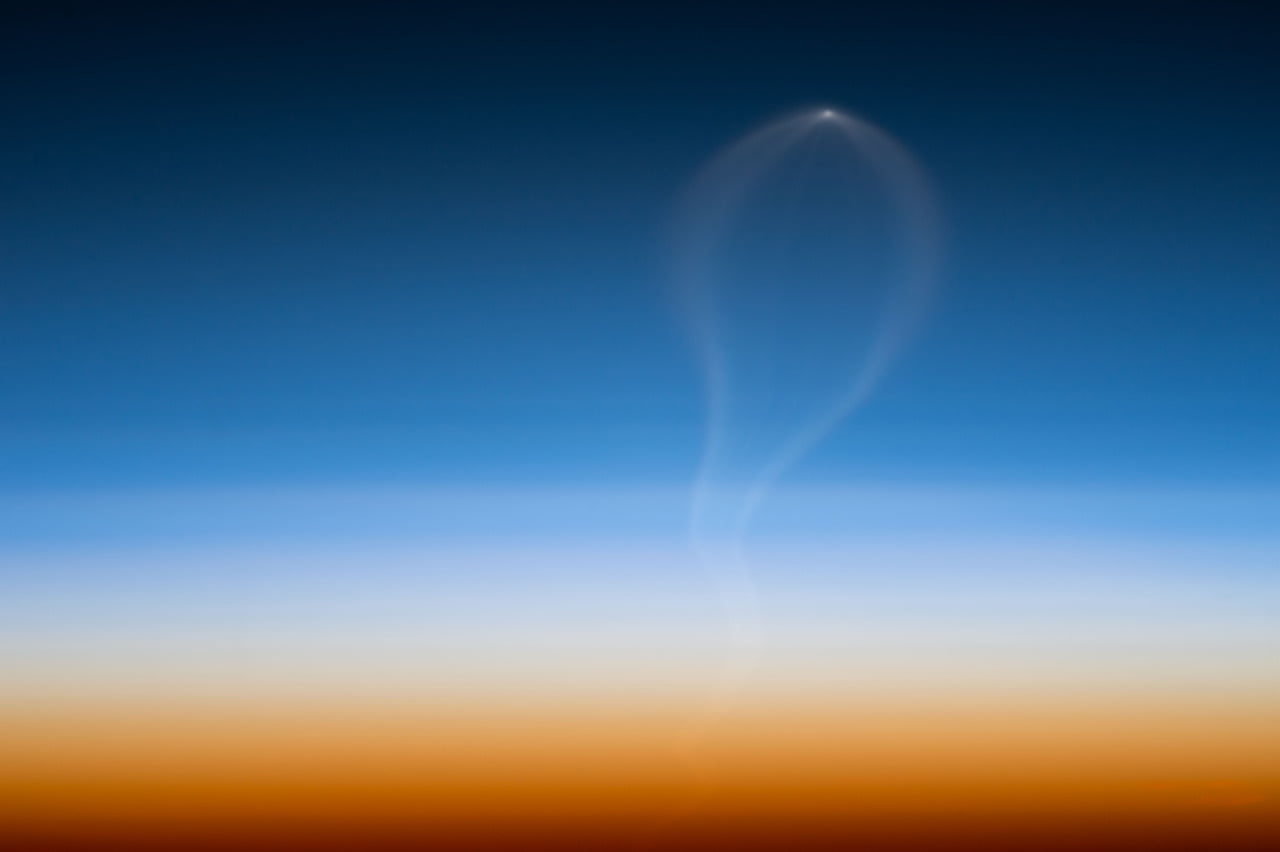
Rocket launches often produce spectacular imagery, but it’s rare to get a launch view quite like this one. The photograph above shows the recent launch of an Atlas V rocket as viewed from the International Space Station. The rocket itself is too small to be seen directly. Instead, that bright spot you see is the rocket’s exhaust. The smoky swooping curves mark the rocket’s exhaust plume. Because the gases leaving the rocket are at much higher pressure than the scant air pressure in the upper parts of the atmosphere, the exhaust expands rapidly, ballooning outward. Here the water vapor in the exhaust has frozen into crystals that catch the sunlight and make them stand out against the surrounding sky. (Image credit: NASA; via NASA Earth Observatory)
Underwater Explosions
Underwater explosions are incredibly dangerous and destructive, and this animation shows you why. What you see here are three balloons, each half-filled with water and half with air. A small explosive has been set off next to them in a pool. In air, the immense energy of an explosion actually doesn’t propagate all that far because much of it gets expended in compressing the air. Water, on the other hand, is incompressible, so that explosive energy just keeps propagating. For squishy, partially air-filled things like us humans or these balloons, that explosion’s force transmits into us with nearly its full effect, causing expansion and contraction of anything compressible inside us as our interior and exterior pressures try to equalize. The results can be devastating. To see the equivalent experiment in air, check out Mark Rober’s full video on how to survive a grenade blast. (Image credit: M. Rober, source)