Category: Phenomena

  • Fire Tornadoes in Action

    Fire Tornadoes in Action

    Commonly called fire tornadoes, these terrifying vortices often occur in large wildfires and have more in common with dust devils or waterspouts than true tornadoes. They form when warm, buoyant air rises due to the fire’s heat. This creates low pressure over the fire source and draws in fresh, cooler air from the surroundings. If there is any small vorticity or rotational motion to that surrounding air, its spin will be amplified as it gets drawn in. This is akin to an ice skater spinning faster when she pulls her arms in – it’s a result of conservation of angular momentum. That intensification of the air’s rotation is what forms the vortex, which we see here due to the flames it draws upward. This footage was captured yesterday by crews fighting fires in Missouri.  (Image credit: Southern Platte Fire Protection District/WCPO 9, source)

    Special thanks to FYFD’s Patreon supporters who help support the website!

  • Featured Video Play Icon

    Seeing Blast Waves

    With a large enough explosion, it’s actually possible to see shock waves. This high-speed camera footage shows the detonation of a car packed with explosives. After the initial flash, you can see the thin membrane of the blast wave expanding outward. This shock wave is a traveling discontinuity in the air’s properties–temperature, pressure, and density all change suddenly over an incredibly small distance. It’s this last variable–density–that enables us to see the effect. Density has a significant impact on air’s index of refraction (which also explains heat mirages). In this case, the shift in refractive index is large enough that we see the difference relative to the background, enabling our eyes to follow an otherwise invisible effect.  (Video credit: Mythbusters/Discovery Channel; via Gizmodo)

    If you enjoy FYFD, please help support me by becoming a patron!

  • Featured Video Play Icon

    Sheep as a Fluid

    Not all fluids are, well, fluid. Traffic, flocks of birds, ants, and even sheep can behave like fluids. This video shows an aerial perspective on sheep being herded, and despite the four-legged nature of these particles, they have a lot of fluid-like characteristics. You can watch ripples and waves travel through the herd and see how disturbances propagate. The herd is actually a brilliant example of compressible flow; notice how the sheep slow down and bunch up as they near the gate then speed up and spread out once they pass the constriction. This is exactly how supersonic fluids behave! (Video credit: T. Whittaker; submitted by Simon H and John B)

    If you’re in the DC area, I’ll be speaking at the Annals of Improbable Research Show at the AAAS meeting Saturday evening. Our session is open to the public, but it’s likely to be crowded, so you may want to arrive early!

  • The Leidenfrost Dunk

    The Leidenfrost Dunk

    The Leidenfrost effect occurs when a liquid is exposed to a surface so hot that it instantly vaporizes part of the liquid. It’s typically seen with a drop of water on a very hot pan; the drop will slide around, nearly frictionless, upon a cushion of its own vapor. You can see the effect when plunging a hot object into a bath of liquid, too. This is what happens when you quickly dunk a hand in liquid nitrogen (not recommended, incidentally) or when you drop a red hot steel ball into water like above. In this case, the object is so hot that it gets encased in a layer of water vapor. If you could maintain the temperature difference necessary to keep the vapor layer intact, you could move underwater at high speeds with low drag, similar to the effects of supercavitation. (Image credit: Paul Pyro, source)

    If you enjoy FYFD, please consider supporting the site by becoming a patron!

  • Featured Video Play Icon

    Tears of Wine

    Give your wine glass a swirl and afterward you may notice little rivulets of wine along the side of your glass. These so-called “tears of wine” or “wine legs” are caused by a combination of evaporation, surface tension, and gravity. After the glass has been swirled, alcohol from the thin layer of wine on the glass wall quickly evaporates, leaving behind a fluid that is more watery than the wine in the glass. Since water has a higher surface tension than alcohol or wine, it pulls more fluid up the wall via the Marangoni effect. This carries on until enough wine is pulled up to form a droplet that’s heavy enough to slide down the glass. This up-and-down exchange of fluid is nicely illustrated in the video above, where the tiny particles in the wine help show how flow gets drawn up even as your eye follows the drops sliding down. (Video credit: A. Athanassiadis and K. Khalil; submitted by Thanasi A.)

    Special thanks to our Patreon patrons, who help keep FYFD up and running.

  • Phytoplankton Flows

    Phytoplankton Flows

    Phytoplankton, tiny plant-like organisms that live in ocean waters, act like nature’s tracer particles, making visible flows that would otherwise go unnoticed. In this satellite imagery, a phytoplankton bloom in the Southern Ocean off the coast of Antarctica highlights the turbulence of this region. Strong, steady winds and currents are typical for this area, which helps drive heat exchange between the ocean and atmosphere. The swirling eddies we see – many of them 100 km across! – are evidence of that turbulence. They’re also a sign of nitrogen and other nutrients getting mixed up in the action; it’s these nutrients that help generate the bloom in the first place.  (Image credit: N. Kuring/NASA Earth Observatory)

  • Pancake Ice in the Sea

    Pancake Ice in the Sea

    Sea ice forms in patterns that depend on local ocean conditions. Pancake ice, like that shown in the above photo from the Antarctic Ross Sea, is formed in rough ocean conditions. Each individual pancake has a raised ridge along its edge, due to wave-induced collisions with other pieces of ice. Over time the smaller pieces of ice will merge together, forming large sheets. Evidence of its turbulent formation will persist, however, in the rough surface of the ice’s underside. For more, check out the National Snow and Ice Data Center. (Image credit: S. Edmonds; via Flow Visualization)

    Do you enjoy FYFD and want to help support it? Then please consider becoming a patron!

    Reminder: If you’re at the University of Illinois at Urbana-Champaign, I’m giving a seminar this afternoon. Not in Illinois? I’ve got other events coming up, too!

  • Featured Video Play Icon

    Wave Clouds

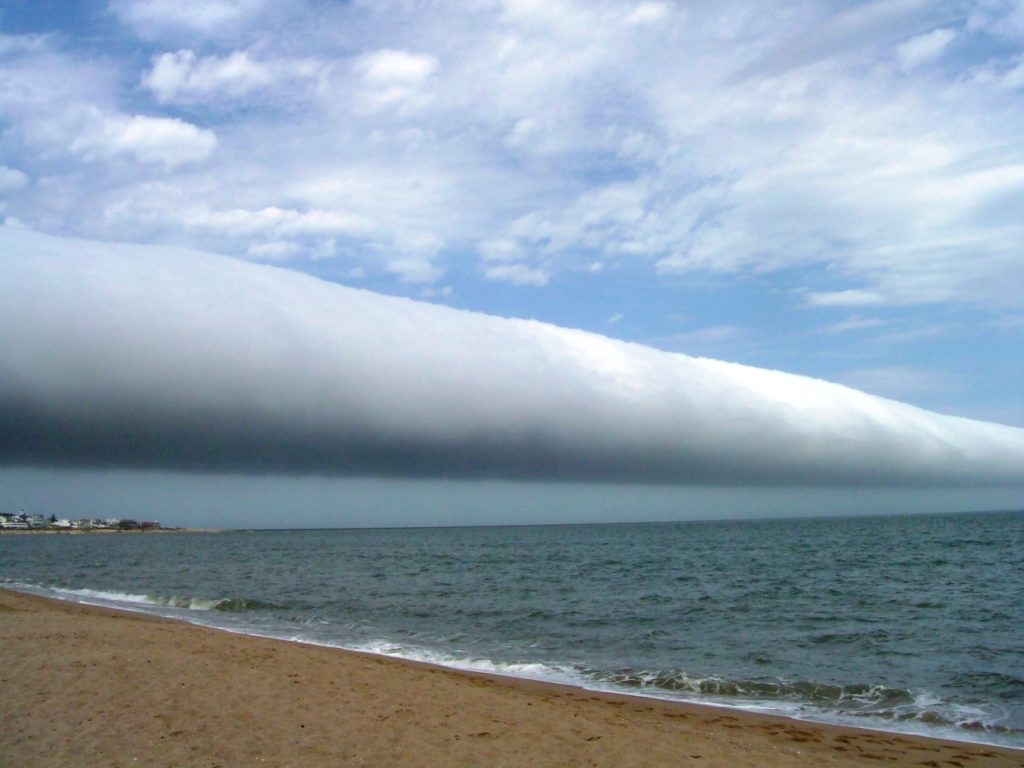
    In this video, Sixty Symbols tackles the physics of wave clouds. When air flows over an obstacle like a mountain, the air can begin to oscillate downstream, forming what is known as a lee wave. As the air bobs up and down, it will cool or warm according to its altitude. At cooler conditions, if the air is moist, it can condense into a cloud at the peak of its oscillation. If you observe this behavior over time, you get what appear to be regularly-spaced stripes of clouds. This is actually a pretty common phenomenon to see, depending on where you live. It’s an example of internal waves in the atmosphere.  (Video credit: Sixty Symbols)

    Do you enjoy FYFD and want to help support it? Then please considering becoming a patron!

    Reminder: If you’re at the University of Illinois at Urbana-Champaign, I’m giving a seminar tomorrow afternoon. Not in Illinois? I’ve got other events coming up, too!

  • Pouring Molten Aluminum on Dry Ice

    Pouring Molten Aluminum on Dry Ice

    What happens when you pour molten aluminum on dry ice? As the Backyard Scientist shows, you get what looks like slippery, sliding, boiling metal. In fact, what you see may remind you of the Leidenfrost effect, where a liquid can slide around over an extremely hot surface on a thin film of its own vapor. Despite the opposite temperature extremes–this is a very cold surface rather than a very hot one–a very similar thing is happening here. The molten aluminum is so much hotter than the dry ice that it causes the dry ice to sublimate, releasing gaseous carbon dioxide that the aluminum slides around on. For the same reason, the aluminum appears to boil in the bottom animation. What we’re really seeing is carbon dioxide gas rising and escaping the aluminum so violently that it carries some of the metal with it. Be sure to check out the full video for more awesome physics!  (Image credit: The Backyard Scientist, source; via Gizmodo)

    Do you enjoy FYFD and want to help support it? Then please consider becoming a patron!

  • Meander from Above

    Meander from Above

    This photo of the Amazon River taken by Astronaut Tim Kopra reveals the many meandering changes of the river’s course. Left untouched by human intervention, rivers tend to get more curvy, or sinuous, over time, simply due to fluid dynamics. Imagine a single bend in a river. Due to conservation of angular momentum, water flows faster around the inside curve of the bend than the outside – just like an ice skater spins faster with her arms pulled in. From Bernoulli’s principle, we know there is an accompanying pressure gradient caused by this velocity difference – with higher pressure near the outer bank and lower pressure on the inner one. This pressure gradient is what guides the water around the bend, keeping the bulk of the fluid moving downstream rather than bending toward either bank.

    At the bottom of the river, though, viscosity slows the water down due to the influence of the ground. This slower water, still subject to the same pressure gradient as the rest of the river, cannot maintain its course going downstream. Instead, it gets pushed from the outer bank toward the inner bank in what’s known as a secondary flow. This secondary flow carries sediment away from the outer bank and deposits it on the inner bank, which, over time, makes the river bend more and more pronounced. (Image credit: T. Kopra/NASA; submitted by jshoer)

    Do you enjoy FYFD and want to help support it? Then please consider becoming a patron!