Time-lapse photography is great for capturing the fluid motion of clouds over the course of a day.
Category: Art

Jet Breakup
A non-cylindrical stream falling through a slit nozzle exhibits the Plateau-Rayleigh instability, which drives a falling jet of fluid to break into droplets due to surface tension. The fingers formed off the falling stream may be a form of Rayleigh-Taylor instability. #

Upside-Down Umbrellas
When a heavier fluid is suspended over a lighter fluid (as with ink or food coloring in water), the interface between fluids is subject to the Rayleigh-Taylor instability. As the heavier fluid starts to sink, it forms “fingers”, which develop into mushroom-cap shapes as the fluid continues falling. Sometimes the shear stress between the heavier fluid and lighter fluid causes secondary Kelvin-Helmholtz instabilities as well. (Photo by Leonardo Aguiar)

High-Speed Cooking
I suspect demonstrating fluid mechanics was not what this cookbook had in mind when they filmed creamer poured into coffee at 2000 fps, but there’s some awesome droplet breakup, crowning, roiling turbulent mixing, and even some deformed Worthington jets here. It’s a reminder that, even though we may not notice it, fluid dynamics are all around.
Pouring Paint
In this artwork by Holton Rower, paint (typically a non-Newtonian fluid) is poured down a rectangular prism; the result is a neat demonstration of shearing in laminar flows. Paint is usually shear-thinning, meaning that its viscosity decreases under shear; this is why the color stripes on the vertical panels expand more than those on the horizontal surfaces do. # (submitted by Stephan)
Shock Waves
Flow visualization really can be considered a form of art. Though we fluid mechanicians are looking for physics, we’re quite aware of the beauty of what we study. The clips in this video mostly show transient shockwave behavior, including lots of shock reflection and even a few instabilities. It’s unclear what the speeds are, aside from faster than sound; the medium is air.

Marangoni Effect
Dyed milk pulls away after a drop of acetone is added. The acetone creates a gradient in the surface tension, which causes mass flow due to the Marangoni effect. See a video of the effect (or try it yourself at home!) here.
Flying Paint
High speed footage of flying paint demonstrates a world of viscosity and surface tension, as well as another great example of fluid dynamics as art. (via Gizmodo)
If you enjoy FYFD, why not take a minute to recommend us in the Tumblr directory? Thanks!

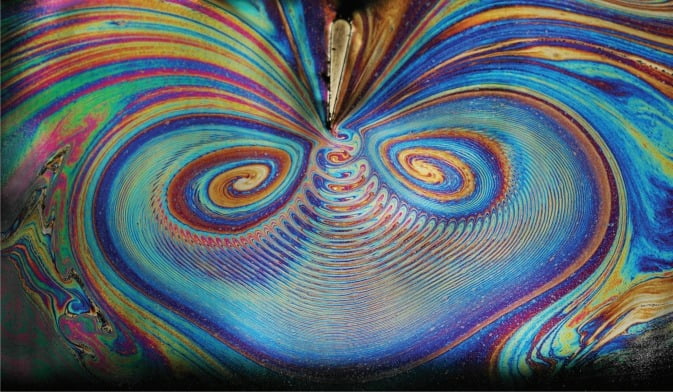
Butterfly Soap Spiral
A stationary soap film disturbed by a flapping foil (seen in the top center) creates a butterfly-like double spiral roll. Two vortices form at the tip of the foil each time it changes direction; look carefully and you can see those tiny vortices all the way through the spirals. (From the 2010 Gallery of Fluid Motion; pdf)
The GE Show
[original media no longer available]
While this video is not strictly about fluid dynamics, there are some pretty cool high-speed fluids moments in it. Watch the reaction of the gelatins as objects hit them and observe the deformation of the water balloons as they strike. (via JetForMe)