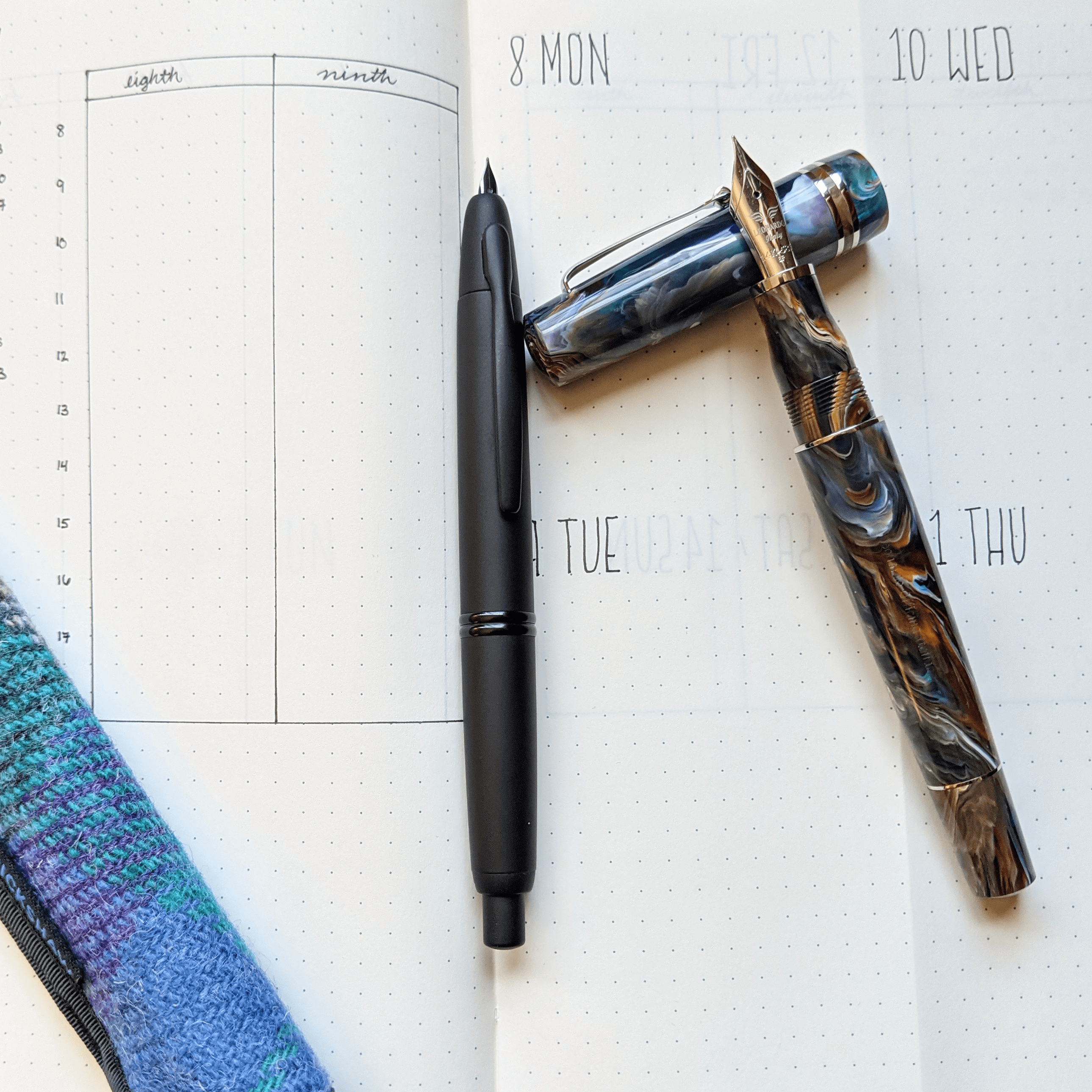
It’s not much of a secret that I love fountain pens. Recently, I got to combine two of my passions by explaining fountain pen physics on the Stationery Orbit podcast. Check out my episode here. (Image credit: N. Sharp)
Category: Admin

The Best of FYFD 2020

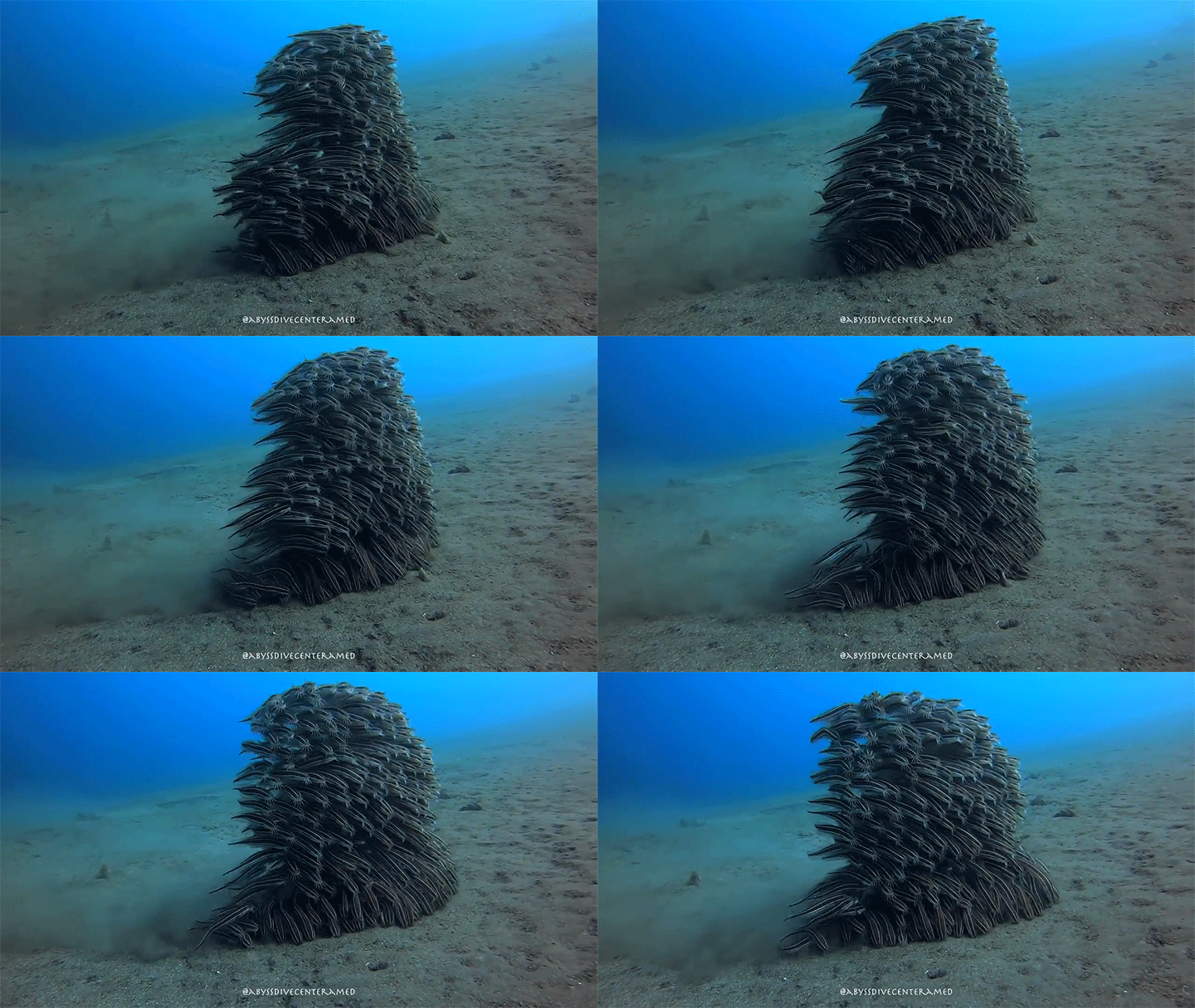


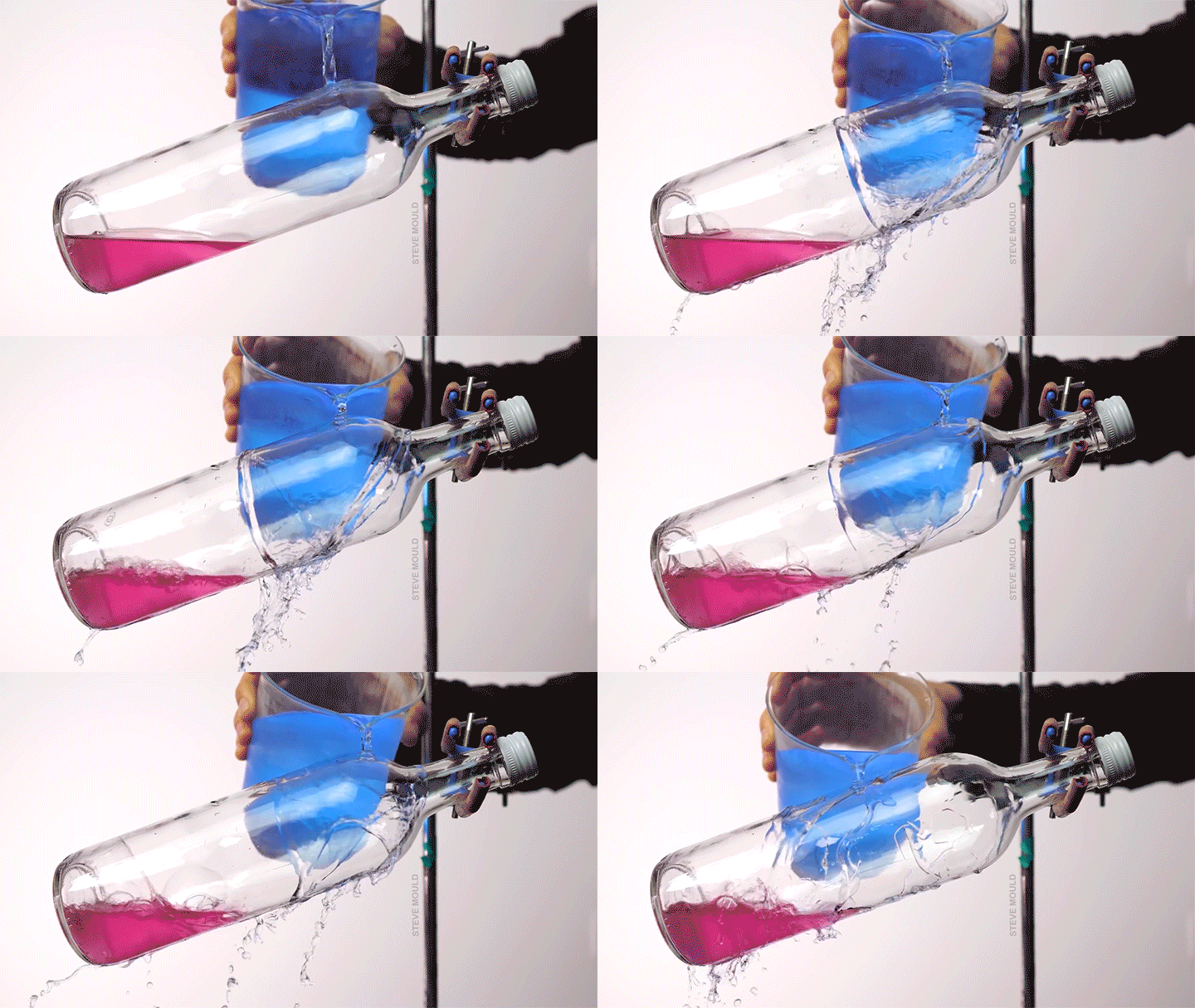


2020 was certainly a strange year, and I confess that I mostly want to congratulate all of us for making it through and then look forward to a better, happier, healthier 2021. But for tradition and posterity’s sake, here were your top FYFD posts of 2020:
- Juvenile catfish collectively convect for protection
- Gliding birds get extra lift from their tails
- How well do masks work?
- Droplets dig into hot powder
- Updating undergraduate heat transfer
- Branching light in soap bubbles
- Boiling water using ice water
- Concentric patterns on freezing and thawing ice
- Bouncing off superhydrophobic defects
- To beat surface tension, tadpoles blow bubbles
There’s a good mix of topics here! A little bit of biophysics, some research, some phenomena, and some good, old-fashioned fluid dynamics.
If you enjoy FYFD, please remember that it’s primarily reader-supported. You can help support the site by becoming a patron, making a one-time donation, buying some merch, or simply by sharing on social media. Happy New Year!
(Image credits: catfish – Abyss Dive Center, owl – J. Usherwood et al., masks – It’s Okay to Be Smart, droplet – C. Kalelkar and H. Sai, boundary layer – J. Lienhard, bubble – A. Patsyk et al., boiling – S. Mould, ice – D. Spitzer, defects – The Lutetium Project, tadpoles – K. Schwenk and J. Phillips)

Event: Machine Learning in Mechanics
This Thursday, August 27th, the U.S. National Committee on Theoretical and Applied Mechanics is holding a special free webinar series on Machine Learning in Mechanics. Details for each talk and a link to register are available here. Note that the event is free but registration is necessary if you want to receive the Zoom link.
Full disclosure: I am a member-at-large of the U.S. National Committee on Theoretical and Applied Mechanics.

10 Years of FYFD
10 years. 2,590 posts. 21 original videos. 378,000+ followers. Countless hours spent blogging and more than 1,000 journal articles read. When I started FYFD ten years ago as a PhD student, I never imagined the impact the blog would have on my life, my career, or my field. It’s been a wild ride, and I’d like to take a moment today to thank each and every one of you for contributing to this journey, whether it’s by supporting on Patreon, liking a post, sharing content, submitting ideas, leaving a comment, sending an email, or saying hi at an event. FYFD would have petered out long ago if not for your support!
Ten years seems like a good time for a little retrospective, so I went back through the archive in search of the most popular post (based on Tumblr’s notes) from each of those ten years. Here’s what I found:
Year 1: The Vortex Street
Year 2: Wave Clouds Over Alabama
Year 3: Surface Tension in Action
Year 4: Why Honeycomb is Hexagonal
Year 5: Bioluminescence
Year 6: Self-Pouring Fluids
Year 7: Watching Radiation
Year 8: The Swimming of a Dead Fish
Year 9: Seeing the Song
Year 10: Collective Catfish ConvectionIf you’d rather enjoy something random rather than something “popular”, you can always use the shortcut https://fyfluiddynamics.com/random to explore posts in the archive.
And in case you’re more interested in watching videos, here are the top FYFD videos (by YouTube views):
(Wow, my editing and production skills have evolved since some of those earlier vids!)
So what are your favorite FYFD memories and posts? Let me know in the comments! (Image and video credits: N. Sharp)

#ShutDownSTEM in Support of Black Academics
Academia, like every part of our society, has a race problem. Today, I’m joining in the effort to change that by taking a break from business as usual and examining the issues facing my Black colleagues and what I can do to change them. I encourage you to do the same, and if you stick around, I’ll give you some ways to help!
The Current State of Affairs
Physics and engineering struggle across the board with diversity. According to a 2020 report from the American Physical Society (APS, home to my professional society, the Division of Fluid Dynamics, or DFD), my society’s membership is currently about 14% female. That’s actually an improvement over 3 years ago, when we were all of 11% female. APS doesn’t even publish unit-level statistics on racial and ethnic minorities, though they do report statistics for minorities across physics as a whole.
Only 3-4% of bachelor’s degrees awarded in physics or engineering go to Black graduates. At the graduate level, the statistics are even grimmer. Only about 100 Black women total have earned PhDs in physics. And studies have made it clear that the issues standing in the way of Black physicists and engineers are largely systemic and beyond their personal control. The problem is not that Black physicists and engineers are less capable; it’s that they face systemic and structural obstacles that make it harder to succeed. Those include isolation, frequent microaggressions, fewer role models and mentors, and implicit bias.
Working Toward Change
As someone without an academic institution, I’m somewhat limited in my capacity to change the culture there. I have no say in hiring or tenure decisions. (If you are at a university, here are some resources that may help you create change.)
But my work does play an important role in increasing visibility for minorities in physics in engineering, including African Americans. To that end, I pledge to redouble my efforts to feature the voices and work of Black fluid dynamicists.
I also want to support organizations that help Black physicists and engineers like the National Society of Black Physicists, the National Society of Black Engineers, and African American Women in Physics. And this is where you can help! For the next month, I will donate all of my proceeds from the sales of FYFD merchandise to these organizations. Moreover, I will personally match those proceeds with my own donation (up to $500). So if you’ve been thinking about grabbing a t-shirt or some stickers to share your love of fluid dynamics, now’s a great time!

Buy FYFD merch before July 10th and help support Black physicists and engineers! Final Thoughts and More Resources
It’s important to recognize that #ShutDownSTEM is about more than one day. It’s about making a sustained commitment to eliminate anti-Black racism in STEM and academia. To that end, I include here some useful resources, both on general anti-racism efforts and on academic ones in particular. I hope you’ll join me in making our field more diverse and inclusive.
Anti-Racism Resources
Meet Some Black Physicists, Engineers, and Fluid Dynamicists
This list is in no way comprehensive, but I want to highlight some of the amazing Black folks who have and are working in these fields. Have recommendations for more? Let me know in the comments or on Twitter.
- AAAS If/Then Ambassadors
- #BlackinSTEM, #BlackintheIvoryTower, #BlackintheIvory
- Erika Anderson
- Lance Collins (Google Scholar)
- John Dabiri (Google Scholar; on FYFD and FYFD YouTube)
- Dennice Gayme (Google Scholar; on APS News)
- Sydney Hamilton
- Erika J
- Mary Jackson (see Hidden Figures, Publications)
- Joseph A Johnson III (Google Scholar)
(Featured image credit: #ShutDownSTEM)

The Best of FYFD 2019


2019 was an even busier year than last year! I spent nearly two whole months traveling for business, gave 13 invited talks and workshops, and produced three FYFD videos. I also published more than 250 blog posts and migrated all 2400+ of them to a new site. And, according to you, here are the top 10 FYFD posts of the year:
- The perfect conditions make birdsong visible
- Pigeons are impressive fliers
- The water anole’s clever method of breathing underwater
- 100 years ago, Boston was flooded with molasses
- The BZ reaction is some of nature’s most beautiful chemistry
- The labyrinthine dance of ferrofluid
- 360-degree splashes
- The extraordinary flight of dandelion seeds
- Dye shows what happens beneath a wave
- Bees do the wave to frighten off predators
Nature makes a strong showing in this year’s top posts with five biophysics topics. FYFD videos also had a good year: both my Boston Molasses Flood video and dandelion flight video made the top 10!
If you’d like to see more great posts like these, please remember that FYFD is primarily supported by readers like you. You can help support the site by becoming a patron, making a one-time donation, or buying some merch. Happy New Year!
(Image credits: birdsong – K. Swoboda; pigeon take-off – BBC Earth; water anole – L. Swierk; Boston molasses flood – Boston Public Library; BZ reaction – Beauty of Science; ferrofluid – M. Zahn and C. Lorenz; splashes – Macro Room; dandelion – N. Sharp; dyed wave – S. Morris; bees – Beekeeping International)

2019 APS DFD Schedule
It’s time for the annual American Physical Society Division of Fluid Dynamics meeting, and once again, I’ll be attending. If you’ve been scanning the program wondering where I am, wonder no more! Here’s a run-down of the talks and events I’ll be appearing at:
- “All the Faces of Fluid Dynamics” Panel – Sunday, Nov 24, 12:45-13:55
- “Improving Scientific Visuals” Talk – Monday, Nov 25, 8:52
- “Adopting a Communication Lifestyle” Invited Talk – Monday, Nov 25, 11:40
Yes, in very exciting news, the DFD has offered me an invited talk this year, and I hope to see many of you in the audience come Monday! Maybe for those who can’t attend in person, we can get a volunteer or two to live-tweet it?
As usual, I’ll be hanging around throughout the conference, so if you see me, feel free to come say hi.

The Best of FYFD 2018


2018 was a busy year for me with over 40 days of business travel, 10 invited talks, and a whole slew of new YouTube videos on top of regular FYFD posts. But now it’s time for the traditional look back at the top 10 FYFD posts of 2018, according to you:
1. Swimming so easy a dead fish can do it
2. The wall of lava lamps that helps secure the Internet
3. Jellyfish versus vortex ring
4. Crushing crayons in a hydraulic press shows off the sharkskin instability
5. Vortex ring from an exploding meteor
6. Starburst patterns form when avalanching materials size separate
7. Kelp change shape depending on their currents
8. The creepy hydraulics of a spider’s gait
9. Pneumatically-driven, 3D-printed plants of the future
10. Exothermic chemistry visualized in infraredThis year’s list is an interesting mix – some biology, vortex rings, non-Newtonian and granular physics; it’s a good list for some of the more unexpected sides of fluid dynamics.
If you’d like to see more great posts like these, please remember that FYFD is primarily supported by readers like you. You can help support the site by becoming a patron, making a one-time donation, or buying some merch. Happy New Year!
(Image credits: fish – D. Beal et al.; lava lamps – T. Scott; vortex ring – V. de Valles; crayons – Hydraulic Press Channel; meteor – P. Horálek; rotating drum – I. Zuriguel et al.; kelp – J. Hildering; spider – R. Miller; hydrophytes – N. Hone; chemistry – Beauty of Science)

Happy 2000 Posts!


Happy Friday and happy 2000th FYFD post! To celebrate, I played with surface tension and the Marangoni effect to make some art. For a run-down on the physics, check out this previous post on water calligraphy. Two thousand posts feels like a major milestone. Not everyone realizes this, but FYFD is a one-woman operation, so 2000 posts is a whole lot of research, image editing, and writing. For fun, I’m including here eight completely random FYFD entries, representing less than one-half of one percent of my total archives:
1. Why did Chinese junks put holes in their rudders?
2. Making droplets in an ultrasonic humidifier
3. Floating on a granular raft
4. Air-trapping fur keeps otters warm
5. The physics of the knuckleball
6. What makes badminton so fast?
7. Playing with fluorescein
8. How frost formsWant to keep up the random walk? Use https://fyfluiddynamics.com/random to find random entries, or if you prefer your browsing to be more directed, check out the visual archive or the themed series page.
As always, a special thanks to those who help support FYFD through Patreon subscriptions – I couldn’t keep writing and making videos without your help! And thank you to all of you who read and share FYFD. Whether you’ve been following along for a week or for the last eight years, your enthusiasm keeps me motivated! Thank you!
(Image credits: 2k animation – N. Sharp; Chinese junk ship – Premier Ship Models; ultrasonic humidifier – S. J. Kim et al.; granular raft – E. Jambon-Puillet and S. Protiere; 3D-printed “fur” – F. Frankel; knuckleball – L. Kang; shuttlecock – Science Friday; fluorescein – Shanks FX; freezing droplets – J. Boreyko et al.)

The Best of FYFD 2017




2017 was a busy, busy year here at FYFD, but a lot of that happened behind the scenes with multiple collaborations that were months in the planning. You’ll start to see the results of those collaborations here in January, starting this Friday. I’m really excited for you all to see what I’ve been up to!
In the meantime, we’ll take our traditional look back at the top 10 FYFD posts of 2017, according to you:
1. Cinemagraph of a breaking wave
2. Visualizing radiation in a cloud chamber
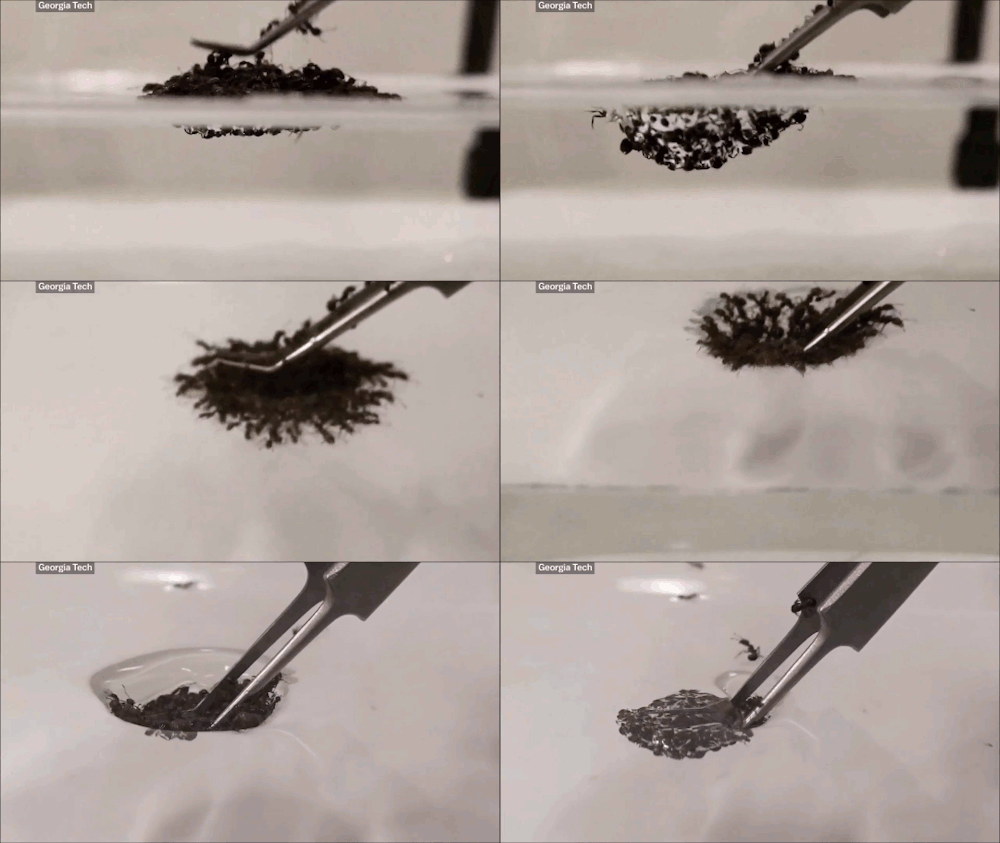
3. Fire ants as a fluid
4. The water music of Vanuatu
5. How hummingbirds drink nectar
6. When vortex rings collide
7. How water balloons can bounce off a bed of nails
8. Spinning ice disks form on freezing rivers
9. A hot-tub-sized fluidized bed
10. The physics of fluidized bedsLots of crazy, cool stuff in there! Special congrats to The Splash Lab for making the top 10 two years in a row. Stay tuned in 2018 for more exciting fluid dynamical developments, and if you’d like to help support FYFD, remember that you can always become a patron, make a one-time donation, or purchase some merch!
(Image credits: R. Collins / J. Maria; Cloudylabs; Vox/Georgia Tech; R. Hurd et al.; A. Varma; A. Lawrence; T. Hecksher et al.; K. Messer; M. Rober; R. Cheng)


