Year: 2019

  • Flow in the Heart

    Flow in the Heart

    Few flows are more integral to our well-being than blood flow through the heart. Over the course of our lives, our hearts develop from a few cells pushing viscous blood through tiny arteries to the muscular center of a vast circulatory network, capable of powering us through incredible physical feats. What’s most astonishing about all this is that the heart goes through all these changes and adaptations without ever pausing. 

    Peering into the heart to see it in action is difficult, but researchers today are combining imaging techniques like CT and MRI with computational fluid dynamics to build patient-specific heart models. Not only does this help us understand hearts in general; it’s paving the way toward predicting how a specific treatment may affect a patient. Imagine, for example, being able to simulate and compare different models of an artificial heart valve to see which will work best for a particular patient. We’re not to the point of doing so yet, but it’s a very real possibility in the future. 

    To see some examples of predicted and measured heart flows, check out this video by J. Lantz. In the meantime, happy Valentine’s Day! (Image credits: Linköping University Cardiovascular Magnetic Resonance Group, video source; via Another Fine Mesh)

  • Forming an Oxbow

    Forming an Oxbow

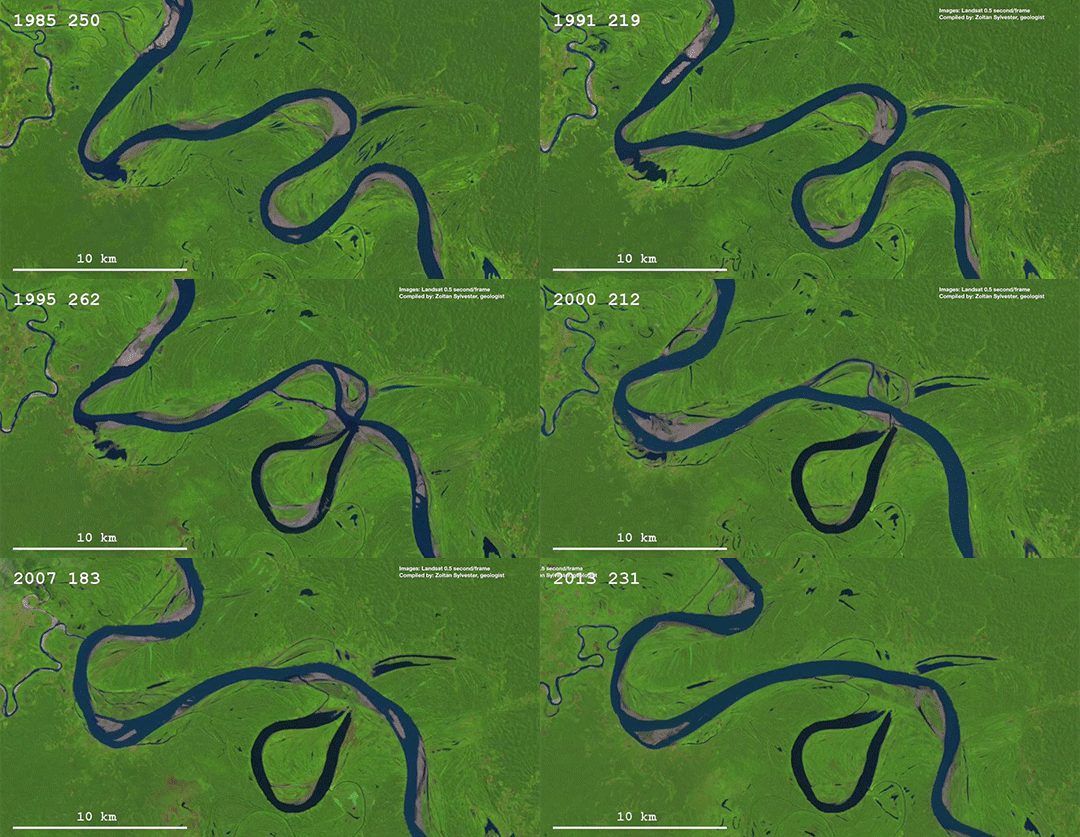
    Without human intervention, meandering rivers become more sinuous over time. This is driven by the flow around a river bend, which tends to push sediment from the outer bank of the curve to the inner, making the bend more pronounced. Eventually, loops in the river can pinch off and form a separate oxbow lake, as seen in the animation above and video below.

    By studying many photo sequences like this one, researchers have concluded that how quickly a river bend meanders depends on its curvature. In general, the higher the curvature, the faster the river bend will migrate. When rivers deviate from this rule of thumb, it’s typically because part of a river bank is tougher to erode than other sections. (Image and video credit: Z. Sylvester/Geolounge; research credit: Z. Sylvester; via Landsat; submitted by Aatish B.)

  • Swallowing Physics

    Swallowing Physics

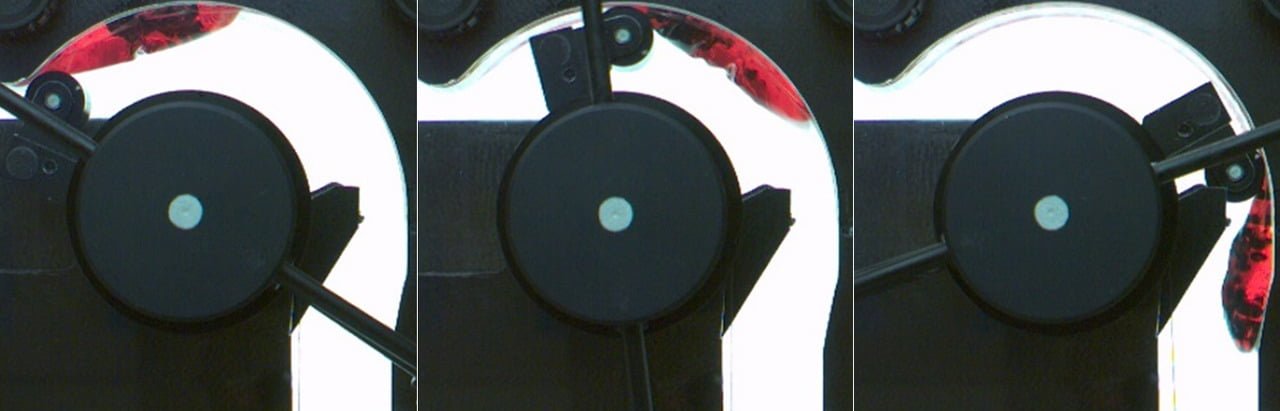
    Swallowing – whether of food, beverage, or medication – is an important process for humans, but it’s one many struggle with, especially as they age. To help study the physics behind swallowing, one research group has built an artificial mouth and throat model, shown in the bottom row of images. The model uses rollers to imitate the wave-like motion of swallowing. 

    In our mouths, chewed food typically combines with saliva to form a soft ball we can move from our tongue and down our throat with a series of reflex actions. How easily we swallow something depends on its flow properties, our saliva, shape, and more. 

    In their early studies of model swallowing, researchers have focused on what it takes to swallow pills (suspended in liquid). What they found is probably consistent with your own experience: smaller pills are easier to swallow than large ones, and elongated pills are easier to swallow than round ones of the same volume. That seems to be a function of elongated pills’ smaller cross-section when aligned with flow going down the throat. As the research continues, scientists hope to explore what can be done to make food easier to swallow for those who struggle with it. (Image credits: meal – D. Shevtsova; model – M. Marconati; via APS Physics; submitted by Kam-Yung Soh)

  • Featured Video Play Icon

    Swirling Polygons

    We don’t usually think of fluids forming corners, but they can. Here you see liquid nitrogen in a simple pot. Since the pot is much hotter than the boiling point of the nitrogen, the liquid nitrogen is floating on a layer of its own vapor. This is called the Leidenfrost effect. That nearly frictionless contact with the pot means that stirring the nitrogen conveniently spins it up into these rotating polygons, visible in high-speed footage. The faster you stir the nitrogen, the more points you get. 

    Check out the full video below for instructions on how the researchers constructed their set-up. If you try it, though, remember to have plenty of ventilation. When the nitrogen vaporizes, its volume increases dramatically, and if you’re not careful, it will displace too much oxygen and make it hard to breathe. (Image and video credit: A. Duchesne et al., source)

  • Powdery Trails

    Powdery Trails

    Because air and water are colorless and transparent, we cannot see most of the flows around us – but they’re always there. In a recent series, photographer Jess Bell has been capturing images of jumping dogs trailing a colorful powder wake. There’s no compositing in the photos. Bell puts powder on the dogs, then photographs them as they jump. The results show the billowing, turbulent wakes left by the dogs. I particularly like how you can see the stream of powder coming from some of the dogs’ ears. For more of Bell’s work, check out her website and Instagram. (Image credit: J. Bell; via PetaPixel and Rakesh R.)

  • Featured Video Play Icon

    Hydraulic Jumps

    Chances are that you’ve seen plenty of hydraulic jumps in your life, whether they were in your kitchen sink, the whitewater of a river, or at the bottom of a spillway. Practical Engineering has a great primer on this oddity of open channel flow. 

    When water (or other liquids) flow with a surface open to the air – think like a river rather than a pipe – the flow has three important regimes: subcritical, critical, and supercritical. Which state the flow is in depends on the speed of the flow compared to the speed of a wave traveling in that flow. If the waves are faster than the flow, we call it subcritical. If the flow is faster than the waves, it’s called supercritical. (This is equivalent to subsonic or supersonic flow, where the regime depends on the flow speed compared to the speed of sound.)

    Flows can transition naturally from one state to another, and where they transition from fast, supercritical flow to slower, subcritical flow, we find hydraulic jumps – places where the kinetic energy of the supercritical flow gets changed into turbulence and potential energy through a change in height. Check out the video above to learn how civil engineers use hydraulic jumps to control water and erosion. (Video and image credit: Practical Engineering)

  • Amber Waves

    Amber Waves

    When I was a teenager, I liked riding my bike along the river boardwalk near my house. There were fields there, like those in the image above and video below, with tall grass that would bend and sway in the wind. The long stalks undulated almost like a fluid, and they were mesmerizing. This video gives you a higher vantage point, where you can see the larger patterns of motion. What you’re seeing, I think, are some of the large-scale turbulent variations in the wind. Rather than being uniform and laminar, the wind contains pockets of turbulent gusts, which the sway of the long grass reveals to the naked eye. In terms of physical mechanism, I suspect it’s similar to how wind imprints its patterns on water. (Video and image credit: N. Moore)

  • Exploding a Drop

    Exploding a Drop

    Leidenfrost drops levitate over a hot substrate on a thin layer of their own vapor, constantly replenished as the drop evaporates. For the most part, previous studies have focused on pure droplets, but a new one looks at what happens when you add surfactants – and the results are, well, explosive.

    Surfactants are a type of chemical that like to gather at the surface of a drop, and, unlike water, they’re nonvolatile – they don’t evaporate easily. So as the Leidenfrost drop evaporates and shrinks, the surface of the drop becomes more and more crowded with surfactant molecules. Eventually, they form an elastic shell around the remaining water, making evaporation more difficult.

    Inside the droplet, the temperature continues to rise, eventually reaching a point where bubbles of vapor can nucleate inside. When that happens, the bubbles expand almost instantaneously and the internal pressure spike bursts the shell, causing the entire droplet to explode. (Image and research credit: F. Moreau et al.)

  • Inside Fondue

    Inside Fondue

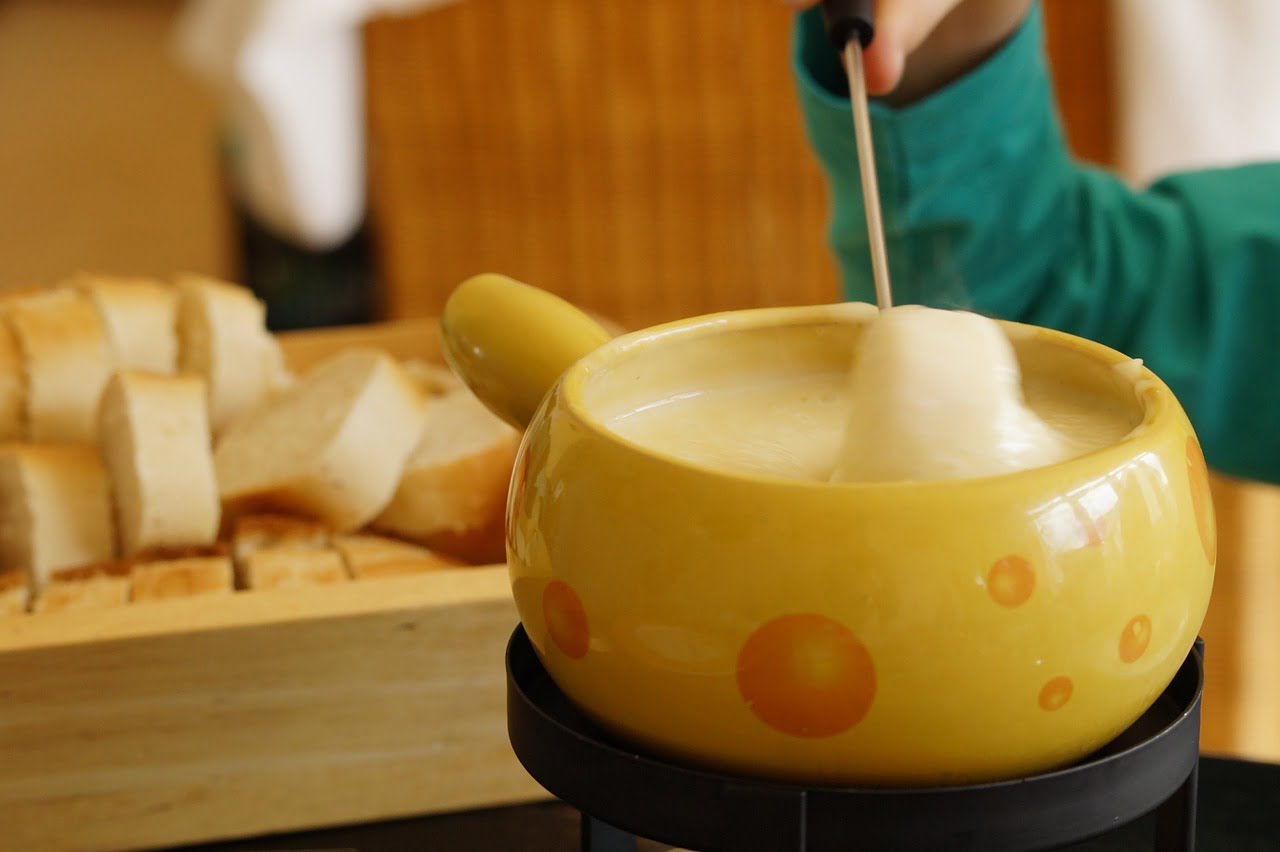
    Cheese fondue is a complex – and delicious – Swiss delicacy. The perfect fondue requires the right mix of ingredients and preparation to get the rheology – the flow character – just right. Fondue is a colloid, a fluid containing a mixture of suspended insoluble particles.

    The major components, rheologically speaking, are fat globules and casein proteins from the cheese, ethanol from the wine, and some added starch. Left on their own, the fat and casein tend to separate, something that’s sure to ruin the fondue. Adding the right amount of starch prevents that separation and keeps the fondue together. The viscosity of fondue is very important as well. If it’s too runny or too gummy, the mouthfeel will be wrong and it may not stick to the bread when dipped. Adding wine decreases the viscosity.

    All in all, the quality and perception of a good fondue relies heavily on its rheological character. Without the right proportion of ingredients to set the perfect viscous and chemical character, the dish literally comes apart. (Image credit: Pixabay; research credit and submission: P. Bertsch et al.)

  • Collective Motion: Nematodes

    Collective Motion: Nematodes

    We often imagine that collective motion creates an advantage – that the schooling fish and flocks of birds gain something from this behavior – but that’s not always the case. Above, you see nematodes moving through a thin liquid layer. Random collisions occasionally bring the nematodes into contact, and once that happens, surface tension holds them together with a force that exceeds what their muscles can supply. Essentially, they move together for the same reason that Cheerios clump together in your cereal bowl. But despite being stuck alongside one another, there’s no change in how the nematode moves. It sees neither an advantage nor a disadvantage from being attached to its neighbor. (Image and research credit: S. Gart et al., source)

    This post completes our series on collective motion. Check out the previous posts about honeybee waveshow crowds are like sand, the fluid properties of worms, and why a lack of randomness makes predicting group behaviors hard.