Year: 2019

  • Putting a Spin on Splashes

    Putting a Spin on Splashes

    Researchers put a spin on splashing droplets with selective wetting. When a drop impacts on a water-repellent, superhydrophobic surface, it will spread circularly, then pull back together and rebound off the surface. That’s because the surface coating resists actually touching – or being wetted by – the water. But just as there are surface coatings that resist water, there are those that attract it.

    Above, researchers have coated a surface so that it’s mostly superhydrophobic, but it also has narrow pinwheel-like arms that are hydrophilic. As the drop impacts, it spreads across the surface and then retracts. But where the hydrophilic arms are, the drop lingers. This creates the four lobes we see on the droplet, and the asymmetric retraction gives the drop angular momentum. As it leaves the surface, the spin continues. In some configurations, the researchers could make the drop spin at more than 7300 rpm. (Image and research credit: H. Li et al; via Science; submitted by Kam-Yung Soh)
  • Catching Prey

    Catching Prey

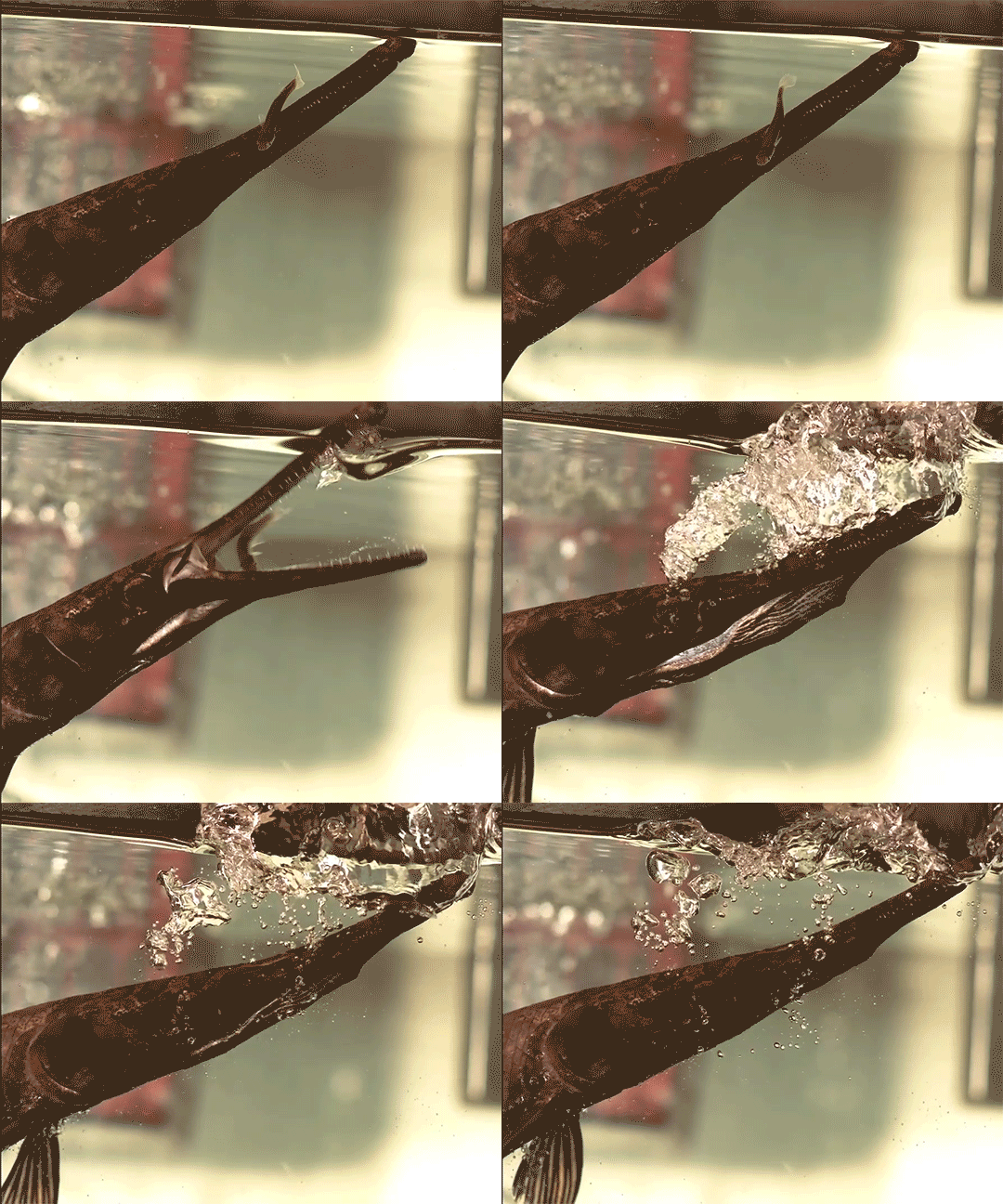
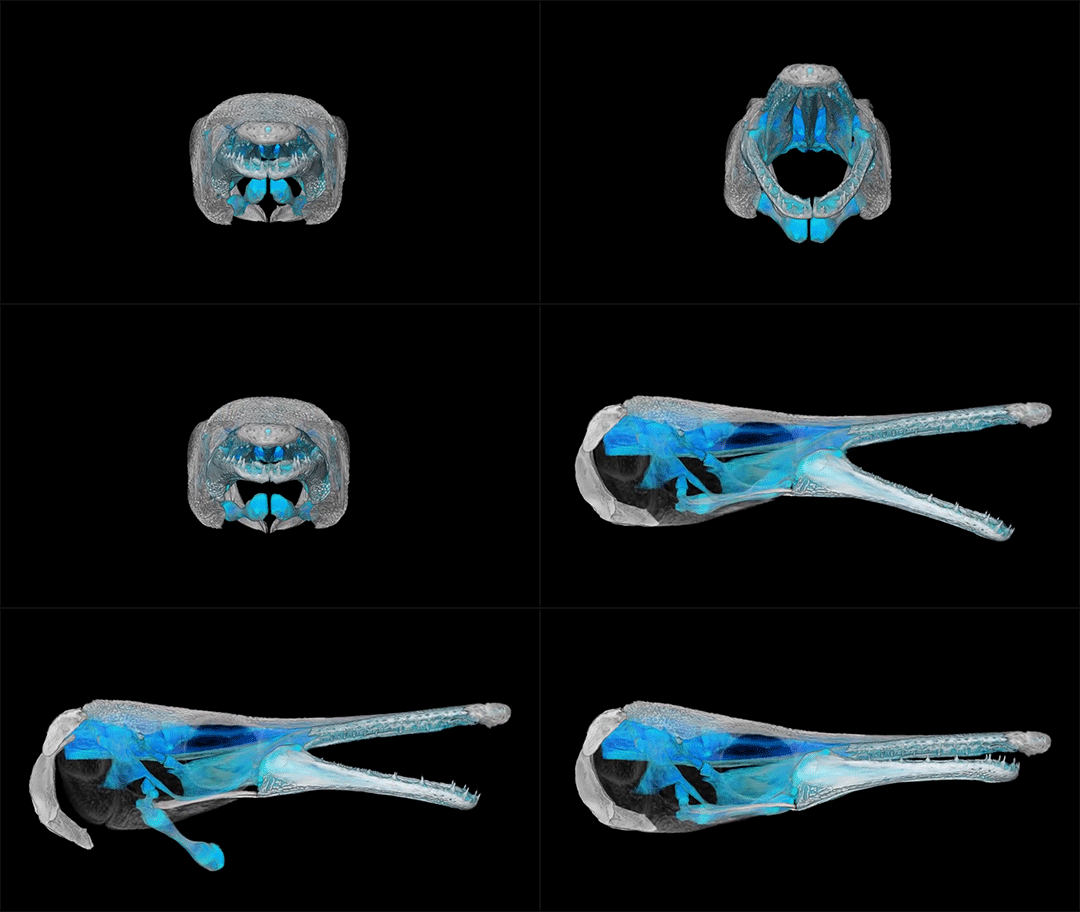
    The skinny, freshwater alligator gar can grow to more than 2 meters in length, giving it a distinct resemblance to its namesake. But this fish’s history traces back more than a hundred million years to the Early Cretaceous. And a new (pre-printed) study, combining live observations and numerical models built from CT-scans, is shedding new light on how the gar and its prehistoric ancestors feed.

    The gar uses a lateral strike (top) to come at its prey from the side. But hydrodynamically speaking, that’s a tough way to catch dinner. As soon as the gar’s snout accelerates toward its prey, it pushes a bow wave ahead of it, like an early warning signal. To counter that disadvantage, the gar has a complex bone structure in its skull (bottom) that helps it generate suction. Note how the gar’s jaw and throat open sequentially from front to back. Each expansion sucks in water, and by timing them just right, the gar produces suction throughout its entire attack. The bow wave warning does its prey no good if both are already getting sucked into the gar’s mouth! (Image and research credit: J. Lemberg et al., bioRxiv pre-print; via Science; submitted by Kam-Yung Soh)

  • Magma Mixing

    Magma Mixing

    Magmas typically consist of a mixture of molten liquid, bubbles, and solid crystals. As they mix, those crystals can sink from one viscous layer into another. To investigate this sort of process, researchers studied solid particles sinking across an interface between two viscous liquids. This is what we see above. One fluid is clear; the other is dyed red, and gravity points toward the left so the particles fall from right to left.

    What happens when the particle reaches the interface between fluids depends on three main factors: the gravitational force acting on the particle, the surface tension at the interface, and the ratio of the viscosities of the two fluids. The researchers observed two main outcomes. In one (top), the particle slows at the interface and breaks through slowly, its surface wetted by the second fluid so that it drags little to none of the previous fluid with it. The researchers named this the film drainage mode. It tends to occur when the viscosity ratio between fluids is large.

    The second method, shown in the bottom image, is the tailing mode. As the particle approaches, the interface deforms. A thick layer of the first fluid coats the particle even as it pass through, forming a tail that destabilizes behind the falling particle. This mode occurs when the viscosity ratio is small or the gravitational force is large compared to the surface tension. (Image and research credit: P. Jarvis et al.)

  • Featured Video Play Icon

    Slow Mo Geyser

    Geysers are one of the most surreal wonders of our planet – pools of turquoise that periodically erupt into towers of water and steam. But what we see from the surface is only a small part of the story. Geysers require two main ingredients: an intense geothermal heat source and the right plumbing. Below ground, that plumping needs both a reservoir for water to gather and narrow constrictions that encourage the build-up of pressure.

    A cycle begins with water filling the reservoir; this can be both geothermally heated water and groundwater seeping in. As the geyser fills, the pressure at the bottom increases. Eventually, the water becomes superheated, meaning that it’s hotter than its boiling point at standard atmospheric pressure. That’s when the steam bubbles you see above rise to the surface. When they break through, it causes a sudden drop in the reservoir pressure. The superheated water there flashes into steam, causing the geyser to erupt. Check out the full video below for some awesome high-speed video of those eruptions, and, if you’re curious what the inside of an active geyser looks like check out Eric King’s video. (Image and video credit: The Slow Mo Guys; submitted by @eclecticca)

  • Seeing Shock Waves

    Seeing Shock Waves

    This week NASA released the first-ever image of shock waves interacting between two supersonic aircraft. It’s a stunning effort, requiring a cutting-edge version of a century-old photographic technique and perfect coordination between three airplanes – the two supersonic Air Force T-38s and the NASA B-200 King Air that captured the image. The T-38s are flying in formation, roughly 30 ft apart, and the interaction of their shock waves is distinctly visible. The otherwise straight lines curve sharply near their intersections.

    Fully capturing this kind of behavior in ground-based tests or in computer simulation is incredibly difficult, and engineers will no doubt be studying and comparing every one of these images with those smaller-scale counterparts. NASA developed this system as part of their ongoing project for commercial supersonic technologies. (Image credit: NASA Armstrong; submitted by multiple readers)

  • How the Hagfish Deploys Its Slime

    How the Hagfish Deploys Its Slime

    Hagfish – an eel-like species – are known for their prodigious slime production, which helps them escape predators (and, in some cases, seriously muck up highways). Part of the hagfish’s slime consists of ~10 cm fibers that the creature deploys in tiny skeins (bottom) only a hundred microns across. To form the viscoelastic slime that thwarts its predators, those skeins of fiber have to unravel and do so in only tenths of a second. A new study shows that viscous drag plays a major role in that unraveling. 

    Most fish use a suction method to catch prey. In the hagfish’s case, that does the predator more harm than good because the very flow it creates to try and catch the hagfish pulls the slime skein apart and helps the slime expand 10,000 times in volume, creating a mess that chokes the gills of the attacking fish. (Image credit: top – L. Böni et al.; bottom – G. Choudhary et al., source; research credit: G. Choudhary et al.; via Ars Technica; submitted by Kam Yung Soh)

  • Viscoelasticity and Liquid Armor

    Viscoelasticity and Liquid Armor

    One proposed method for improving bulletproof armor is adding a layer of non-Newtonian fluid that can help absorb and dissipate the kinetic energy of impact. Thus far researchers have focused on shear-thickening fluids – like cornstarch-based oobleck – filled with particles that jam together if anything tries to deform them quickly. But is it really the shear-thickening properties that matter for high-speed impacts?

    To test this, researchers studied projectile impact on three fluids: water (left), a cornstarch mixture (not shown), and a shear-thinning polymer mixture (right). Water is Newtonian, and it slows down the projectile but doesn’t stop it. Both the shear-thickening cornstarch and the shear-thinning polymer mixture do stop the projectile. And by modeling the impacts, researchers concluded that the key to that energy dissipation isn’t their shear-related behaviors: it’s the fact that both fluids are viscoelastic.

    That means that these fluids show both viscous (fluid-like) and elastic (solid-like) responses depending on the timescale of an impact. The high speed of the impact triggered a strong viscous response in both fluids, bringing the projectile to a halt. And if, as the researchers suggest, it’s a fluid’s viscoelasticity that matters most, that widens the field of candidates when it comes to developing a fluid-based armor. (Image and research credit: T. de Goede et al.)

  • Sorting Blood Cells

    Sorting Blood Cells

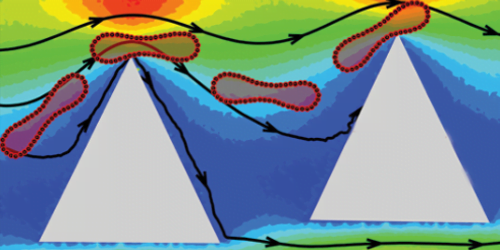
    Many diseases – like sickle-cell anemia and malaria – are accompanied by changes in the stiffness of red blood cells. And while microfluidic devices capable of sorting blood cells by size exist, few have made microfluidic devices capable of sorting blood cells by their deformability. But a new set of simulations suggests we could do so relatively easily.

    Existing devices sort blood cells by size using an array of tiny posts – kind of like a cellular pachinko machine. Through simulation, researchers found that by changing the shape of these posts – specifically by turning them from circles into sharper triangles –  they could sort the red blood cells by their stiffness. Because the sharp corners create large local stresses in the fluid, the blood cells get deformed when passing the corner. That ends up deflecting stiffer cells into a different stream. Build a whole array of posts and you can sort the blood cells by their degree of stiffness – ideally allowing you to isolate the most diseased cells. (Image and research credit: Z. Zhang et al.; via APS Physics)

    ETA: Added a clarification: some researchers, like Beech et al., have investigated deformability-based sorting devices.

  • Featured Video Play Icon

    Melting

    File this one under “Oddly Satisfying” – this timelapse video shows the process of melting a jawbreaker candy using a blowtorch. Over a minute and a half, each colorful layer of candy melts away to reveal the strata beneath. There’s a definite connection here to some of the previous research we’ve discussed on erosion, dissolution, and melting. The blowtorch’s flame generates a hot boundary layer around the candy surface; it’s thickest and hottest at the central stagnation point, but judging by the melting layer we see running all the way to the candy’s shoulder, its size and effect are substantial even there. It’s hard to tell from the video whether the surface of candy is getting roughened (a la scalloping) or whether that’s just an uneven layer of melted candy flow. Regardless, it’s a fun watch. (Video and image credit: Let’s Melt This; via Colossal)

  • Noisy Jets

    Noisy Jets

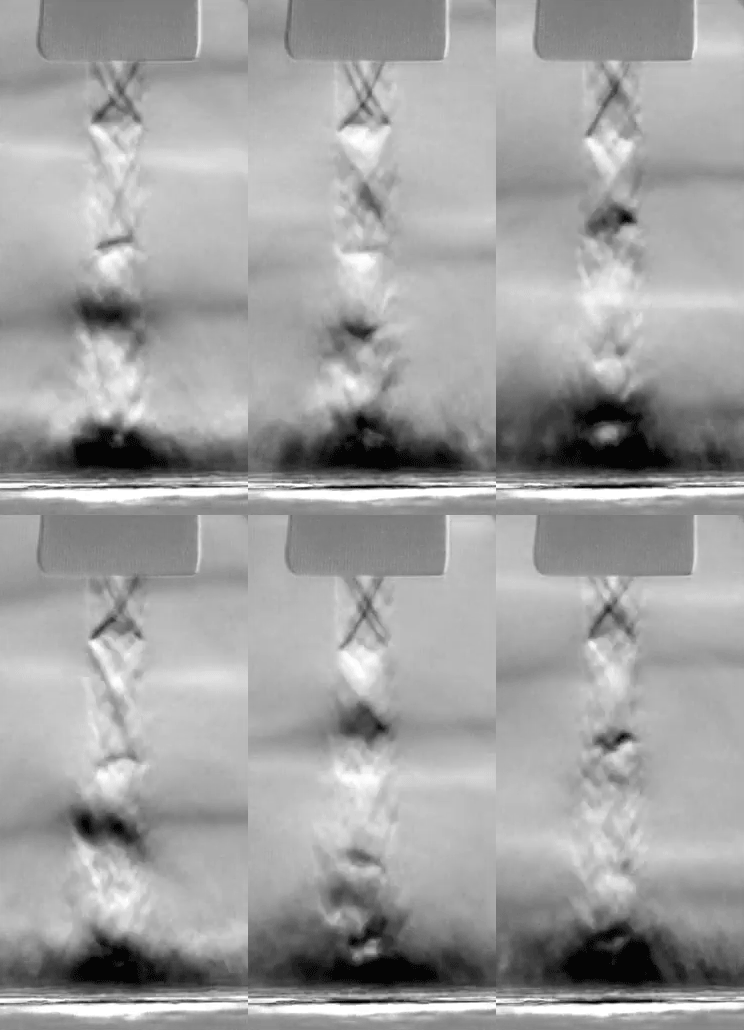
    One major problem that has plagued supersonic aircraft is their noise. The Concorde – thus far the only supersonic commercial airliner – was plagued with noise complaints that ultimately restricted its usability. Noise reduction is a major area of inquiry in aerospace, and the video below shows one experiment trying to understand the connections between supersonic flow and noise.

    Above you see a supersonic, Mach 1.5 microjet emanating from a nozzle at the top of the image. The jet is hitting a flat plate at the bottom of the image. Just beyond nozzle’s exit, you can see the X-shape of shock waves inside the jet. The position of that X is oscillating up and down.

    In the background, you can see horizontal light and dark lines traveling up and down. Those horizontal lines in the background are acoustic waves. When they hit the bottom plate, they reflect and travel upward until they hit another surface (outside the picture) and reflect back down. As they travel, they interact with the jet, causing those X-shaped shock waves to move up and down. This coupling between flow and acoustic waves makes the jet much louder – up to 140 dB – than it would be otherwise.

    Researchers hope that unraveling the physics of simpler systems like this one will help them quiet more complicated aircraft. (Image and video credit: F. Zigunov et al.)