Although we often think of solids as immovable in the face of flow, the motion of air and water sculpts many parts of our world. One common pattern, seen both on surfaces that melt and those that dissolve into a flow, is called scalloping. Mathematical analysis shows that flat surfaces exposed to a flow that melts or dissolves them unavoidably develop these scallops. The surface becomes rougher as the scallops form, but the instability that drives them only works up to a specific level of roughness. Instead of the scallops becoming deeper and deeper, the flow shifts as the surface changes. Peaks in the surface erode faster than the valleys, which tends to keep the scallops relatively uniform in depth after they’ve formed. Scallops like these are often seen in soluble rocks like limestone or marble as well as in snow and ice. (Image credit: Seattle Times, G. Smith; research credit: P. Claudin et al., L. Ristroph)
Month: January 2018

“Breathe”
In black and white, the towering power of a thunderstorm looks almost apocalyptic. Photographer Mike Olbinski’s latest storm timelapse, “Breathe,” features roiling turbulence, distant downpours, and eerie mammatus clouds. Supercell thunderstorms churn and rotate over empty horizons. Billowing cumulus clouds condense from bright skies. Flashes of lightning reveal the outlines of massive thunderheads. It’s a beautiful glimpse of atmospheric fluid dynamics in action, with every texture magnified and enhanced by the stark black and white palette. (Video and image credit: M. Olbinski; via Gizmodo)

In the Eye of a Hurricane
Although eyes are common at the center of large-scale cyclones, scientists are only now beginning to understand how they form. Since real-world cyclogenesis is complicated by many competing effects, researchers look at simplified model systems first. A typical one uses a shallow, rotating cylindrical domain in which heat rises from below. The rotation provides a Coriolis force, which shapes the flow. In particular, it causes a boundary layer along the lower surface of the domain, creating a thin region where the flow moves radially inward. (Its opposite forms at the upper surface of the domain, sending flow radiating outward.) Like an ice skater spinning, the flow’s vorticity intensifies as it approaches the central axis of rotation. When the conditions are right, this intensely swirling boundary layer flow lifts up into the main flow, forming an eyewall. The eye itself, it turns out, is merely a reaction to the eyewall’s formation. (Image credit: S. Cristoforetti/ESA; research credit: L. Oruba et al.)

Jumping Larvae
Gall midge larvae, despite their lack of legs, are prodigious jumpers. These worm-like creatures use hydrostatic pressure to jump more than 30 body lengths. To do so, the larva curls itself into a loop, latching its mouth to its tail. It then shifts the fluids inside its body, flattening itself as the pressure builds. When the larva releases its tail, it flies into the air at about 1 m/s. The human equivalent of a gall midge larva’s jump would be about 60 meters, far beyond the world record long jump of less than 9 meters (with a running start). The larva’s technique is a relatively simple but highly effective one that might be useful in applications like soft robotics. (Video credit: Science; research credit: G. Farley et al.)

Withstanding Windstorms
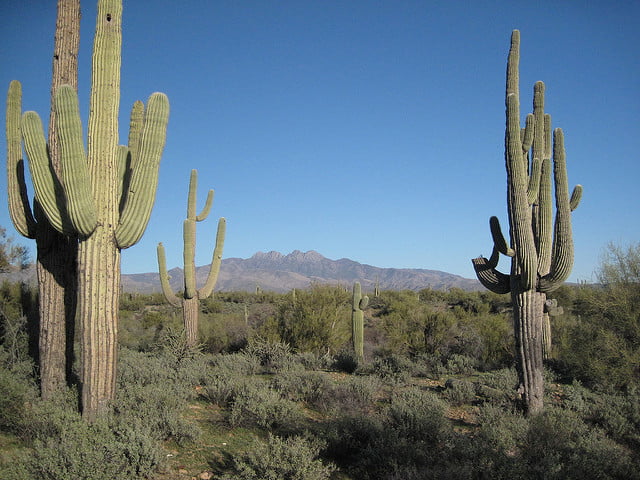
Saguaro cacti can grow 15 meters tall, and despite their shallow root systems can withstand storm winds up to 38 meters per second without being blown over. Grooves in the cacti’s surface may contribute to its resilience, by adding structural support and/or through reducing aerodynamic loads. The latter theory mirrors the concept of dimples on a golf ball; namely, grooves create turbulence in the flow near the cactus, which allows air flow to track further around the cactus before separating. The result is less drag for a given wind speed than a smooth cactus would experience.
Indeed, recent experiments on a grooved cylinder with a pneumatically-controlled shape showed exactly that; the morphable cylinder’s drag was consistently significantly lower than fixed samples. Cacti do change their shapes somewhat as their water content changes, but they don’t have the ability for up-to-the-minute alterations. Nevertheless, their adaptations can inspire engineered creations that morph to reduce wind impact. (Image credit: A. Levine; research credit: M. Guttag and P. Reis)

Water Walking, Exploding Droplets, and Colliding Vortices
Every year I look forward to the APS DFD conference in November. It brings thousands of researchers together to share the latest in fluid dynamics. So much goes on in those three days that it’s impossible to capture, but last year I teamed up with Tom Crawford and the Journal of Fluid Mechanics to attempt just that. We interviewed 50 researchers on their projects, and we’ll be bringing you their work, in their words, each month leading up to the 2018 APS DFD meeting.
This first video focuses on some of the awesome entries to the 2017 Gallery of Fluid Motion. Watch to learn about oil droplets that go flying everywhere when you’re cooking, balls that walk on water, the water music of Vanuatu and more! To see the videos we discuss and all the other entries, go to gfm.aps.org. (Video credit: N. Sharp and T. Crawford)

An Armored Bed
A river’s flow constantly changes its underlying bed. The rocks and particulates beneath a flowing river can typically be divided into two zones: an upper layer called the bed-load zone where the flow moves particles with it and a lower layer where particles are mostly trapped but may creep over long periods. In gravelly river-beds this upper bed-load zone tends to accumulate more large particles, a phenomenon known as armoring. Experiments show that, in this region, large particles have a net vertical velocity moving upward, while smaller particles tend to move downward. Exactly why large particles are more prevalent in the bed-load zone in unknown; several theories have been offered. One suggests that the size segregation is similar to the Brazil nut effect and that smaller particles have a tendency to fall into gaps and sink more easily than larger ones. (Image and research credit: B. Ferdowsi et al., source)

Juno’s Citizen Science
The Juno mission’s JunoCam has been producing stunning photos each time the spacecraft swoops past Jupiter. The instrument has a planning team, but its primary use is for citizen scientists, who have been suggesting images to take each orbit and have been processing those images. Most of the photos we see are like the one on the left above – photos that have been heavily color-enhanced to highlight details. The image on the right shows what Jupiter would look like to the human eye. Look closely, and you’ll catch many of the same colors and shapes in both photos.
At a recent conference, a member of JunoCam’s team presented scientific results that have come from the instrument, including analysis of Jupiter’s polar storm systems (8 vortices for the north pole and 5 for the south), tantalizing hints at Jovian equivalents to earthly cloud types, and more. She also announced a new Analysis page where members of the public can both see the science in progress and participate first-hand! (Image credit: NASA / SwRI / MSSS / G. Eichstädt / S. Doran; NASA / JPL-Caltech / SwRI / MSSS / B. Jónsson; via E. Lakdawalla; submitted by jshoer)

The Foggy Grand Canyon
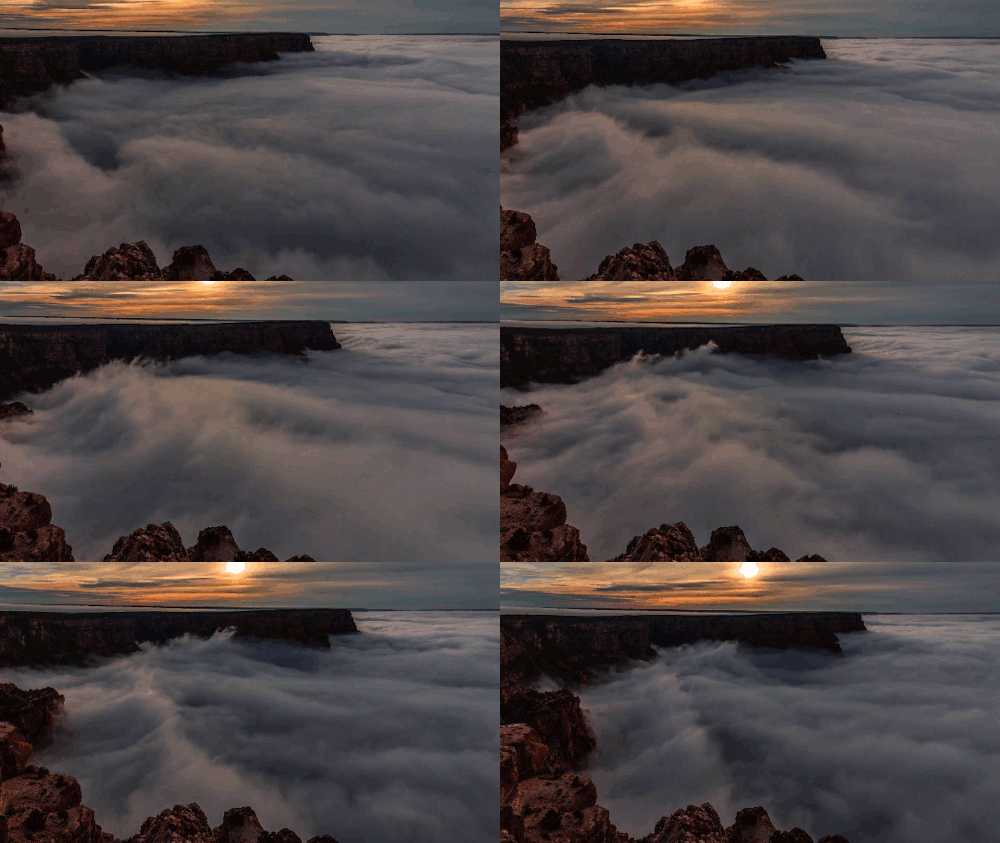
On occasion in the late fall and early winter, the Grand Canyon can fill with clouds of fog. This occurs when a layer of warm air traps cold, moist air inside the canyon, creating what’s known as a temperature inversion. The trapped air’s moisture condenses into fog, creating the appearance of a cloud sea lapping at the canyon walls. Such inversions often proceed a big snowstorm, as shown in this video. (Video and image credit: H. Mehmedinovic / SKYGLOWPROJECT; via Gizmodo)


The Lava Lamps That Secure the Internet
A wall of lava lamps in a San Francisco office currently helps keep about 10% of the Internet’s traffic secure. Internet security company Cloudflare uses a video feed of the lava lamps as one of the inputs to the algorithms they use to generate large random numbers for encryption. The concept dates back to a 1996 patent for a product called LavaRand. The idea is that using a chaotic, unpredictable source as a seed for random number generators makes it much harder for an adversary to crack your encryption.
With lava lamps, a lot of that chaos comes from the fluid dynamics involved – without perfect knowledge of thousands of variables, it would be impossible to simulate the lava lamp wall and get the same outcome as the real one – but there’s also randomness that comes from the measurement. People walking by, shifts in lighting, and random fluctuations of individual pixels all help make the video feed unpredictable. For those interested in the details of how Cloudflare uses their lava lamps, the company explains things for both technical and non-technical readers. You can also check out Tom Scott’s video for a good overview. (Image and video credit: T. Scott; submitted by Jean H.)