Year: 2017

  • Creating Clouds

    Creating Clouds

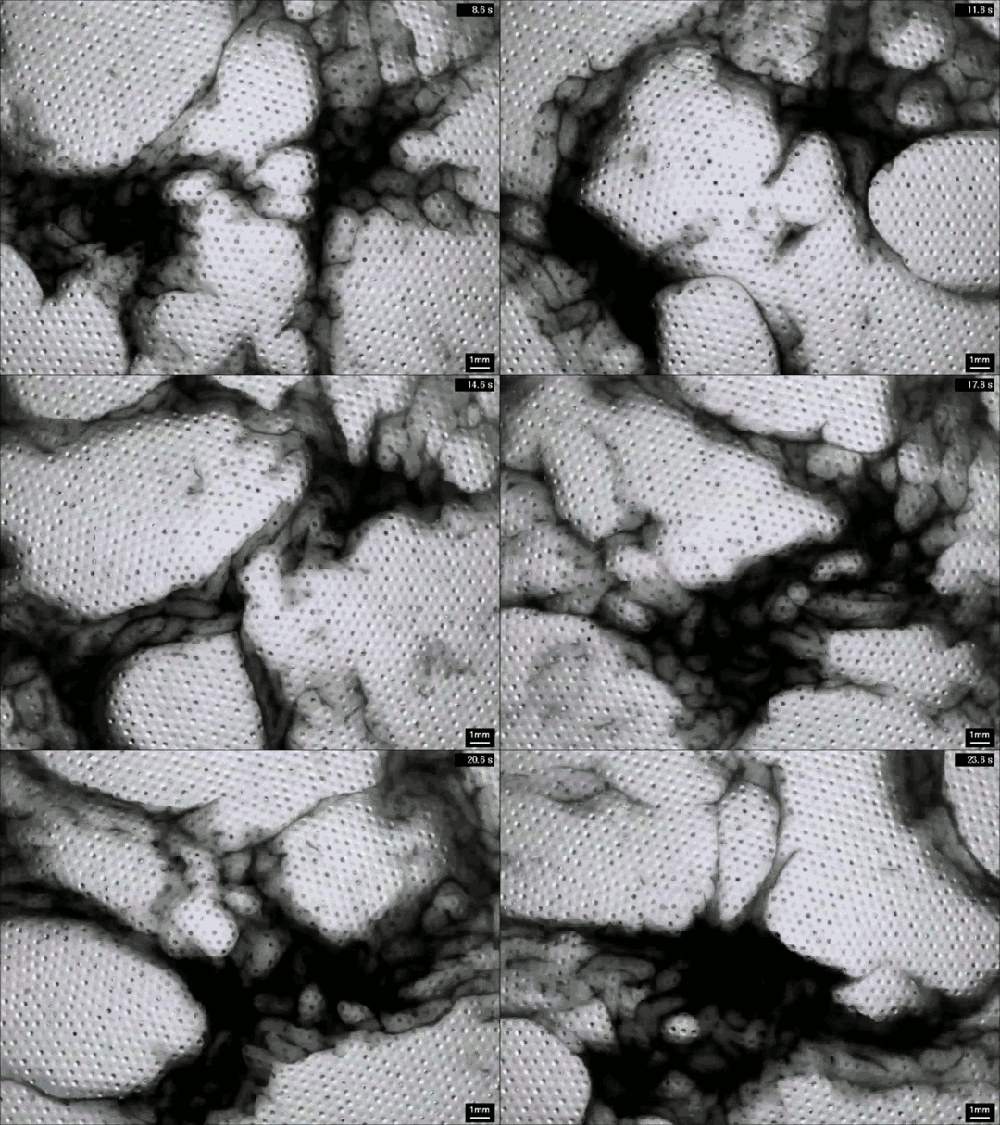
    What you see here is the formation of clouds and rain – but it’s not quite what you’re used to seeing outside. This is an experiment using a mixture of sulfur hexafluoride and helium to create clouds in a laboratory. Everything is contained in a cell between two transparent plates. Liquid sulfur hexafluoride takes up about half of the cell, and when the lower plate is heated, that liquid begins evaporating and rising in the bright regions. When it reaches the cooled top plate, the liquid condenses into droplets inside the dimples on the plate, eventually growing large enough to fall back as rain. The dark wisps you see are areas where cold sulfur hexafluoride is sinking, much like in the water clouds we are used to. Setups like this one allow scientists to study the effects of turbulence on cloud physics and the formation of droplets. (Image credit: E. Bodenschatz et al., source)

    Boston-area folks! I’ll be taking part in the Improbable Research show Saturday evening at 8 pm at the Sheraton Boston. Come hear about the Boston Molasses Flood and other bizarre research!
  • Leidenfrost Atop a Fluid

    Leidenfrost Atop a Fluid

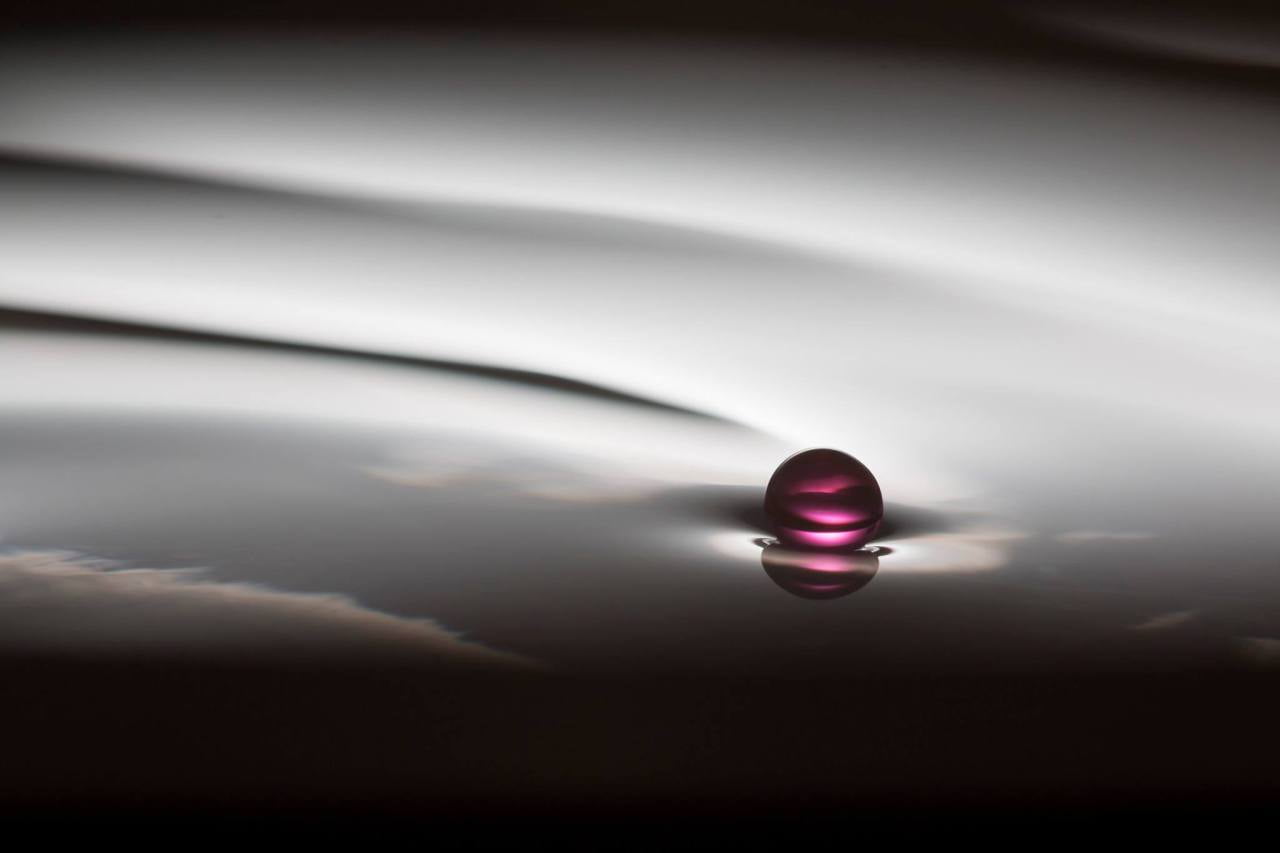
    Leidenfrost droplets typically hover on a thin layer of vapor above a surface that is much hotter than the boiling point of the liquid. Such drops move almost frictionlessly across these surfaces and can even propel themselves. The question of how hot is hot enough to produce the Leidenfrost effect is still being debated, but recent research suggests that the answer may depend strongly on surface roughness.

    To test the role of surface roughness, one group tested drops of ethanol atop a heated pool of silicone oil, as pictured above. Ethanol’s boiling point is 78 degrees Celsius, and the researchers found they could hold the ethanol drop in a Leidenfrost state by heating the pool to 79 degrees Celsius – only 1 degree above ethanol’s boiling point! Thanks to surface tension, a liquid surface is essentially molecularly smooth. The fact that solid surfaces require much higher temperatures before the Leidenfrost effect is observed indicates that even the slightest roughness can have a large impact on the Leidenfrost temperature. (Image credit: F. Cavagnon; research credit: L. Maquet et al., pdf)

    Heads-up for Boston-area folks! I’ll be taking part this Saturday evening in the Improbable Research show at the AAAS conference. The show is free and open to the public but fills up quickly, so be sure to come early for a seat.

  • Leapfrogging Vortices

    Leapfrogging Vortices

    Two vortex rings travelling along the same line can repeatedly leapfrog one another. During my recent visit to the University of Chicago, PhD student Robert Morton of the Irvine Lab demonstrated this leapfrogging in the same apparatus they use to study knotted vortices. Leapfrogging works because of the mutual interaction of the flow fields of the two vortex rings. Their influence on one another causes the front vortex ring to slow down and widen while the trailing vortex narrows and speeds up. Once the vortices have switched places, the process repeats. In a real fluid, viscosity eventually breaks things down and causes the vortex rings to merge, but in simulation, inviscid vortex rings can leapfrog indefinitely. Our friend Physics Girl even showed that half-vortex-rings can leapfrog. (Image credit: N. Sharp; thanks to R. Morton for the demo)

  • Happy Valentine’s Day

    Happy Valentine’s Day

    This heart-shaped atmospheric apparition is a lenticular cloud captured over the mountains of New Zealand. As you can see in the companion video, the cloud itself remains stationary over the mountain. This is a key feature of lenticular clouds, which form when air flowing over/around an obstacle drops below the dew point. This causes moisture in the air to condense for a time before it descends and warms once more. Thus, even though air is continuously flowing past, what we see is a stationary, lens-shaped cloud. Happy Valentine’s Day from FYFD!  (Image credit: M. Kunze, video; via APOD)

  • Featured Video Play Icon

    Four Seasons

    The team behind Beauty of Science decided to explore the four seasons in this video combining macro footage of crystal growth, chemical reactions, and fluid dynamics. It’s always a fun game with videos like this to try and guess exactly what makes the mesmerizing patterns we see. Are those blue streaming waves in Spring caused by alcohol shifting the surface tension in a mixture? Are the dots of color welling up in Autumn a lighter fluid bursting up from underneath a denser one? As fun as the visuals are, though, what really made this video stand out for me was its excellent use of “The Blue Danube” to tie everything together. Check it out and don’t forget the audio! (Video credit: Beauty of Science; via Gizmodo)

  • Self-Wrapping Drops

    Self-Wrapping Drops

    A liquid drop can fold itself up in a thin sheet. The animation above shows a drop of water with an ultra-thin (79nm) circular sheet of polystyrene atop it. As a needle removes water from the underside of the droplet, the shrinking droplet causes wrinkles and folds to form in the sheet. What’s going on here is a competition between the energy required to change the droplet’s shape and the energy needed to bend the sheet. Eventually, the droplet’s volume is small enough that the bending of the sheet overrules surface tension in dictating the droplet’s shape. The result is a tiny empanada-shaped droplet completely encapsulated by the sheet. (Image credit: J. Paulsen et al., source; research paper)

  • Microgravity Can Change Vision

    Microgravity Can Change Vision

    In recent years, astronauts have reported their vision changing as a result of long-duration spaceflight. Pre- and post-flight studies of astronauts’ eyes showed flattening along the backside of the eyeball, and scientists hypothesized that the redistribution of body fluids that occurs in microgravity could be reshaping astronauts’ eyes by increasing the intracranial pressure in their skulls.

    A new study tested this hypothesis with the first-ever measurements of intracranial pressure during microgravity flights and during extended microgravity simulation (a.k.a. bedrest with one’s head pointed downward). The authors found that humans here on Earth experience substantial changes in intracranial pressure depending on our posture – while upright we experience much lower intracranial pressure than we do when we’re lying flat. In both microgravity flights and simulation, patients had intracranial pressures that were higher than earthbound upright values but lower than what is experienced when lying flat on Earth.

    Since we humans on Earth spend about 2/3rds of our time upright and 1/3rd prone, our bodies are accustomed to regular variations in intracranial pressure. In space, astronauts don’t receive that regular unloading of intracranial pressure we have when we’re upright. So now researchers suggest that it is the lack of daily variation in intracranial pressure that is the culprit behind astronauts’ vision changes – not the absolute value of the pressure itself. (Image credit: NASA; N. Alperin et al.; research credit: J. Lawley et al.)

  • Swimming with Corkscrews

    Swimming with Corkscrews

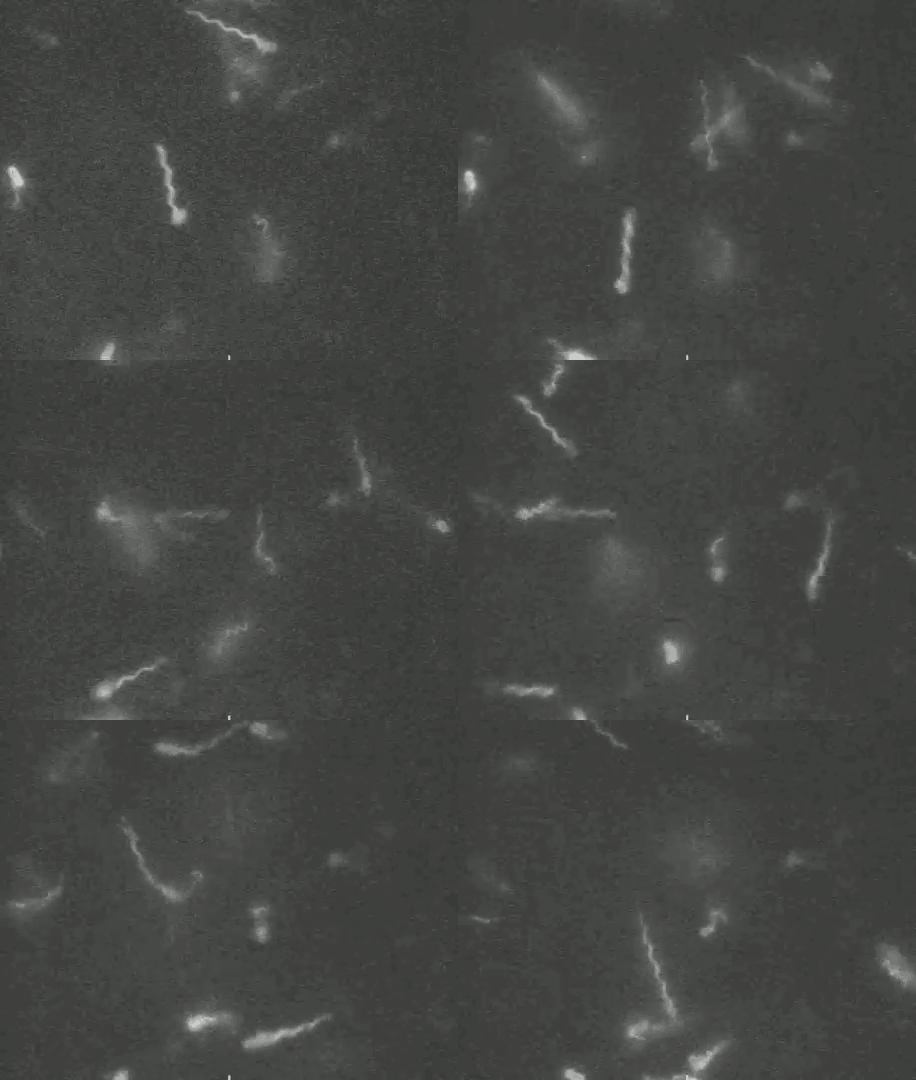
    E. coli, like many bacteria, swim using corkscrew-like appendages called flagella. Because the bacteria are extremely tiny – their flagella may be less than ten microns long – their swimming is overwhelmingly dependent on viscosity. (Inertial effects are 100 to 10,000 times smaller than viscous effects for swimming E. coli.) Rotating their helical flagella generates viscous drag along the surface of the corkscrew. Because the flagella is asymmetric when you add all of those drag components together, the net force is thrust that moves the bacterium forward. Watch carefully in the animation above and you’ll see that E. coli have multiple flagella and will swing one out to the side during maneuvers. (Image credit: L. Turner et al., source; reproduced in a review by E. Lauga, pdf)

  • Featured Video Play Icon

    Unboiling an Egg

    Cooking is something we think of as a one-way process. You add heat to food, it changes forms, and there’s undoing that. But that process is less one-directional than we thought, at least in some cases. Take boiling an egg. When you add heat to egg whites, it breaks down bonds between the folded proteins and lets those proteins build more bonds with other sections of proteins, eventually solidifying into a seemingly unbreakable mess. You can’t break those bonds by adding or removing thermal energy, but you can shake the proteins apart and refold them into their original shapes.

    Researchers accomplish this by putting the boiled egg whites in a solution of water and urea and spinning them. When they spin the fluid mixture, the fluid near the wall spins faster than the fluid in the center of the vial, which creates shear stress. That shear stress helps untangle the proteins and reform them into their original shape–thereby unboiling the egg white. Now you definitely don’t want to eat the results – urea is, of course, a component of urine – but it does demonstrate that fluid dynamics can be used to reverse chemical processes we thought were irreversible. And that surprising discovery nabbed the researchers an Ig Nobel Prize in 2015. (Video credit: TedEd/E. Nelson; research credit: T. Yuan et al.)

  • Soft Robots

    Soft Robots

    A research group at MIT has created a new class of fast-acting, soft robots from hydrogels. The robots are activated by pumping water in or out of hollow, interlocking chambers; depending on the configuration, this can curl or stretch parts of the robot. The hydrogel bots can move quickly enough to catch and release a live fish without harming it. (Which is a feat of speed I can’t even manage.) Because hydrogels are polymer gels consisting primarily of water, the robots could be especially helpful in biomedical applications, where their components may be less likely to be rejected by the body. For more, see MIT News or the original paper. (Image credit: H. Yuk/MIT News, source; research credit: H. Yuk et al.)