Jet engines are a major part of aviation today, and this great video from the new LIB LAB project breaks down how jet engines operate. It focuses especially on the subject of combustion, in which fuel-air mixtures are burned to generate power and thrust. By breaking fuels down into simpler compounds, jet engines are able to accelerate exhaust gases, which creates thrust. They even provide instructions for an effervescence-driven bubble rocket so that kids can (safely!) experiment with propulsion at home. (Video credit: LIB LAB/Corvallis-Benton County Public Library)
Year: 2017

Supporting Bubbles
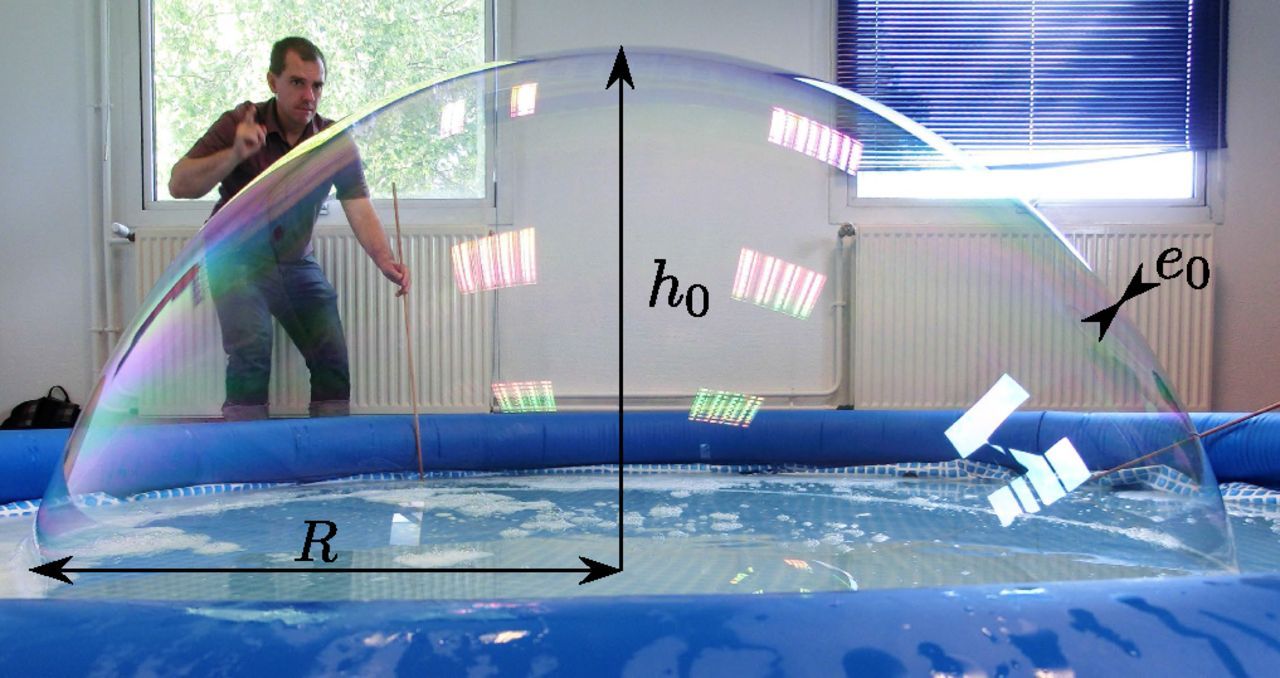
Surface tension holds small droplets in a partial sphere known as a spherical cap. But when droplets become larger, they flatten out into puddles due to the influence of gravity. In contrast, soap bubbles remain spherical to much larger sizes. The bubble pictured above, for example, is more than 1 meter in radius and nearly 1 meter in height.
There is a maximum height for a soap bubble, though, and it’s set by the physical chemistry of the surfactants used in the soap. To support itself, the bubble requires a difference in surface tension between the top and bottom of the bubble. A higher surface tension is necessary at the top of the bubble to help prevent fluid from draining away. The difference in surface tension between the top and bottom of the bubble can never be greater than the difference in surface tension between pure water and the soap mixture – thus those values set a maximum height for a bubble. The researchers found their bubbles maxed out at a height of about 2 meters, consistent with their theoretical predictions. (Image credit: C. Cohen et al.; via freshphotons)

Spillways
Extensive rains in California have brought an unusual sight to Lake Berryessa – an overflowing spillway. The upper photo, taken in 2010, shows the concrete structure of the spillway’s entrance, known as a bellmouth – or, in the words of locals, a glory hole. When the water level rises above the concrete, water begins to cascade down the spillway to relieve flooding.
The flow is rather mesmerizing and beautifully laminar until it’s fallen many feet down the hole. This is intentional on the part of the designers – at least the laminar part. It means that the flow velocity at the entrance is slow, so that animals (or trespassing people) nearby are not going to get sucked down the spillway a la Charybdis. Nevertheless, the spillway does make quick work of excess water. The New York Times reported that on February 21st about two million gallons (7.5 million liters) of water a minute flowed down the spillway. (Image credits: J. Brooks; T. Van Hoosear; video credit: Lake Berryessa News; submitted by Zach B.)


Battery Rockets
When I post Slow Mo Guys videos, it often comes with a warning not to try this at home. For their latest video, that deserves an extra-special mention: seriously, don’t try this. In this video, Dan and Gav explode lithium-ion batteries. In the process, they discover a safety feature – namely vents on one face of the battery. Because runaway thermal reactions (a.k.a. explosions) are a possibility with this type of battery system, consumer-grade batteries are designed to try and prevent extreme damage. One of these outwardly visible safety features are these four vents that release gas when when the battery is too hot. By venting the gas, manufacturers keep the battery from exploding and sending hot chemicals and shrapnel in all directions. Instead the venting gas turns the entire battery into a miniature rocket. (Video and image credit: The Slow Mo Guys)


Wrinkling Winds

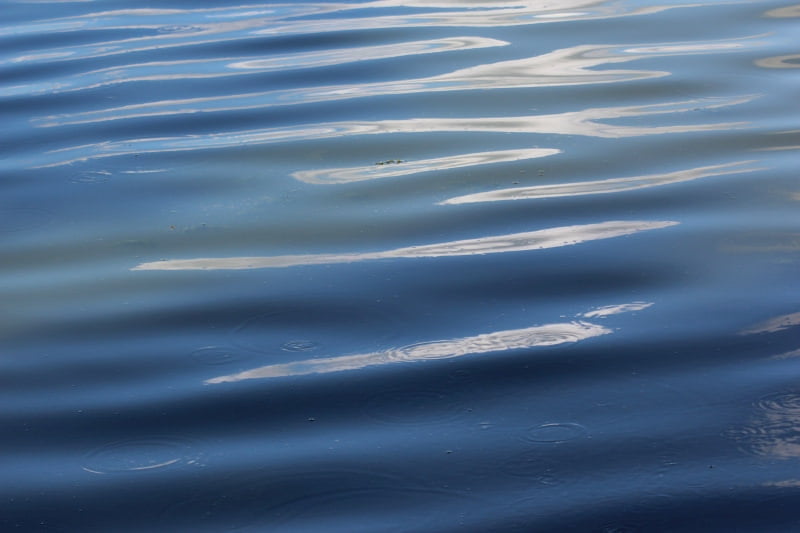
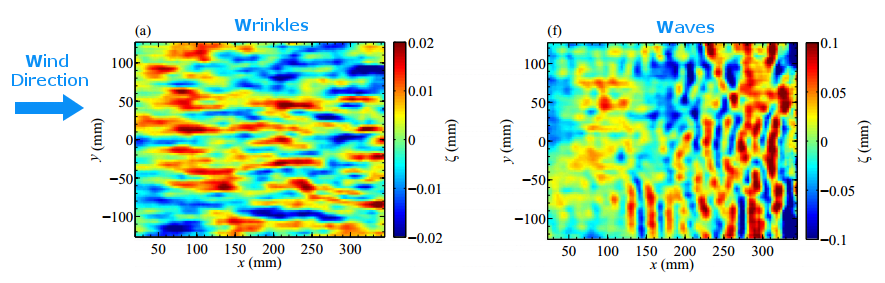
If you’ve ever sat out on a lake and just watched the water’s surface, you’ve probably noticed how complex and variable it looks. There may be waves that rock your kayak but there are smaller variations, too, like little ripples or even tiny wrinkles that appear on the surface. Much of this activity comes from wind blowing across the water. When the wind exceeds a critical speed, waves form. They generally travel in lines that are aligned perpendicular to the wind (lower right). But what happens when the wind is below the critical speed?
A recent study looked at just this question. By blowing air across the surface of different liquids and observing variations in the surface height as small as 2 micrometers, the researchers were able to measure tiny wrinkles on the water’s surface (lower left) when the wind speed was small. The size and shape of the wrinkles actually corresponds to structures in the turbulent air flow over the water! For fluids like water, there’s a smooth transition from wrinkles to waves as the wind speed increases, so both may be visible at the same time. For higher viscosity fluids, the switch from one to the other is more abrupt. (Image credits: water – M. Soveran; figure – A. Paquier et al. w/ annotations added in blue; research credit: A. Paquier et al.)

Aerodynamic Leidenfrost Effect

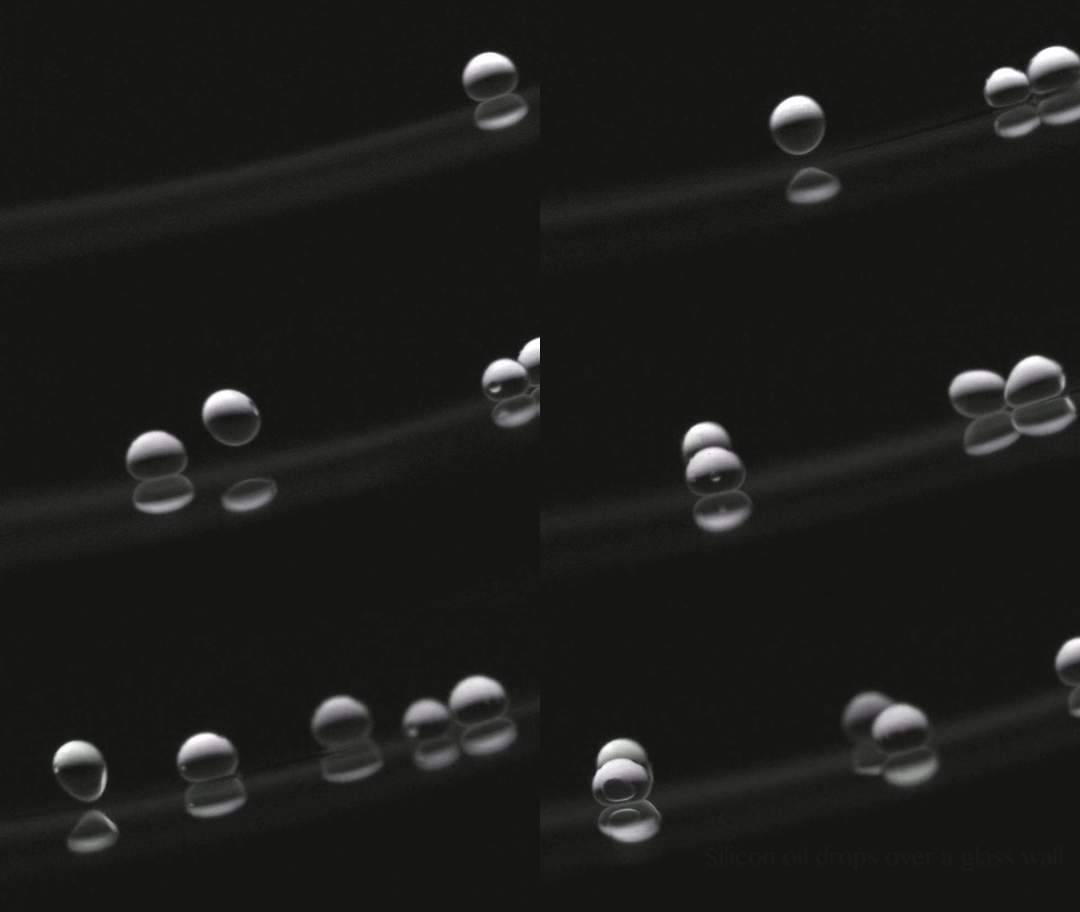
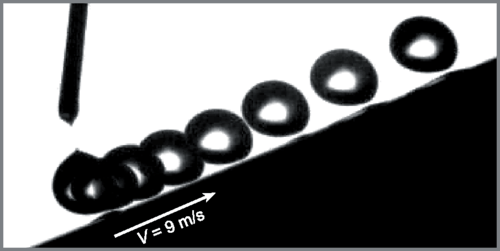
If you place a droplet on a surface much hotter than its boiling point, that droplet will skitter and float almost frictionlessly across the surface on a thin layer of its own vapor. This is what is known as the Leidenfrost effect. But you don’t have to heat a surface to get this behavior. There’s also an aerodynamic Leidenfrost effect, shown above, when the surface is moving. As the surface moves, it drags a layer of air along with it, and that layer of air is capable of keeping droplets aloft indefinitely. The thickness of the air layer depends on speed; the faster the plate moves, the thicker the air layer underneath droplets. The aerodynamic forces generated are large enough to drive a droplet up an incline against the force of gravity (bottom image). (Image credit: animation – M. Saito et al., source; chronophotograph – A. Gautheir et al., pdf)
An Octopus’ Handshake
Cephalopods, especially octopuses, are fascinating creatures. At sea level, an octopus can generate an impressive pressure differential of 1 to 2 atmospheres with each of its suckers. That incredible grip is possible thanks to fluid dynamics. An octopus’s sucker consists of two main parts: the ring-shaped infundibulum on the outer surface and the inner, cup-shaped acetabulum. When the infundibulum makes contact with a surface, it creates a water-tight seal. The octopus then contracts radial muscles along the acetabulum. This expands the inner chamber. The water trapped in the acetabulum now has to take up a greater volume, causing the pressure to drop and creating suction. To let go, the octopus simply relaxes the radial muscles or contracts circular ones to reduce the chamber volume and release the suction. (Video credit: Deep Look)
Vortex Impact
When a vortex ring impacts a solid wall (or a mirrored vortex ring), it expands and quickly breaks up. The animations above show something a little different: what happens when a vortex ring hits a water-air interface. As seen in the side view (top image), the vortex starts to expand, but its shear at the interface generates a stream of smaller vortices that disrupt the larger vortex. (They even look like a little string of Kelvin-Helmholtz vortices!) When viewed from above (bottom image), the vortex ring impact and breakdown look even more complicated. Mushroom-like structures get spat out the sides as those secondary vortices form, and the entire structure quickly breaks up into utter turbulence. There’s some remarkable visual similarities between this situation and some we’ve seen before, like a sphere meeting a wall and drop hitting a pool. (Image credit: A. Benusiglio et al., source)

Breaking Soon


Australian photographer Warren Keelan captures spectacular photos of waves just before and during the moment they break. Fluid dynamics is defined by motion – specifically the motion of substances that do not hold a single form – but one thing I love about wave photography is how crisp and solid water appears when frozen in time. In a way, it feels like a reminder that, even though we classify matter into different states, ultimately those states have a lot in common. (Image credit: W. Keelan; via Colossal)

Venusian Waves
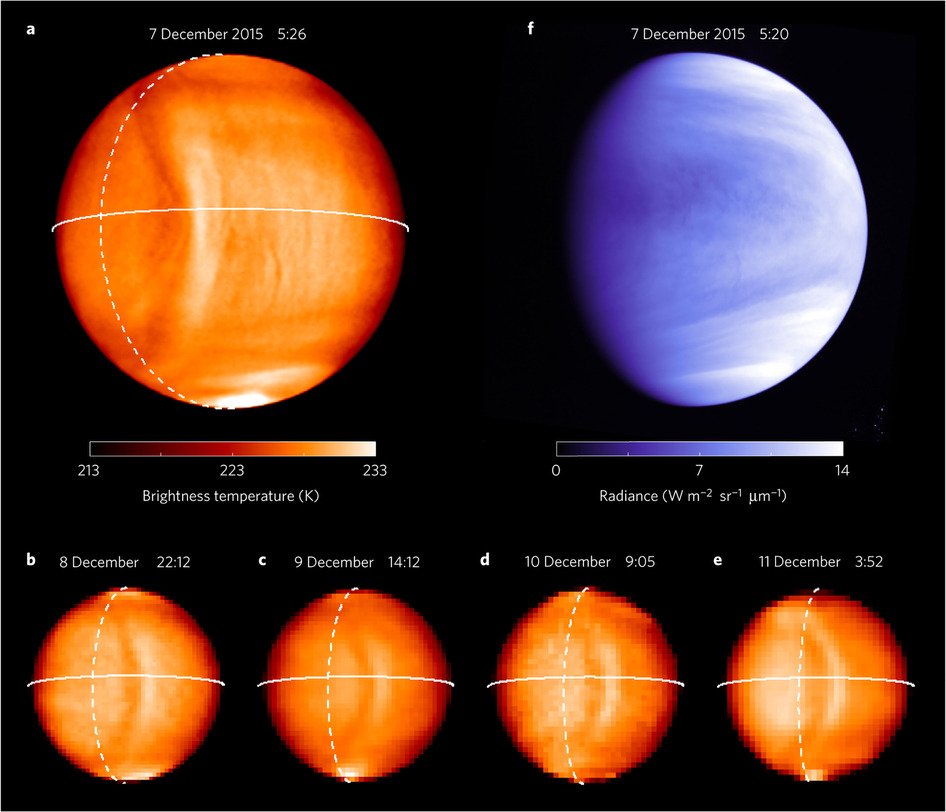
Despite its proximity, Venus remains largely mysterious, thanks to its cloudy atmosphere and incredible harsh conditions. A recent study using data from the Japanese satellite Akatsuki revealed an enormous bow-shaped wave in the Venusian atmosphere. The wave appeared at an altitude of about 65 km and stretched more than 10,000 km long, across both the northern and southern hemispheres. Although surface winds on Venus are believed to be small due to its incredibly slow rotation, winds higher in the atmosphere are much faster – so it was strange to observe this wave sitting essentially stationary for five days of observation.
When the scientists mapped the location of wave relative to the surface, they found it was sitting over the Aphrodite Terra highlands, suggesting that this structure is a gravity wave generated by winds interacting with the topography. Similar, albeit smaller, gravity waves are often observed on Earth near mountains. The finding raises questions about our understanding of Venusian atmospheric dynamics and exactly how disturbances from surface winds could create enormous structures so high in the atmosphere. (Image credit: T. Fukuhara et al.; h/t to SciShow Space)