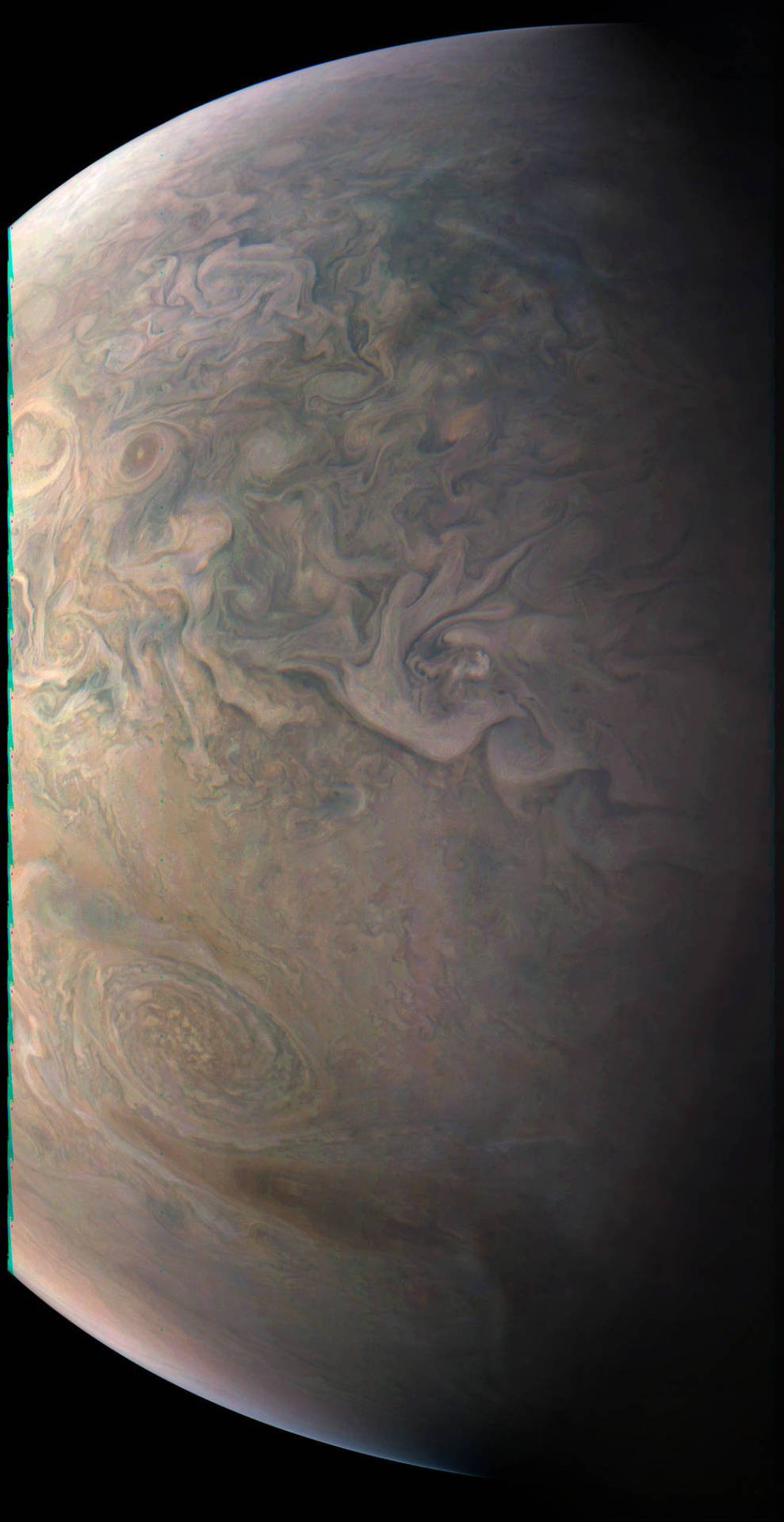
The Juno mission has been revealing angles of Jupiter we’ve never seen before. This photo shows Jupiter’s northern temperate latitudes and NN-LRS-1, a.k.a. the Little Red Spot (lower left), the third largest anticyclone on Jupiter. The Little Red Spot is a storm roughly the size of the Earth and was first observed in 1993. As an anticyclone, it has large-scale rotation around a core of high pressure and rotates in a clockwise direction since it is in the northern hemisphere. Jupiter’s anticyclones seem to be powered by merging with other storms; in 1998, the Little Red Spot merged with three other storms that had existed for decades. (Image credit: NASA/JPL-Caltech/SwRI/MSSS/Gerald Eichstaedt/John Rogers; via Bad Astronomy)
Year: 2017

The Archer Fish’s Arrow
Archer fish have a remarkable superpower. When hunting, they target insects above the water and knock them down with a precision strike from a jet of water they spit out. As previous research has shown, the archer fish packs an impressive punch by carefully modulating the water jet so that its tail travels faster and catches up to the front of the jet just as it strikes its target. Even more impressively, the archer fish can make this perfect strike on targets at different distances, which requires the fish to make significant adjustments to each jet. As this video from Deep Look discusses, the archer fish’s impressive hunting hints that it may have greater intelligence than we thought possible, given a comparison of its brain to ours. (Video credit: Deep Look)

Freezing Impact
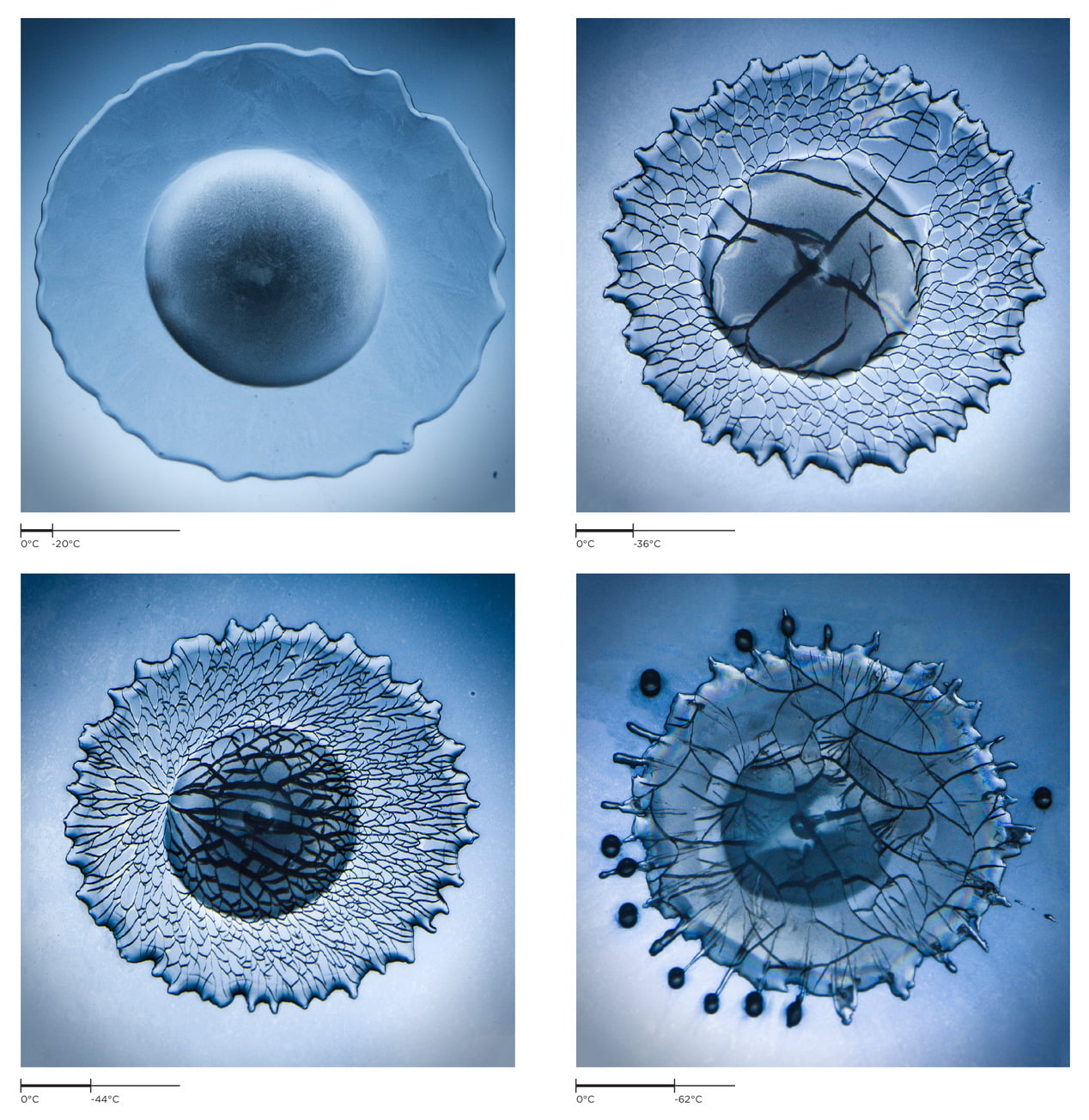
When a water droplet hits a frozen surface, what happens depends significantly on the temperature of the substrate. At relatively high temperatures (-20 degrees C), the droplet freezes without any cracking (upper left). As the surface gets colder, drops begin to crack. At first the cracks are relatively large and unstructured (upper right), but at lower temperatures, they grow in a network of smaller cracks with more distinctive structure (lower left). Cold temperatures can also affect the contact line where water, air, and substrate meet. This can cause droplets to splash even as they’re freezing (lower right). (Image credit: V. Thievenaz et al.; see also E. Ghabache et al.)
Popping
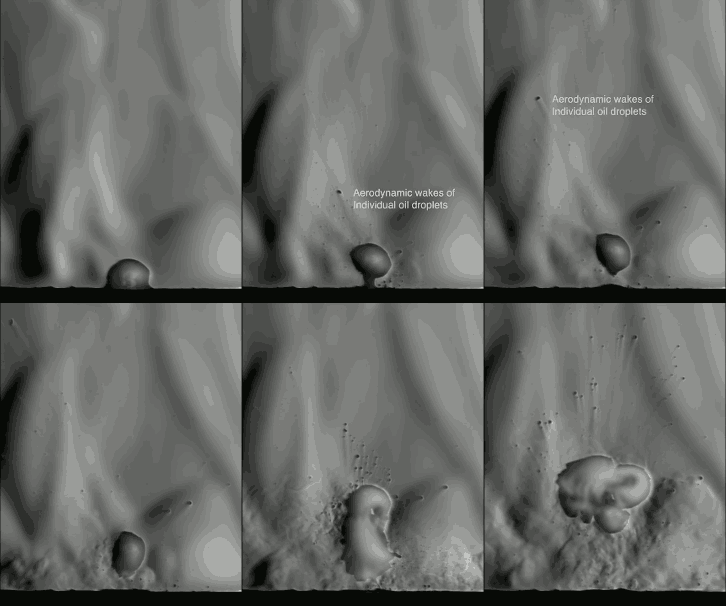
Popcorn’s explosive pop looks pretty cool in high-speed video, but just watching it with a regular camera doesn’t show everything that’s going on. If we take a look at it through schlieren optics, the kernel’s pop looks even more extraordinary:

The schlieren technique reveals density differences in the gases around the corn–effectively allowing us to see what is invisible to the naked eye. The popcorn kernel acts like a pressure vessel until the expansion of steam inside causes its shell to rupture. The first hints of escaping steam send droplets of oil shooting upward. The kernel may hop as steam pours out the rupture point, causing the turbulent billowing seen in the animation above. As the heat causes legs of starch to expand out of the kernel, they can push off the ground and propel the popcorn higher. As for the eponymous popping sound, that is the result of escaping water vapor, not the actual rupture or rebound of the kernel! See more of the invisible world surrounding a popping kernel in the video below. (Image credits: Warped Perception, source; Bell Labs Ireland, source; WP video via Gizmodo; BLI video submitted by Kevin)
Freezing Bubbles
Soap bubbles are wonderfully ephemeral, their surfaces constantly in motion as air currents, surface tension variations, and temperature differences make them dance. In this video, though, photographer Paweł Załuska focuses on freezing soap bubbles. Watching the growth of ice crystals across the bubbles’ thin surface is mesmerizing. Snowflake-like crystals can nucleate anywhere on the film and, as in the sequence at 0:48, those crystals can float around on the bubble’s surface like snowflakes drifting on a breeze until enough of the film solidifies to bring the bubble to a halt and, then, a collapse. (Video credit: P. Załuska/ZALUSKart; via Gizmodo)

Accidental Painting

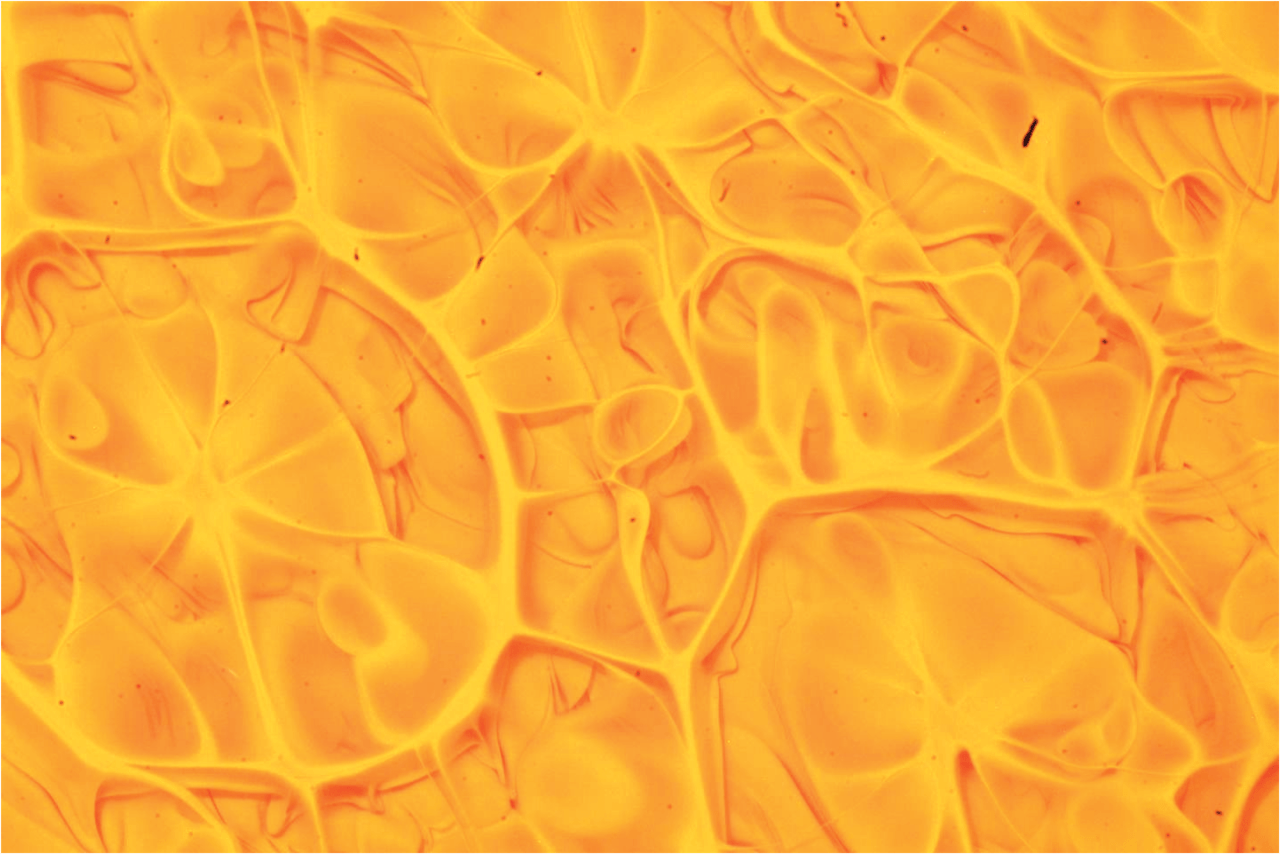
Some paintings of Mexican artist David Alfaro Siqueiros feature patchy, spotted areas of contrasting color formed by what Siqueiros described as “accidental painting”. Many modern artists use this technique as well. By pouring thin layers of two different colors atop one other, Siqueiros was able to generate seemingly spontaneous patterns like those shown above. In fact, what Siqueiros was using was a density-driven fluid instability! These patterns will only appear when a denser paint is poured atop a lighter one. They’re the result of a Rayleigh-Taylor instability – the same behavior that makes beautiful swirls of cream in coffee and the finger-like protrusions seen in supernovae.
Although a density difference is necessary to generate accidental painting, other factors like the paint layer’s thickness and viscosity affect the final pattern. For those who are mathematically-inclined, this paper has a linear stability analysis that shows how density difference, viscosity, and other factors affect the cell sizes in the pattern. (Image and research credits: S. Zetina et al.; GIF source)

As the Dust Blows In
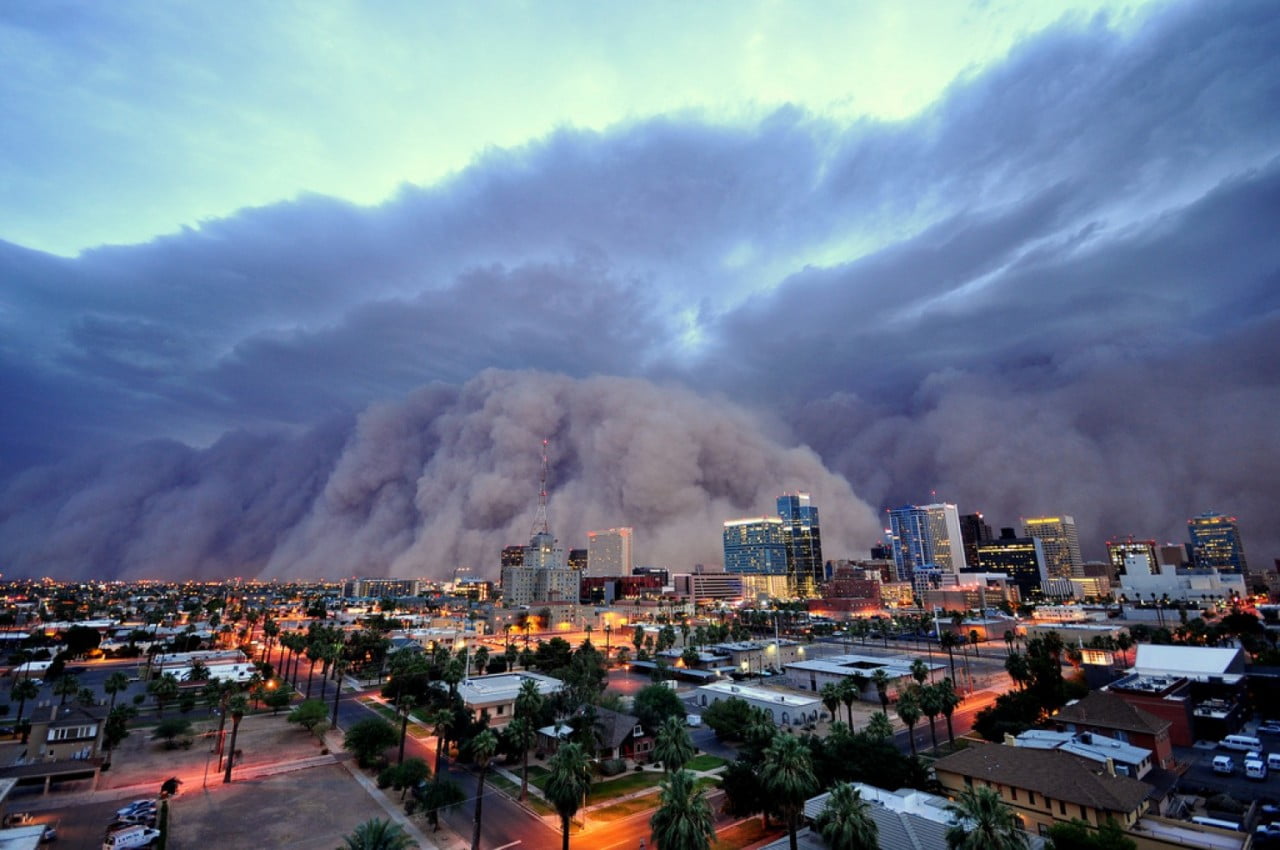
This towering cloud of dust is known as a haboob, and while it appears apocalyptic, it is a relatively common occurrence in parts of the world, including the U.S. southwest and the Middle East. Haboobs often form when a collapsing thunderstorm releases a downburst of cold air. That wind picks up loose dust along the ground and creates a wall of sediment that may be as much as 100 kilometers wide and several kilometers tall. Inside the haboob, winds can reach speeds as high as 100 kph and visibility can be reduced to nearly zero. Because of this, the storms can be quite dangerous, especially to anyone who attempts to drive during one. (Image credit: D. Bryant)

Wrapping Up

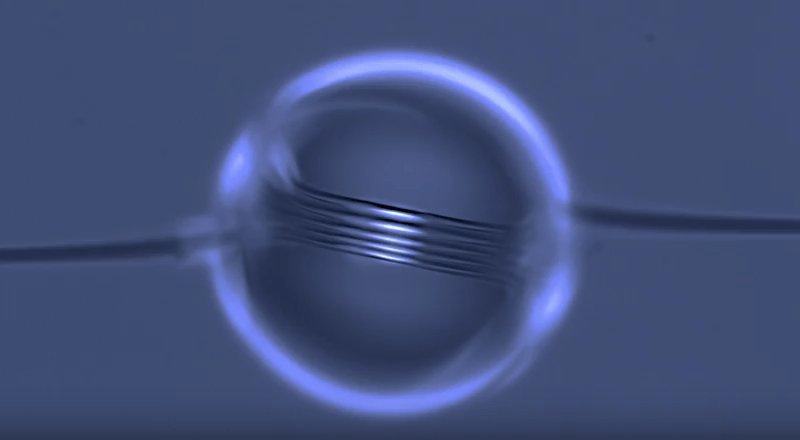
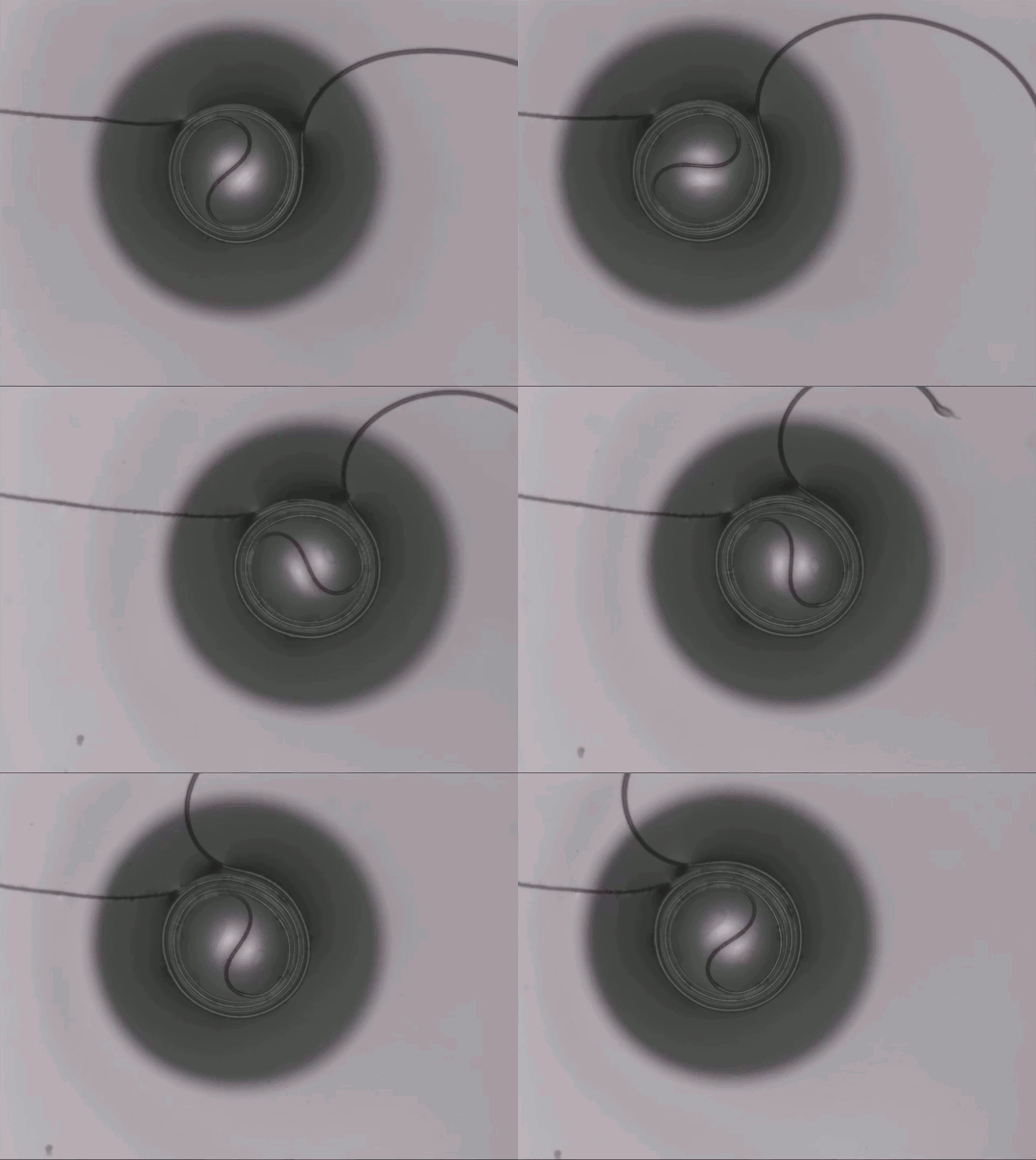
It’s often at the intersection of topics that we can learn something new and fascinating. The latest video from The Lutetium Project shows examples of this at the intersection of solid mechanics and fluid dynamics with a look at elastocapillarity. Breaking that word down, that’s where elasticity – that stretchy quality associated with solids – meets capillarity – the surface-tension-dominated behavior of a fluid. In particular, they explore some of the mind-boggling and surprising interactions that happen between drops, bubbles, and thin flexible fibers smaller than the width of a human hair. Check out the full video below. (Images credit: K. Dalnoki-Veress et al.; video credit: The Lutetium Project)

Vibrated to Bits
Sound and vibration can be powerful tools for controlling liquids. In this animation, a water/glycerin drop violently bursts into a cloud of droplets when it is vibrated vertically 1000 times per second by a piezoelectric actuator. This vibration shakes the drop with accelerations of 150 g. Initially, the amplitude is small enough to simply create ripples around the drop’s circumference. As it increases, the drop deforms more at the edges and starts to eject droplets there. When the vibration hits a critical amplitude, the entire drop explodes into droplets. The technique is called vibration-induced droplet bursting, and its near-instantaneous ability to atomize drops makes it a candidate for applications like spray cooling microprocessors or spray coating a solid surface. (Video credit: B. Vukasinovic, source)
Pascal’s Barrel Follow-Up
Pascal’s Law tells us that pressure in a fluid depends on the height and density of the fluid. This is something that you’ve experienced firsthand if you’ve ever tried to dive in deep water. The deeper into the water you swim, the greater the pressure you feel, especially in your ears. Go deep enough and the pressure difference between your inner ear and the water becomes outright painful.
In the video demonstration above, you’ll see how a tall, thin tube containing only 1 liter of water is able to shatter a 50-liter container of water. Not only does this show just how powerful height is in creating pressure in a fluid, but it shows how a fluid can be used to transmit pressure over a distance – one of the fundamental principles of hydraulics! (Video credit: K. Visnjic et al.; submitted by Frederik B.)
Reader @hoosierfordman77 writes:
“They’re pressurizing the line by using a syringe sealed to the tube. Of course, the volume of water in the tube added to this. But it was not the only source of pressure. Also explaining that pressure only has one vector as in the illustration using Hoover Dam is preposterous. Sir [sic] later stated correctly that pressure is evenly distributed through the inside of a container. If her demonstration was correct then the pressure of the water in lake Meade is not proportional to the volume of the lake…only proportional to its depth. Now I’ve not done testing but I do not believe a 100,000 acre lake that’s 1 foot deep would be held back by the walls of a kiddie pool that routinely handle that depth.” (emphasis added)
Hi, hoosierfordman77, thanks for your comment! It does seem counter-intuitive that pressure in a reservoir is proportional to depth, not volume, but it is correct. If you go swimming 1 meter below the water surface, the pressure you experience is the same whether you’re in a backyard pool or the Gulf of Mexico. And, yes, a 100,000 acre lake that’s 1 foot deep has a static pressure that could be withstood by a kiddie pool.
Now engineers don’t build it that way for a couple of reasons. 1) Pascal’s Law only describes hydrostatic forces – that is, the force experienced when the water is motionless. In reality, a dam would need to withstand not only the hydrostatic forces caused by the water’s depth but also any forces exerted when the water moves due to wind action, temperature differences, etc. And 2) after evaluating all of the expected forces a structure will endure, engineers add a factor of safety to make the structure strong enough to withstand forces above and beyond what is expected in ordinary or extraordinary operation.
As for the syringe, it only adds additional pressure to the line if they do not allow a gap for air in the line to escape. That can be a bit of a challenge, as they acknowledge in the video when they discuss the effects of air bubbles in the line. However, there is every indication that they were aware of this potential in their demonstration and did everything they could to ensure that it was not affecting the result. The fact remains, however, that extra pressure in the line is unnecessary – the 1 liter of water’s depth alone will shatter that container.