Surface tension in a liquid arises from molecular forces. Within a liquid like water, a molecule inside the fluid experiences equal tugs from similar molecules in every direction. A molecule at the surface, on the other hand, experiences the pull of similar molecules only on some sides. The net effect of this imbalance is a tensile force along the liquid surface that acts kind of like a sheet of elastic rubber – this is the effect we call surface tension. If you break the surface tension in a soap film like the one shown above, any tear will expand rapidly as the intact surface tension at the edges pulls the interior fluid away from the tear. (Image credit: C. Kalelkar and A. Sahni, source)
Year: 2017

Sloshing in Space
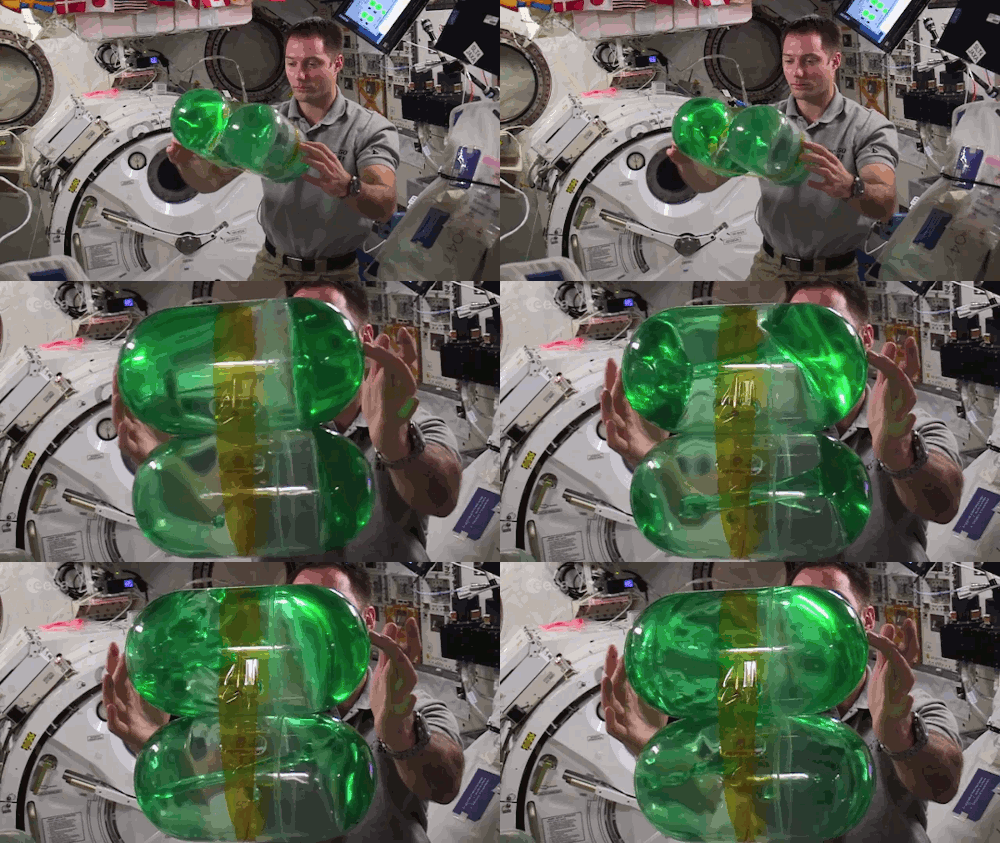
Last month, French astronaut Thomas Pesquet posted a video of some experiments he did on the International Space Station exploring the movement of fluids in microgravity. He filmed the experiments as part of the SPHERES Slosh project. Sloshing is the technical term for how liquids respond to the motion of their container, and it’s a tough problem whether you’re carrying a full coffee mug on Earth or dealing with a partially-emptied fuel canister in orbit.
Here on Earth, gravitational forces dominate how fluids respond, but in microgravity, surface tension is a more powerful player. Pesquet’s demonstrations help scientists here on Earth better understand and model how liquids respond to movement in space. One major application for this is in spacecraft fuel tanks, which engineers must be able to design so that they empty themselves consistently with or without the added complications of spinning, maneuvering, or impulsive kicks of acceleration. (Video and image credit: ESA; submitted by gdurey)


Breaking Down Vortices
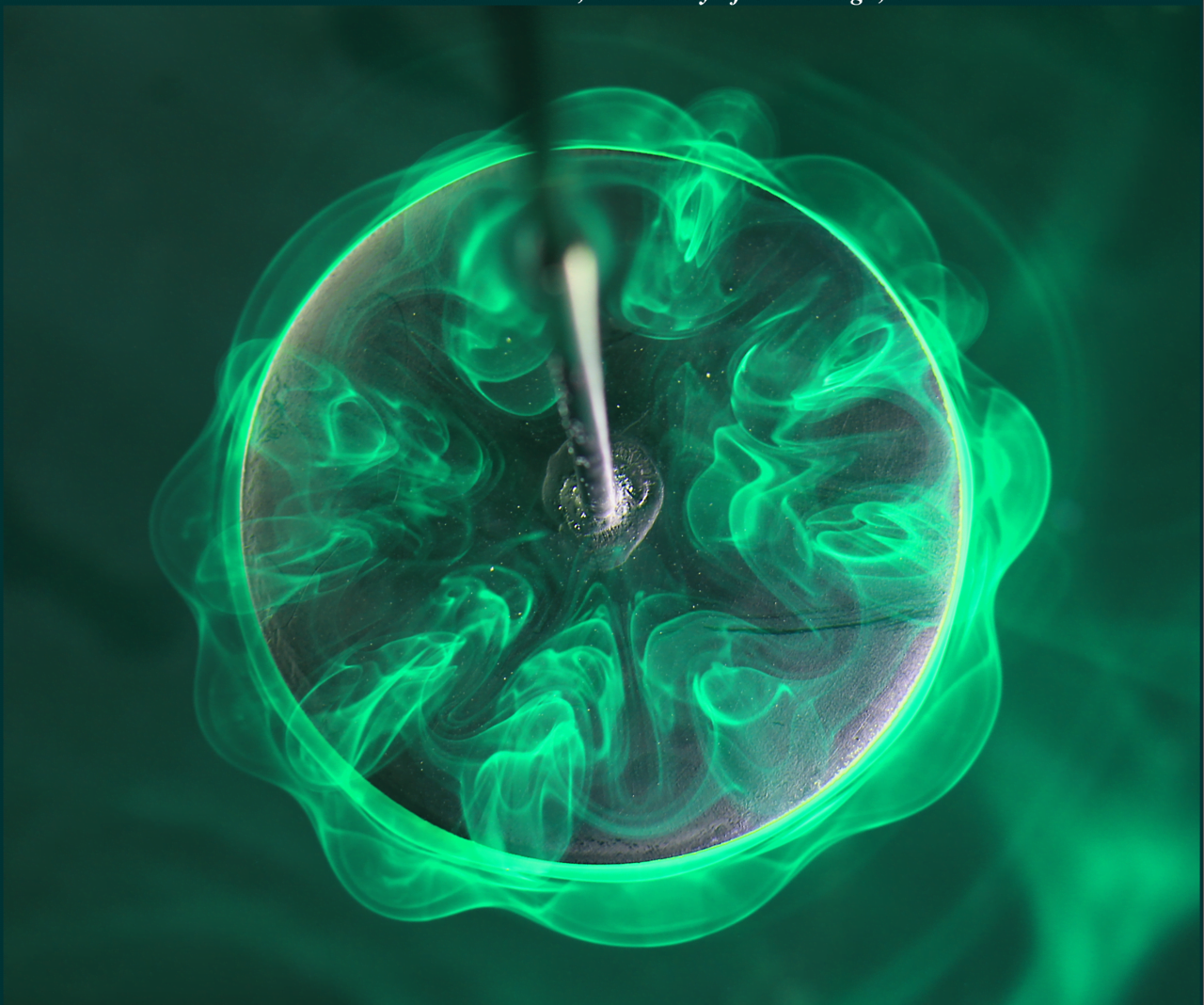
Vortex rings are ubiquitous in nature, showing up in droplet impacts, in propulsion, and even in volcanic eruptions. Understanding the interaction and breakdown of multiple vortices with one another is therefore key. The image above shows a circular disk that’s being oscillated up and down (in and out of the page). As the disk moves and changes direction, it generates vortices that interact with one another. Here some of those interactions are visualized with fluorescent dye. The overlapping vortices form complex and beautiful shapes on their way to breakdown. (Image credit: J. Deng et al., poster, paper)
Molten Copper
In this video, the Slow Mo Guys prove that pouring molten copper in slow motion is every bit as satisfying as one would imagine. Because they pour the metal from fairly high up, they get a nice break-up from a jet into a series of droplets; that’s due to the Plateau-Rayleigh instability, in which surface tension drives the fluid to break up into drops. Upon impact, the copper splashes and splatters very nicely, forming the crown-like splash many are familiar with from famous photos like Doc Edgerton’s milk drop. The key difference between the molten copper and any other liquid’s splash comes from cooling; watch closely and you’ll see some of the copper solidifying along the edges and surface of the fluid as it cools. In this respect, watching the molten copper is more like watching lava flow than seeing water splash. (Video and image credit: The Slow Mo Guys)

Shocks on a Wing
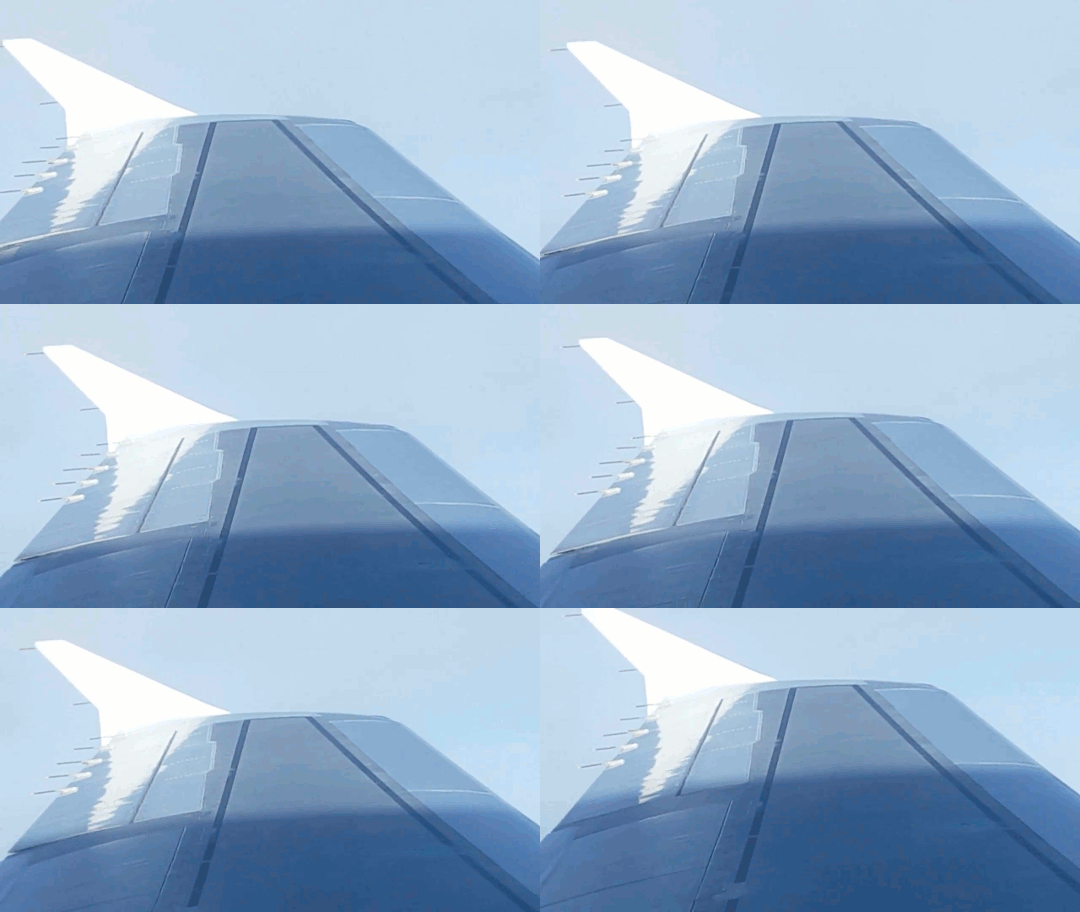
Commercial airliners fly in what is known as the transonic regime at Mach numbers between 0.8 and 1.0. While the airplane itself never exceeds the speed of sound, that doesn’t mean that there aren’t localized regions where air flows over the airplane at speeds above Mach 1. In fact, it’s actually possible sometimes to see shock waves on the top of airliner’s wings with nothing more than your eyes. The animations above show shock waves sitting about 50-60% of the way down the wing’s chord on a Boeing 737 (top) and Airbus A-320 (bottom). The shock wave looks like an unsteady visual aberration sitting a little ways forward of the wing’s control surfaces.
The wings themselves are shaped so that these little shock waves are relatively stationary and remain upstream of the flaps pilots use for control. Otherwise, the sharp pressure change across a shock wave sitting over a control surface could make moving that surface difficult. This was one of the challenges pilots first trying to break the sound barrier faced. (Image credits: R. Corman, source; agermannamedhans, source)

Vertical Axis Wind Turbines
Most people are familiar with the propeller-like shape of conventional wind turbines. These turbines can be more than 100m tall and can generate several megawatts apiece, but placing them in arrays requires a lot of open space because flow downstream of one turbine will interfere with the efficiency of the next. Vertical axis wind turbines (VAWT), like those shown in the photo above, are smaller and produce a fraction of the power of their larger horizontal-axis counterparts, but VAWTs can be placed much closer together. In fact, putting them in closely spaced arrays can actually increase their output through flow synergies. Researchers hope that eventually VAWT arrays will be able to produce significantly more power per land area than conventional wind turbines. (Image credit: Texas A&M Corpus Christi)
Windy Urban Corridors (*)


For pedestrians, windy conditions can be uncomfortable or even downright dangerous. And while you might expect the buildings of an urban environment to protect people from the wind, that’s not always the case. The image above shows a simulation of ground-level wind conditions in Venice on a breezy day. While many areas, shown in blue and green, have lower wind speeds, there are a few areas, shown in red, where wind speeds are well above the day’s average. This enhancement often occurs in areas where buildings constrict airflow and funnel it together. The buildings create a form of the Venturi effect, where narrowing passages cause local pressure to drop, driving an increase in wind speed. Architects and urban designers are increasingly turning to numerical simulations and CFD to study these effects in urban environments and to search for ways to mitigate problems and keep pedestrians safe. (Image credits: CFD analysis – SimScale; pedestrians – Saltysalt, skolnv)
(*) This post was sponsored by SimScale, the cloud-based simulation platform. SimScale offers a free Community plan for anyone interested in trying CFD, FEA and thermal simulations in their browser. Sign up for a free account here.
For information on FYFD’s sponsored post policy, click here.
Sponsored Post Policy
In order to help support FYFD and continue its mission of bringing you a daily dose of fluidsy science, I will be posting occasional sponsored blog posts, beginning tomorrow. There are a couple of important things I want you to know:
– I still have full editorial control of sponsored posts. In fact, one of my goals is that every sponsored post should read like and carry the same value to my readers that any regular post does. Given that it will read like any other FYFD post, it’s also important that
– Every sponsored post will be clearly marked. The end of the post will include a statement of sponsorship, some brief info about the sponsor, and a link to them.If you have questions/comments about this policy or if you are interested in discussing a future sponsored post, you’re always welcome to get in touch with me here on the Tumblr, through Twitter, or by email.
Bursting Droplets
Mixing multiple fluids can often lead to surprising and mesmerizing effects, whether it’s droplets that dance or tears along the walls of a wine glass. A recent paper highlights another such mixture-driven instability – the bursting of a water-alcohol droplet deposited on an oil bath. The Lutetium Project tackles the physics behind this colorful burst in the short video above. The behavior is driven by the quick evaporation rate of alcohol in the droplet and the way this changing chemical concentration affects surface tension in the droplet. Alcohol evaporates more quickly from the edges of the drop, creating a region of higher surface tension around the edge. This pulls fluid to the rim of the drop, where it breaks up into droplets that get pulled outward as the inner drop shrinks.
The oil bath plays an important role in the instability, too. Without it, friction between the drop and a wall is too high for the droplet to “burst”. A thick layer of oil acts as a lubricant, allowing the escaping satellite drops to speed away. (Video and image credit: The Lutetium Project; research credit: L. Keiser et al.; submitted by G. Durey)
Breaking the Wave Speed Limit
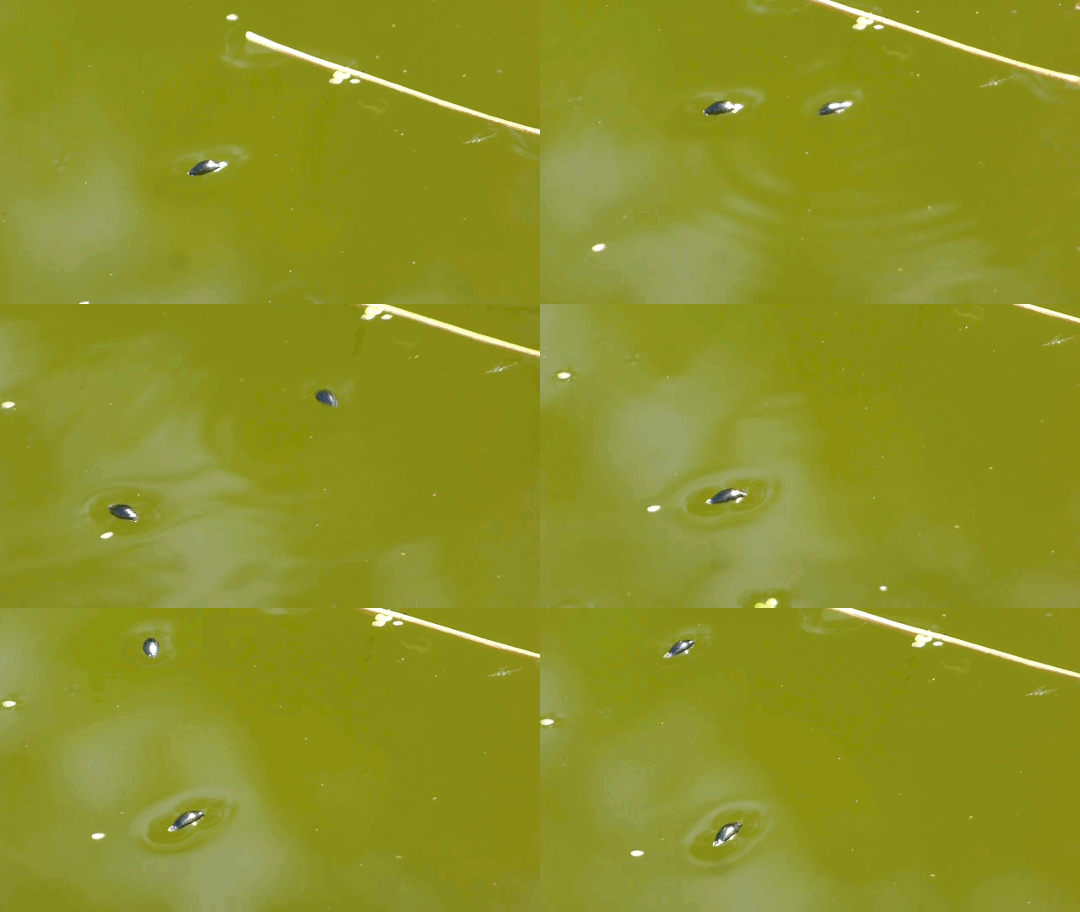
Whirligig beetles are small surface swimming insects. As they race across the water surface, they create both visible and unnoticeable waves on the water. These waves are the result of both surface tension and gravity. Typically, it’s the wavelength of the gravity waves that limit a swimmer or boat’s speed. When the wavelength of the gravity waves a swimmer creates meets the size of the swimmer, the waves generated ahead of the swimmer start to reinforce the waves forming at the back of the swimmer. This traps the swimmer (or boat) in a trough between its bow and stern waves and limits the max speed of the swimmer since overcoming this critical hull speed requires excessive amounts of power.
The tiny whirligig beetle overcomes this natural speed limit cleverly. It is smaller than the shortest possible gravity wave in water. Thus, it can never be trapped between its bow and stern waves! This allows the tiny swimmer to zip across the water’s surface at speeds above 0.5 m/s. That’s over 30 beetle body lengths per second! (Image credit: H. L. Drake, source; research credit: V. Tucker; submitted by Marc A.)