Tag: wrinkling

  • Why Creases Don’t Disappear

    Why Creases Don’t Disappear

    Flex your fingers and you’ll see your skin fold into well-defined creases. Many soft solids (including old apples) fold this way, and like your skin, the creases never fully disappear, even when the stress is removed. A recent study finds that surface tension and contact-line-pinning are critical to the irreversibility of these creases.

    The authors studied sticky polymer gel layers under a confocal microscope as the gel folded. In doing so, they found that surface tension dictates the microscopic geometry of a fold, causing the two sides of a surface to touch. They also found that completely unfolding a creased surface requires more energy than folding it in the first place did because the folded surfaces adhere to one another.

    When unfolded, the crease behaves somewhat like a droplet on a rough surface. Such droplets move in fits; their contact line stays pinned to the rough microscopic peaks of the surface until there’s enough energy to overcome that attachment and the contact line jumps to another position. Similarly, a creased surface cannot simply unfold smoothly. Adhesion ensures that part of the crease remains, serving as a starting point for the next fold-unfold cycle. (Image credit: C. Rainer; research credit: M. van Limbeek et al.; via APS Physics; submitted by Kam-Yung Soh)
  • Wrinkles on Collapsing Bubbles

    Wrinkles on Collapsing Bubbles

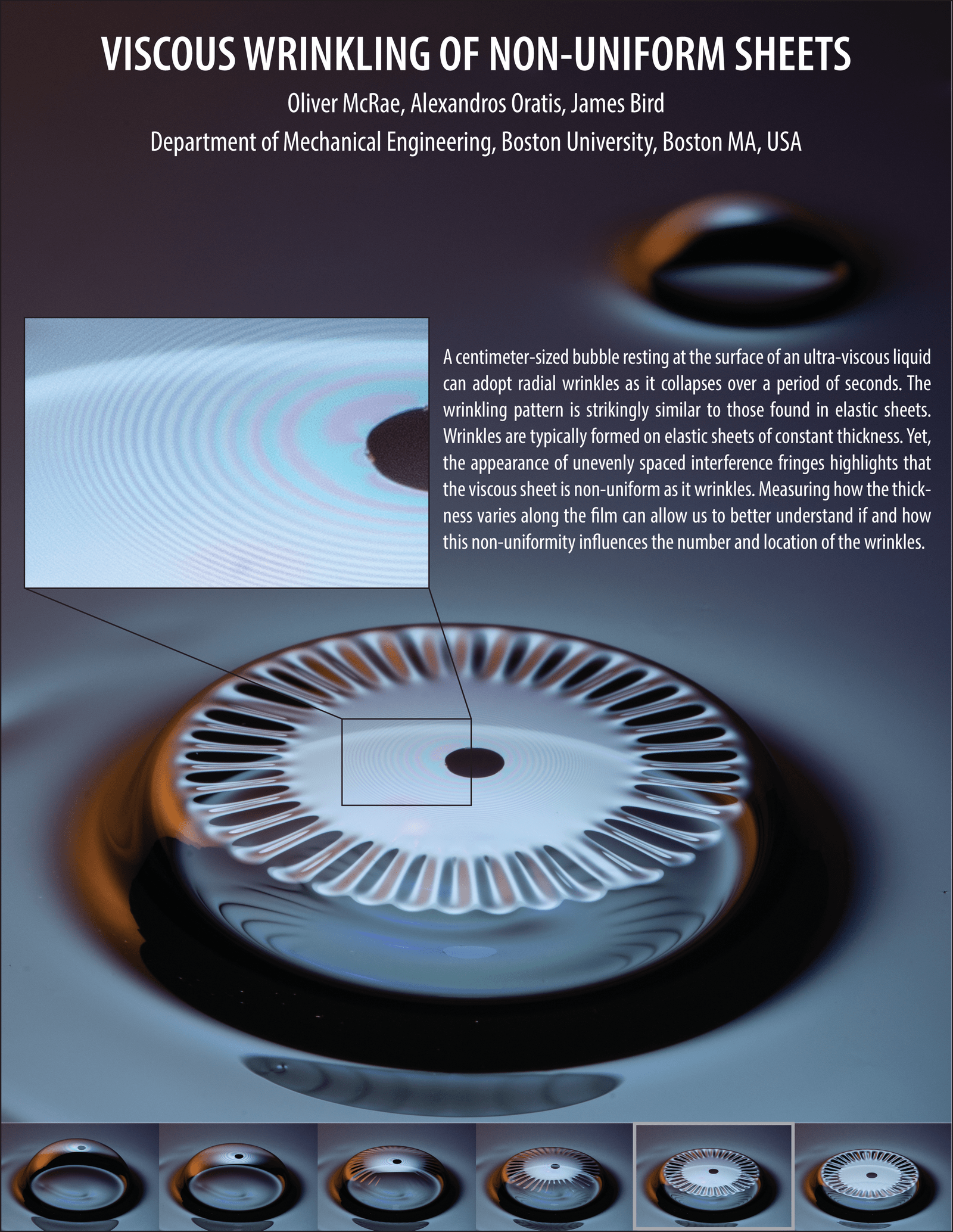
    As a bubble sitting on a pool collapses, wrinkles form around its edges. Visually, the result is quite similar to the wrinkles one gets on an elastic sheet. Unlike the solid sheet, though, the bubble’s film varies in thickness; we know this because of the fringes shown in the enlarged inset of the poster. Researchers are studying this non-uniformity to see whether it affects the number and shape of wrinkles that form on the bubble. (Image and research credit: O. McRae et al.)

  • Wrinkles on Bubble Collapse

    Wrinkles on Bubble Collapse

    A viscous bubble wrinkles when it collapses, and scientists long assumed this behavior was caused by gravity. But a new experiment shows that the buckling is, instead, driven by surface tension.

    To test gravity’s influence on bubble collapse, the researchers popped bubbles in three orientations: the (normal) upright orientation (Images 1 and 2), upside-down (Image 3), and sideways (Image 4). In all cases, the bubble’s thin film wrinkled as it collapsed, indicating that gravity had little influence on the process. Instead the authors concluded that surface-tension-driven collapse causes the dynamic buckling of the film. (Image and research credit: A. Oratis et al.; submitted by Zander B.)

  • Wriggling Threads

    Wriggling Threads

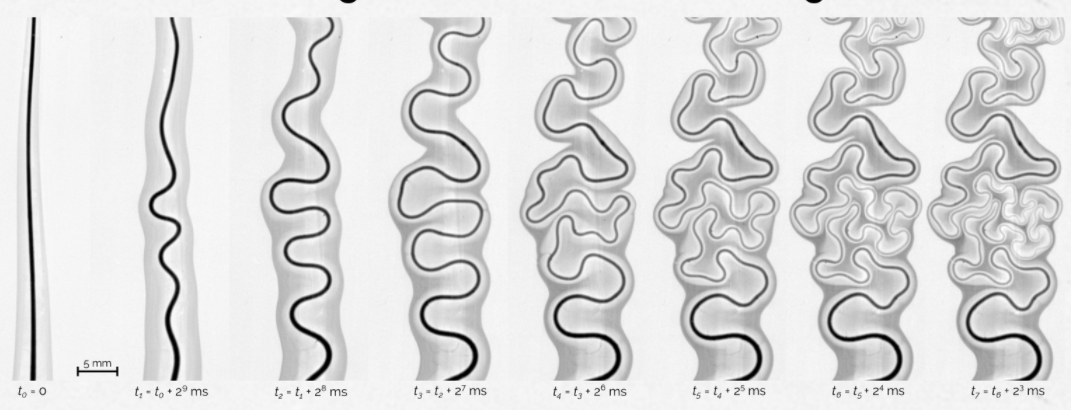
    A thread of mineral oil laid across a pool of water twists and turns like a river run wild. Because the oil has a lower surface tension than the water, Marangoni forces spread it outward (far left). Small variations in the thread make the areas of highest oil concentration start to bend just a bit. Inside the bends, the gradient of surface tension – the difference between the lowest and highest surface tensions – is very high, which pulls at these regions more than others. So bends beget more bends, causing the entire thread to wrinkle. Although the behavior is driven by a completely different process than the one that causes rivers to meander, the end result looks remarkably similar; this is because, in both cases, forces act to make each bend increasingly sinuous. (Image credit: B. Néel et al., source)

    Editor’s note: Starting tomorrow I’ll be on a trip that takes me out of range of the Internet until next week. Regular posts are queued up and should post as usual, but we’ll all have to trust Tumblr to handle everything because I won’t be able to check. Thanks!

  • Wrinkling Drops

    Wrinkling Drops

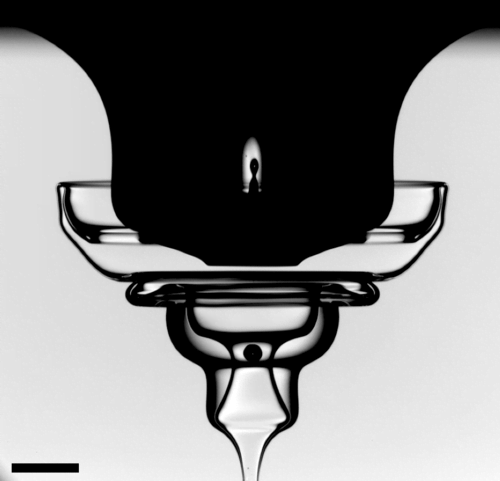
    When a viscous drop falls into a pool of a less viscous liquid, the drop can deform into some beautiful and complex shapes. Typically, shear forces between the drop and its surroundings cause a vortex ring to roll up and advect downward, thereby stretching the remainder of the drop into thin sheets that can buckle and wrinkle. Here the drop is about 150 times more viscous than the pool and impacts at 1.45 m/s, making a rather energetic entry. The vortex ring (not visible) has stretched the drop’s remains downward while a buoyant bubble caught by the impact pulls some of the drop back toward the surface. As a result, the thin sheets of the drop’s fluid are buckling and folding back on themselves like an elaborate and delicate glass sculpture. This entire paper is full of gorgeous images and videos. Be sure to check them out! (Image and research credit: E. Q. Li et al.; see supplemental info zip for videos)

  • Wrinkling Winds

    Wrinkling Winds

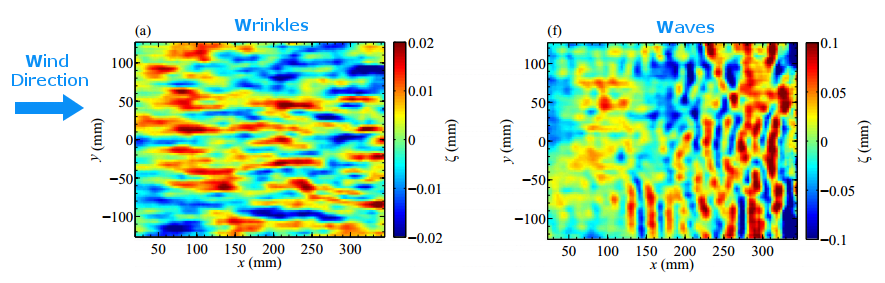
    If you’ve ever sat out on a lake and just watched the water’s surface, you’ve probably noticed how complex and variable it looks. There may be waves that rock your kayak but there are smaller variations, too, like little ripples or even tiny wrinkles that appear on the surface. Much of this activity comes from wind blowing across the water. When the wind exceeds a critical speed, waves form. They generally travel in lines that are aligned perpendicular to the wind (lower right). But what happens when the wind is below the critical speed?

    A recent study looked at just this question. By blowing air across the surface of different liquids and observing variations in the surface height as small as 2 micrometers, the researchers were able to measure tiny wrinkles on the water’s surface (lower left) when the wind speed was small. The size and shape of the wrinkles actually corresponds to structures in the turbulent air flow over the water! For fluids like water, there’s a smooth transition from wrinkles to waves as the wind speed increases, so both may be visible at the same time. For higher viscosity fluids, the switch from one to the other is more abrupt. (Image credits: water – M. Soveran; figure – A. Paquier et al. w/ annotations added in blue; research credit: A. Paquier et al.)

  • Self-Wrapping Drops

    Self-Wrapping Drops

    A liquid drop can fold itself up in a thin sheet. The animation above shows a drop of water with an ultra-thin (79nm) circular sheet of polystyrene atop it. As a needle removes water from the underside of the droplet, the shrinking droplet causes wrinkles and folds to form in the sheet. What’s going on here is a competition between the energy required to change the droplet’s shape and the energy needed to bend the sheet. Eventually, the droplet’s volume is small enough that the bending of the sheet overrules surface tension in dictating the droplet’s shape. The result is a tiny empanada-shaped droplet completely encapsulated by the sheet. (Image credit: J. Paulsen et al., source; research paper)

  • Falling Atop Sheets

    Falling Atop Sheets

    A sphere falling into water is a classic problem in fluid dynamics, but scientists are becoming increasingly interested in what happens when they introduce new dimensions to the problem. Here researchers float an extremely thin elastic sheet atop water and study how it wrinkles when a steel sphere impacts it. Despite its elasticity, the sheet does not stretch when the ball hits. Instead it compresses and forms wrinkles. Some of those wrinkles deepen into folds, but the wrinkle pattern that forms right at impact determines the way the film will bunch up. If the ball is heavy enough, it will drag the sheet entirely underwater; if not, the sheet will catch the ball and continue floating. Scientists are interested in these interactions between liquids and thin solids because sheets could be used to encapsulate liquids for applications like targeted drug delivery. (Image credit: M. Inizan et al., source)

  • Crown Splash Sealing

    Crown Splash Sealing

    A sphere falling into water generates a spectacular crown
    splash at the surface. The object’s impact ejects a thin sheet of fluid
    that rises vertically. The air pulled down into the cavity by the
    sphere’s passage makes the air pressure inside the sheet lower than the
    ambient air pressure on the exterior of the sheet. This pressure
    difference is part of what draws the crown inward to seal the cavity. As
    the splash collapses inward and seals, the liquid sheet starts to
    buckle and wrinkle, leaving periodic stripes around the closing neck.
    This so-called buckling instability occurs when the radius of the neck
    collapses faster than the vertical speed of the splash. For more, see
    the research paper or this award-winning video. (Image credit: J. Marston et al., source)