Watching soap bubbles up close is endlessly fascinating. The iridescent colors reflect the soap film’s thickness, or, in the case of black spots, its lack thereof. The dancing of the colors shows the soap film’s flow and the ever-shifting balance of surface tension necessary to keep the film intact. Even the junctures of the bubbles–so precise and mathematically perfect in structure–reflect the molecular interactions that govern them. (Video credit: Stereokroma; via R. Weston)
Year: 2017

Dissolving
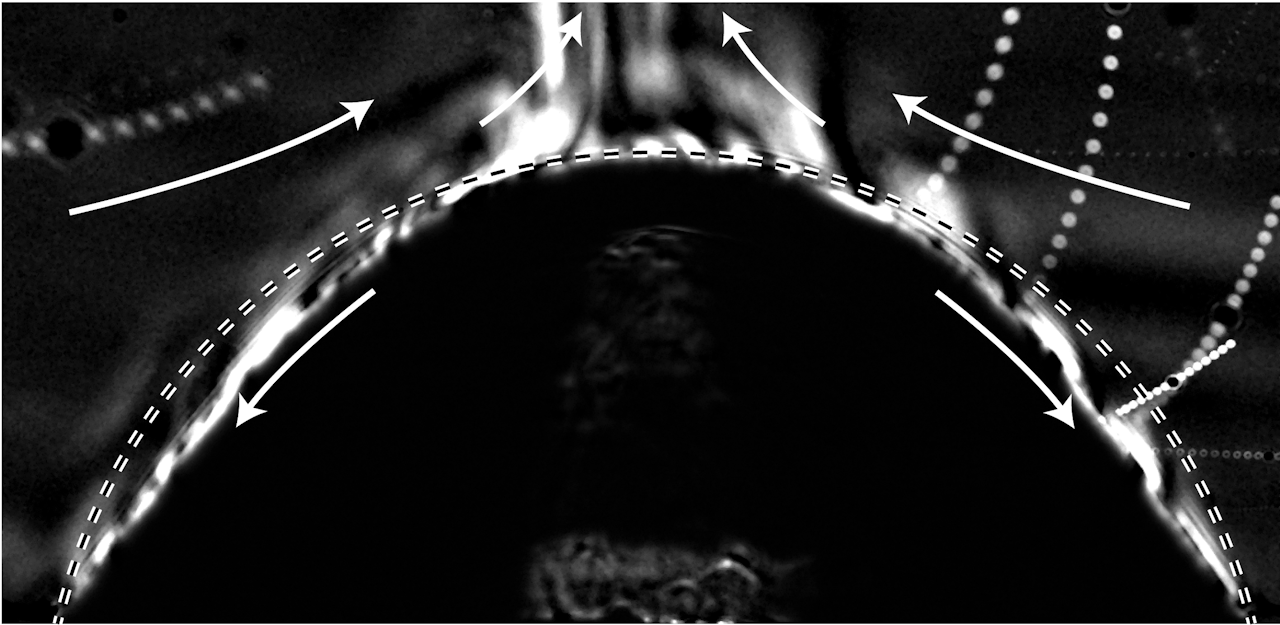
It looks like the fiery edge of a star’s corona, but this photo actually shows a dissolving droplet. The droplet, shown as the lower dark region in this shadowgraph image, is a mixture of pentanol and decanol sitting in a bath of water. Pentanol is a type of alcohol that is fully miscible with decanol and is water soluble, so that it will dissolve into the surrounding water over time. Decanol, on the other hand, is immiscible with water, so that part of the droplet won’t mix with the surrounding water.
The bright swirls along the droplet’s edge show areas with more pentanol. As the alcohol dissolves into the water, it forms a buoyant plume at the top of the droplet that rises due to pentanol’s lower density. That rising plume draws fresh water in from the sides, shown by the upper white arrows. Inside the droplet, flow moves in the opposite direction, from the top toward the outer edges. This is a result of uneven surface tension within the droplet. Scientists are interested in understanding the dynamics of these multiple component drops for applications like printing, where it’s desirable for pigments in an ink drop to be distributed evenly as the drop dries. (Image credit: E. Dietrich et al.)

Turbine Wakes in the Sea
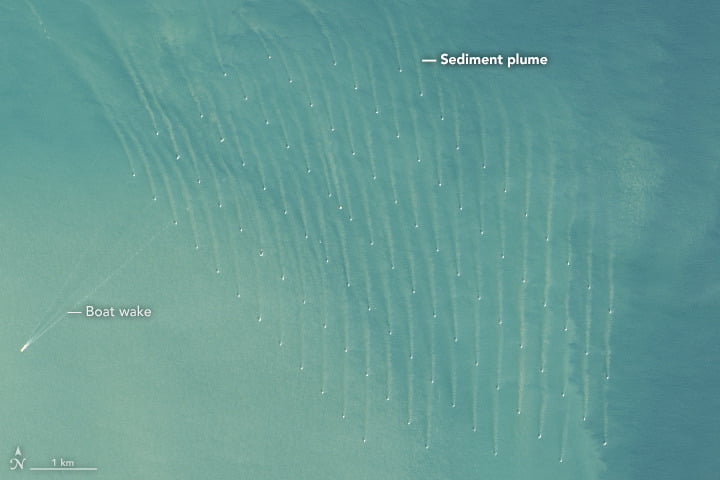
What we we build always has an impact on the environment around us. The white dots you see in the image above are an array of offshore wind turbines, standing in waters 20 to 25 meters deep. The brownish lines extending from each turbine show the underwater wakes of the turbines, colored by the sediment they’ve picked up. As with trees in a snowstorm, the currents flowing past the base of the turbine likely form a horseshoe vortex that lifts up the sediment into the wake. Because the tides in this area reverse direction every six hours, these sediment plumes can appear quite dynamic in satellite imagery, frequently changing strength and direction. (Image credit: NASA Earth Observatory)

A Water Balloon on a Bed of Nails
If you dropped a water balloon on a bed of nails, you’d expect it to burst spectacularly. And you’d be right – some of the time. Under the right conditions, though, you’d see what a high-speed camera caught in the animation above: a pancake-shaped bounce with nary a leak. Physically, this is a scaled-up version of what happens to a water droplet when it hits a superhydrophobic surface.
Water repellent superhydrophobic surfaces are covered in microscale roughness, much like a bed of tiny nails. When the balloon (or droplet) hits, it deforms into the gaps between posts. In the case of the water balloon, its rubbery exterior pulls back against that deformation. (For the droplet, the same effect is provided by surface tension.) That tension pulls the deformed parts of the balloon back up, causing the whole balloon to rebound off the nails in a pancake-like shape. For more, check out this video on the student balloon project or the original water droplet research. (Image credits: T. Hecksher et al., Y. Liu et al.; via The New York Times; submitted by Justin B.)


Pascal’s Barrel
Pascal’s Law tells us that pressure in a fluid depends on the height and density of the fluid. This is something that you’ve experienced firsthand if you’ve ever tried to dive in deep water. The deeper into the water you swim, the greater the pressure you feel, especially in your ears. Go deep enough and the pressure difference between your inner ear and the water becomes outright painful.
In the video demonstration above, you’ll see how a tall, thin tube containing only 1 liter of water is able to shatter a 50-liter container of water. Not only does this show just how powerful height is in creating pressure in a fluid, but it shows how a fluid can be used to transmit pressure over a distance – one of the fundamental principles of hydraulics! (Video credit: K. Visnjic et al.; submitted by Frederik B.)

Geological Flowers


These strange flower-like formations appear in a former limestone quarry in France. The black that you see is bitumen, or asphalt. These dendritic structures appear in spots where the rock has fractured. Originally, two rock faces met here, with a thin layer of bitumen glued between them. As one face pulled away, air began to seep into the space between, slowly injecting itself into the more viscous bitumen. Just as we observe in the laboratory, the air and bitumen formed viscous fingers, creating a classic pattern known as the Saffman-Taylor instability. It’s so cool to see an example of this in nature! You can see more photos of the formations here. (Image credit: P. Thomas)

Weather Posters


Weather Underground has created a whole series of posters celebrating and briefly explaining various weather phenomena. Many of their subjects are beautiful and unusual types of clouds like the lenticular clouds that form over mountains and hole-punch clouds created when supercooled water vapor gets disturbed. They have a few non-cloud phenomena we’ve discussed previously, too, such as dust devils and bizarre, wind-formed snow rollers. I highly encourage you to check out the full collection, which they’ve made available as phone and computer wallpapers as well as posters. Personally, these combine two of my favorite things: fluid dynamics and retro-style nature posters! (Image credit: Weather Underground)
Washington Ice Disk


Winter weather in northern latitudes sometimes brings with it unusual phenomena like this ice disk spinning in the Middle Fork Snoqualmie River in Washington state. Photographer Kaylyn Messer ventured out to capture photos and videos of the event over the weekend. There are a couple theories as to how such disks form, but swirling river eddies are a key ingredient. One theory posits that chunks of ice forming on the river get caught up by the spinning eddy and slowly freeze together to form the disk. Another theory proposes that the disks occur when an existing chunk of ice breaks away, gets caught in the spinning eddy and slowly has its edges ground down into a circle. Personally, I lean toward the former explanation, though there is likely grinding at the edges either way. See more about this ice circle over at Messer’s blog. (Image credit: K. Messer; GIF by @itscolossal; via Colossal)
“Pulse”
Photographer Mike Olbinski returns with another incredible storm-chasing timelapse video, this time all in black-and-white. To me, that choice helps “Pulse” emphasize the ominous majesty of these supercells and tornadoes by highlighting the textures that make up the clouds. Watching clouds in timelapse, they seem to materialize from nowhere as moisture drawn up from the land cools and condenses. Sped up, suddenly the convective rotation and the roiling turbulence inside clouds is perfectly clear. I especially love the sequence beginning at 2:25, where a distant black line slowly transforms into an incredible landscape marked with successive waves of rolling, turbulent clouds. Watch this one on a large screen at a high resolution, if you can. You won’t regret it! (Video credit: M. Olbinski)

Shot Through a Drop
Shoot a sphere through a drop with sufficient speed, and you’ll see something like the composite photo above. Going from right to left, the projectile is initially coated in liquid and stretches the fluid behind it as it continues flying. This forms a thin sheet of fluid called a lamella with a thicker, uneven rim at its far end. The lamella continues stretching until the projectile breaks through and detaches. Now the lamella starts rebounding back on itself as surface tension struggles to keep the fluid together. A new rim forms on the front, and both the front and back rims thicken as the lamella collapses. Along the rims thicker portions start forming droplets – like spikes on a crown – as the surface-tension-driven Plateau-Rayleigh instability starts breaking the structure down. The untenable sheet of fluid will break up into a cloud of smaller, satellite droplets when it can hold together no longer. (Image credit: V. Sechenyh et al., video)