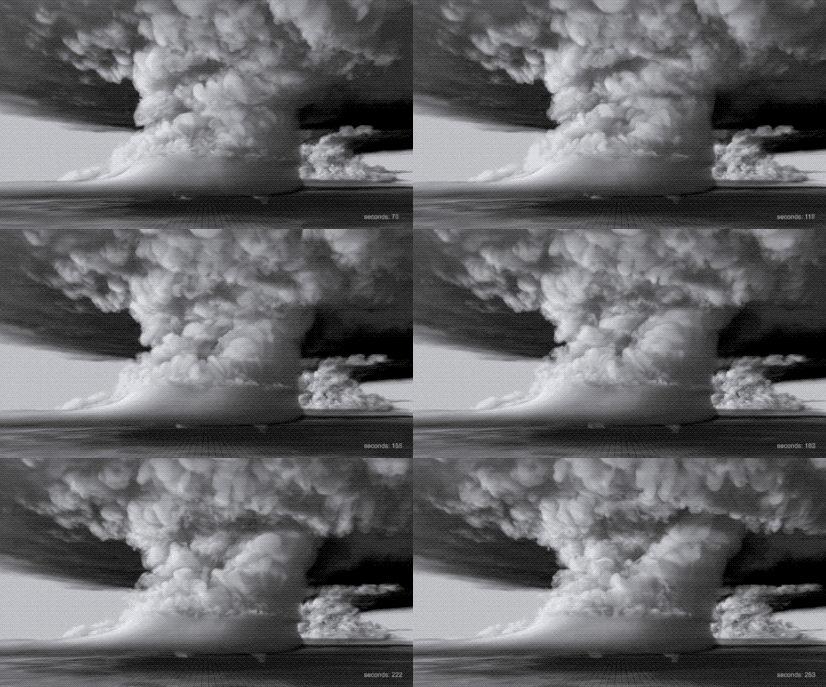
With today’s supercomputing power, it’s possible to simulate entire thunderstorms to study how and why some of them can spawn deadly tornadoes. The animation above comes from a computer simulation of a supercell thunderstorm. The simulation uses initial conditions from a 2011 storm that produced an EF-5 tornado – the highest category of tornado, based on its wind speeds. To see more of the simulation, check out the video below. One thing that might surprise you is just how enormous the towering supercell clouds are compared to the tornado produced in the simulation. Often what we can see of a storm from the ground is only the tiniest part of what goes into producing it. (Image credit: L. Orf et al., source; GIF via @popsci; video credit: UWSSEC)
Year: 2017

Fanning the Flame
A fan’s blade passes through the hot air rising above a flame in this iconic image by high-speed photography pioneer Harold Edgerton. This photo uses an optical technique known as schlieren photography that makes density differences in transparent media like air visible. Because of its lower density, the hot plume of air above the flame rises. When the fan blade swings past, it sheds a vortex off its tip and the rising air from the flame gets pulled into the vortex to make it visible. To the left, a ghostly counter-rotating vortex sits on the opposite side of the fan blade. (Photo credit: H. Edgerton and K. Vandiver)

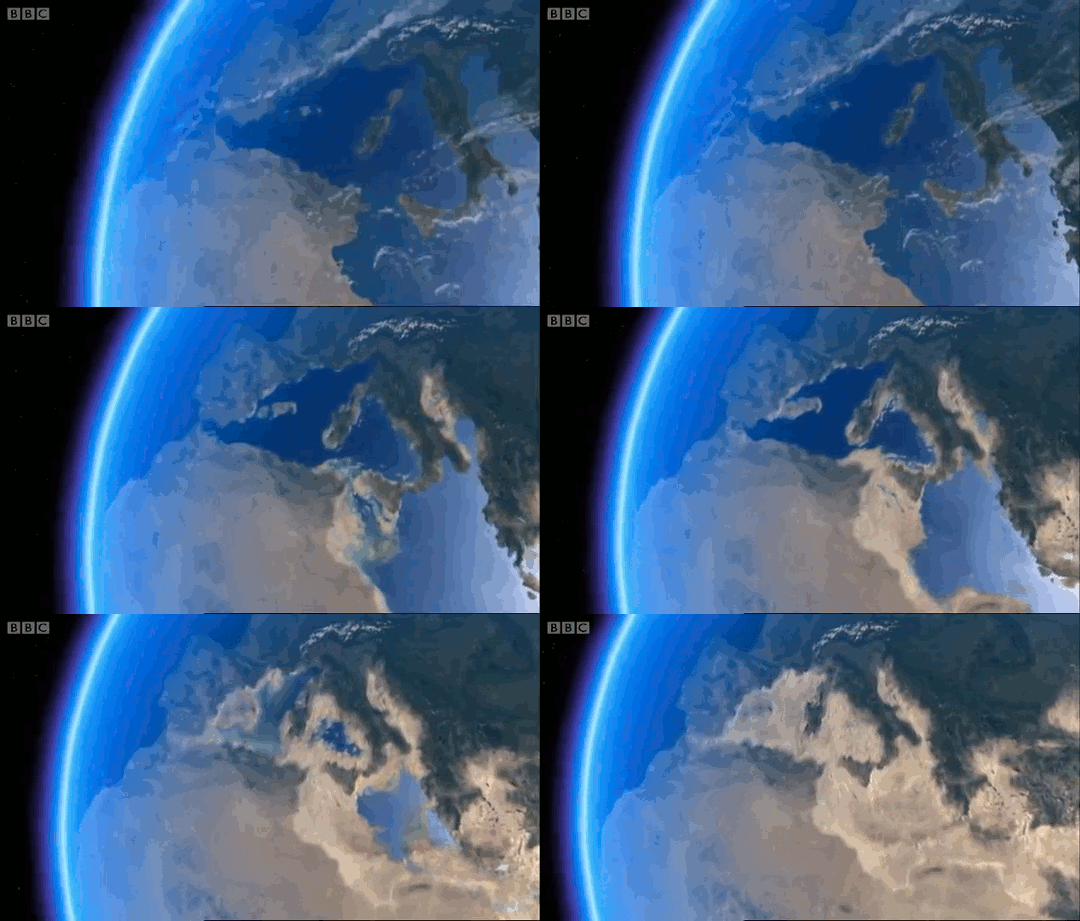
When the Mediterranean Flooded
Around 6 million years ago, the African and Eurasian plates moved together, cutting the Mediterranean Sea off from the Atlantic. Without an influx of water from the Atlantic, evaporation began removing more water from the Mediterranean than rivers could replace. The sea dried out almost completely over the course of a couple thousand years.
About 5.3 million years ago, the Straits of Gibraltar reopened, creating a massive flood into the Mediterranean known as the Zanclean Flood. Water rushed down the straits and into the Mediterranean at speeds as high as 40 m/s (90 mph). At its peak, the Zanclean Flood is estimated to have reached rates 1000 times greater than the volumetric flow rate of the Amazon River.
A similar breach flood occurred in the Black Sea within the past 10,000 years when the Bosporus became unblocked. That flood likely had a devastating impact on Neolithic societies in the area and may be the inspiration for the floods described in the Epic of Gilgamesh and the Bible. (Image credit: BBC, source)

Staying Cool in the Outback
Daytime temperatures in the Australian outback can soar, creating a harsh environment for life. Red kangaroos use several methods to regulate their body temperature during the hottest part of the day. They shelter under trees to escape the sun, they dig away the solar-heated topsoil and flop down in cooler soil, and they lick their forearms. Like our wrists, kangaroo forearms have a network of blood vessels near the surface. As their saliva evaporates, it cools the skin and the blood vessels beneath it. Humans are cooled the same way when our sweat evaporates, but a more kangaroo-like trick for cooling off is running cold water over your wrists. (Video credit: BBC/Planet Earth)

Breaking Wave
This animation shows a cinemagraph of a breaking wave photographed by Ray Collins. The motion was inferred and digitally added by a second artist, Jersey Maria. The result is hypnotic, as if we are traveling beside the wave and watching it tear apart ever so slowly. The wave seems to be poised on a tipping point, only breaking up along its back edge, when instinct tells us it will keep steepening and tipping forward until its top curl crashes down in a wave of white foam. Surf photography like Collins’ work shows us an alternative perspective on waves, their power frozen into a single instant. Reanimated, it feels like we’re seeing the wave in hyper-slow-motion, watching every tiny movement of water before everything crashes down. Even if it’s not physically realistic, it is an awesome view. (Image credit: R. Collins / J. Maria, source, original; via Iwan A.)

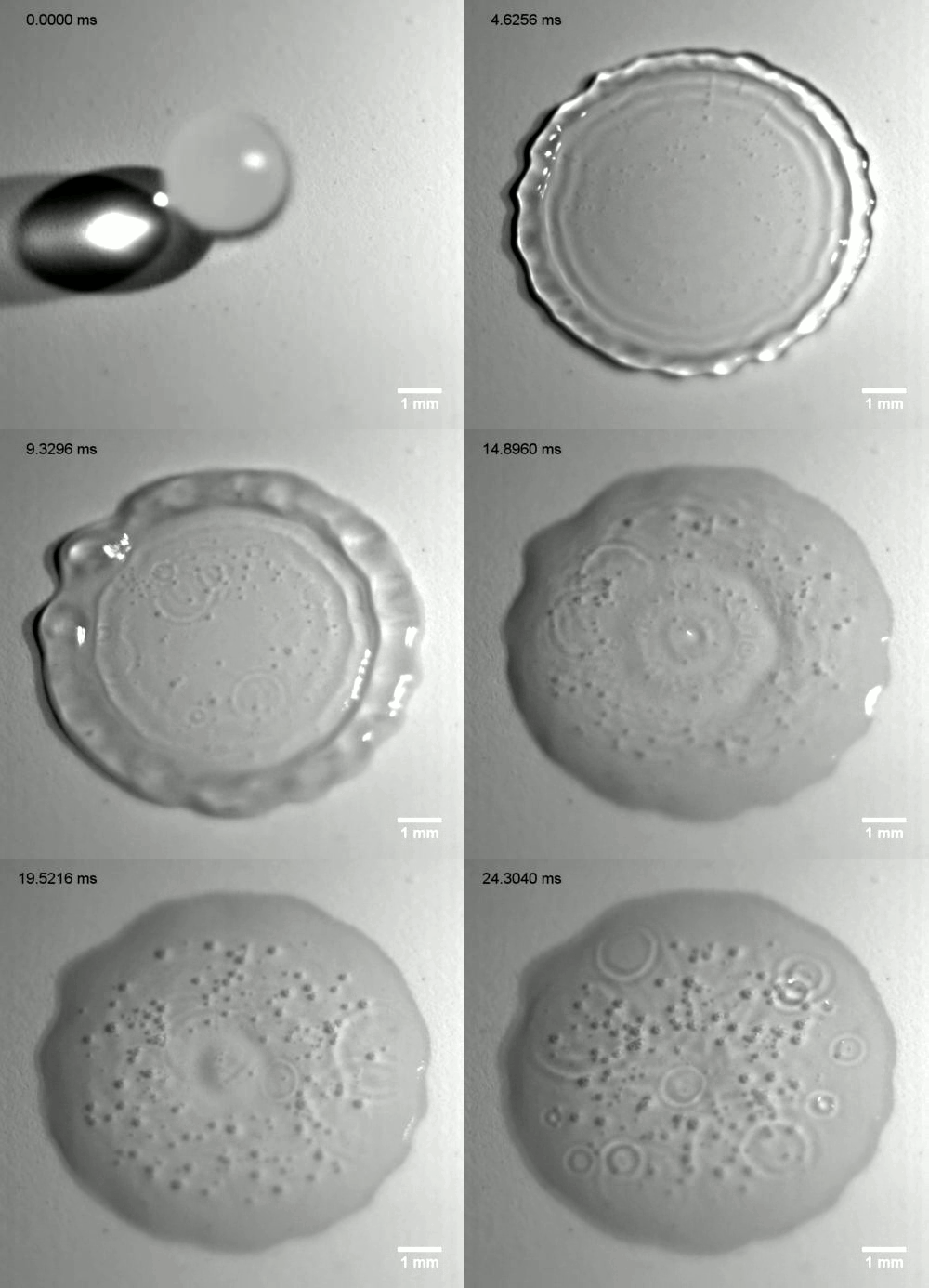
Spreading Bubbles Help Nature’s Scuba Divers
How liquid droplets spread on solid surfaces is pretty well understood, but researchers have looked less at the related problem of how a gas spreads. In a recent paper, scientists have examined the spreading dynamics of bubbles impacting an immersed solid. As the bubble contacts the surface, it quickly squeezes out water trapped between the bubble and the gas layer trapped at the solid surface. The bubble squishes as surface tension tries to flatten the liquid-gas interface. Buoyancy also helps flatten the bubble. The spreading is remarkably fast, taking only about 10 milliseconds. That’s good news for the many insects who use trapped air bubbles like these to breathe underwater. Check out the video below to learn about some of these natural scuba divers. (Image credit: H. de Maleprade et al., source; video credit: Deep Look)

Ice Bridges
During winter, Canada’s Arctic Archipelago, home of the Northwest Passage, generally fills with sea ice. These ice bridges form in the long and narrow straits between islands. A new paper models ice bridge formation and break-up, showing that ice bridges can only form when ice floating in the strait is sufficiently thick and compact. To form a bridge, wind must first push the ice together and then frictional forces between individual pieces of ice must be large enough to resist wind or water driving them apart. As temperatures drop, the individual ice chunks can then freeze together into solid sheets until summer returns.
The existence of a critical thickness and density of the ice field for ice bridge formation has important implications for climate change. As Arctic temperatures warm for longer periods, these waters may no longer generate ice of sufficient thickness and quantity for ice bridges to form. Since ice bridges serve as important oases for marine mammals and sea birds and help isolate Arctic sea ice from warmer waters, their loss will have a profound impact on both Arctic ecology and global climate. (Image credit: NASA Earth Observatory; research credit: B. Rallabandi et al.; via Physics Buzz)

Icy Spikes


Water is one of those strange materials that expands when it freezes, which raises an interesting question: what happens to a water drop that freezes from the outside in? A freezing water droplet quickly forms an ice shell (top image) that expands inward, squeezing the water inside. As the pressure rises, the droplet develops a spicule – a lance-like projection that helps relieve some of the pressure.
Eventually the spicule stops growing and pressure rises inside the freezing drop. Cracks split the shell, and, as they pull open, the cracks cause a sudden drop in pressure for the water inside (middle image). If the droplet is large enough, the pressure drop is enough for cavitation bubbles to form. You can see them in the middle image just as the cracks appear.
After an extended cycle of cracking and healing, the elastic energy released from a crack can finally overcome surface energy’s ability to hold the drop together and it will explode spectacularly (bottom image). This only happens for drops larger than a millimeter, though. Smaller drops – like those found in clouds – won’t explode thanks to the added effects of surface tension. (Image credit: S. Wildeman et al., source)
ETA: A previous version of this post erroneously said this was freezing from the “inside out” instead of “outside in”.

Acrylic and Oil


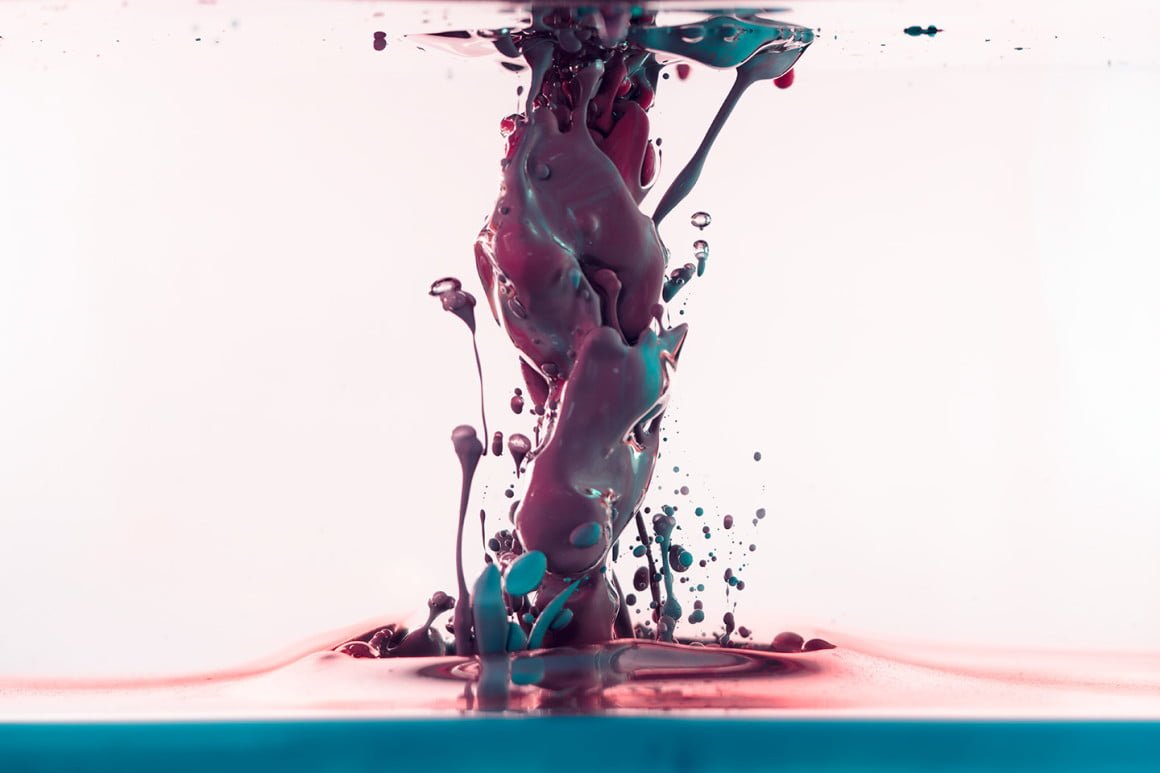
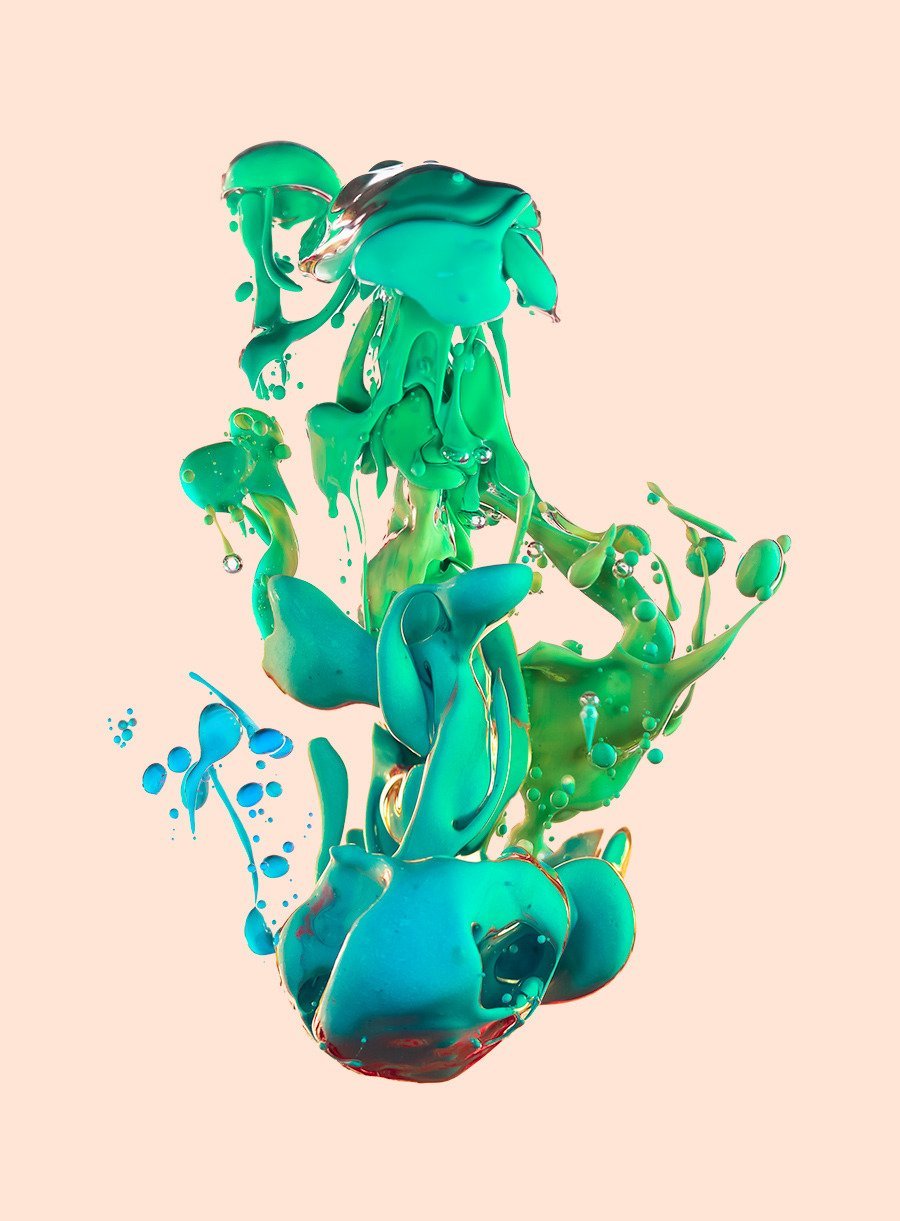
Photographer Alberto Seveso is well-known for ink in water art, some of which FYFD has featured previously (1, 2, 3). More recently, he’s been experimenting with alternative methods, dropping fluids like acrylic paint into sunflower oil. The effect is quite different but no less beautiful. Because the paint and oil are immiscible, the boundaries between the two fluids are much more clearly defined and highlighted in an iridescent sheen. Instead of appearing like billowing waves of silk, the paint forms abstract and alien shapes driven by gravity, inertia, and density differences. For many more great examples, check out Seveso’s website. (Photo credit: A. Seveso)

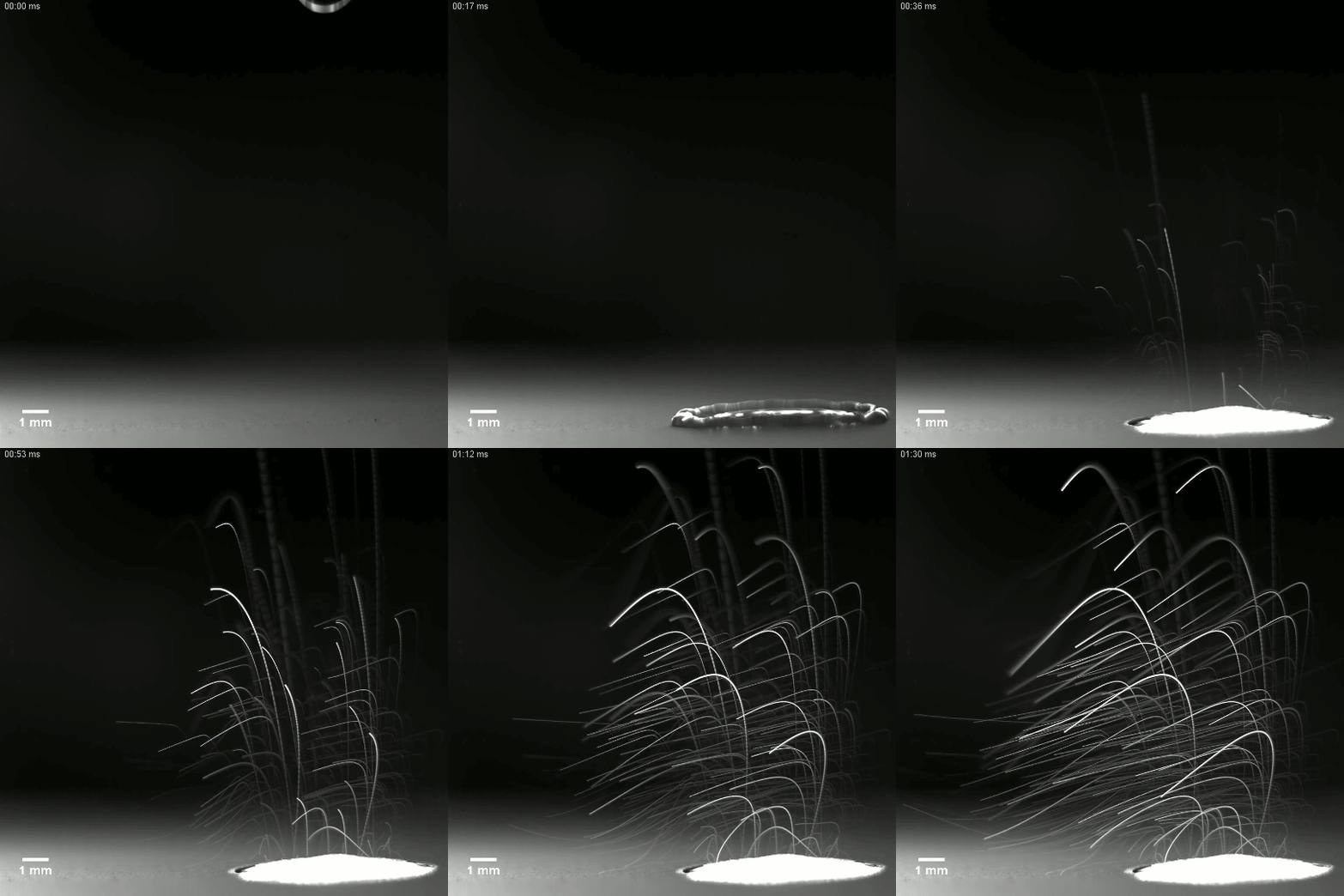
How Rainfall Can Spread Pathogens
Rainfall may provide a mechanism for soil bacteria to spread. A new study examines how raindrops hitting infected soil can eject bacteria into the air. When drops fall at the rate of a light rainfall, they form tiny bubbles after impact (upper left). Those microbubbles rise to the top of the water and burst, sending extremely tiny droplets – or aerosols – spraying up into the air (upper right). Soil bacteria can hitch a ride on these aerosols, staying alive for up to an hour while the wind transports them to fresh, new soil. The researchers found that the most aerosols were produced when soil temperature was about 86 degrees Fahrenheit (30 degrees Celsius) – the temperature of tropical soils. Depending on the conditions, a single raindrop could aerosolize anything from zero to several thousands of soil bacteria. (Image and research credit: Y. Joung et al.; video credit: MIT News)