Month: February 2016

  • Featured Video Play Icon

    Seeing Blast Waves

    With a large enough explosion, it’s actually possible to see shock waves. This high-speed camera footage shows the detonation of a car packed with explosives. After the initial flash, you can see the thin membrane of the blast wave expanding outward. This shock wave is a traveling discontinuity in the air’s properties–temperature, pressure, and density all change suddenly over an incredibly small distance. It’s this last variable–density–that enables us to see the effect. Density has a significant impact on air’s index of refraction (which also explains heat mirages). In this case, the shift in refractive index is large enough that we see the difference relative to the background, enabling our eyes to follow an otherwise invisible effect.  (Video credit: Mythbusters/Discovery Channel; via Gizmodo)

    If you enjoy FYFD, please help support me by becoming a patron!

  • Drying Blood Can Reveal Anemia

    Drying Blood Can Reveal Anemia

    Blood is a remarkably complicated fluid, thanks in part to its many constituents. What we see here is an animation of a drop of blood evaporating at several times normal speed. As water from the blood evaporates, it causes relative changes in surface tension. These surface tension gradients cause convection inside the drop and carry red blood cells toward the outer portion of the drop. As the blood evaporates further, it leaves behind different patterns that depend on which parts of the whole blood mixture were deposited in each region. Interestingly, the final desiccation patterns can indicate the healthiness of a patient. Below are images of dried blood patterns from (left) a healthy individual and (right) an anemic individual. (Image credits: D. Brutin et. al., source)

    image

    Special thanks to our Patreon patrons, who help keep FYFD bringing you daily doses of fluid dynamics.

  • Featured Video Play Icon

    Sheep as a Fluid

    Not all fluids are, well, fluid. Traffic, flocks of birds, ants, and even sheep can behave like fluids. This video shows an aerial perspective on sheep being herded, and despite the four-legged nature of these particles, they have a lot of fluid-like characteristics. You can watch ripples and waves travel through the herd and see how disturbances propagate. The herd is actually a brilliant example of compressible flow; notice how the sheep slow down and bunch up as they near the gate then speed up and spread out once they pass the constriction. This is exactly how supersonic fluids behave! (Video credit: T. Whittaker; submitted by Simon H and John B)

    If you’re in the DC area, I’ll be speaking at the Annals of Improbable Research Show at the AAAS meeting Saturday evening. Our session is open to the public, but it’s likely to be crowded, so you may want to arrive early!

  • Featured Video Play Icon

    Freezing Soap Bubbles

    I’m not a winter person, but there’s something almost magical about the way water freezes. From instant snow to snow rollers and weird ice formations to slushy waves, winter brings all kinds of bizarre and unexpected sights. The video above is an artistic look at one of my favorites – freezing soap bubbles. Normally, the thin film of a soap bubble is in wild motion, convecting due to gravity, surface tension differences, and the surrounding air. Such a thin layer of liquid loses its heat quickly, though, and, as ice crystals form, the bubble’s convection and rotation slow dramatically, often breaking the thin membrane. Happily photographer Paweł Załuska had the patience to capture the beautiful ones that didn’t break!  (Video credit: P. Załuska; via Gizmodo)

    If you enjoy FYFD and want to help support it, please consider becoming a patron!

  • The Leidenfrost Dunk

    The Leidenfrost Dunk

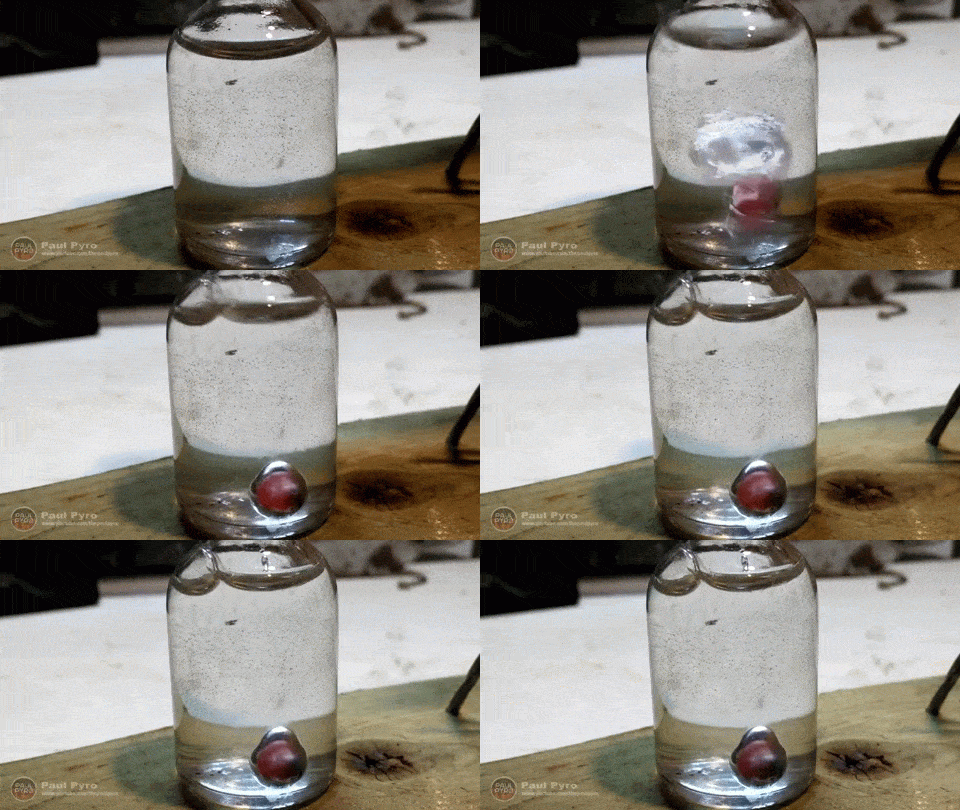
    The Leidenfrost effect occurs when a liquid is exposed to a surface so hot that it instantly vaporizes part of the liquid. It’s typically seen with a drop of water on a very hot pan; the drop will slide around, nearly frictionless, upon a cushion of its own vapor. You can see the effect when plunging a hot object into a bath of liquid, too. This is what happens when you quickly dunk a hand in liquid nitrogen (not recommended, incidentally) or when you drop a red hot steel ball into water like above. In this case, the object is so hot that it gets encased in a layer of water vapor. If you could maintain the temperature difference necessary to keep the vapor layer intact, you could move underwater at high speeds with low drag, similar to the effects of supercavitation. (Image credit: Paul Pyro, source)

    If you enjoy FYFD, please consider supporting the site by becoming a patron!

  • Featured Video Play Icon

    Tears of Wine

    Give your wine glass a swirl and afterward you may notice little rivulets of wine along the side of your glass. These so-called “tears of wine” or “wine legs” are caused by a combination of evaporation, surface tension, and gravity. After the glass has been swirled, alcohol from the thin layer of wine on the glass wall quickly evaporates, leaving behind a fluid that is more watery than the wine in the glass. Since water has a higher surface tension than alcohol or wine, it pulls more fluid up the wall via the Marangoni effect. This carries on until enough wine is pulled up to form a droplet that’s heavy enough to slide down the glass. This up-and-down exchange of fluid is nicely illustrated in the video above, where the tiny particles in the wine help show how flow gets drawn up even as your eye follows the drops sliding down. (Video credit: A. Athanassiadis and K. Khalil; submitted by Thanasi A.)

    Special thanks to our Patreon patrons, who help keep FYFD up and running.

  • Phytoplankton Flows

    Phytoplankton Flows

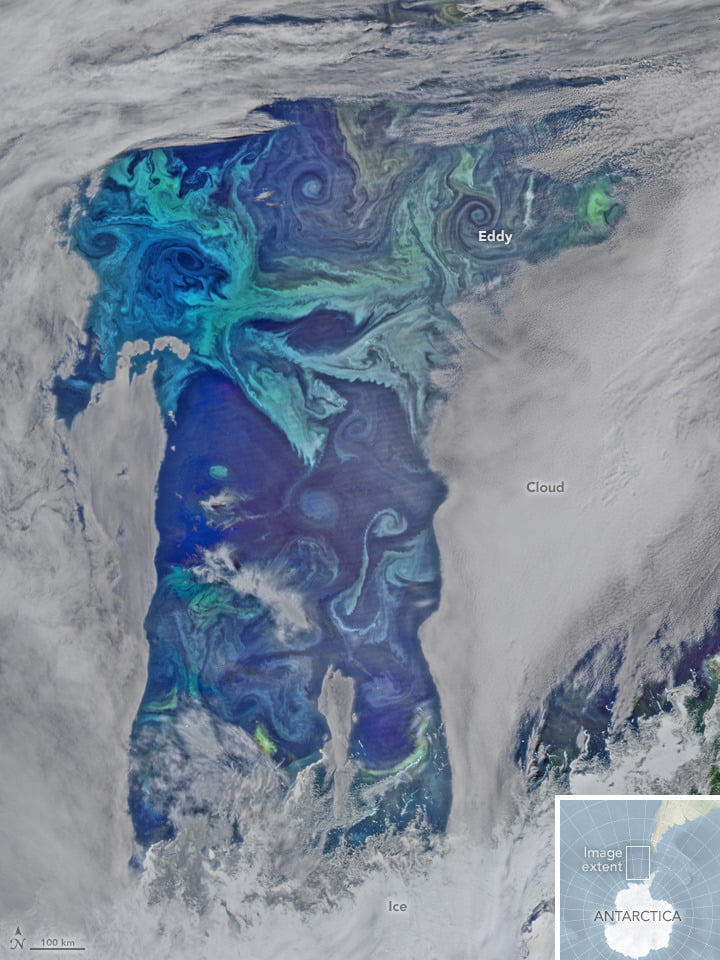
    Phytoplankton, tiny plant-like organisms that live in ocean waters, act like nature’s tracer particles, making visible flows that would otherwise go unnoticed. In this satellite imagery, a phytoplankton bloom in the Southern Ocean off the coast of Antarctica highlights the turbulence of this region. Strong, steady winds and currents are typical for this area, which helps drive heat exchange between the ocean and atmosphere. The swirling eddies we see – many of them 100 km across! – are evidence of that turbulence. They’re also a sign of nitrogen and other nutrients getting mixed up in the action; it’s these nutrients that help generate the bloom in the first place.  (Image credit: N. Kuring/NASA Earth Observatory)

  • Skipping Squishy Spheres

    Skipping Squishy Spheres

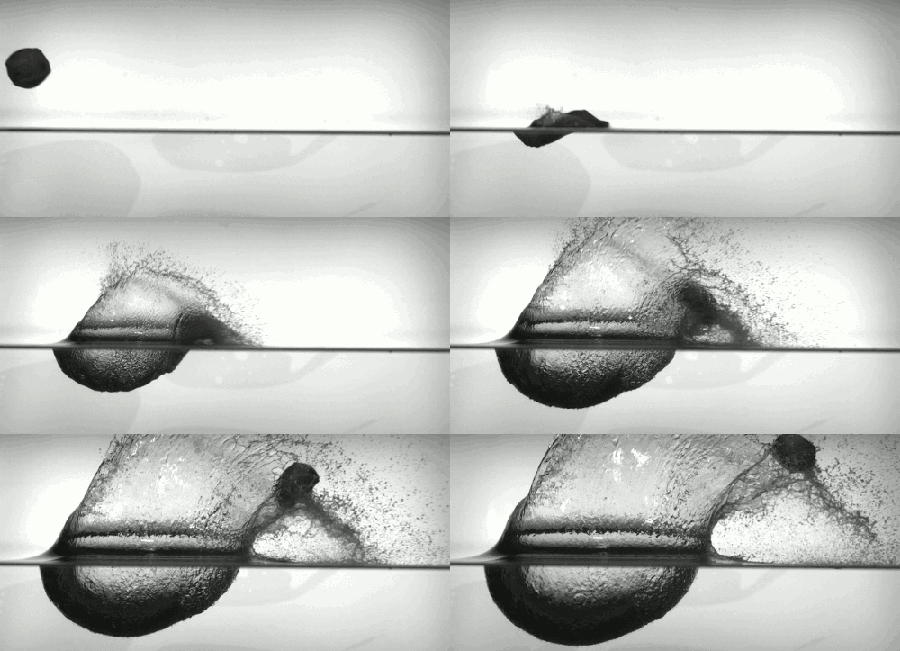
    Skipping a stone on water requires a flat, disk-like stone thrown at a shallow angle, but elastic spheres are remarkable skippers, too, even at higher impact angles. Researchers at the Splash Lab have just published their work on why these balls skip so well. As seen in the top animation, the elastic spheres deform on impact, flattening to a more disk-like shape that rides at an angle of attack relative to the air-water interface. Both features are important to the spheres’ enhanced skipping. By flattening, the sphere comes into greater contact with the water and by orienting at a larger angle of attack, the sphere increases the vertical component of force the water generates on the sphere. It’s this vertical force that lifts the sphere up and lets it keep bouncing.

    Because the ball is soft, it keeps deforming after its impact and bounce (see top animation). For some skips, the timescale of the sphere’s elastic waves is smaller than the length of time the sphere is in contact with the water. When this is the case, the sphere’s elastic waves will affect the impact cavity in the water, forming what the researchers call a

    matryoshka cavity, after the Russian nesting dolls. An example is shown in the second animation. For more, check out the USU press releasethe original paper, or the award-winning video they made a few years ago.  (Image credits: J. Belden et al./The Splash Lab)

    If you enjoy FYFD and want to help support it, please consider becoming a patron!

  • Featured Video Play Icon

    Fluids Round-up

    Here’s to another fluids round-up, our look at some of the interesting fluids-related stories around the web:

    – Above is a music video by Roman Hill that relies on mixing and merging different fluids and perturbing ferrofluids for its visuals as it re-imagines the genesis of life.

    – GoPro takes viewers inside a Category 5 typhoon with 112 mph (180 kph; 50 m/s) winds.

    – Astronaut Scott Kelly demonstrates playing ping pong with a ball of water in space. (via Gizmodo)

    – See fluid dynamics on a global scale with Glittering Blue. (via The Atlantic)

    – To make a taller siphon, you have to find a way to avoid cavitation.

    – Speaking of siphons, Randall Munroe tackles the question of siphoning water from Europa over at What If? (submitted by jshoer)

    – The Mythbusters make a giant tanker implode using air pressure.

    – Sixty Symbols explores how tiny things swim.

    – What happens when you bathe in 500 pounds of putty? Let’s just say that bathing in an extremely viscous non-Newtonian fluid is not recommended. (via Gizmodo)

    (Video credit and submission: R. Hill et al.)

    Don’t forget to check out our Patreon page. Please help support FYFD by becoming a patron. 

  • Featured Video Play Icon

    Ode to Bubbles

    Boiling water plays a major role in the steam cycles we use to generate power. One of the challenges in these systems is that it’s hard to control the rate of bubble formation when boiling. In this video, researchers demonstrate their new method for bubble control in a clever and amusing fashion. The twin keys to their success are surfactants and electricity. Surfactant molecules, like soap, have both a polar (hydrophilic) end and a non-polar (hydrophobic) end. By applying an electric field at the metal surface, the researchers can attract or repel surfactant molecules from the wall, making it either hydrophobic or hydrophilic depending on the field’s polarity. Since hydrophobic surfaces have a high rate of bubble formation, this lets the scientists essentially turn nucleation on and off with the flip of a switch! (Video credit: MIT Device Research Lab; see also: research paperMIT News Video, press release)

    Do you enjoy FYFD and want to help support it? Then please consider becoming a patron!