In this video, Derek Muller explains how an experiment known as Lord Kelvin’s thunderstorm generates electricity from falling water. The set-up relies on a positive feedback loop that creates a separation of charge between the two streams of water. Check out the video for a great demonstration and explanation. If you prefer your science with a more dystopian flavor, there’s a second version of the video made in collaboration with the Hunger Games movies. (Video credit: Veritasium; submitted by entropy-perturbation)
Year: 2014

Inside the Strait of Gibraltar
When a fluid is stratified into layers, it’s possible to have waves generated and transmitted along the interface between layers. Because these waves remain inside the bulk fluid, they are called internal waves. They often occur in the atmosphere or the ocean as fluids with different properties move past changing terrain. The Strait of Gibraltar is an excellent source of internal waves. The tidal exchange of waters between the Mediterranean Sea and Atlantic Ocean takes place through a narrow corridor interrupted by the peak of Camarinal Sill. The internal waves generated by the constriction are large enough that their effect on the surface flow is visible to satellites. The video above visualizations data from a numerical simulation of flow through the Strait, showing the obstacles, flow, and wave structures generated. (Video credit: J.C. Sanchez Garrido et al.)
Levitating Droplets with Motion
There are many ways to levitate a droplet – heating, vibration, and acoustic levitation all come to mind – but this video demonstrates a simpler method: a moving wall. Depositing a drop on a moving wall keeps it aloft with a thin, constantly replenished layer of air. The thickness of this lubricating air film is directly measurable from interference fringes created by light reflecting off the surface of the drop. Incredibly, the air layer is only a few microns thick, but the resulting pressure in the air film is high enough to levitate millimeter-sized droplets! (Video credit: M. Saito et al.; via @AlvaroGuM)

The Marangoni Effect
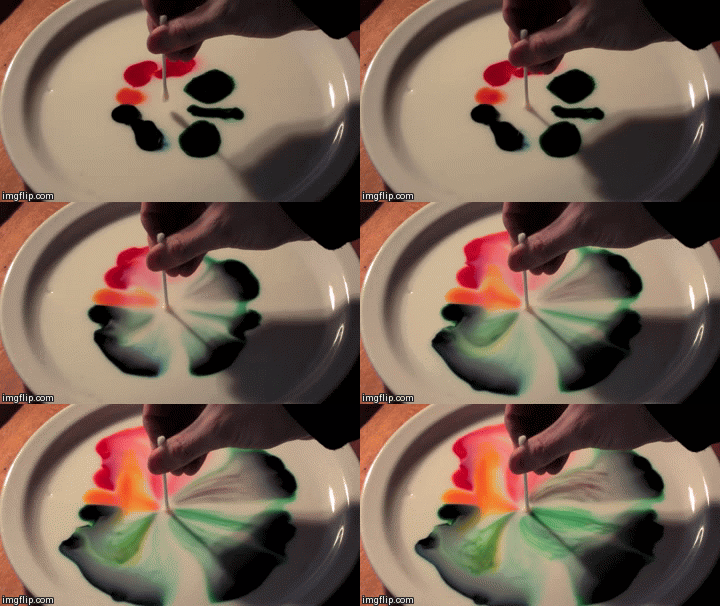
Differences in surface tension can create Marangoni flow along an interface. Imagine a shallow bowl filled with a liquid. In the middle of the fluid, every molecule is surrounded on all sides by like molecules, which push and pull it equally in all directions. But at the surface, the fluid molecules are only acted on by similar molecules in some directions. This imbalance in molecular forces is what creates surface tension. When the surface tension is constant, the fluid surface is like a taut rubber sheet. Poke a hole in that sheet, and everything pulls away from the hole. Likewise, when the surface tension varies, fluid will move from areas of low surface tension toward areas of higher surface tension. This effect is easily demonstrated at home in a setup like the animation above. Pour milk (higher fat content is better) and food coloring in a shallow container. Then lower the local surface tension using dish soap or rubbing alcohol and watch the colors run away! (Image credit: Flow Visualization at UC Boulder, source video)

Plume Stratification
Clean-up of accidents like the 2010 Deepwater Horizon oil spill can be complicated by what goes on beneath the ocean surface. Variations in temperature and salinity in seawater create stratification, stacked layers of water with differing densities. When less dense layers are on top, the fluid is said to be stably stratified. Since oil is less dense than water, one might assume that buoyancy should make an oil plume should rise straight to the ocean surface. But the presence of additives or surfactants in the oil mixture plume can prevent that. With surfactants present, an oil mixture tends to emulsify, breaking into tiny droplets like a well-mixed salad dressing. Even if the density of the emulsion is smaller than the surrounding fluids, such a plume can get trapped at a density boundary, as seen in the photo above. Researchers report a critical escape height, which depending on the plume’s characteristics and stratification boundary, determines whether a plume escapes or becomes trapped. (Image credit: R. Camassa et al.)
Bounce or Freeze?
Icing is a major problem for aircraft. When ice builds up on the leading edge of a wing it creates major disruptions in flow around the wing and can lead to a loss of flight control. One of the important factors in predicting and controlling ice building up is knowing when and where water droplets will freeze. The video above shows how surface conditions on the wing affect how an impacting droplet freezes. On a subzero hydrophilic surface, a falling droplet spreads and freezes over a wide area, which would hasten ice buildup. A hydrophobic surface is slightly better, with the droplet freezing over a smaller area, whereas a superhydrophobic surface shows no ice buildup. Unfortunately, at present superhydrophobic surfaces and surface treatments are extremely delicate, making them unsuitable for use on aircraft leading edges. (Video credit: G. Finlay)
“Cymatic Sun”
“Cymatic Sun” from artist Lachlan Turczan uses vibrating fluids to generate mesmerizing and surreal visuals. At some points distinct Faraday waves are visible on the surface. At other times, there is simply a blur of motion and refracted light. Check out my “fluids as art” tag for many more great examples of fluid dynamics and art merging. (Video credit and submission: L. Turczan)
Shooting Droplets with Lasers
Last week we saw what happens when a solid projectile hits a water droplet; today’s video shows the impact of a laser pulse on a droplet. Several things happen here, but at very different speeds. When the laser impacts, it vaporizes part of the droplet within nanoseconds. A shock wave spreads from the point of impact and a cloud of mist sprays out. This also generates pressure on the impact face of the droplet, but it takes milliseconds–millions of nanoseconds–for the droplet to start moving and deforming. The subsequent explosion of the drop depends both on the laser energy and focus, which determine the size of the impulse imparted to the droplet. The motivation for the work is extreme ultraviolet lithography–a technique used for manufacturing next-generation semiconductor integrated circuits–which uses lasers to vaporize microscopic droplets during the manufacturing process. (Video credit: A. Klein et al.)

Meandering Rivulet
This rivulet is the result of a horizontal liquid jet impacting a vertical pane of glass. Gravity, surface tension, adhesion, and even surface finish can affect the path the water follows. Like the meandering path of rain on a windshield, it’s hard to predict a priori where the flow will go without accounting for a myriad of seemingly inconsequential variables governing both the liquid and solid surface. (Photo credit: T. Wang)

Hydrofoil Cavitation
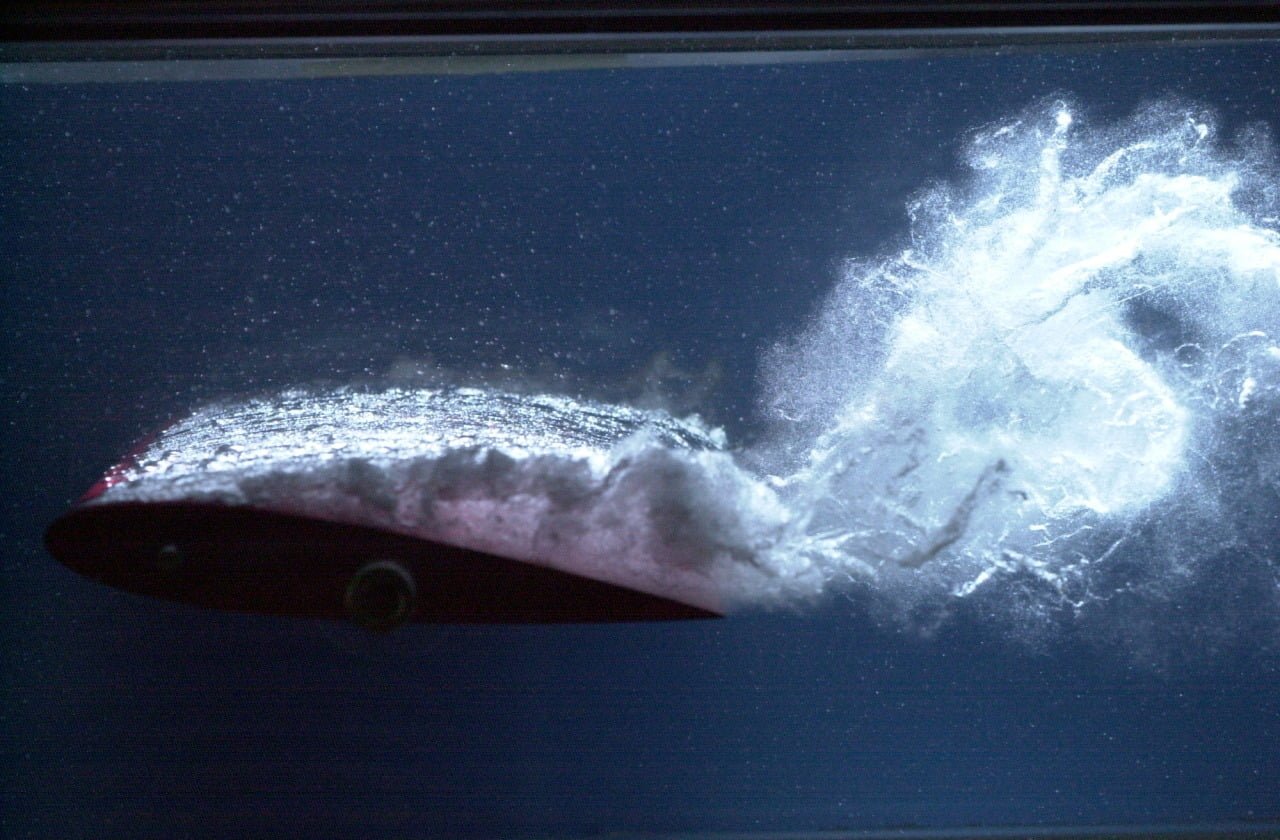
A cavitation-induced bubbly sheet flows over the upper surface of a hydrofoil in the image above. Cavitation can occur when local pressure in a liquid drops below the vapor pressure, causing a cavity to form. Due to its angle of attack, water flowing over the upper surface of the hydrofoil is accelerated. The high flow velocities and accompanying low pressures over the top of the hydrofoil produce cavitation bubbles which continue to flow over and off the surface. Because cavitation bubbles implode when the pressure again increases, they can cause serious damage to solid surfaces. This is why generating cavitation can damage propellers or shatter a bottle. (Photo credit: R. Arndt et al.)