Year: 2014

  • Sochi 2014: Speedskating Suits

    Sochi 2014: Speedskating Suits

    Long track speed skating is a race against the clock. Skaters reach speeds of roughly 50 kph, so drag has a significant impact. This is why skaters stay bent and spend straightaways–their fastest segments on the ice–with their arms pulled behind them. It’s also why their speedsuits have hoods to cover their hair. This year the U.S. speed skaters are wearing special suits designed by Under Armour and Lockheed Martin especially for their aerodynamics. The suits feature a mixture of fabrics including raised surface features on the hood and forearms. These bumps are designed to trip turbulent flow in these regions. It seems counterintuitive, but drag is actually lower for a turbulent boundary layer than a laminar one at the right Reynolds number range. This is because turbulent boundary layers are better at staying attached to non-streamlined bodies. The longer flow stays attached to the skater, the smaller the pressure difference between the air in front of the skater and the air in his wake. The suit’s seams and even its hot-rod-like flames were placed with this effect in mind. Only time will tell whether the suits really give skaters a competitive edge, but since Sochi’s low-altitude increases drag on skaters, they will appreciate some extra speed. For more, NSF has an inside look at the suit’s development. (Photo credits: Under Armour)

    FYFD is exploring the fluid dynamics of the Winter Olympics. Check out previous posts on how lugers slide fast and why ice is slippery, and be sure to stay tuned for more!
  • Sochi 2014: Luge

    Sochi 2014: Luge

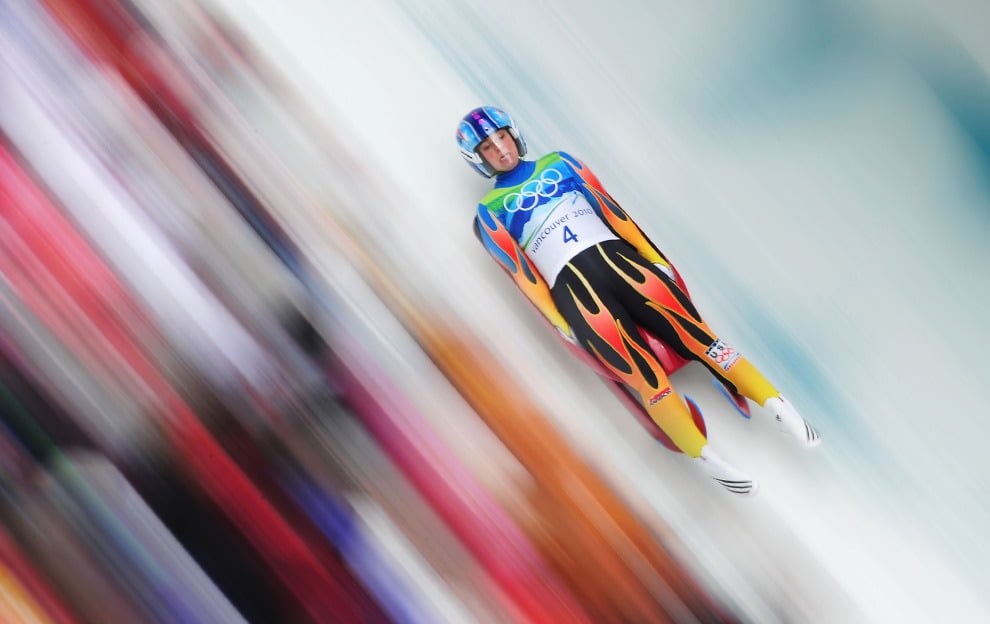
    Like athletes in many of the gravity sports in the Winter Olympics, lugers want to be as aerodynamic as possible to minimize their drag. Once a luger has started sliding, only gravity can increase their speed – every other force, from friction to drag, pulls away valuable time. Luge sleds are built on sharp runners and athletes slide feet-first in a position much more streamlined than the head-first position of skeleton. Both contribute to the much higher speeds in luge – up to 140 kph (87 mph). Luge is also the only sliding sport measured down to thousandths of a second, so every gram of drag* makes a difference. Lugers keep their heads pulled back and wear full helmets to keep the air flow consistent and attached as much as possible. It is also typical for them to spend time in the wind tunnel, testing their sled’s aerodynamics, adjusting their position, and even testing their suits. (Photo credit: S. Botterill)

    * For those wondering, yes, drag is a force and a gram is a unit of mass, not force. However, it is not unusual when testing athletes in wind tunnels to compare drag between configurations in terms of grams.

    FYFD is celebrating the Games with a series on fluid dynamics in the Winter Olympics. Stay tuned for more!

  • Sochi 2014: Why is Ice Slippery?

    Sochi 2014: Why is Ice Slippery?

    Ice is a key component of many Winter Olympic disciplines, including figure skating, hockey, speed skating, curling, and the sliding sports. The low friction and slippery nature of the ice are vital to the events, but oddly enough, scientists don’t yet fully understand why ice is slippery. A common explanation is that the narrow blades on which athletes compete cause extremely high pressures that locally melts the ice, creating a thin layer of water upon which the athlete glides. The trouble with this explanation is that it only accounts for ice being slippery within a few degrees of its melting point. Not only that, anyone who has fallen when walking on ice knows that it is slippery even without ice skates. In 1859 physicist Michael Faraday suggested that ice may be covered in a thin liquid-like layer even at temperatures well below freezing. Experiments since then suggest that this layer is tens or hundreds of nanometers thick, depending on the purity of the surface film. Robert Rosenberg has an excellent review of the subject in Physics Today. (Image credit: Reuters/D. Gray via The Big Picture)

    This post opens up our series on fluid dynamics in the Winter Olympics. Stay tuned for more over the next two weeks. Got a question in mind? Seen a great article? Feel free to ask questions or submit links on Tumblr, Twitter, or by email.

  • Sochi 2014 Incoming

    Sochi 2014 Incoming

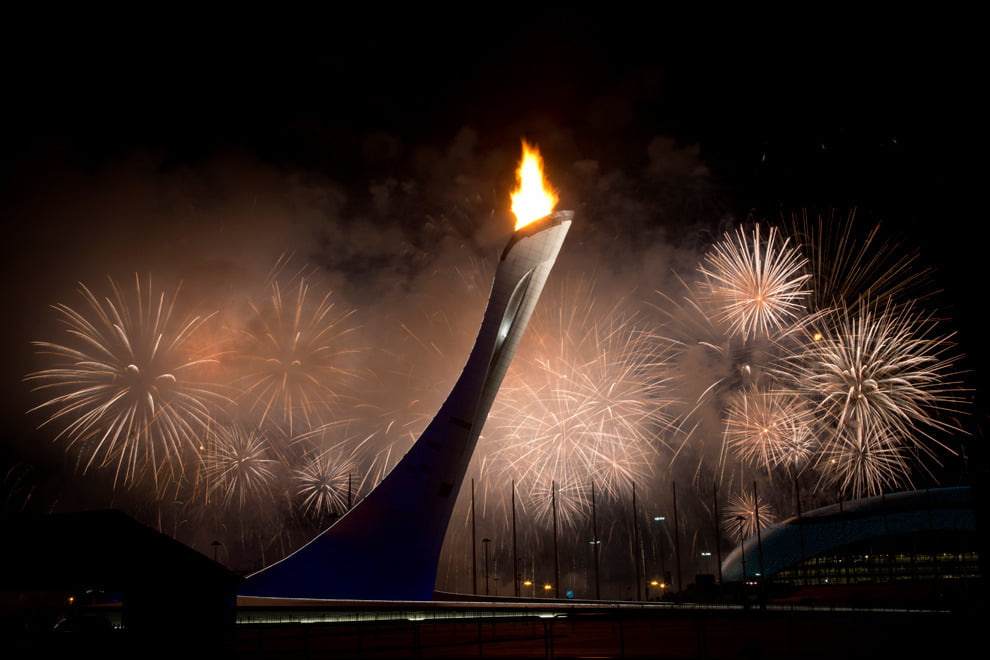
    The Winter Olympics are underway in Sochi, Russia, and here at FYFD, I am busy preparing a special series of posts on fluid dynamics in the Winter Games. Look for the first of those starting on Monday.  In the meantime, you can check out some of FYFD’s previous themed series now compiled into a special archive. (Photo credit: B. Armangue)

  • Convective Impressionism

    Convective Impressionism

    Buoyant convection, driven by temperature-dependent changes in density, is a major force here on Earth. It’s responsible for mixing in the oceans, governs the shape of flames, and drives weather patterns. The images above show flow patterns caused by buoyant convection. The colors come from liquid crystal beads immersed in the fluid; red indicates cooler fluid and blue indicates warmer fluid. You can see plumes of warmer fluid rising in some of the photos. At the same time, though, the images are beautiful simply as art and are strongly reminiscent of works by Vincent van Gogh. (Image credit: J. Zhang et al.)

  • Featured Video Play Icon

    The Reynolds Experiment

    One of the most famous and enduring of all fluid dynamics experiments is Osborne Reynolds’ pipe flow experiment, first published in 1883 and recreated in the video above. At the time, it was understood that flows could be laminar or turbulent, though Reynolds’ terminology of direct or sinuous is somewhat more poetic:

    Again, the internal motion of water assumes one or other of two broadly distinguishable forms-either the elements of the fluid follow one another along lines of motion which lead in the most direct manner to their destination, or they eddy about in sinuous paths the most indirect possible. #

    There had, however, been no direct evidence of these eddies in a pipe. Reynolds built an apparatus that allowed him to control the velocity of flow through a clear pipe and simultaneously introduce a line of dye into the flow. He carefully varied the velocity and temperature (and thus viscosity) in his apparatus and not only documented both laminar and turbulent flow but found that the transition from one to another could be described by a dimensionless number he derived from the Navier-Stokes equation. This number was dependent on the fluid’s velocity and kinematic viscosity as well as the diameter of the pipe. This was the birth of the Reynolds number, one of the most important parameters in all of fluid dynamics. (Video credit: S. dos Santos; research credit: O. Reynolds)

  • Wind and Waves Visualized

    Wind and Waves Visualized

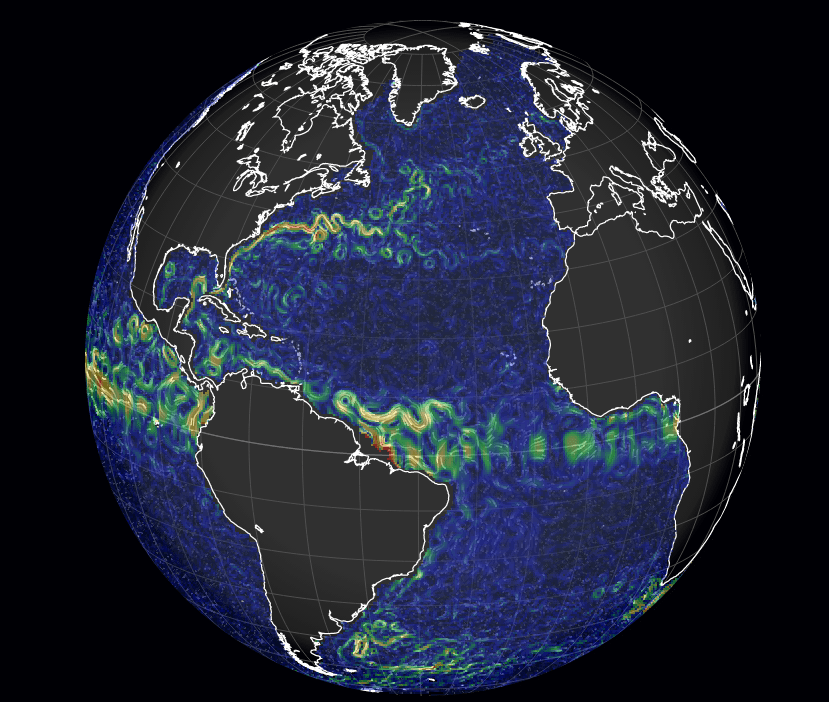
    Much like the wind map we featured previously, designer Cameron Beccario’s visualizations of wind and ocean surface current data draw from near-real-time sources to create a stunning picture of fluid dynamics on a planetary scale. The number of options in terms of projections and data are really quite incredible, and you’ll want to play around to get a real sense for it. Want to see the wind and total precipitable water at 1000 hPa? Here you go. Maybe you prefer studying Pacific ocean currents. All the data are there to play with. People often wonder why weather forecasts aren’t always right, but, when you look at the scale and complexity of these flows, it’s almost a wonder that we can predict them at all. (Image credits:C. Beccario/earth; via skunkbear and io9)

  • Protostellar Jets

    Protostellar Jets

    As young stars form, they often produce narrow high-speed jets from their poles. By astronomical standards, these fountains are dense, narrowly collimated, and quickly changing. The jets have been measured at velocities greater than 200 km/s and Mach numbers as high as 20. The animation above (which you should watch in its full and glorious resolution here) is a numerical simulation of a protostellar jet. Every few decades the source star releases a new pulse, which expands, cools, and becomes unstable as it travels away from the star. Models like these, combined with observations from telescopes like Hubble, help astronomers unravel how and why these jets form. (Image credit: J. Stone and M. Norman)

    ETA: As it happens, the APOD today is also about protostellar jets, so check that out for an image of the real thing. Thanks, jshoer!

  • Featured Video Play Icon

    The Structure of Turbulence

    Though they may appear random at first glance, turbulent flows do possess structure. The video above shows a numerical simulation of a mixing layer, a flow in which two adjacent regions of fluid move with different velocities. The upper third of the frame shows a top view, and the bottom frame shows a side view, in which the upper fluid layer moves faster than the lower one. The difference in velocities creates shear which quickly drives the mixing layer into turbulence. But watch the chaos carefully, and your eye will pick out vortices rolling clockwise in the largest scales of the mixing layer. These features are known as coherent structures, and they are key to current efforts to understand and model turbulent flows. (Video credit: A. McMullan)

  • Bubble Vortices

    Bubble Vortices

    Vortices appear in scales both large and small, from your shower and the flap of an insect’s wing to cyclones and massive storms on other planets. Especially with these large-scale vortices, it can be difficult to understand the factors that affect their trajectories and intensities over time. Here researchers have studied the vortices produced on a heated half bubble for clues as to their long-term behavior. Heating the base of the bubble creates large thermal plumes which rise and generate large vortices, like the one seen above, on the bubble’s surface. Researchers observed the behavior of the vortices with and without rotation of the bubble. They found that rotating bubbles favored vortices near the polar latitudes of the bubble, just as planets like the Earth and Saturn have long-lived polar vortices. They also found that the intensification of both bubble vortices and hurricanes was reasonably captured by a single time constant, which may lead to better predictions of storm behaviors. Their latest paper is freely available here. (Image credit: H. Kellay et al.; research credit: T. Meuel et al.; via io9)