This bulbous, ethereal shape is a spreading flame front captured by artist Fabian Oefner in his new “Aurora” series. Oefner used a few alcohol droplets in a glass vessel and ignited the volatile vapors, capturing the propagating flame. Take a look at it in action. Because the air inside the vessel is mostly still, the chemical reactions in the combustion occur much faster than the air’s motion. As a result, the flame spreads as a thin sheet instead of a uniform, widespread flame. The wrinkled and corrugated look of the flame front is due local turbulence distorting the flame. (Photo credit: F. Oefner)
Year: 2014

When Turbulence Is Desirable
One of the common themes in aerodynamics, especially in sports applications, is that tripping the flow to turbulence can decrease drag compared to maintaining laminar flow. This seems counterintuitive, but only because part of the story is missing. When a fluid flows around a complex shape, there are actually three options: laminar, turbulent, or separated flow. An object’s shape creates pressure forces on the surrounding fluid flow, in some cases causing an increasing, or unfavorable, pressure gradient. When this occurs, fluid, especially the slower-moving fluid near a surface, can struggle to continue flowing in the streamwise flow direction. Consider the video above, in which the flow moves from left to right. Near the surface a turbulent boundary layer is visible, where fluid motion is significantly slower and more random. Occasionally the flow even reverses direction and billows up off the surface. This is separation. Unlike laminar boundary layers, turbulent boundary layers can better resist and recover from flow separation. This is ultimately what makes them preferable when dealing with the aerodynamics of complex objects. (Video credit: A. Hoque)

Viscosity’s Impact
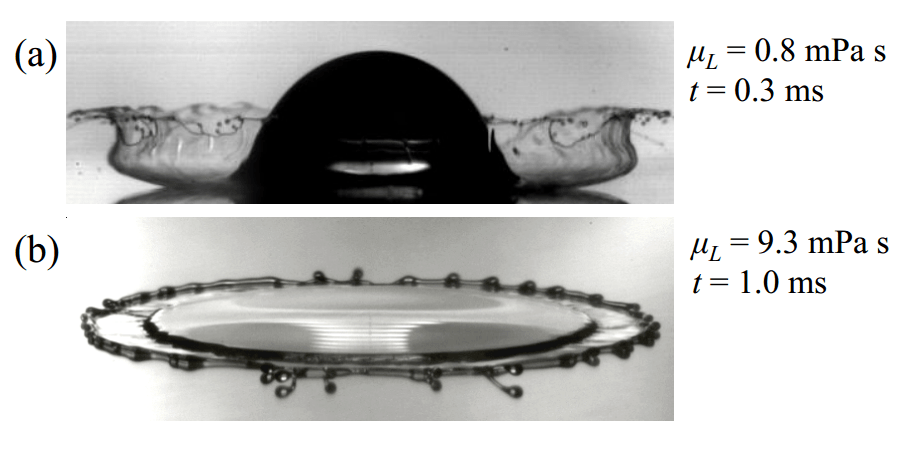
Everyone has seen drops of liquid falling onto a dry surface, yet the process is still being unraveled by researchers. We have learned, for example, that lowering the ambient air pressure can completely suppress splashing. Viscosity of the fluid also clearly plays a role, but the relationship between these and other variables is unclear. The images above show two droplet impacts in which the viscosity differs. The top image shows a low viscosity fluid, which almost immediately after impact forms a thin expanding sheet of fluid that lifts off the surface to create a crownlike splash. In contrast, the higher viscosity fluid in the bottom image spreads as a thick lamella with a thinner outer sheet that breaks down at the rim. Researchers found that both the high- and low-viscosity fluids have splashes featuring these thin liquid sheets, but the time scales on which the sheet develops differ. Moreover, lowering the ambient pressure increases the time required for the sheet to develop regardless of the fluid’s viscosity. (Image credit: C. Stevens et al.; submitted by @ASoutIglesias)
When Jets Collide
When two jets of a viscous liquid collide, they can form a chain-like stream or even a fishbone pattern, depending on the flow rate. This video demonstrates the menagerie of shapes that form not only with changing flow rates but by changing how the jets collide – from a glancing impingement to direct collision. When just touching, the viscous jets generate long threads of fluid that tear off and form tiny satellite droplets. At low flow rates, continuing to bring the jets closer causes them to twist around one another, releasing a series of pinched-off droplets. At higher flow rates, bringing the jets closer to each other creates a thin webbing of fluid between the jets that ultimately becomes a full fishbone pattern when the jets fully collide. The surface-tension-driven Plateau-Rayleigh instability helps drive the pinch-off and break-up into droplets. (Video credit: B. Keshavarz and G. McKinley)

Cylinder Wakes
A simple cylinder in a steady flow creates a beautiful wake pattern known as a von Karman vortex street. The image above shows several examples of this pattern. Flow is from bottom to top, and the Reynolds number is increasing from left to right. In the experiment, this increasing Reynolds number corresponds to increasing the flow velocity because the cylinder size, fluid, and temperature were all fixed. As the Reynolds number first increases, the cylinder begins to shed vortices. The vortices alternate the side of the cylinder from which they are shed as well as alternating in their sense of rotation (clockwise or counterclockwise). Further increasing the Reynolds number increases the complexity of the wake, with more and more vortices being shed. The vortex street is a beautiful example of how fluid behavior is similar across a range of scales from the laboratory to our planet’s atmosphere. (Image credit: Z. Trávníček et. al)
Soil Liquefaction
Soil liquefaction is a rather unsettling process in which apparently solid ground begins moving in a fluid-like way after agitation. It occurs in loose sediments when the spaces between individual particles become nearly saturated with water. This can happen, for example, after heavy rains or in a place with inadequate drainage. Such cases are typically very localized, though, and require some significant agitation of the surface, like pressing with heavy machinery or jumping in a single spot. Soil liquefaction becomes a greater danger, however, in an earthquake. Even in a dry area, the earth’s shaking can force groundwater up into the surface sediment and vibrate the soil sufficiently to liquify it, causing whole buildings to sink or tip and wreaking havoc on manmade infrastructure. (Video credit: jokulhlaups)

Spinning Polygons


Nature is full of surprising behaviors. If one imagines putting a bucket of water on a rotating plate and spinning it, one would expect the water’s free surface to take on a curved, axially symmetric shape. The photos above are from a similar experiment, but instead of the entire container rotating, only the bottom plate spins. Surprisingly, the water’s surface does not remain symmetric around the axis of rotation. Instead, the water forms stable polygon shapes that rotate slower than the spinning plate. As the plate’s rotation speed increases, the number of corners in the polygon increases. Shapes up to a hexagon were observed in the experiment. Photos of the set-up and more experimental results are available, as is the original research paper. Symmetry breaking and polygons can also be found in hydraulic jumps and bumps, liquid sheets, and planetary polar vortices. (Photo credit: T. Jansson et al.; research paper)
Sand Ripples
Wave motion in a bay or near a beach can cause significant sediment transport. Individual granular particles, like sand, can be lifted by the passage of a single wave, but, over time, complex patterns form as the granular bottom surface shifts due to the waves. This video shows time-lapse footage of the ripples that form and move in submerged sand during many hours of wave motion. A slight imperfection in the surface causes a network of sand ripples to grow and spread. Once formed, those ripples shift and reform depending on changes in the wave conditions. (Video credit: T. Parron et al.)
Knotting Vortices
Knots have long fascinated humans, appearing in art for thousands of years and generating entire fields of study. Until recently, however, the idea of a knotted fluid was purely theoretical. To knot fluids, researchers used 3D printing to create twisted hydrofoil shapes. When towed through water, fluid travels around the shape and spins up at the trailing edge, creating a knotted vortex ring. The knotted vortices were captured with 3D imaging, allowing scientists to observe how they evolve. So far the knots they’ve created have all been unstable, deforming until two vortex lines approach one another. Upon contact, the vortices disconnect and reconnect with one another, unraveling the knot. Intriguingly, these vortex reconnections seem remarkably similar to the vortex reconnections observed between quantized vortices in superfluids. (Video credit: D. Kleckner et al.)

Happy 1000 Posts!

Today is FYFD’s 1000th post! It’s been a wild ride over the last three-and-a-half years and I cannot thank you all enough for coming along. I’m continually amazed by FYFD’s popularity among readers of all ages and backgrounds, and it’s truly a joy to see excitement for fluid dynamics spreading.
The keen-eyed among you may have noticed a subtle change to the main page: I successfully defended my PhD Friday! I’m still working on wrapping my head around the idea of not being a student any more.
Anyway, I just wanted to take a few minutes to celebrate. I encourage you to take a look back at the archives, which are full of amazing science and physics, or read one of the themed series FYFD has featured. And, if you’ve enjoyed the blog, please don’t hesitate to spread the word! Thank you all again for your support. 🙂