Month: November 2014

  • Featured Video Play Icon

    “Cymatics”

    Nigel Stanford’s new “Cymatics” music video is full of stunning science-inspired visuals. The entire video is set up around various science demos–many of which will be familiar to readers–that translate sound or vibration into visual elements. The video uses ferrofluids, vibrates vodka on a speaker to create Faraday waves, and visualizes resonant sound waves with a Rubens’ tube. I don’t want to give away all the awesome effects, so watch it for yourself, and then check out their behind-the-scenes page where they talk about how they created each effect. (Video credit: N. Stanford; submitted by buckitdrop)

    Also, today is the final day of voting for the Vizzies, an NSF-sponsored contest for the best science and engineering visuals. Head over to their website to check out the finalists and choose your favorites!

  • Jet Impact

    Jet Impact

    Viscoelasticity can generate some bizarre fluid behaviors. Viscoelastic fluids are special class of non-Newtonian fluid in which the response to deformation is both viscous, like a fluid, and elastic, like rubber. Above, a jet of viscoelastic fluid impacts a plate as viewed from the side (top image) and beneath (bottom image). When the jet impacts the plate, elastic stresses in the fluid destabilize the cylindrical symmetry of the jet. The jet instead becomes webbed, with an odd, asymmetric number of webs. The number of webs depends on the viscoelastic properties of the fluid as well as the jet’s speed and distance from the plate. (Image credit: B. Néel et al.)

  • Featured Video Play Icon

    Fine-Tuning Flight

    We humans generally use fixed wings for flight, but in nature, flapping flight dominates. As an animal flaps, it extends or draws in its wings during key points of the cycle in order to change its aerodynamics. But this control can be more than just a matter of stretching their wings. Recent work on bats shows that they can fine-tune the stiffness of their wings’ membrane using tiny, hair-thin muscles. Each muscle is too slight to change a wing’s shape on its own, but by firing synchronously–tensing on the downstroke and relaxing on the upstroke–the bat can manipulate its membrane stiffness and thereby affect its wing shape. Moreover, the timing of the muscles’ action changes with flight speed, suggesting that the bats are actively controlling their aerodynamics during flight. (Video credit: Swartz-Breuer lab/Brown University; via Futurity; submitted by Boris M)

  • Featured Video Play Icon

    The Airbag’s Inflation

    Airbags have become a standard safety feature for automobiles. As the Slow Mo Guys demonstrate in the video above, the bags inflate incredibly quickly–less than 1/25th of a second! The incredible speed of the system’s deployment is what keeps the car’s occupants from slamming into the hard surfaces of the wheel or dashboard. But this only works if the passenger is far enough away that the airbag is inflated before they contact it. Because the bag inflates so quickly, it does so with enormous force, like the airbag in the video flinging the glass of water. When a car registers a crash, it sparks the ignitor of a solid-propellant inflator, initiating a chemical reaction that produces the nitrogen gas that fills the airbag. This is essentially the same process as a solid-propellant rocket. (Video credit: The Slow Mo Guys)

  • Barchan Dunes

    Barchan Dunes

    Crescent-shaped barchan dunes are common on both Earth (top image) and Mars (bottom image). They form in areas where the wind comes predominantly from one direction. As the wind blows, it deposits sand on the gently sloping windward face of the dune. The leeward face of the dune is steeper; its shape is set by the sand’s angle of repose–essentially the steepest angle the sand can maintain without an avalanche. Barchan dunes are very mobile, moving between one and a hundred meters per year. They have also been seen moving through one another or moving along in formation. (Image credits: Google Earth, NASA/JPL/University of Arizona)

  • Featured Video Play Icon

    Inside a Water Blob

    This new video from the Space Station shows once again that astronauts have the most fun job on–or off–the planet. In it, the Expedition 40 crew members submerge a GoPro camera in a microgravity water blob. Here on Earth, we’re used to surface tension being a minor or secondary force with most fluids we experience daily. This is because gravity often provides the overwhelming effect. But in microgravity, those effects are absent, and forces like surface tension and adhesion dominate water’s behavior. This both why the crew can make such a large water sphere hold together, and why one astronaut eventually gets his hands stuck in the sphere.  (Video credit: NASA; submitted by jshoer)

  • “Milky WaY”

    “Milky WaY”

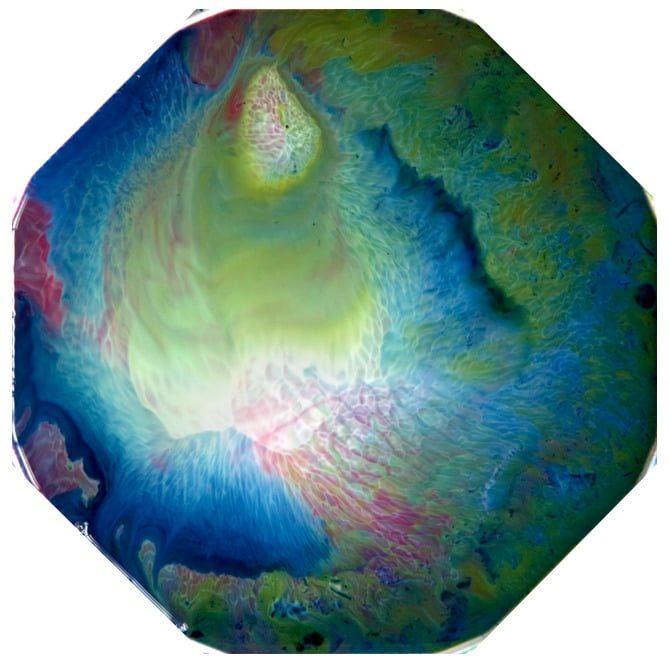
    Photographer Paulo Stagnaro uses milk and food coloring in his series “Milky WaY”. Despite the simple ingredients, the photos illustrate the enormous variety of shape and form in fluid dynamics. Surface tensiondiffusion, and intentional mixing create abstract and ephemeral portraits of fluid motion. For similar work, see Pery Bruge’s art or just try browsing through FYFD’s “fluids as art” tag for more examples of science and art intersecting. (Photo credit: P. Stagnaro; submitted by Stephanie M.)

  • Von Karman Vortex Streets

    Von Karman Vortex Streets

    The wake of a cylinder is a series of alternating vortices shed as the flow moves past. This distinctive pattern is known as a von Karman vortex street. The speed of the flow and the size of the cylinder determine how often vortices are shed. Incredibly, this pattern appears at scales ranging from the laboratory demo all the way to the wakes of islands. Von Karman vortex streets can even be seen from space. (Image credit: R. Gontijo and W. Cerqueira, source video)

  • Turbulence and Star Formation

    Turbulence and Star Formation

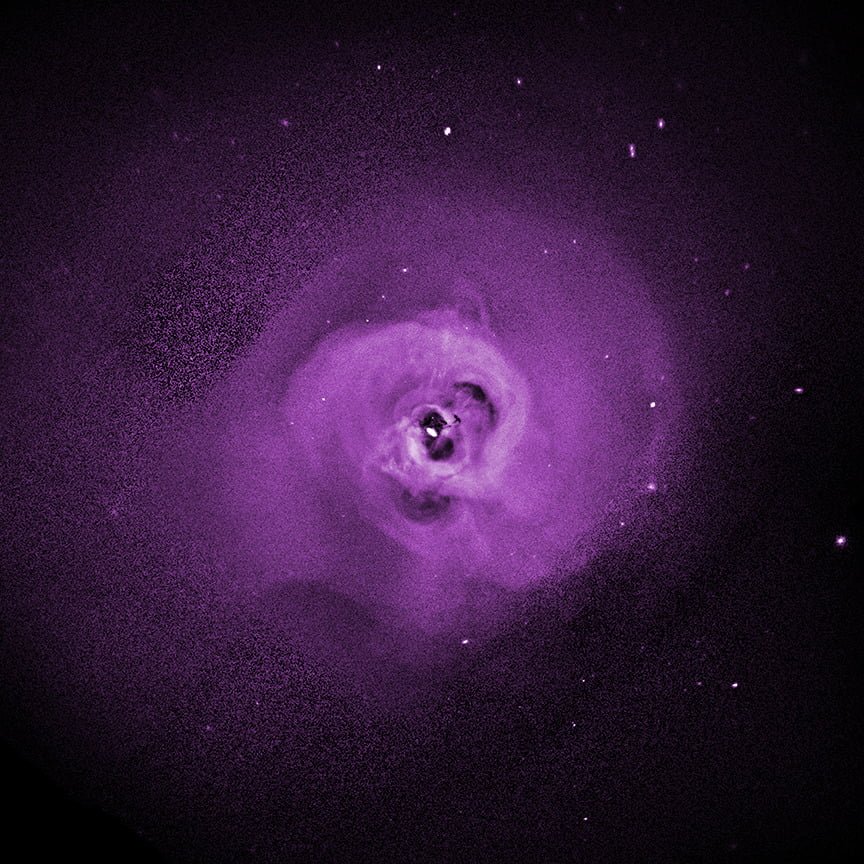
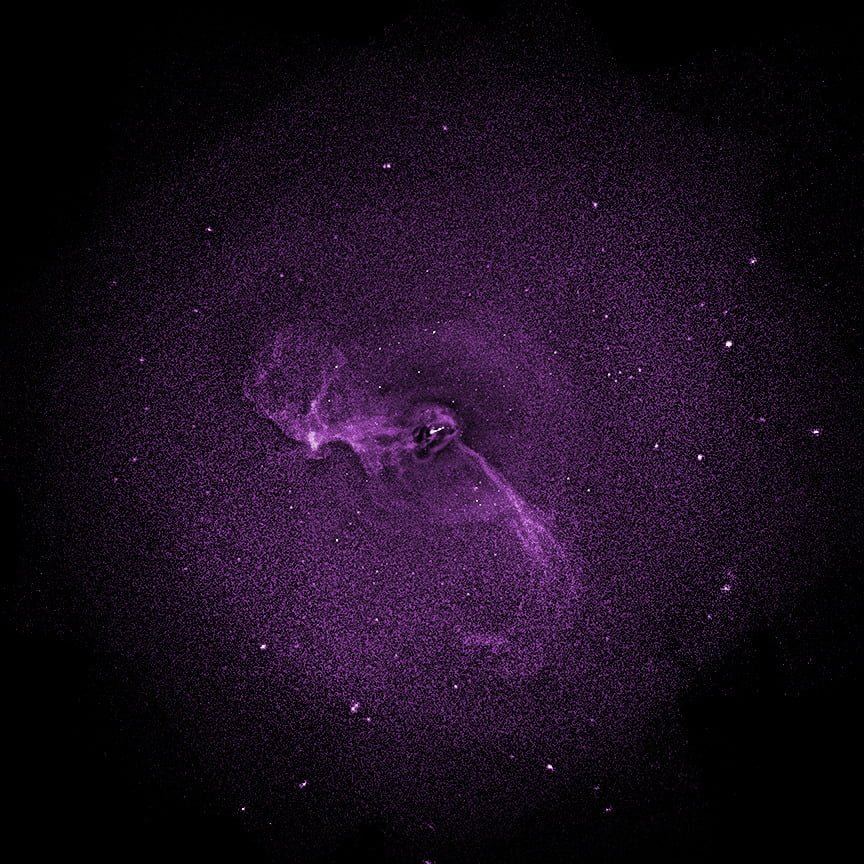
    Galaxy clusters are objects containing hundreds or thousands of galaxies immersed in hot gas. This gas glows brightly in X-ray, as seen in the Perseus (top) and Virgo (bottom) clusters above. Over time, the gas near the center of the clusters should cool, generating many new stars, but this is not what astronomers observe. New research suggests turbulence may prevent this star formation. The supermassive black holes near the center of these galaxy clusters pump enormous amounts of energy into their surroundings through jets of particles. Those jets churn the gas of the cluster, generating turbulence, which ultimately dissipates as heat. It is this turbulent heating astronomers think counters the radiative cooling of the gas, thereby keeping the gas hot enough to prevent star formation. You can read more about the findings in the research paper.  (Image credits: NASA/Chandra/I. Zhuravleva et al.; via io9)

  • Iridescent Clouds

    Iridescent Clouds

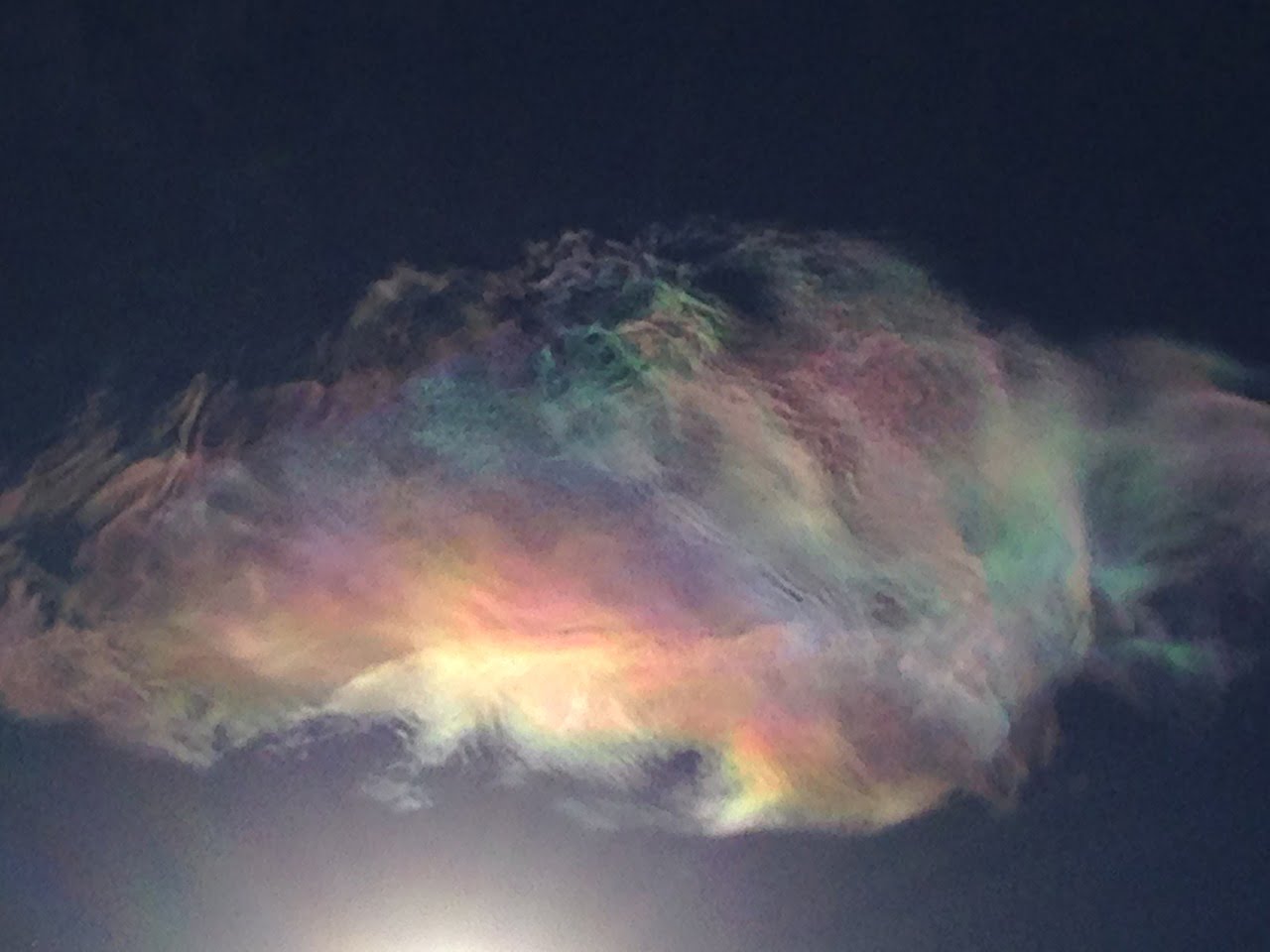
    Look up at the clouds on the right day and you may catch a glimpse of a rainbow-like phenomenon known as cloud iridescence. These colors occur when sunlight is diffracted through small water droplets or ice crystals. For the effect to be apparent, the cloud must be optically thin, meaning that most of the rays of sunlight must pass through only a single droplet or ice crystal. This means the effect is usually visible only near the edges of clouds or as new clouds are forming. You can see more photos of the phenomenon here, and there’s a great video where cloud iridescence makes an appearance during a rocket launch in this previous entry.  (Photo credit and submission: C. Havlin)