Spinning an object in motion through a fluid produces a lift force perpendicular to the spin axis. Known as the Magnus effect, this physics is behind the non-intuitive behavior of football’s corner kick, volleyball’s spike, golf’s slice, and baseball’s curveball. The simulation above shows a curveball during flight, with pressure distributions across the ball’s surface shown with colors. Red corresponds to high pressure and blue to low pressure. Because the ball is spinning forward, pressure forces are unequal between the top and bottom of the ball, with the bottom part of the baseball experiencing lower pressure. As with a wing in flight, this pressure difference between surfaces creates a force – for the curveball, downward. (Video credit: Tetra Research)
Month: June 2013

Bubbles, Drops, and Colors


The immiscibility of oil and water creates a multitude of bubbles of all sizes. A lack of miscibility occurs when the forces between like molecules are very strong for two liquids–essentially the oil molecules and the water molecules are so much more strongly attracted to themselves than they are to one another that they cannot mix. Surface tension–another expression of molecular forces–pulls the oil into droplets that float in the water and refract the light in such lovely ways. (Photo credit: Vendula Adriana Kaprálová Hauznerová; via thinxblog)

Geyser Physics
Three basic components are necessary for a geyser: water, an intense geothermal heat source, and an appropriate plumbing system. In order to achieve an explosive eruption, the plumbing of a geyser includes both a reservoir in which water can gather as well as some constrictions that encourage the build-up of pressure. A cycle begins with geothermally heated water and groundwater filling the reservoir. As the water level increases, the pressure at the bottom of the reservoir increases. This allows the water to become superheated–hotter than its boiling point at standard pressure. Eventually, the water will boil even at high pressure. When this happens, steam bubbles rise to the surface and burst through the vent, spilling some of the water and thereby reducing the pressure on the water underneath. With the sudden drop in pressure, the superheated water will flash into steam, erupting into a violent boil and ejecting a huge jet of steam and water. For more on the process, check out this animation by Brian Davis, or to see what a geyser looks like on the inside, check out Eric King’s video. (Video credit: Valmurec; idea via Eric K.)
Supercell Thunderstorm
Photographer Mike Olbinski has captured a spectacular timelapse of a supercell thunderstorm over the plains of Texas. Supercells are characterized by a strong, rotating updraft known as a mesocyclone, seen clearly in the video. These storms are commonly isolated occurrences, forming when horizontal vorticity in the form of wind shear is redirected upwards by an updraft. Such a strong updraft is typically created by a capping inversion, a situation where a layer of warmer air traps the colder air beneath it. (This is why one sees a distinctive cut-off at the top of some clouds.) As warm air rises from the surface, either the air above the cap will cool or the air below the cap will warm. Either situation results in an instability with cooler air on top of warmer air, providing a catalyst for the kind of dramatic weather seen here. (Video credit: M. Olbinski; via io9)

Reader Question: Does Flow Viz Alter Flow?

 gorbax asks:
 I’ve been wondering for a while, actually, how do we know when the method of flow visualization doesn’t actually alter the flow of a fluid itself?
This is a great question and one that fluid dynamicists have to deal with all the time. Ideally, we’d love to measure everything we want from a flow at all points at all times without doing anything to affect it. In reality, however, that just doesn’t happen. Some measurement techniques are less intrusive than others, but just about everything risks having some effect. This raises two questions: 1) How small can we make that effect? and 2) Do we even care if we’re affecting the flow?
With regards to the first, the onus is typically on the experimentalist to show that whatever visualization technique he/she uses is not significantly affecting the flow. For something like particle image velocimetry, which requires seeding the flow with particles, this means selecting particles that follow the flow rather than changing it and considering carefully how and where to seed the flow such that any added vorticity from the injection does not alter the flow significantly. Checking for this can be done many ways, for example with comparisons to other measurement techniques (with and without seeding) or by comparing to simulation.
The second question–do we care?–is also a significant consideration. Because the purpose of flow visualization is often to get a qualitative feel for the flow field rather than quantitative information, it is often not a significant concern if there is some slight effect from the visualization technique. This can often be the case with smoke-wire and dye visualizations where we just want to see what’s going on.
Finally, there are some instances of flow visualization which are completely unobtrusive to the flow. Schlieren photography and infrared thermography are two examples. Both are optical techniques that act from a distance and take advantage of extant flow properties to make certain features visible. The real key is knowing what technique(s) will work for the flow you have and will give you the information you want. After that, it’s all about proper and thorough execution. (Photo credits: N. Vandenberge et al., T. Omer, M. Canals, P. Danehy et al., A. Wilkens et al., W. Saric et al.)
Visualization Via Temperature
One downside to many flow visualization techniques, like those using dye, smoke, or particles, is the difficulty of dealing with their aftermath. You can only introduce so much of them into a wind or water tunnel before it’s necessary to shutdown and clean everything. One alternative is to use temperature, as shown in the video above. By simply introducing a warmer fluid and using an IR camera, it’s possible to accomplish many of the same effects without the mess. (Video credit: A. Khandekar and J. Jacob; submitted by J. Jacob)

Fluids Round-up – 9 June 2013
It’s time for some more fluidsy fun around the Internet! Here are some fun links I’ve come across since our last round-up.
- NPR reviews how dolphins and others play with vortex rings.
- Lawrence Berkeley National Laboratory/UC Berkeley offer some insight into simulating bubbles popping. (Hint: it requires supercomputers.)
- FlowViz shares some awesome accidental Rayleigh-Taylor instabilities you can replicate at home.
- PhysicsBuzz brings us a podcast on tornado physics.
- Reader Cedric Vella sent in his fluids-featuring trailer.
- io9 pointed out some great cymatics footage that shows off how granular materials and vibration creates beautiful patterns.
- And finally: what happens when you drop hot charcoal into liquid oxygen? The Periodic Table of Videos shows us, in high speed! (via Flow Visualization)
(Photo credit: L. L. A. Adams et al., multi-fluid double emulsions)

Visualizing F-18 Flow
Flow visualization techniques are helpful outside of wind and water tunnels, too. The photo above comes from the F-18 High Alpha Research Vehicle (HARV) program in which techniques like smoke and dye visualization were used in-flight to visualize airflow around an F-18 at large angles of attack. During flight a glycol-based liquid dye was released from tiny holes along the plane’s forebody, creating the pattern seen here later on the ground. This particular test corresponded to about 26 degrees angle of attack. (Photo credit: NASA Dryden)
Droplets Within Droplets
This video shows a multi-layered droplet, in which several droplets are formed one inside the other as an initial drop falls through a layer of oil sitting atop another liquid. When the drop falls, its potential energy gets transformed into interface energy, creating a fascinating interplay of surface tension, deformation, and miscibility between the fluids. Such self-contained multi-layered droplets, similar to multiple emulsions, could be helpful in pharmaceutical development. (Video credit: E. Lorenceau and S. Dorbolo 2004)

Dye Droplet
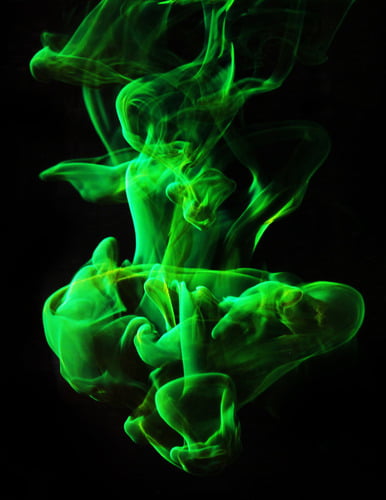
A drop of fluorescent dye falling into quiescent water forms fantastical structures that are a mixture of vorticity, turbulence, and molecular diffusion. The horseshoe-like shape near the front of the drop is a typical shape for two fluids strained by moving past one another. The main section of the drop billows outward like a parachute, but the turbulence of its wake stretches the dye into fine threads that quickly disperse in the water. (Photo credit: D. Quinn et al.)