
Droplets of oleic acid spread across a thin film of glycerol on a silicon wafer. The shapes here are driven by hydrodynamic instabilities, particularly Marangoni effects due to the differences in surface tension between the two fluids. (Photo credit: A. Darhuber, B. Fischer and S. Troian)
Month: December 2011

Atomizing Jets
The breakup of impinging jets into droplets (also called atomization) and the subsequent dynamics of those droplets are important in applications like jet and rocket engines where the mixing of liquid fuel with oxygen is necessary for efficient combustion. This video showcases recent efforts in high fidelity numerical simulation and modeling of such flows. The complexity of the problem requires clever ways of reducing the computational efforts required. One such method uses adaptotive meshing to concentrate grid points in areas where variables are changing quickly while leaving the grid sparse in areas of less interest. Because the flow is constantly evolving, the mesh must be able to adapt as the simulation steps forward in time. Even so, such calculations typically require supercomputers to complete. (Video credit: X. Chen et al)
Brinicles
In the frozen reaches of our planet, the atmosphere and ocean can interact in bizarre ways. Under calm ocean conditions when the air at sea level is much colder than the water temperature brinicles–the underwater equivalent to an icicle–can form. The cold air above rapidly freezes ocean water at the surface, concentrating water’s salt content into a very cold brine which sinks rapidly. As this brine descends, it freezes the water around it into an ice sheath. As the brinicle grows and eventually reaches the sea floor, its cold temperatures can wreak havoc on the creatures living there.
Testing Flames in Space
In microgravity, flames behave very differently than on earth due to a lack of buoyant forces. On earth, a flame can continue burning because, as the warm air around it rises, cooler air gets entrained, drawing fresh oxygen to the flame. In microgravity, both the heat from the flame and the oxygen it needs to burn move only by molecular diffusion, the random motion of molecules, or the background environmental flow (air circulation on the ISS, for example). This video shows a test of the Flame Extinguishment Experiment (FLEX) currently flying onboard the ISS. A fuel droplet is ignited, burns in a symmetric sphere and then eventually extinguishes either due to a lack of fuel or a lack of oxygen. Check out this NASA press release for more, including great quotes like this:
“As a Princeton undergrad, I saw in a graduate course the conservation equations of combustion and realized that those equations were complex enough to occupy me for the rest of my life; they contained so much interesting physics.” – Forman Williams
Wave-Particle Duality in Bouncing Droplets
A droplet atop a vibrating pool is prevented from coalescing by the constant influx of air into a thin lubrication layer between it and the pool. But that is not the strangest aspect of its behavior. Researchers have found that this system demonstrates some aspects of the mind-bending wave-particle duality at the heart of quantum physics. (Submitted by Dan H.) #

Ink Sculptures

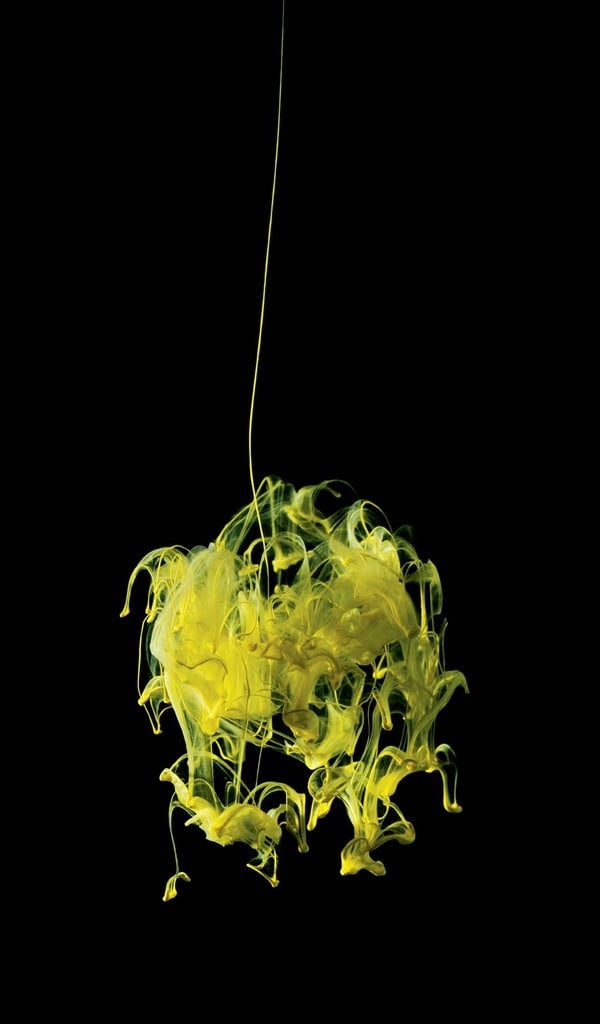
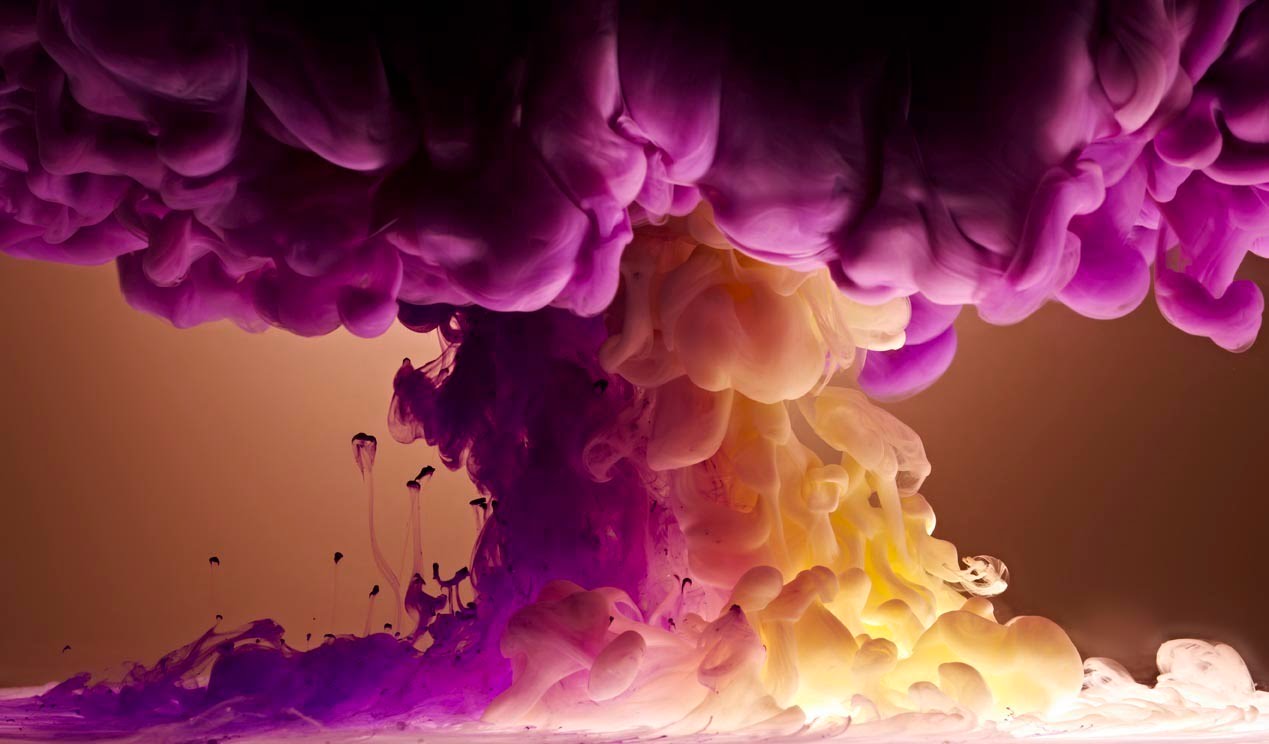
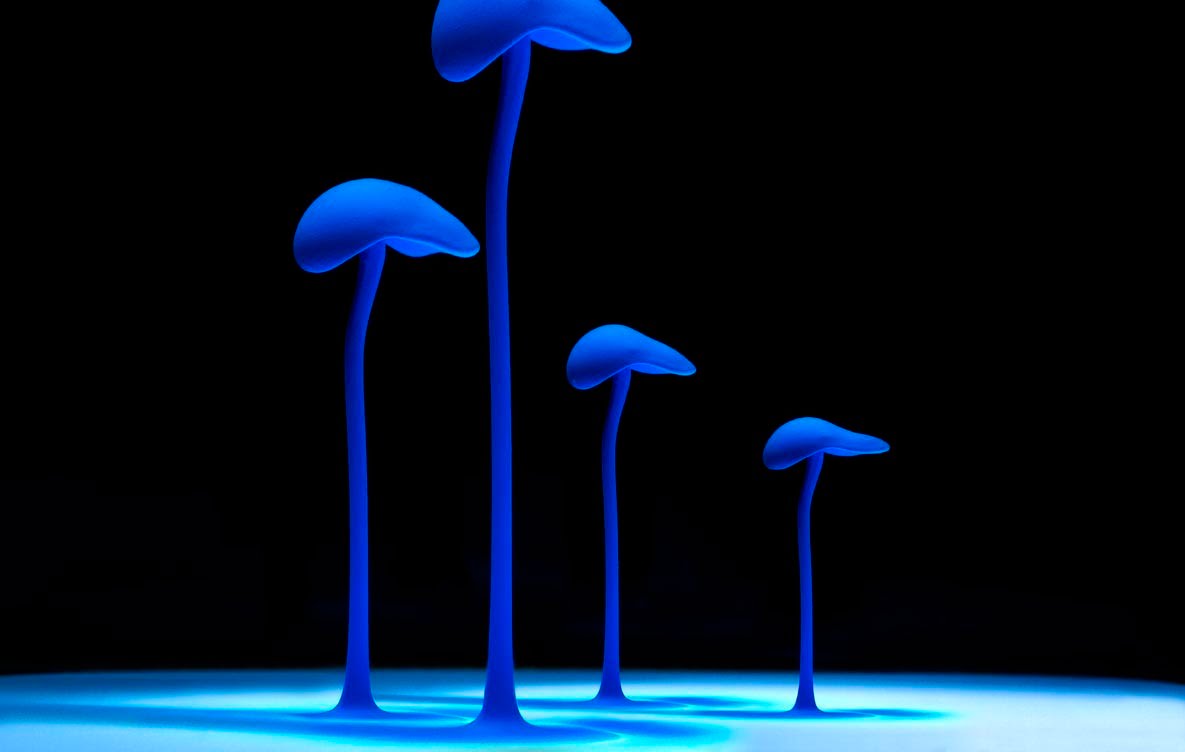
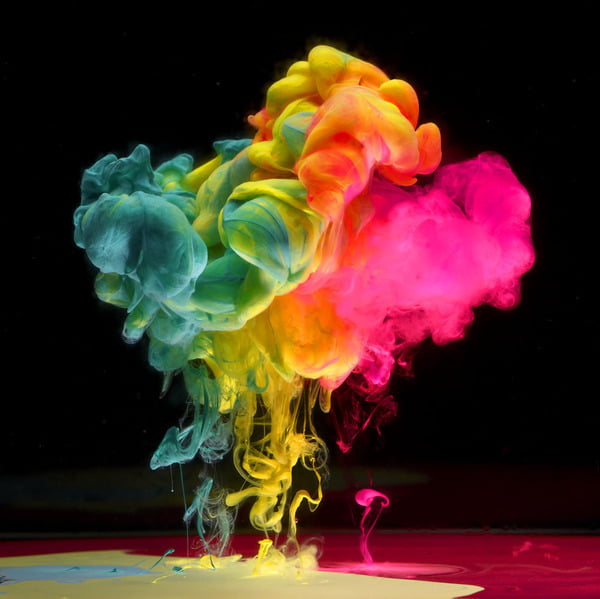
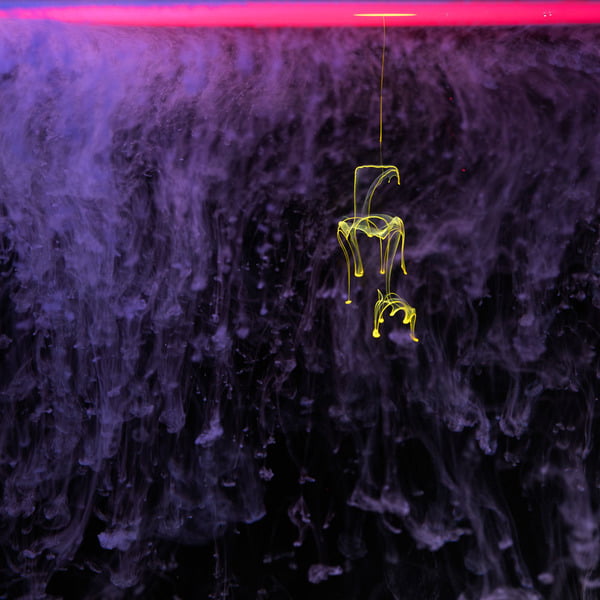
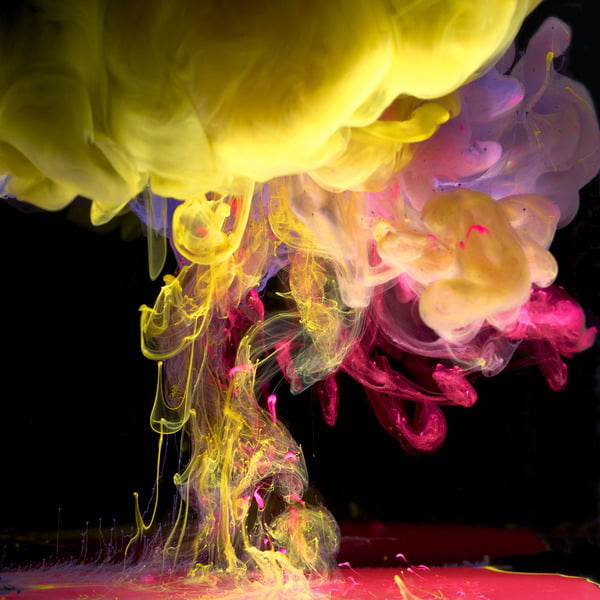
Dripping ink into water can create fantastic structures as the two fluids mix. In this artwork there are numerous complex mixing phenomena: the eddies and multiple scales of turbulence; the long, thin streams of laminar flow; and the wispy mushrooms and umbrellas of the Rayleigh-Taylor instability. (Photo credit: Mark Mawson; via @thinkgeek)
Water Balloon Physics
[original media no longer available]
This video explores some of the physics behind the much-loved bursting water balloon. The first sections show some “canonical” cases–dropping water balloons onto a flat rigid surface. In some cases the balloon will bounce and in others it breaks. The bursting water balloons develop strong capillary waves (like ripples) across the upper surface and have some shear-induced deformation of the water surface as the rubber peals away. Then the authors placed a water balloon underwater and vibrated it before bursting it with a pin. They note that the breakdown of the interface between the balloon water and surrounding water shows evidence of Rayleigh-Taylor and Richtmyer-Meshkov instabilities. The Rayleigh-Taylor instability is the mushroom-like formation observed when stratified fluids of differing densities mix, while the Richtmyer-Meshkov instability is associated with the impulsive acceleration of fluids of differing density.
Underwater Plumes
During 2010’s Deepwater Horizon oil spill there were reports of underwater plumes of oil escaping collection. This video demonstrates how such a plume can form. There are two clips shown here; in both the tank is filled with salt water of varying salinity, with denser saltwater at the bottom. The first jet is a green alcohol/water mixture and the second is a red gauge oil. Both jets have the same density and flow rate, but they vary in their Reynolds number. The first turbulent jet gets trapped at the interface between the denser and lighter saltwater while the less turbulent red jet passes the interface with no difficulty. The researchers suggest that strong turbulence can create an emulsion, a mixture of two normally immiscible fluids–imagine shaking a container of oil and vinegar really well–which can lead to underwater trapping.
Cavity Collapse
When a solid object is driven into a quiescent liquid, a cavity is formed. As the cavity collapses jets–a type of singularity–form. In this video, researchers explore the effect of the geometry of a disk being driven into water on the shape of the cavity formed and how it collapses. As in this video of droplet impacts on posts of different geometries, there’s a lovely symmetry in the results. (Video credit: O. Enriquez et al)
Seed-Ejection via Raindrop
[original media no longer available]
We don’t often think of plants as using fluid dynamics aside from capillary action drawing water from their roots, but many plants also use fluid dynamics to disperse reproductive materials. This high-speed video explores the efficacy of splashing raindrops at ejecting seeds from different blossoms. (Video credit: G. Amador et al)

