A supercritical fluid exists without a distinct liquid or gas phase and forms when temperatures and pressures exceed the substance’s critical point. Here supercritical transition is demonstrated with an ampule of liquid chlorine. When immersed in a hot bath, the temperature and pressure inside the ampule rises until around 0:20 when the meniscus marking the interface between liquid and gas disappears. The chlorine is now in its supercritical state. Around 0:43 the hot bath is removed and the chlorine begins to cool, reverting to distinct phases of matter around 0:55.
Videos
Supercavitating Penguins
[original media no longer available]
Penguins, already fluid dynamicists by nature, have developed clever methods of increasing their speed to escape from the leopard seals that prey on them. In the clip above, notice from 1:55 onward as the penguins swim for the surface and leap onto the ice – they leave a trail of bubbles in their wake. The penguins are using supercavitation to decrease their drag. When the penguins first dive in to the water, they splay their feathers out in the air and then lock them closed in the water, trapping pockets of air beneath them. When the need for a burst of speed arises, the penguin shifts its feathers to release the air, coating most of its body in a layer of bubbles. Because the drag in air is much less than the drag in water, this enables the bird to achieve much higher speeds than they normally do when swimming.

Bursting Bubbles
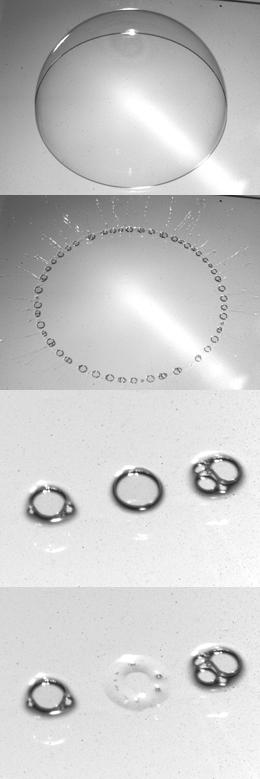
Sometimes bursting one bubble just leads to more bubbles. This high-speed video shows how popping a bubble sitting on a fluid surface can lead to a ring of daughter bubbles. When the surface of the bubble is ruptured, filaments of the liquid that made up the surface are drawn back toward the pool by surface tension, trapping small pockets of the air that had been inside the bubble. A dimple forms on the surface and rebounds as a jet that lacks the kinetic energy to eject droplets. Watch as the jet returns to the interface, and you will notice the tiny bubbles around it. At 56 ms, one of the daughter bubbles on the left bursts. See Nature for more. (Video credit: J. Bird et al)
“Ferroux”
In this video, artist Afiq Omar mixes ferrofluid with soap, alcohol, milk, and other liquids to create a surrealistic fluidic dance. In addition to using different fluid mixtures, I suspect he accomplishes many effects using several different permanent magnets and electromagnets to vary the magnetic fields around the ferrofluid mixtures. (Video credit: Afiq Omar; via Wired)
Flapping to Fly Efficiently
High-speed video shows that bats achieve some of their efficiency in flight by pulling their wings inward on the upstroke, as seen above. While this does affect drag forces on the wing slightly, the primary energy savings comes from the inertial ease of lifting the folded wing. Much the way it is easier to lift your arm when it is folded than when you stretch it outright, it takes less energy for the bat to lift a folded wing than one that is fully extended. (via Wired Science)
Fixing Potholes with Oobleck
Shear-thickening non-Newtonian fluids like oobleck become more viscous as force is applied to them. This behavior causes them to form finger-like structures when vibrated, makes it good liquid armor, and even enables people to run across a pool of it without sinking. Now undergraduates at Case Western Reserve University have found a new use for such fluids: pothole filling. They have created a pothole patch that consists of a waterproof bag filled with a dry solution that, when mixed with water, creates a non-Newtonian fluid capable of flowing to take the shape of the pothole but resisting a car tire like a solid. They cover the patch with a layer of black fabric so that drivers don’t avoid the patch. See the video above for a demonstration and ScienceNOW for more. (submitted by aggieastronaut)
Vibrating Oil
This high-speed video shows the behavior of oil on a vibrating surface. As the amplitude of the vibration is altered various behaviors can be observed. Initially small waves appear on the surface of the oil, then the surface erupts into a mass of jets and ejected droplets, reminiscent of a vibrated interfaces within a prism or vibration-induced atomization. When the amplitude is reduced after about half a minute, we see Faraday waves across the surface, as well as tiny droplets that bounce and skitter across the surface. They are kept from coalescing by a thin layer of air trapped between the droplet and the oil pool below. Because of the vibration, the air layer is continuously refreshed, keeping the droplet aloft until its kinetic energy is large enough that it impacts the surface of the oil and gets swallowed up.
Jumping Water Droplets
Superhydrophobic surfaces resist wetting from water, but it turns out they can also trigger interesting behaviors in the tiny droplets condensing on the surface. High-speed video reveals that when two condensate droplets coalesce, the energy released by surface tension causes the new droplet to jump off the surface. The phenomenon is the same as one observed in some types of mushroom–when a condensate droplet touches a wetted spore, the spore is ejected from the mushroom. (Video credit: J. Boreyko)
Frozen Fluid Illusion
This video creates the illusion of a jet of water frozen in mid-air. The effect is achieved by vibrating the water at the frequency of the speaker, then filming at a frame rate identical to the vibrational frequency. Thus the water pulses at the exact rate that the camera captures images, making the water appear stationary even though it is moving. (submitted by Simon H)
Dancing Plasma
Two dark areas of plasma, cooler than the surrounding fluid, dance and intertwine above the sun’s surface. Plasma, a rarefied gas made up of ions, is an electrically conductive fluid, shaped here by the magnetic field of the sun. Note how the strands pass material back and forth along the magnetic field lines. This timelapse video, captured by NASA’s Solar Dynamics Observatory, takes place over the course of a day and is captured in the extreme ultraviolet range.