Videos

  • Featured Video Play Icon

    Fiery Backdraft

    Combustion is ultimately a chemical reaction, and like any chemical reaction, it requires the right balance of ingredients. The only way to completely exhaust the reaction is to have the perfect amount of fuel (i.e. stuff to burn) and oxidizer (i.e. oxygen). When those ratios don’t match, the reaction can slow down or even appear to end, but that doesn’t mean a fire’s gone out.

    Firefighters face one of the dangerous consequences of this situation in the form of backdrafts. When a fire has been burning in a sealed container and exhausted its oxygen supply, it can get extremely hot even if the flames seem to have died down. When oxygen is added back by opening a door or window, the fire can react explosively, as the Slow Mo Guys demonstrate above. The good news is that backdrafts are relatively rare and there are steps you can take to avoid them. (Image and video credit: The Slow Mo Guys)

  • Featured Video Play Icon

    Breaking

    As waves fold over and break, they trap air, creating bubbles of many sizes. The smallest of these bubbles can be only a few microns across and persist for long times compared to larger bubbles. When they burst, they create tiny droplets that can carry sea salt up into the atmosphere to seed rain. Understanding how these bubbles form and how many there are of a given size is key to predicting both oceanic and atmospheric behaviors. Numerical simulations like the one featured in the video above reveal the dynamic collisions that create these tiny bubbles and help researchers learn how to model the tiniest bubbles so that future simulations can be faster. (Image and video credit: W. Chan et al.)

  • Featured Video Play Icon

    The Beauty of Flames

    The flickering yellow and orange flames most of us are used to thinking of are rather different from the flames researchers study. In this video, the Beauty of Science team offers a short primer on different flame shapes studied in combustion, including laminar, swirling, and jet flames. Each has its own distinctive character and may be advantageous or not, depending on the application for the flame. A laminar flame, for example, is steady, which might make it a good choice for something like a Bunsen burner, where consistency is needed. Whereas a turbulent flame is better capable of mixing fuel and oxidizer, which is key in applications like rocket engines, where that mixing can be a limiting factor in the engine’s efficiency. (Image and video credit: Beauty of Science)

  • Featured Video Play Icon

    Weirs

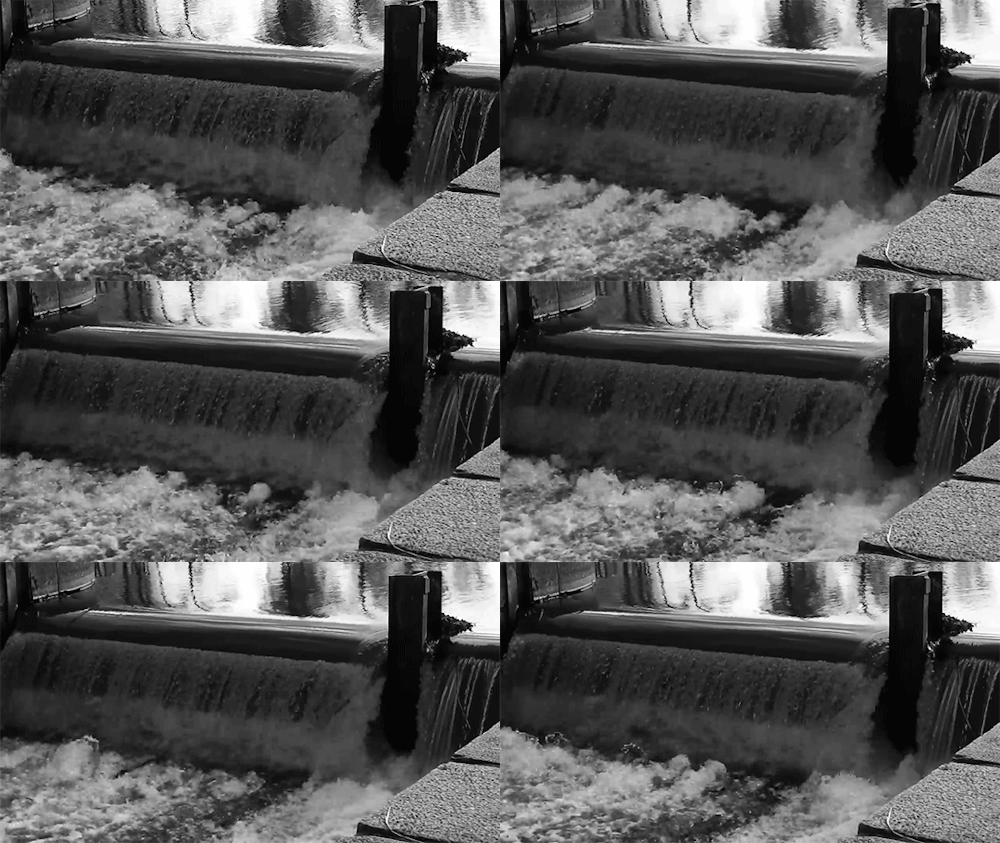
    Hydraulic engineers use weirs, like the one shown below, to control upstream flow conditions. Weirs can come in many forms, but they essentially look like a small dam with water flowing over the top. They’re used to control both the flow rate and the upstream water level. As Grady from Practical Engineering explains, there are a few characteristics hydraulic engineers can vary to help adapt to changing water conditions. Check out the full video above to learn more about these important engineering features you’ve likely seen but never learned about. (Video and image credit: Practical Engineering)

  • Featured Video Play Icon

    Sniffing

    In many ways, smell is a strange sense. The very act of sniffing – pulling air and odor molecules into our noses – changes what remains behind in a way that sight and sound do not. Humans aren’t great sniffers, but dogs have an exquisite sense of smell, and in this video, Deep Look describes how and why that is. From special scent organs to their experimental protocols, dogs are well-adapted to reading the world by smell. (Image and video credit: Deep Look)

  • Featured Video Play Icon

    Melting

    File this one under “Oddly Satisfying” – this timelapse video shows the process of melting a jawbreaker candy using a blowtorch. Over a minute and a half, each colorful layer of candy melts away to reveal the strata beneath. There’s a definite connection here to some of the previous research we’ve discussed on erosion, dissolution, and melting. The blowtorch’s flame generates a hot boundary layer around the candy surface; it’s thickest and hottest at the central stagnation point, but judging by the melting layer we see running all the way to the candy’s shoulder, its size and effect are substantial even there. It’s hard to tell from the video whether the surface of candy is getting roughened (a la scalloping) or whether that’s just an uneven layer of melted candy flow. Regardless, it’s a fun watch. (Video and image credit: Let’s Melt This; via Colossal)

  • Featured Video Play Icon

    “The World Below”

    Since the first cosmonauts and astronauts entered orbit around our planet, they’ve held a unique perspective. Thanks to the timelapse photography of recent astronauts aboard the ISS and the editing skills of photographer Bruce W. Berry, Jr, the rest of us can enjoy a taste of that viewpoint. Turn up the volume, fire up the big screen, and enjoy.

    I particularly like how several of the sequences show off the depth of the atmosphere. Earth’s atmosphere is incredibly thin compared to the size of our planet – less than one percent of Earth’s radius – but thanks to the shadows that clouds cast on one another, you can really appreciate their height in sequences like the one at 2:26. (Video credit: B. Berry, Jr. using NASA footage)

  • Featured Video Play Icon

    Even Mountains Flow

    Over about 5 months of 2018, the summit of Mount Kilauea slowly collapsed as the volcano erupted. Seen in timelapse, it’s a remarkable reminder of the ancient Greek philosopher Heraclitus’s observation, “Everything flows.” All things change, so given enough time, just about everything can flow.

    Fluid dynamicists actually capture this concept in a dimensionless ratio known as the Deborah number. Named for a Biblical prophet who states, “The mountains flow before the Lord,” the Deborah number is defined as the ratio between the time needed for a material to respond applied stress and the time over which the process is observed. In practice, a lower Deborah number indicates a more fluid-like material while a higher one represents more solid-like behavior.

    Be sure to check out the full video. There’s some spectacular lava flow footage near the end – definitely a small Deborah number! (Video and image credit: USGS via Science; research credit: C. Neal et al.)

  • Ice Cream Vortex

    [original media no longer available]

    Here’s a fun demonstration of vorticity: sticking an ice cream cone in a bathtub vortex. Now, before someone points out that this is clearly a sink, not a bathtub, the term “bathtub vortex” actually has a standard scientific usage; it’s used to describe a vortex that forms when water drains out a small hole in a larger container.

    Vortices like this have a surprisingly complex flow structure. Although there is some flow dragged into the vortex near the surface, flow visualization shows that most of the flow actually occurs along the bottom of the container. Fluid there gets dragged along the surface, then sucked upward near the center of the vortex, and finally gets pulled down the drain.

    So what’s going on here? As long as the ice cream cone stays balanced inside the center of the vortex, it spins with the fluid due to viscous drag. When it’s unbalanced – like when it precesses too far or throws a chunk of cone off –  I suspect the bottom of the cone is encountering that area of upwelling, which tips the cone completely. The surface flow then pulls it back into the center of the vortex, allowing it to right itself. (Video credit: Cheesemadoodles; research credit: A. Anderson et al.; submitted by randumblrposts and eclecticca)

  • Featured Video Play Icon

    Hydraulic Jumps

    Chances are that you’ve seen plenty of hydraulic jumps in your life, whether they were in your kitchen sink, the whitewater of a river, or at the bottom of a spillway. Practical Engineering has a great primer on this oddity of open channel flow. 

    When water (or other liquids) flow with a surface open to the air – think like a river rather than a pipe – the flow has three important regimes: subcritical, critical, and supercritical. Which state the flow is in depends on the speed of the flow compared to the speed of a wave traveling in that flow. If the waves are faster than the flow, we call it subcritical. If the flow is faster than the waves, it’s called supercritical. (This is equivalent to subsonic or supersonic flow, where the regime depends on the flow speed compared to the speed of sound.)

    Flows can transition naturally from one state to another, and where they transition from fast, supercritical flow to slower, subcritical flow, we find hydraulic jumps – places where the kinetic energy of the supercritical flow gets changed into turbulence and potential energy through a change in height. Check out the video above to learn how civil engineers use hydraulic jumps to control water and erosion. (Video and image credit: Practical Engineering)