Photographer Dave Sandford braved the cold and turbulent waters of Lake Erie in late fall to capture some remarkable wave action. Like on the ocean, waves in the Great Lakes are largely driven by winds, but lakes don’t develop the constant set of rolling waves that oceans do. Instead their waves are more erratic and unpredictable. Sandford focused on capturing the moment when wind-driven waves coming into shore collided with waves rebounding from piers or rocks along the shore. The results are waves that, through Sandford’s lens, look like exploding mountainsides. Such energetic waves mix sediment and nutrients in the lake, and the spray of droplets can even loft aerosols and pollutants from the water into the atmosphere. (Photo credit: D. Sandford; via Flow Vis)
Tag: waves

Living Fluid Dynamics
This short film for the 2016 Gallery of Fluid Motion features Montana State University students experiencing fluid dynamics in the classroom and in their daily lives. As in her previous film (which we deconstructed), Shanon Reckinger aims to illustrate some of our everyday interactions with fluids. This time identifying individual phenomena is left as an exercise for the viewer, but there are hints hidden in the classroom scenes. How many can you catch? I’ve labeled some of the ones I noticed in the tags. (Video credit: S. Reckinger et al.)

Fish, Feathers, and Phlegm
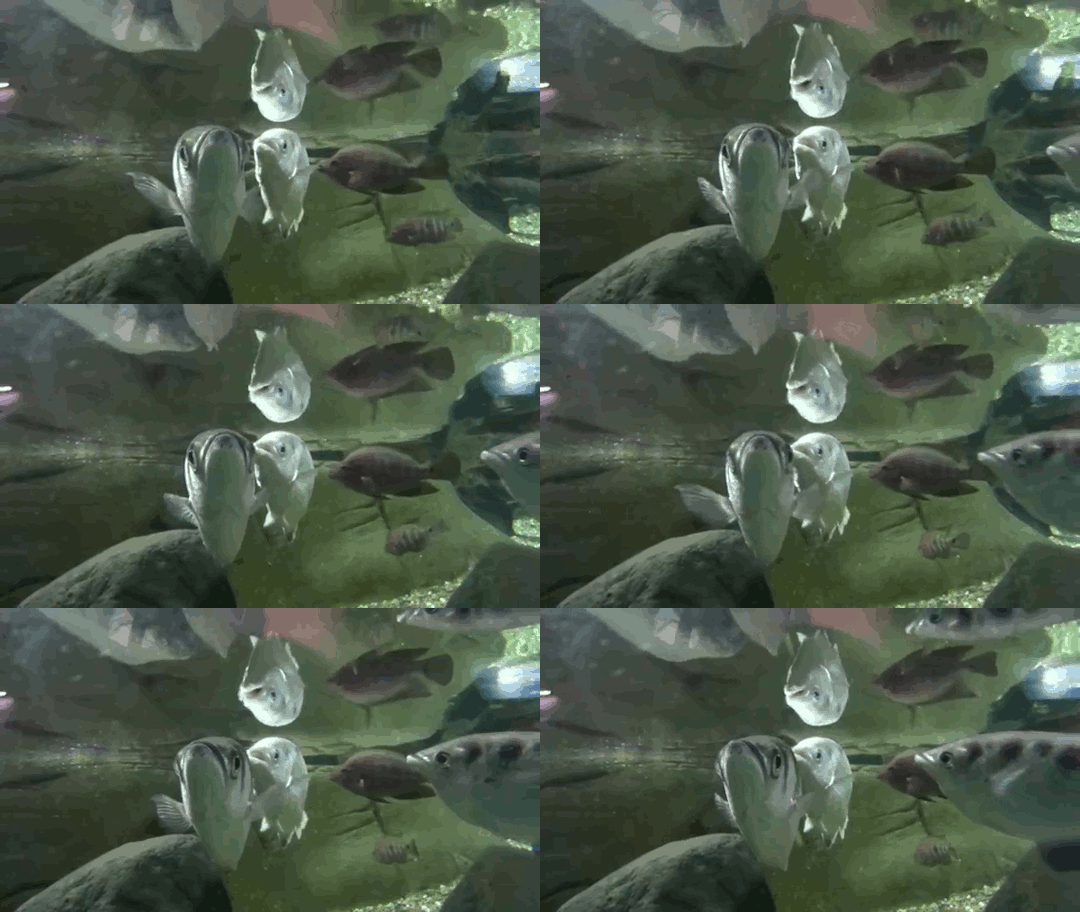
Inside Science has a new documentary all about fluid dynamics! It features interviews with five researchers about current work ranging from the physics of surfing to the spreading of diseases. Penguins, sharks, archer fish, 3D printing, and influenza all make an appearance (seriously, fluid dynamics has everything, guys). If you’d like to learn more about some of these topics, I’ve touched on several of them before, including icing, penguin physics, shark skin, archer fish, and disease transmission via droplets. (Video credit: Inside Science/AIP)


Reversing Time

Waves contain lots of information. They are also time invariant, which means that they will behave the same regardless of whether time moves forward or backward. This isn’t a property we observe often in life since time just moves forward for us. But a new experiment has demonstrated a method of wave control that can, in a sense, roll back the clock.
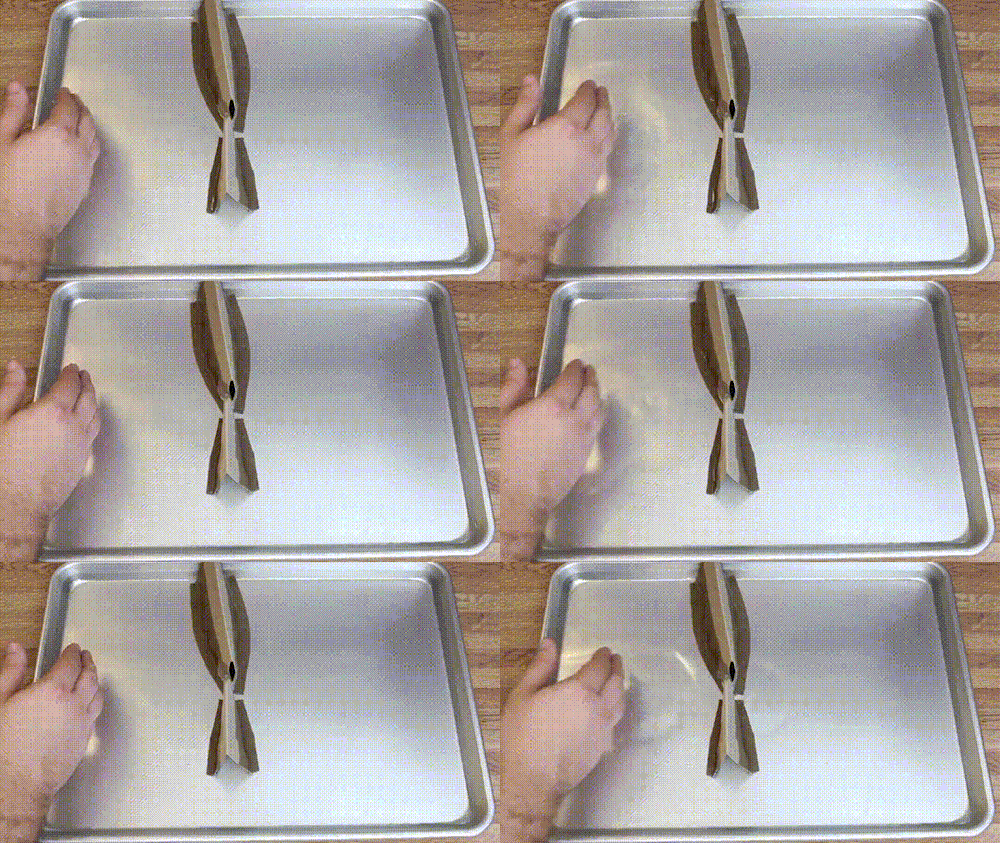
To do this, the scientists created a instantaneous time mirror, or ITM. When they create a disturbance on the surface of a pool of water, it sends out capillary waves in the form of ripples. A short time later, they accelerate the pool sharply downward. This universal disturbance is their instantaneous time mirror, which generates backward-propagating ripples. Those new backward-propagating waves travel back toward the source and refocus into the shape of the initial disturbance. This works for both a simple point disturbance (top image) and for a more complicated geometry like a smiley face (bottom image). (Image credit: V. Bacot et al., source; submitted by @g_durey)
ETA: To be clear, this experiment does not refute causality. It’s more like saying that the information for the initial conditions is still carried on in the later state and that you can do something to extract that information.

Diffraction
Wave phenomena can sometimes be a little difficult to wrap one’s head around. In this video, Mike from The Point Studios explains wave diffraction and why opening a window can help you spy on the conversation next door. Diffraction occurs when waves encounter an obstacle. If that obstacle is a slit in a wall, the slit becomes a point source, radiating waves outward spherically. The video focuses on acoustics, but diffraction matters in more than just sound – it’s key to water ripples, light and other electromagnetic waves, and, according to quantum theory, the fundamental building blocks of matter. (Video credit: The Point Studios)


Below a Surfer’s Wave
From below a plunging breaking wave–the classic surfer’s wave–looks like a giant vortex tube. Smaller rib vortices, the rings around the main vortex in the photo above, can form where there are variations along the breaking wave. As the wave rolls on, it stretches the vorticity variations along the wave’s span. When stretched, vortices spin up and intensify; this is a result of conservation of angular momentum. Check out more amazing photos of waves in Ray Collins’ portfolio. (Photo credit: R. Collins; via The Inertia)

Water-Based Tractor Beam
Researchers in Australia have demonstrated a “tractor beam” capable of manipulating floating objects from a distance using surface waves on water. And, unlike some research, you can try to replicate this result right in the comfort of your own bathtub! When a wave generator oscillates up and down, it creates surface waves that move objects and particles on the water’s surface. When the wave amplitudes are small, the outgoing wave fronts tend to be planar, as in part (a) of the figure above. These planar waves push surface flow away from the wave generator in a central outward jet, and new fluid is entrained from the sides to replace it. This creates the kind of flowfield shown in the streaklines of part (b).Increasing the amplitude of the surface waves drastically changes the surface flow’s behavior. Larger wave amplitudes are more susceptible to instabilities due to the nonlinear nature of the surface waves. This means that the planar wave fronts seen in part (a) break down into a three-dimensional wavefield, like the one shown in part (c). Near the wave-maker, the surface waves now behave chaotically. This pulsating motion ejects surface flow parallel to the wave-maker, which in turn draws fluid and any floating object toward the wave-maker. The corresponding surface flowfield is shown in part (d). The researchers are refining the process, but they hope the physics will one day be useful in applications oil spill clean-up. (Video credit: Australia National University; image and research credit: H. Punzmann et al. 1, 2; via phys.org; submitted by Tracy M)

Wave Tank
A new wave tank facility opening at the University of Edinburgh promises new capabilities to simulate ocean wave behavior. The circular 25m diameter wave tank is lined with 168 wave makers and is equipped with 28 submerged flow-drive units. Together, these allow the tank to simultaneously simulate nearly any wave type as well as tidal currents up to 1.6 m/s. The facility is intended for 1/20th scale modeling; projected to full-size, this means that the tank is capable of making waves representative of 28 m high ocean waves and tidal currents in excess of 12 knots. It’s expected to be particularly valuable in the development and testing of wave and tidal motion generators for clean energy. For more, see BBC News and FloWave’s own website. (Image credit: Brightspace/BBC News; submitted by srikard)

Kelvin Wakes
Ducks, boats, and other objects moving along water create a distinctive V-shaped pattern known as a Kelvin wake. As the boat moves, it creates disturbance waves of many different wavelengths. The constructive interference of the slower waves compresses them into the shock wave that forms either arm of the V. Sometimes evenly spaced wavelets occur along the arms as well. Between the arms are curved waves that result from other excited wave components. The pattern was first derived by Lord Kelvin as universally true at all speeds – at least for an ideal fluid – but practically speaking, water depth and propeller effects can make a difference. Recently, some physicists have even suggested that above a certain point, an object’s speed can affect the wake shape, but this remains contentious. (Image credit: K. Leidorf; via Colossal; submitted by Peter)

Sand Ripples
Wave motion in a bay or near a beach can cause significant sediment transport. Individual granular particles, like sand, can be lifted by the passage of a single wave, but, over time, complex patterns form as the granular bottom surface shifts due to the waves. This video shows time-lapse footage of the ripples that form and move in submerged sand during many hours of wave motion. A slight imperfection in the surface causes a network of sand ripples to grow and spread. Once formed, those ripples shift and reform depending on changes in the wave conditions. (Video credit: T. Parron et al.)


Researchers in Australia have