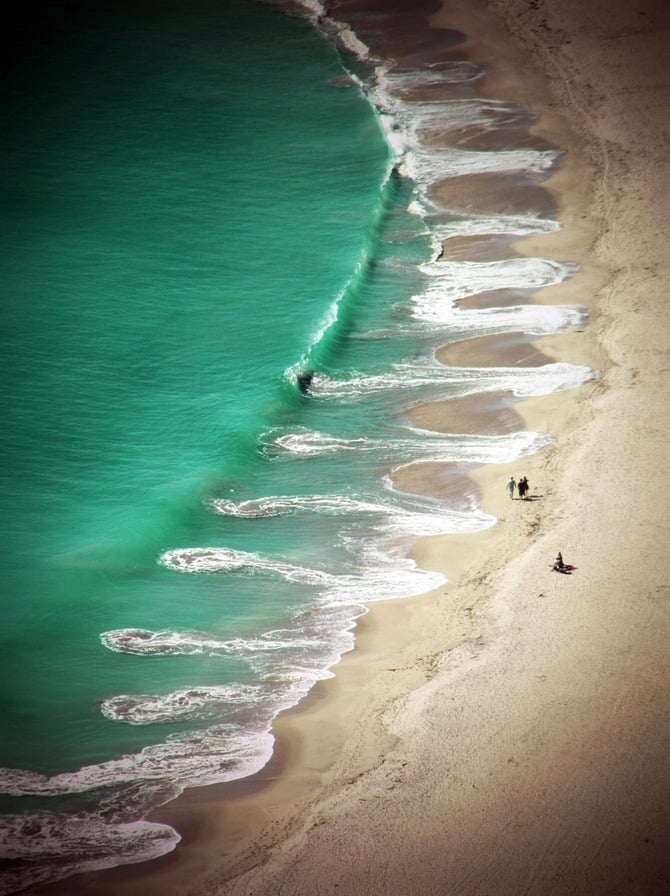
Beach cusps are arc-like patterns of sediment that appear on shorelines around the world. Cusps consist of horns, made up of coarse materials, connected by a curved embayment that contains finer particles. They are regular and periodic in their spacing and usually only a few meters across. A couple of theories exist as to how cusps form, but once they do, they are self-sustaining. When an incoming wave hits a horn, the water splits and diverts. The impact of the wave on the horn slows the water, causing it to deposit heavy, coarse particles on the horns while finer sediment gets carried up to the embayment before the wave flows back outward. (Photo credit: L. Tella; inspired by E. Wiebe)
Tag: waves

Breaking Waves
Most beach-goers have probably wondered just what makes the waves coming in to shore rear up and break. The secret lies in the depths–or rather the lack thereof–beneath the waves. Far from shore, the wave’s length scale is small compared to the ocean depth, and the ocean’s bottom is effectively infinitely far away to all parts of the wave. But, as the wave rolls toward shore, the depth decreases and the ocean bottom begins to influence the wave. In the trough, the ocean bottom slows the wave. Meanwhile, the crest of the wave carries forward, rising until its height reaches 80% of the water depth, at which point it will tip over and break.(Video credit: BBC)

Fluids Round-up – 25 May 2013
Sometimes I come across cool links and stories about fluid dynamics that don’t quite fit into a typical FYFD post, but I’d like to start sharing those semi-regularly with round-up posts. Here’s some fun stuff I’ve seen lately:
- We’ve talked before about penguins and fluid dynamics, but this IOP talk from Helen Czerski is a great take on how they use fluids to escape predators.
- Over at FlowViz, Richard has a great video demonstrating deep versus shallow water waves side-by-side.
- io9 shows off the vibrational modes of mercury as well as explaining why birds can be good at flying or swimming but not both.
- Giant paint explosions (specifically here) may be fun to watch but the dangers are not for squeamish viewers.
- Dylan G sent us this 512K real-time fluid particle simulation that’s a fun distraction.
- xckd’s Randall Munroe answers all kinds of physics questions at his What If? blog, but occasionally there are some fluids ones. Two of my favorites consider a hypersonic steak and what happens if the glass is literally half full.
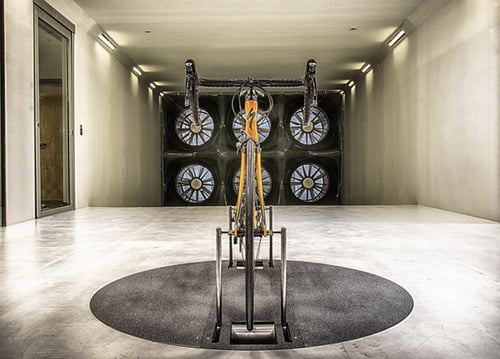
- Finally, for the cyclists and triathletes among you, the recent news that bicycle manufacturer Specialized has built its own wind tunnel has generated lots of discussion of aerodynamics in sport. Mark Cote (@MITAeroBike) and Chris Yu (@chrisyuinc) of Specialized’s aero R&D have been answering questions on Slowtwitch, Twitter, and in live chats.
And, yes, that last Specialized video chat includes an FYFD shout-out about 49 minutes in. 🙂
(Photo credit: Specialized)

Reader Question: Energy from Whirlpools?
shiftymctwizz asks:
So I just read your post about vortices, and now I’m wondering if we could build structures similar to the Corryvreckan and put turbines in them for energy production? Would it be any more efficient than hydroelectric dams? Are you the right person to ask?
I can’t give you numbers off the top of my head, but I suspect that your typical hydroelectric dam will be more reliable if not more efficient. The trouble with things like the Corryvreckan, aside from the randomness of where the vortices pop up, is that they aren’t there every single day the way, say, Niagara Falls is.
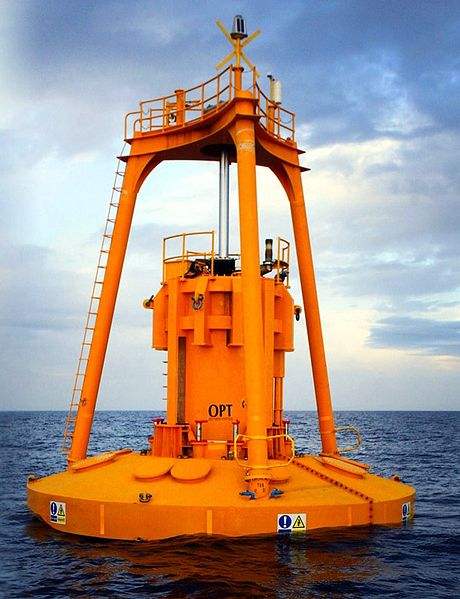
That said, there is on-going work to effectively harness ocean waves for power, with ideas like buoy generators or sea snake generators. As with most concepts one of the difficulties in implementation is determining a safe and efficient manner to transmit the electricity generated from these offshore sites (we’re generally talking miles from shore) to where it’s needed. This problem is often similarly faced by solar and wind energy producers. There are already wave farms in place around the world, though, and it’s a promising field of renewable energy. (Photo credit: Wikimedia)

Reader Question: Standing Waves
captainandry asks:
What would happen to a fish or swimmer in a standing wave?
First of all, check out the video that inspired this question, which shows a standing water wave created in a wave tank. Before we tackle the standing wave, it’s helpful to know what motion exists in a typical water wave. For deep water waves, the motion of a particle as the waves pass is circular, with a decreasing radius with increasing depth. Below a certain depth the energy of the surface wave doesn’t penetrate. Here’s an animation, where the red dots represent massless particles and the blue circles show their paths:
In shallower waters, the circular paths get compressed into ellipses. The image below shows pathlines for particles at different depths as a water wave passes. Notice how the paths are circular near the surface, where the depth is much greater than the wavelength, while close to the bottom, the pathlines are elliptical.

So what about motion for a standing water wave? Such a wave has no apparent horizontal motion, as seen in the animation below:

Similar to the way that decreasing the depth compresses the circular particle motion into an ellipsoid, creating a standing wave compresses the horizontal motion of any particle near the surface. What this means is that anything floating near the surface of the standing wave will simply bob up and down. Unless it’s located at one of the nodes (marked by red dots), in which case it won’t move at all! As with the other types of water waves, the amount of displacement will decrease with depth. People and fish, of course, are not massless particles, so their motion will be damped by inertia, but the same principles apply.
(Photo credits: P. Videtich; R. L. Wiegel and J.W. Johnson; Wikipedia)

Under the Waves

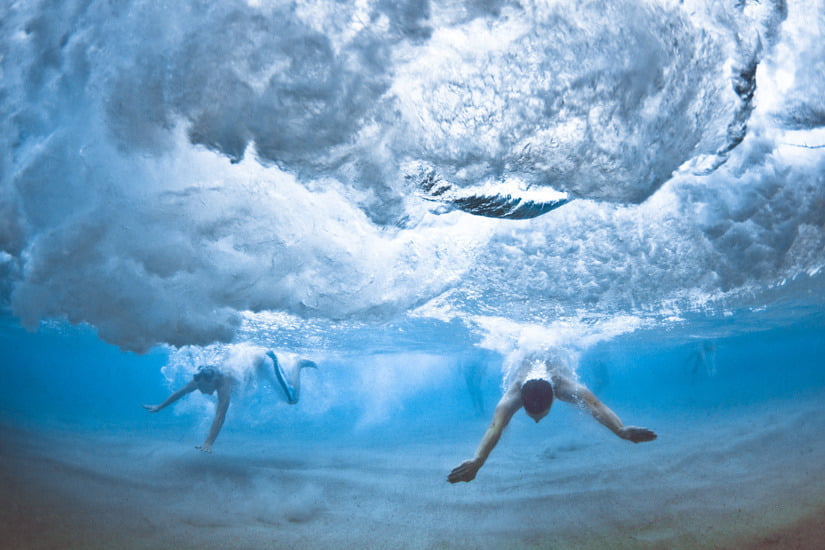


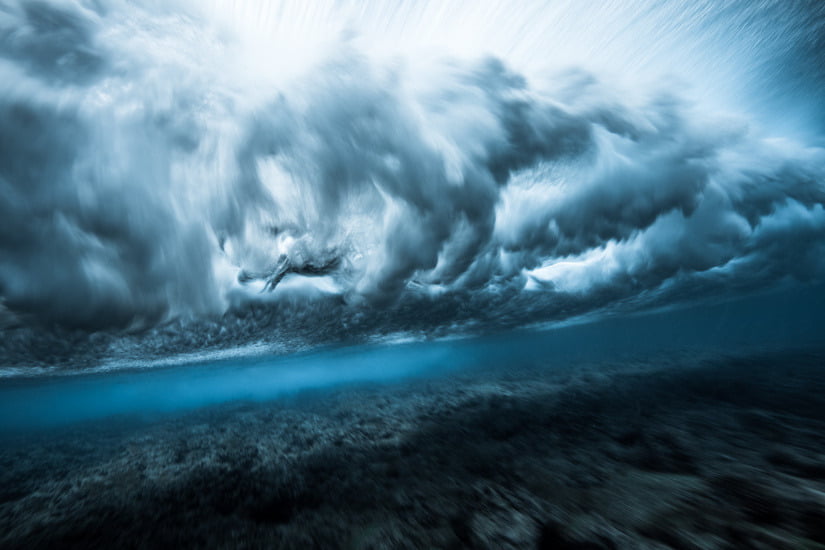
When I was a kid, I liked to dive underwater in the pool and sit at the bottom, looking up at the peculiar dancing sky the water made overhead. Photographer Mark Tipple takes it further, capturing images of the ocean from below the surface as waves roll in. His photos show swimmers and surfers diving to escape a roiling wave that, from below, bears a surreal similarity to the underside of a thundercloud in a summer storm. This is part of the beauty of fluid dynamics. Despite their differences, water and air obey the same physics. (Photo credits: Mark Tipple; via io9)
Following a Breaking Wave
It’s fascinating to sit on the beach and watch the waves roll in and break, but rarely do we get a view like the one in this video. Here researchers have created a breaking wave in a wave tank and recorded the wave as it travels the length of the tank with a high-speed camera moving at the same speed as the wave crest. This perspective, moving alongside the fluid, is a Lagrangian coordinate system; if one instead stood still and watched the wave roll past, it would be an Eulerian measurement. Traveling with the wave, we can see how a lip forms on the wave crest, then rolls down, capturing a tube of air. As water begins to flow over the lip, perturbations grow, causing ripples in the laminar curtain. Then the water strikes the main wave and rebounds turbulently, creating a familiar white cap. In the second half of the video, the process is shown from above, highlighting the entrainment of air and the creation of the bubbles that form the white cap of a breaking wave. (Video credit: R. Liu et al)
Leidenfrost Dynamics
When a liquid impacts a solid heated well above the liquid’s boiling point, droplets can form, levitating on a thin film of vapor that helps insulate them from the heat of the solid. This is known as the Leidenfrost effect. Here a very large Leidenfrost droplet is shown from the side in high-speed. A vapor chimney forms beneath the drop, causing the dome in the liquid. When the dome bursts, the droplet momentarily forms a torus before closing. The resulting oscillatory waves in the droplet are spectacular. The same behavior can be viewed from above in this video. (Video credit: D. Soto and R. Thevenin; from an upcoming review by D. Quere)

London 2012: Swimming Pool Physics


The era of the LZR suit may be over in swimming, but technology is still making an impact when it comes to making swimmers faster. One thing you’ll often hear from commentators is how the London Aquatic Center boasts one of the world’s fastest pools. When swimmers compete, they have to contend with all the turbulence created in the pool by eight people trying to direct as much water behind them as possible as quickly as possible. Like ripples spreading on a pond, these waves travel, reflect, and interfere, ultimately disrupting the swimmers and causing extra drag. In a fast pool, engineers have made adjustments to reduce the impact of these waves on swimmers. Firstly, the pool is 3 meters deep, meaning that vertical disruptions are mostly damped out before they reach the bottom, so any wave reflected off the bottom of the pool will be extremely weak. Along the sides and ends of the pool, a special trough captures surface waves, preventing them from reflecting back out into the pool. The lane lines are also designed to soak up wave energy so that it does not propagate as much between lanes. When waves hit the lines, their links spin, dissipating some of the wave’s energy.
Despite these advances, the outermost lanes–those against the walls–are not used in competition. This helps to equalize the turbulence between lanes. Whether there is any fluid mechanical advantage to being in a particular lane is debatable. The outer lanes have the advantage of only one competitor’s wake to contend with, but they isolate the swimmer so he or she cannot see their competition as well. In the inner lanes, you’ll sometimes see swimmers try to swim close to the lane line if their competition is ahead of them, the idea being that they may be able to draft on their competitor’s bow wave to reduce drag. Generally speaking, the lane positions are determined by seeding going into the event, where the faster swimmers are given the innermost lanes. This is why it’s rare to see gold medals coming from the outermost lanes. For more, check out NBC’s video on designing fast pools (US only, unfortunately). (Photo credits: Associated Press, Reuters, Geoff Caddick)
Rogue Wave Recreated
For years, mariners have reported occurrences of rogue waves–sudden, isolated waves many times larger than the surrounding surface waves. Until 1995, when a rogue wave was first measured, debate raged as to whether such waves even existed. Scientists have since agreed that nonlinear models of wave interaction are the most likely source of the amplification necessary to create rogue waves. Since the Navier-Stokes equations that govern hydrodynamics are so difficult to solve, scientists have looked to simpler nonlinear wave equations, like the nonlinear Schroedinger equation that governs optics, to generate rogue-wave-like behavior. While the equation gives insight into how a given wave system will evolve, it is still necessary to determine what initial conditions can lead to the formation of a rogue wave. All manner of random conditions exist in the ocean, but to recreate the behavior in a simplified system, we must know which initial conditions are the right ones. Akhmediev et al presented a theoretical perspective on the initial conditions that might lead to rogue wave amplification, and now, for the first time, researchers have been able to create a rogue wave in a wave tank. That little blip that sinks the Lego pirate ship is a great accomplishment toward understanding a phenomenon whose very existence was in question less than twenty years ago. (Video credit: A Chabchoub, N Hoffmann, and N Akhmediev; via Gizmodo; for more, see APS Viewpoints and Akhmediev et al)