The flapping of flexible objects like flags have long fascinated mankind. The figure above from Shelley and Zhang 2011 shows several possible flapping states. In (a) a thread immersed in a running soap film displays the standard von Karman vortex street of shed vortices in its wake. Parts (b) and © show the thread in coherent flapping motion; (b) shows an snapshot of the flapping thread in the soap film whereas © is a timelapse of the thread showing its full range of motion. Image (d) shows the effects of a higher flow speed–the flapping motion becomes aperiodic. Image (e) shows a stiff metal wire bent into the shape of a flapping filament; note the strong boundary layer separation around the wire compared to the thread in Image (b). As one might expect, the drag on the unflapping wire is significantly greater than the drag on the flapping thread. (Image credit: M. Shelley and J. Zhang, Shelley and Zhang 2011)
Tag: wake

Flapping Wakes
As a flapping object moves through a fluid, many patterns of vortices can form in its wake. The familiar von Karman vortex street, so often seen in clouds or behind cylinders, is only the beginning. In the photo above, a symmetric foil flaps in a vertical soap film; as the amplitude and frequency of the oscillation varies, the wake patterns it produces change dramatically. From left to right, a) a von Karman wake; b) an inverted von Karman wake; c) a 2P wake, in which two vortex pairs are shed with each cycle; d) a 2P+2S wake, in which two vortex pairs and two single vortices are shed per cycle; e) a 4P wake; and f) a 4P+2S wake. See some of these flows in action in these videos. (Photo credit: T. Schnipper et al.)

Cloud Swirls
Two interesting sets of clouds are featured in this satellite photo of the Canary Islands and the coast of Africa. In the upper part of the picture, closed cell stratocumulus clouds cover the ocean. As the wind drives these clouds over the islands, their pattern is disturbed by mountains that force the lower layers of air up and around, forming von Karman vortices and wakes that mingle and twist the cloud patterns to the south of the islands. (Photo credit: European Space Agency; via Wired)

Mackerel vs. Eel: Who Swam It Better?
Which matters more, form or function? This simulation sets out to answer that question by comparing the swimming motion of eels and mackerels. Eels have longer, more rounded body shapes and swim in an undulatory fashion with their whole body, whereas mackerels have shorter bodies with a more elliptical cross-section and primarily move their tails when swimming. The simulation separates body type from swimming motion by creating virtual races between fishes of the same body type using the two forms of swimming. Eels swim at moderate Reynolds numbers where viscous and inertial effects are reasonably balanced. Under those conditions, eel-like swimming was faster, even with a mackerel’s body type. At the higher Reynolds numbers where mackerels usually swim, inertial forces domination and the racing fish moved faster if they swam like a mackerel, even with the body of an eel. The results suggest that the swimming motion matters more in each Reynolds number range than the shape of the swimmer. This is a neat way that simulation can answer questions we cannot test with an experiment! (Video credit: I. Borazjani and F. Sotiropoulos)

Flow Around Traffic
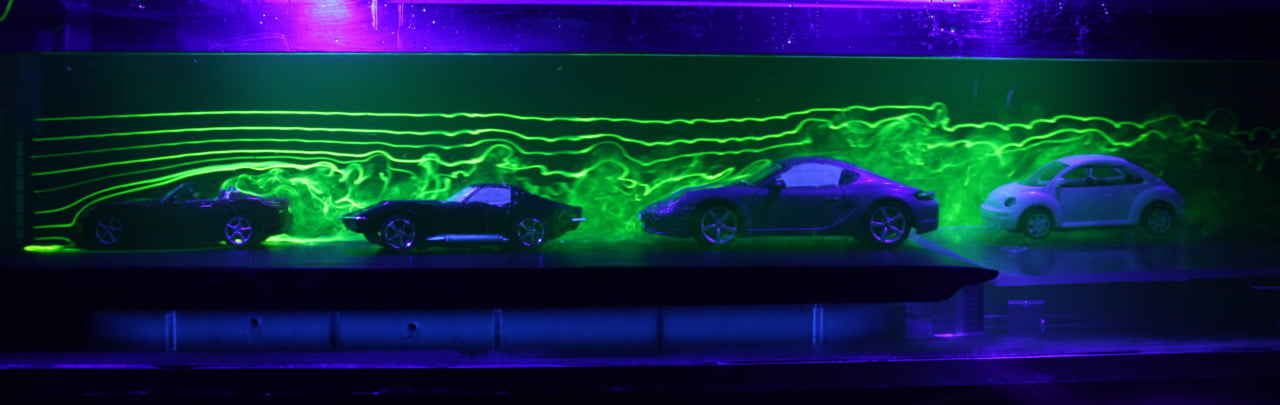
Flow visualization in a water tunnel shows what the flow around a line of traffic looks like. Note the progressively more turbulent flow around each car as it sits in the wake of the car before it. Turbulent flow is usually associated with increased drag forces, but because turbulence can actually help prevent flow separation it is sometimes desirable as a method for decreasing drag. In the case of these cars drafting on one another, it is clear that the cars further back in the line cause less effect on the fluid–and thus have less drag to overcome–than the front car. (Photo credit: Rob Bulmahn)
Supersonic Flow Around a Cylinder
This numerical simulation shows unsteady supersonic flow (Mach 2) around a circular cylinder. On the right are contours of density, and on the left is entropy viscosity, used for stability in the computations. After the flow starts, the bow shock in front of the cylinder and its reflections off the walls and the shock waves in the cylinder’s wake relax into a steady-state condition. About halfway through the video, you will notice the von Karman vortex street of alternating vortices shed from the cylinder, much like one sees at low speeds. The simulation is inviscid to simplify the equations, which are solved using tools from the FEniCS project. (Video credit: M. Nazarov)

Artificial Fins in Tandem
For this image, two artificial fish fins are placed side-by-side and flapped in phase. Flow in the image is upward. The wakes of the fins interact in a complicated vortex street. Researchers hope that studying such flows can help in designing the next generation of autonomous underwater vehicles. (Photo credit: B. Boschitsch, P. Dewey, and A. Smits)

Shark Wakes
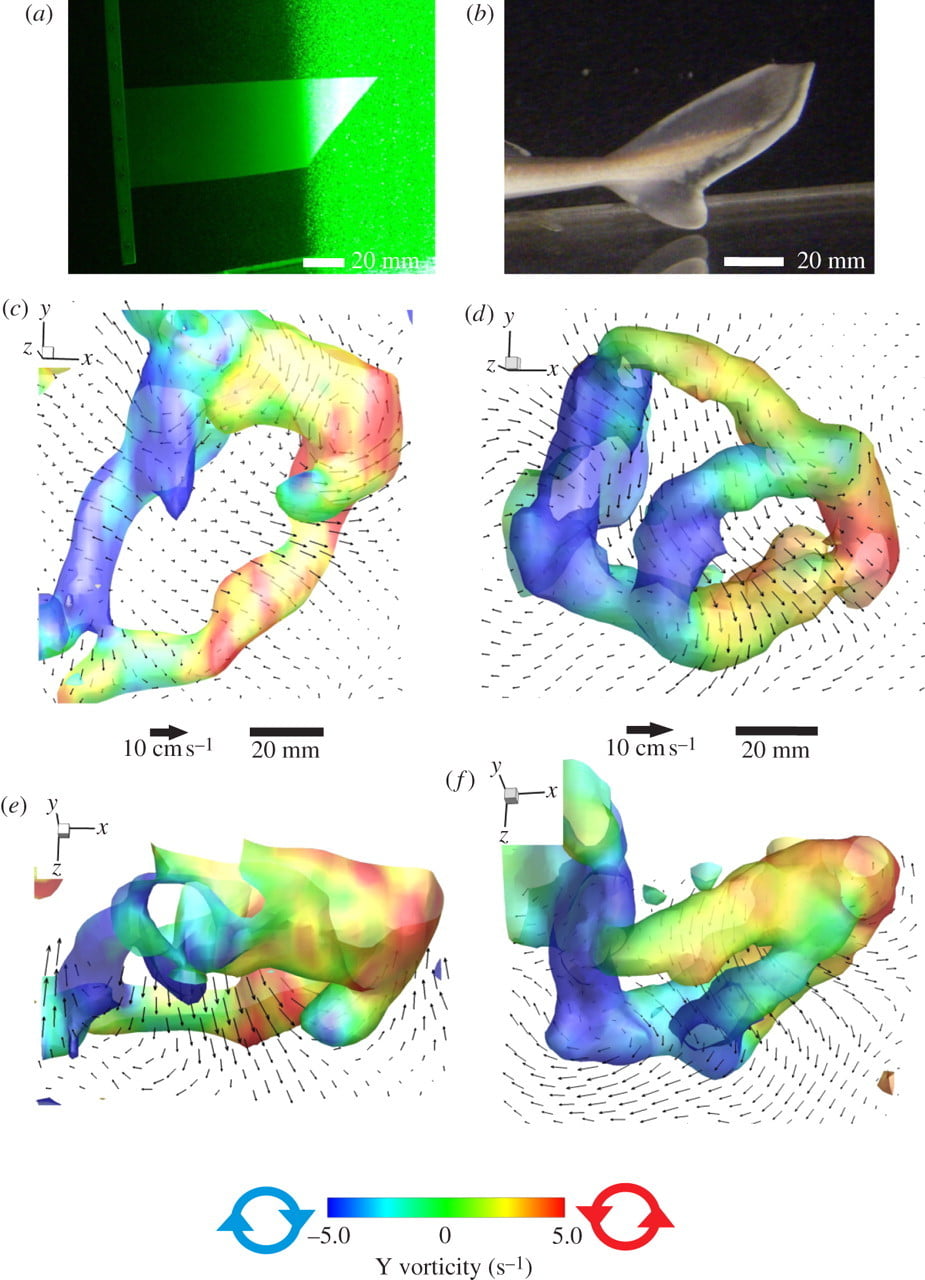
Volumetric imaging of swimming spiny dogfish, a type of shark, shows that their distinctively asymmetric tails produce a set of dual-linked vortex rings with every half beat of their tail. The figure above shows data from the actual shark on the right (b,d,f) and a similarly shaped robotic tail on the left (a,c,e). The second row contains lateral views (c,d) and the bottom row contains dorsal views (e,f) of the vorticity isosurfaces measured. The robotic tail does not demonstrate the same double vortex structure, leading scientists to suspect that the shark may be actively stiffening its tail mid-stroke to control its wake. The finding could help engineers design aquatic robots whose morphing fins help it swim more efficiently. For more, see Wired.

Pitching Plate Flow Viz
This photograph uses fluorescent dye to visualize the wake behind a rigid flat plate pitching about its leading edge. A vortex is shed from the plate twice in each cycle of oscillation. These vortices entangle, producing the structured wake above. The top photo shows a side view of the wake, the bottom photo is a top view. (Photo credit: J. Buchholz and A. Smits)