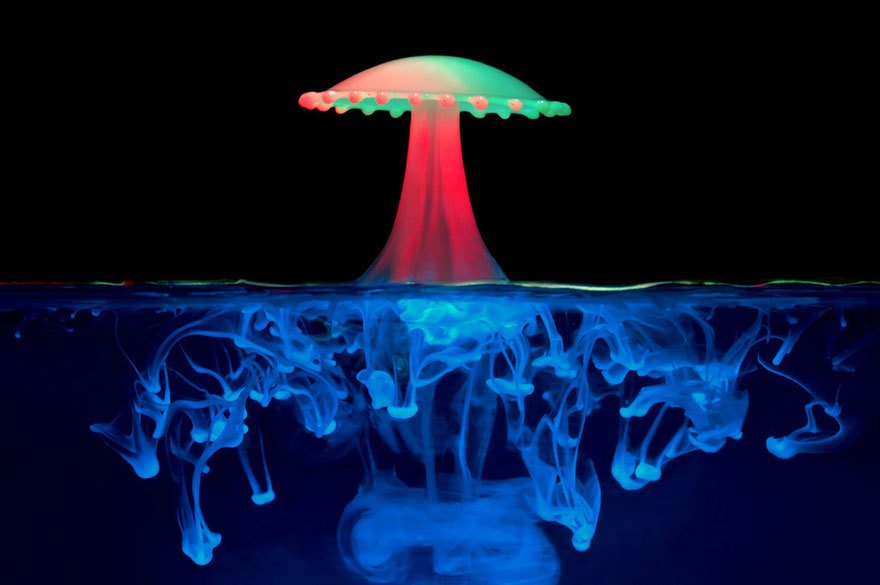
Artist Corrie White uses dyes and droplets to capture fantastical liquid sculptures at high-speed. The mushroom-like upper half of this photo is formed when the rebounding jet from one droplet’s impact on the water is hit by a well-timed second droplet, creating the splash’s umbrella. In the lower half of the picture, we see the remains of previous droplets, mixing and diffusing into the water via the Rayleigh-Taylor instability caused by their slight difference in density relative to the water. There’s also a hint of a vortex ring, likely from the droplet that caused the rebounding jet. (Photo credit: Corrie White)
Tag: vortex rings

Truck Vortices
The video above shows vortex rings of smoke ejected from the burning tire of a moving truck. Without seeing the damaged tire, it’s tough to pinpoint the cause with certainty, but here are a couple of ideas. Typically vortex rings are formed with a burst of air through a narrow orifice; this is, for example, how humans, dolphins, vortex cannons, and volcanoes all make smoke rings. If air is escaping the tire through small holes, this could cause rings. Unlike in those situations, though, the tire is spinning, which means its motion is already imparting vorticity to the flow, so that any air escaping the tire forms a vortex ring. (Video credit: The Armory; submitted by eruditebaboon)
ETA: Others are suggesting the vortex rings are due to a failure of the engine, with unsteady exhaust velocities resulting in the vortex structures. I think this might still depend on the exhaust pipe’s geometry. Regardless of the exact cause, the video remains an interesting bit of fluid dynamics.
Dropping Through Strata
When a droplet falls through an air/water interface, a vortex ring can form and fall through the liquid. In this video, the researchers investigate the effects of a stratified fluid interface on this falling vortex ring. In this case, a less dense fluid sits atop a denser one. Depending on the density of the initial falling droplet and the distance it travels through the first fluid, the behavior and break-up of the vortex ring when it hits the denser fluid differs. Here four different behaviors are demonstrated, including bouncing and trapping of the vortex ring. (Video credit: R. Camassa et al.)
Supersonic Bubble Shock Waves
Supercomputing has been an enormous boon to fluid dynamics over the past few decades. Many problems, like the interaction between a supersonic shock wave and a bubble, are too complicated for analytical solutions and difficult to measure experimentally. Numerical simulation of the problem, combined with visualization of key variables, adds invaluable understanding. Here a shock wave strikes a helium bubble at Mach 3, and the subsequent interactions in terms of density and vorticity are shown. This situation is relevant to a number of applications, such as supersonic combustion and shockwave lithotripsy–a medical technique in which kidney stones are broken up inside the body using shock waves. After impact, an air jet forms and penetrates the center of the structure while the outer regions mix and form a persistent vortex ring. (Video credit: B. Hejazialhosseini et al.; via Physics Buzz)

Falling Oil
A drop of silicone oil falling through a liquid with lower surface tension distorts into multiple vortex rings connected by thin films. This behavior is caused by the interaction between viscous and capillary forces and is observable for only a narrow range of oil viscosities. (Photo credit: A. Felce and T. Cubaud)
Inky Vortex
Ink released into water shows the swirling motion inside a vortex ring as well as its deformation and breakup upon stagnation against a wall. Although humans are known to make such vortex rings with smoke or bubbles, they are common in nature as well. Buoyant plumes often feature vortex rings at their head; dolphins and whales play with bubble rings; volcanoes blow smoke rings; and mosses use them to distribute spores.
Dolphin Bubble Rings
Dolphins create vortex rings to play with by exhaling through their blowholes. The sharp impulse of air, combined with the round shape, creates a vortex ring of bubbles. Humans can do this underwater, too, but dolphins aren’t content to lie at the bottom of the pool. Because smaller vortex rings are more coherent and last longer, they will break the growing vortex so that the vortex fragment rejoins as a smaller vortex ring. They also spin the water nearby to cause wave instabilities in the ring.
Plumes Driven by Chemistry
This timelapse video shows the formation and steady-state behavior of a buoyancy-driven plume created by a chemical reaction. As the plume accelerates upward, it develops a head, which in some cases detaches from the plume in the form of a vortex ring. A new head then develops before also detaching and accelerating upwards. (Video credit: M. Rogers)
Vortex Cannon
Building a vortex cannon is a great way to demonstrate the power and longevity of vortex rings. As demonstrated here, it’s possible to create one with just a box with a round hole in it. Adding some smoke or stage fog helps visualize the rings. Vortex rings are found frequently in nature: volcanoes make them, some plants use them to distribute spores, and dolphins and whales use them to play. (submitted by @aggieastronaut)
Vortex Ring Collision
Two vortex rings collide head-on in this video. If their vorticities and velocities are matched in magnitude and opposite in direction, their collision results in a stagnation plane–essentially a wall across which the fluid does not pass. In reality, there are slight variations that result in non-zero velocities where the vortices meet, so some mixing occurs, but the overall symmetry remains striking. The collision breaks up the vortex ring into filaments, some of which cross-link with the other vortex’s filaments, resulting in the little halo-like eddies around the perimeter. Videos of the same experiment at different Reynolds numbers can be found here. (Submitted by Charlie H; Video credit: T. Lim and T. Nickels)