Playing with a vortex cannon is a ton of fun, and they are remarkably easy to make. You can knock over cups or card houses, create art, or just try your best Big Bad Wolf impression. Or you can supersize things like one group in the Czech Republic did and build a 3m vortex cannon capable of firing 100m! (Seriously, watch it in action here.) And if you’d like to learn more about how vortex rings form and why they’re useful in nature and engineering, check out my vortex ring video. (Image credit: Laborky Cz, source; via Gizmodo)
Tag: vortex rings

These Invertibrates May Help Robots Swim
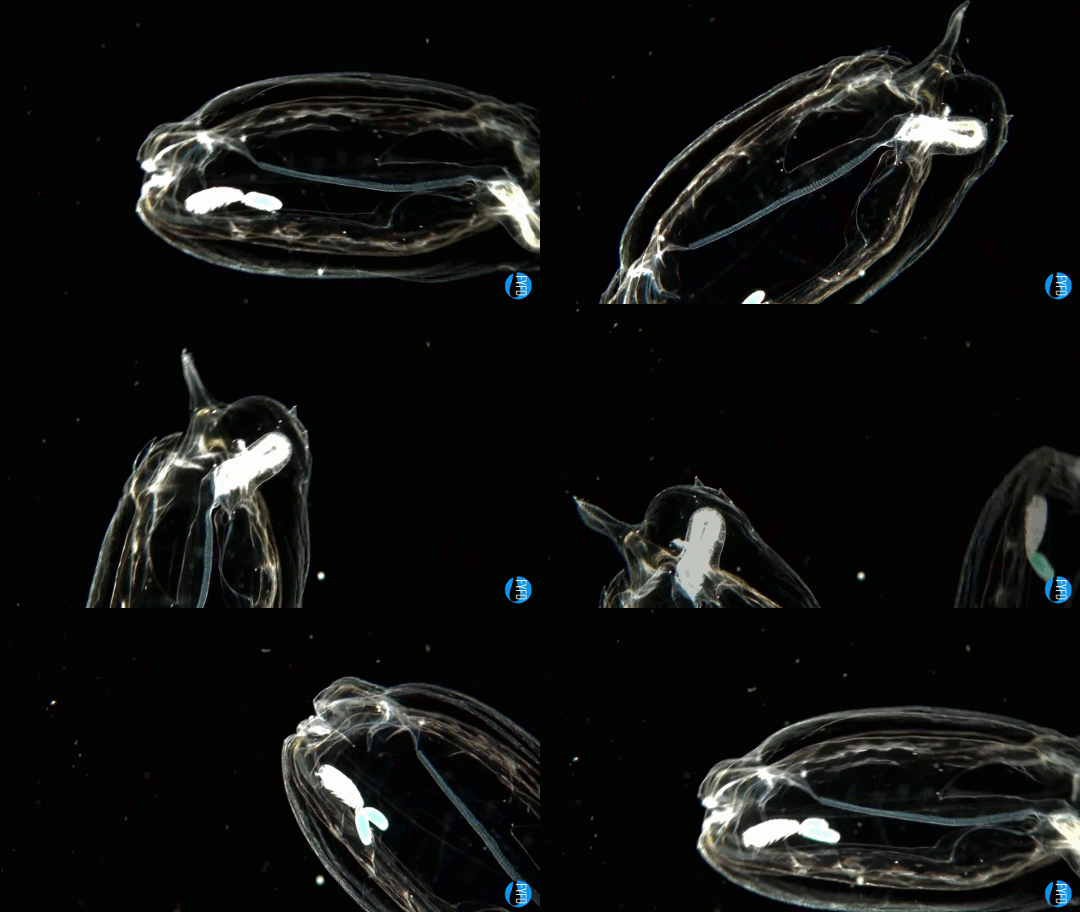
New FYFD video! Learn all about salps, vortex rings, and underwater robots. Thanasi Athanassiadis takes me inside his lab and his newly published research into how proximity affects the thrust two vortex rings can produce.
There are a ton of little things I love about how this video came out, especially the chalkboard animations. Check it the full video below and click through to the video description for lots more information about salps and vortex rings.
(Image and video credits: N. Sharp and A. Athanassiadis; Original salp images: A. Migotto and D. Altherr)

Vortex Ring Roll-Up
Vortex rings are endlessly fascinating, and they appear throughout nature from dolphins to volcanoes and from splashes to falling drops. One way to form them is to inject a jet into a stationary fluid. Viscosity between the fast-moving jet and the quiescent surrounding fluid slows down fluid at the jet’s edge. That slower fluid slips to the rear, only to get sucked into the faster -moving flow and pushed forward again. The result is a spinning toroid, or ring. A similar method generates vortex rings by pushing a fluid out a round orifice. In this case, interaction between the fluid and the wall provides some of the force necessary to form the vortex ring. (Image credit: Irvine Lab, source)

Wrinkling Fluids
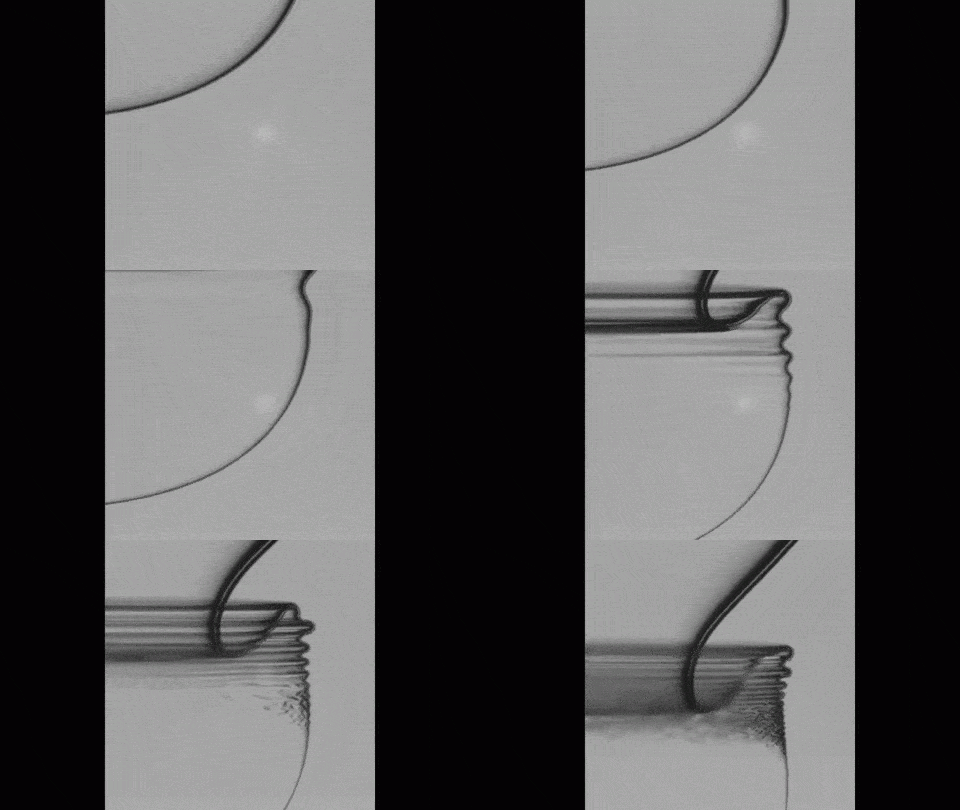
What you see here is a viscous drop falling into a less viscous fluid. Shear forces between the drop and the surrounding fluid cause the drop to quickly deform into a shape like an upside-down mushroom as it descends. The cap forms a vortex ring that curls the viscous fluid back on itself. As it does, that motion compresses the viscous sheet, causing it to wrinkle, as seen in the close-up in the bottom animation. Check out the full video here. (Image credit: E. Q. Li et al., source)
Fluids Round-Up
New year, new (or renewed) experiments. This is the fluids round-up, where I collect cool fluids-related links, articles, etc. that deserve a look. Without further ado:
- Above is a new music video from the Julia Set Collection, featuring all non-CGI, fluids-based visuals. I spy soap films, vibrating liquids, and lots of cool effects with reflection and refraction. We featured some of their previous work, too.
- The Atlantic has a great piece about jellyfish and how they might just change our understanding of efficient swimming.
- Check out the wild shape-shifting of these drops of oil during freezing and learn about the plastic crystal phase some matter experiences.
- Nature has an interesting article on active matter, an intersection of physics and biology exploring how matter self-organizes, whether at the level of cells or the flocking of birds. (submitted by 1307phaezr)
- Ever wonder what the human face looks like in 457 mph winds? Wonder no more.
- Gizmodo has a beautiful set of macro photos of snowflakes. Interested in how snowflakes form and why there are so many different shapes? We’ve got you covered.
- Wired takes a look at the surf forecaster who predicts the waves for the Mavericks big-wave competition.
- Robert Krulwich (and friends) took a closer look at our fish in microgravity. Here’s what they learned!
(Video credit and submission: Julia Set Collection/S. Bocci; image credit: IRPI LLC, source)

Newtonian and Non-Newtonian Vortices

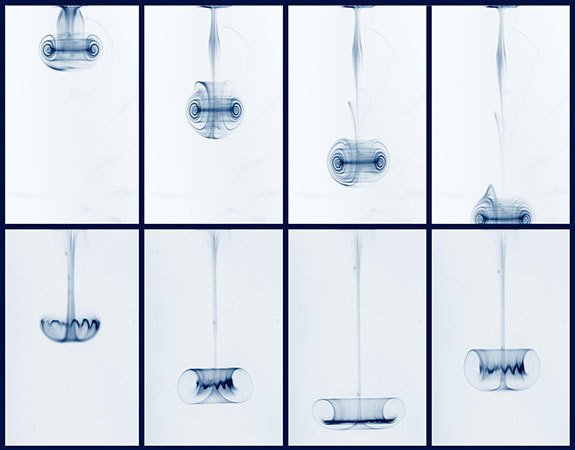
Not all vortex rings are created equal. Despite identical generation mechanisms and Reynolds numbers, the two vortex rings shown above behave very differently. The donut-shaped one, on the top left in green and in the middle row in blue, was formed in a Newtonian fluid, where viscous stress is linearly proportional to deformation. As one would expect, the vortex travels downward and diffuses some as time passes. The mushroom-like vortex ring, on the other hand, is in a viscoelastic fluid, which reacts nonlinearly to deformation. This vortex ring first furls and expands as it travels downward, then stops, contracts, and travels backward! (Image credit: J. Albagnac et al.; via Gallery of Fluid Motion)

Half Vortex Rings
Vortices are one of the most common structures in fluid dynamics. In this video, Dianna from Physics Girl explores an unusual variety of vortex you can create in a pool. Dragging a plate through the water at the surface creates a half vortex ring, which can be tracked either by the surface depressions created or by using food dye for visualization. Vortex rings are quite common, but a half vortex ring is not. The reason is that, ignoring viscous effects, a vortex filament cannot end in a fluid. The vortex must close back on itself in a loop, or, like the half vortex ring, the ends of the vortex must lie on the fluid boundary. It is possible to break vortex lines like those in smoke rings, but the lines will reattach, creating new vortex rings–just as they do in these vortex knots. (Video credit: Physics Girl; submitted by Tom)
Crow Instability
Behind airplanes in flight, water vapor from the engine exhaust will sometimes condense in the wingtip vortices, thereby forming visible contrails. The two initially parallel vortex lines are unstable and any small perturbation to them–a slight crosswind, for example–will cause an instability known as the Crow instability. The contrails become wavy, with the amplitude of the wave growing exponentially in time due to interactions between the two vortices. Eventually, the vortex lines can touch and pinch off into vortex rings. The effect is also quite noticeable when smoke generators are used on a plane, and there are some great examples in this air show video between 3:41:00 and 3:44:00. (Video credit: M. Landy-Gyebnar; h/t to Urs)
Antibubble Vortex Rings
Bubbles are familiar, but antibubbles are a bit more unusual. An antibubble typically has a liquid-air-liquid interface, with a thin shell of air separating a liquid droplet from the surrounding fluid. Although they look rather like bubbles, antibubbles behave differently. Antibubbles are, for example, very sensitive to pressure changes. A sinking antibubble like the one in the video above, experiences a higher pressure on its lower face. This pressure compresses the gas shell and thins it on the bottom. The air shell bursts at the thin point and the antibubble collapses, generating two vortex rings and a small, buoyantly rising bubble. (Video credit: S. Dorbolo et al.)
P.S. – Hello, new followers! Where did you all come from?!
Forming a Vortex
[original media no longer available]
Vortex rings show up remarkably often in nature. In addition to being the playthings of dolphins, whales, scuba divers, humans, and swimmers, vortex rings appear in volcanic outbursts and spore-spreading peat mosses. Vortex rings even occur in blood flow through the human left ventricle in the heart. In each of these cases, the vortex ring is formed by impulsively accelerating fluid through a narrow opening, like the dolphin’s blowhole. The fluid at the edge of injected jet is slowed by friction with the quiescent surrounding fluid. The fluid at the edge of the jet then slips around the sides and into the wake of the faster-moving fluid, where it’s accelerated through the middle of the forming vortex ring. This spinning from the inside-out and back-in persists as long as the vortex is intact, and is part of what keeps the ring from dissipating. (Video credit: SeaWorld; submitted by John C.)