Vortex rings are wonderful at maintaining coherent vorticity while moving over significant distances. If you stand several meters from a foam cup and try blowing to knock it over, it’s not likely to budge. But move the air impulsively with a vortex cannon, and you can knock it over from the opposite side of the room. The same principle works underwater with added visual effect. Here an impulsive burst of air exhaled by the diver forms a bubble ring with vorticity strong enough to knock over a stack of rocks. It may look like a superpower, but this is science! Dolphins and whales are also known to play with this trick. For the non-scuba-divers among you, it’s also possible to learn to do it in a swimming pool. (Video credit: DjDeutchTv; h/t to coolsciencegifs)
Tag: vortex rings

Knotting Vortices
Knots have long fascinated humans, appearing in art for thousands of years and generating entire fields of study. Until recently, however, the idea of a knotted fluid was purely theoretical. To knot fluids, researchers used 3D printing to create twisted hydrofoil shapes. When towed through water, fluid travels around the shape and spins up at the trailing edge, creating a knotted vortex ring. The knotted vortices were captured with 3D imaging, allowing scientists to observe how they evolve. So far the knots they’ve created have all been unstable, deforming until two vortex lines approach one another. Upon contact, the vortices disconnect and reconnect with one another, unraveling the knot. Intriguingly, these vortex reconnections seem remarkably similar to the vortex reconnections observed between quantized vortices in superfluids. (Video credit: D. Kleckner et al.)

Fluids Round-up – 7 December 2013
Fluids round-up time! I missed out last weekend because of the holidays, so this is a long list of links. There’s a lot of really great stuff here, including some neat fluidsy geophysics and astronomy.
- xkcd’s Randall Munroe explains why you can’t boil your tea by stirring it.
- LATimes describes a flying jellyfish robot.
- Wired takes a detailed look at archerfish physics, including some of the fluid dynamics we’ve discussed previously. (via iamaponyrocket)
- Several readers have also pointed out this ASCII CFD simulator, seen in action in this video.
- New models suggest that Europa’s chaotic terrain features may be due to turbulence in its lower latitudes.
- In a similar vein, nearby Jupiter’s Great Red Spot may owe its longevity to existing in three-dimensions.
- NASA revealed new movies and images of Saturn’s polar hexagon this week. For more, see some of the earlier photos and laboratory recreations of the hexagon and this summary from io9. (submitted by @AndrisPiebalgs)
- Continuing with the astronomical bent, check out Anders Sandberg’s musings on what a habitable planet twice the size of Earth would be like.
- Back here on Earth, NASA released some impressive images of global weather patterns as computed by their high-resolution models.
- PhysicsBuzz takes a look at the fluid dynamics of flying fish.
- I’ve seen plenty of videos of people doing crazy things with non-Newtonian fluids, but Hard Science adds an interesting new one: attempting to ride a bike across a pool of oobleck.
- PopSci reported from CES 2013 about a non-Newtonian fluid for protecting tech gadgets from impacts.
- Drummer Ali Siadat shows how to blow the perfect smoke rings using a bass drum. (via Jennifer Ouellette)
- Finally, this week’s lead image comes from the Grand Canyon where a strong temperature inversion created spectacular fog-filled vistas.
(Photo credit: E. Whittaker)

Volcanic Vortices from Etna


Italy’s Mount Etna is erupting again, producing a series of beautiful vortex rings. Like a dolphin’s bubble ring or a vortex cannon, the volcano’s rings are formed when gases are rapidly expelled through a narrow opening. Such formations are extremely common but are generally not visible to the eye. In this case, steam has gotten entrained into the rings to make them visible. Vortex rings can maintain their structure over substantial distances. The photographer of these rings noted that they lasted as many as ten minutes before dissipating. (Photo credit: T. Pfeiffer; via NatGeo)

The Vortex Under a Falling Drop
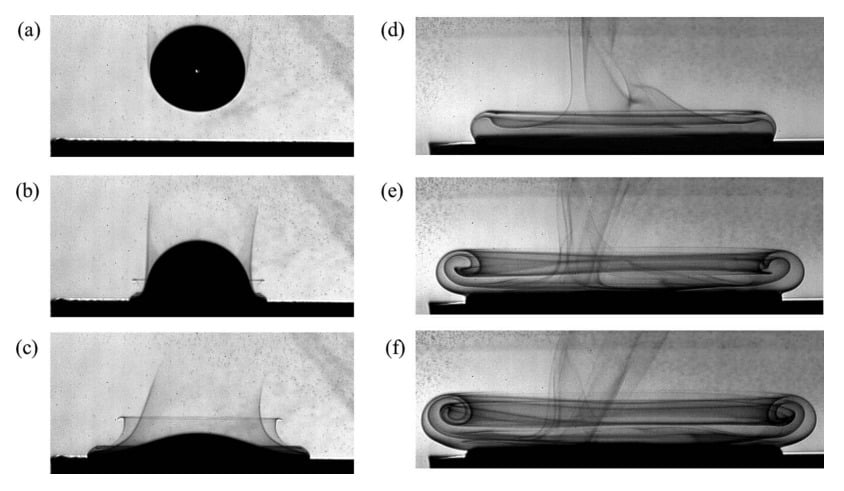
We take for granted that drops which impact a solid surface will splash, but, in fact, drops only splash when the surrounding air pressure is high enough. When the air pressure is low enough, drops simply impact and spread, regardless of the fluid, drop height, or surface roughness. Why this is and what role the surrounding air plays remains unclear. Here researchers visualize the air flow around a droplet impact. In (a) we see the approaching drop and the air it pulls with it. Upon impact in (b) and © the drop spreads and flattens while a crown of air rises in its wake. The drop’s spread initiates a vortex ring that is pinned to the drop’s edge. In later times (d)-(f) the vortex ring detaches from the drop and rolls up. (Photo credit: I. Bischofberger et al.)
Rebounding Off Dry Ice
Droplet rebound is frequently associated with superhydrophobic surfaces but can also be generated by very large temperature differences. For very hot substrates, a thin layer of the drop vaporizes on contact via the Leidenfrost effect and helps a drop rebound by preventing it from wetting the surface. This video shows almost the opposite: a water droplet hitting solid carbon dioxide (-79 degrees C). Upon contact, the solid carbon dioxide sublimates, creating a thin layer of gas that separates the droplet from the surface. You can also see the vortex ring that accompanies the drop’s impact. Water vapor near the carbon dioxide surface has condensed into tiny airborne droplets that act as tracer particles that reveal the vortex’s formation and the rebounding droplet’s wake. (Video credit: C. Antonini et al.; Research paper)

Fluids Round-up – 27 July 2013
Fluids round-up time! Here are our latest fluidsy links from around the web:
- Science@NASA explains how to use capillary action to drink one’s coffee in microgravity. (via io9)
- Nature is not exactly a quiet place. Here are a couple of things you probably haven’t heard: icebergs breaking up and running aground and the “seismic scream” preceding a volcanic eruption.
- Mars Curiosity’s work indicates that Mars once had a thick atmosphere but lost it about 4 billion years ago, possibly to the solar wind after losing its magnetic field.
- Check out this great looped surfing footage for a different perspective on waves (submitted by joteefox)
- io9 offers a primer on the Mach number. It’s worth noting that, for a(n ideal) gas, the speed of sound depends only absolute temperature and composition.
- Disney has designed a device called Aireal that uses vortex rings to provide haptic feedback. (submitted by vincent)
- Ever come across mammatus clouds before? Their distinctive shape is a result of forming from sinking air rather than rising air like most other clouds. (via io9)
(Photo credit: T. Thai)
Reminder: This weekend is your final chance to take the reader survey! Thank you to everyone who has taken a couple minutes to share their thoughts.

Meeting the Wall
Even something as simple as a falling sphere meeting a wall is composed of beautiful fluid motion. In Figure 1 above, we see side-view images of a sphere at low Reynolds number falling toward a wall over several time. Initially an axisymmetric vortex ring is visible in the sphere’s wake; when the sphere touches the wall, secondary vortices form and the wake vortex moves down and out along the wall in an axisymmetric fashion (Figure 2, top view). At higher Reynolds numbers, like those in Figure 3, this axisymmetric spreading of the vortex ring develops an instability and ultimately breaks down. (Photo credit: T. Leweke et al.)

Fluids Round-up – 9 June 2013
It’s time for some more fluidsy fun around the Internet! Here are some fun links I’ve come across since our last round-up.
- NPR reviews how dolphins and others play with vortex rings.
- Lawrence Berkeley National Laboratory/UC Berkeley offer some insight into simulating bubbles popping. (Hint: it requires supercomputers.)
- FlowViz shares some awesome accidental Rayleigh-Taylor instabilities you can replicate at home.
- PhysicsBuzz brings us a podcast on tornado physics.
- Reader Cedric Vella sent in his fluids-featuring trailer.
- io9 pointed out some great cymatics footage that shows off how granular materials and vibration creates beautiful patterns.
- And finally: what happens when you drop hot charcoal into liquid oxygen? The Periodic Table of Videos shows us, in high speed! (via Flow Visualization)
(Photo credit: L. L. A. Adams et al., multi-fluid double emulsions)

Droplet Impact Visualized
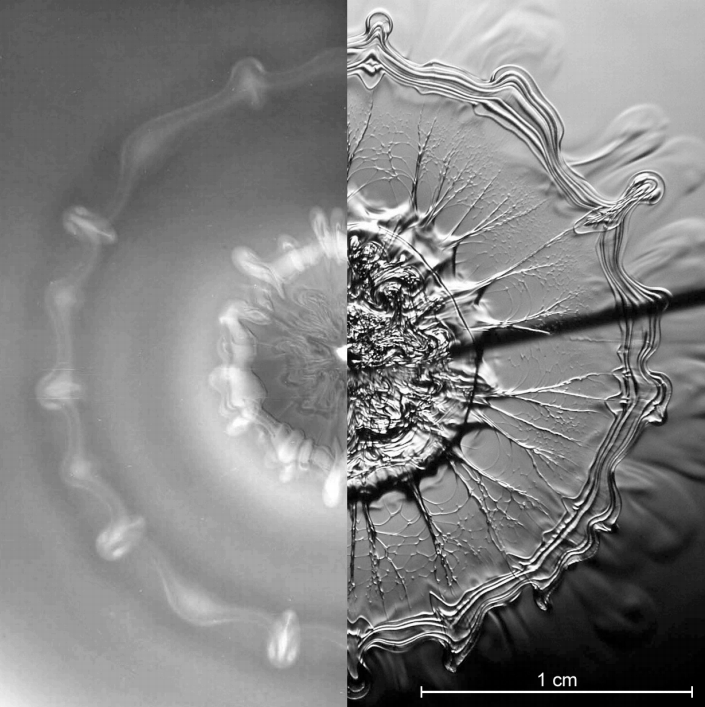
When a drop falls from a moderate height into a shallow pool, its impact creates a complicated pattern. The photo above is a composite image showing a top-down view 100 ms after such an impact. On the left side, the flow is visualized using dye whereas the right shows a schlieren photograph, in which contrast indicates variations in density. Both methods show the same general structure – an inner vortex ring generated at the edge of the impact crater and formed mostly of drop fluid and an outer vortex ring, consisting primarily of pool fluid, formed by the spreading wave. Both regions show signs of instability and breakdown. (Photo credit: A. Wilkens et al.)