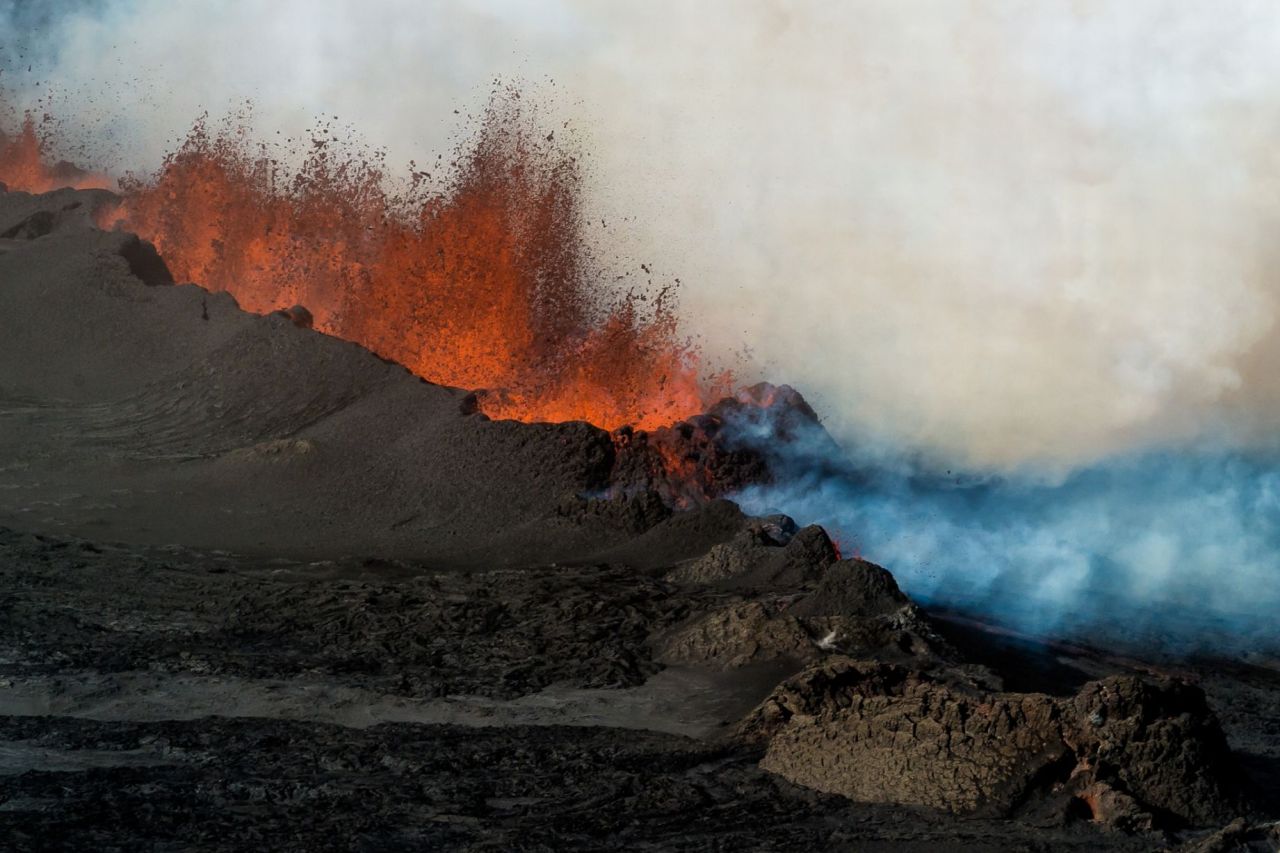
Lava is rather fascinating as a fluid. Lava flow regimes range from extremely viscous creeping flows all the way to moderately turbulent channel flow. Lava itself also has a widely varying rheology, with its bulk properties like viscosity and its response to deformation changing strongly with temperature and composition. As lava cools, instabilities form in the fluid, causing the folding, coiling, branching, swirling, and fracturing associated with different types and classes of lava. (Image credit: E. Guddman, via Mirror)
Tag: volcano

Volcanic Vortices from Etna


Italy’s Mount Etna is erupting again, producing a series of beautiful vortex rings. Like a dolphin’s bubble ring or a vortex cannon, the volcano’s rings are formed when gases are rapidly expelled through a narrow opening. Such formations are extremely common but are generally not visible to the eye. In this case, steam has gotten entrained into the rings to make them visible. Vortex rings can maintain their structure over substantial distances. The photographer of these rings noted that they lasted as many as ten minutes before dissipating. (Photo credit: T. Pfeiffer; via NatGeo)

Lava in Action
We’ve touched on volcanoes and the fluid dynamics of lava a couple of times here at FYFD, but over at Wired volcanologist Erik Klemetti has some wonderful photos and videos he took while visiting an active lava flow in Hawaii along with great explanations of the flow shapes and processes. Above we see him using a rock hammer to remove a sample from an active flow. Klemetti describes the lava’s behavior as taffy-like – extremely viscous and stretchy but prone to break like a plastic. Be sure to check out his posts! (Photo credit: E. Klemetti; submitted by @FlexMonkey)

Etna’s Eruption
After some rumblings in recent weeks, Italy’s Mt. Etna erupted overnight on February 19th, sending fountains of lava shooting into the dark. This impressive video from Klaus Dorschfeldt, a videographer for Italy’s National Institute for Geophysics and Vulcanology, shows the nighttime eruption, including the dark, turbulent outline of a pyroclastic flow of rock and hot gases escaping down the mountainside. Such flows can be devastating in their effect as they rush and spread down the mountain, flattening, burning, or engulfing everything in their path. When Mt. Vesuvius erupted in 79 A.D., it was the pyroclastic flow that buried the towns of Pompeii and Herculaneum. (Video credit: Klaus Dorschfeldt; via io9)
Creating Lava
In Syracuse, NY, artists and scientists work together to study volcanic flows by melting crushed basalt in a special furnace before releasing the lava into the parking lot. This particular flow is very prone to boiling behavior, likely because of the cold air and ground temperatures (less than 0 C). The outer layers of rock cool quickly, leaving bubble-shaped chambers which hotter lava can fill before melting out. (via It’s Okay To Be Smart; submitted by @jpshoer)

Volcanic Vortices
The volcanoes of the South Sandwich Islands, located in the South Atlantic, have a notable effect on cloud formation in this satellite photo. Visokoi Island, on the right, sheds a wake of large vortices that distort the cloud layer above it. On the left, Zavodovski Island’s volcano does the same, with the added effect of low-level volcanic emissions, which include aerosols. These tiny particles provide a nucleus around which water droplets form, causing an marked increase in cloud formation visible in the bright tail streaming off the island. (Photo credit: NASA, via Earth Observatory)

Volcanic Clouds
The volcano Tungurahua erupts in a cloud of ash while molten lava flows down the mountain’s sides. Overhead a wispy lenticular cloud has formed where moist air flowing over the volcano dropped below its dew point. Volcanic eruptions have been known to produce shock waves and vortex rings as well as their distinctive turbulent plumes. (submitted by A. Jones III)
Volcanic Ash Plume
Video footage of Iceland’s Grimsvotn volcano erupting shows a massive turbulent plume of ash. The largest scales of the plume are of the order of hundreds, if not thousands of meters, and the eddies of the plume appear to move very slowly, especially far from the base. According to Kolmogorov, however, at the smallest scales of the flow (< 1 mm), the turbulent motions are isotropic. No one has been able to achieve Reynolds numbers high enough to fully prove or disprove Kolmogorov’s hypothesis, but natural events like volcanic eruptions produce some of the largest Reynolds numbers on earth. (See also: interview with videographer; via Gizmodo, jshoer)
Volcanic Shock Waves
This footage of last year’s eruption of Eyjafjallajökull in Iceland shows shockwaves emanating from the mouth of the volcano as hot ash and gases explode from underground.

Volcanic Turbulence
One of the characteristics of turbulence is its large range of lengthscales. Consider the ash plume from this Japanese volcano. Some of the eddy structures are tens, if not hundreds, of meters in size, yet there is also coherence down to the scale of centimeters. In turbulence, energy cascades from these very large scales to scales small enough that viscosity can dissipate it. This is one of the great challenges in directly calculating or even simply modeling turbulence because no lengthscale can be ignore without affecting the accuracy of the results. #


