Tag: volcano

  • Blowing Smoke

    Blowing Smoke

    It’s unusual – but not entirely unheard of – to see volcanoes blowing smoke rings during inactive periods. But given their unpredictability, scientists had not studied this phenomenon in much depth. In a recent presentation, though, a group unveiled results from numerical studies of volcanic vortex rings. They found that the decreasing pressure on rising magma allows dissolved gases to emerge as bubbles. If the magma has the right viscosity, those bubbles can merge into one big pocket that depressurizes explosively in the vent. As the hot gases burst upward, the walls of the vent cause them to curl up into a vortex ring, provided the vent is fairly circular and uniform. That sends the roiling vortex up into the atmosphere, where it cools, condenses, and becomes visible.

    The need for a circular vent matches observations of volcanic vortex rings in nature, like the infrared image shown above. Volcano watchers find that vortex rings only form from some vents, and the more circular the vent, the more likely it can produce vortex rings. (Image credit: B. Simons; research credit: F. Pulvirenti et al.; via Nat Geo; submitted by Kam-Yung Soh)

  • Volcanic Plume

    Volcanic Plume

    Astronauts aboard the International Space Station captured this dramatic image of Raikoke Volcano’s eruption in late June. This uninhabited Pacific Island is part of the Kuril Islands off mainland Russia. The hot plume of ash and volcanic gas rose until its density matched that of the surrounding air, at which point it could only expand horizontally. This is why the plume appears to have such a flat top. It’s similar to the cumulonimbus clouds we associate with severe thunderstorms. Scientists speculate that the white ring around the plume’s base might be water vapor condensed from ambient air pulled in to the plume’s base or a side-effect of magma flowing into the surrounding sea. (Image credit: NASA; via NASA Earth Observatory)

  • Anak Krakatoa Tsunami

    Anak Krakatoa Tsunami

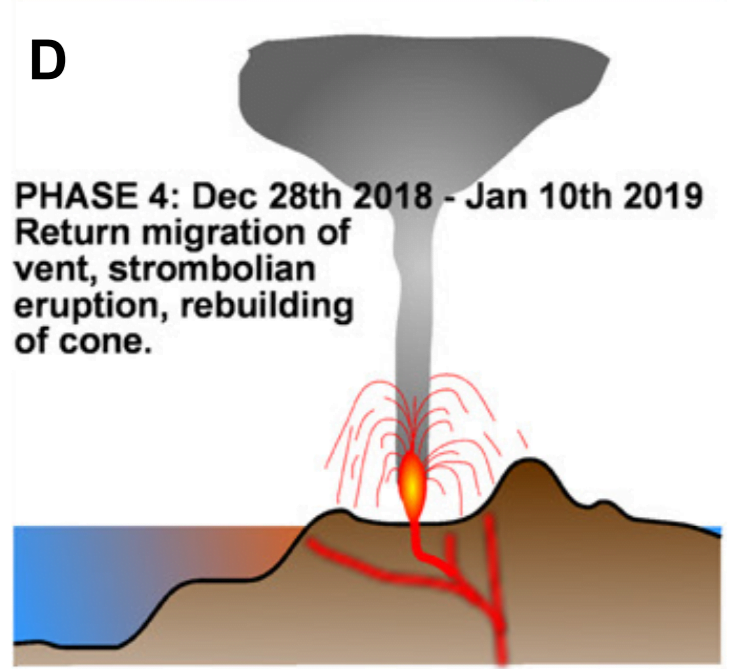
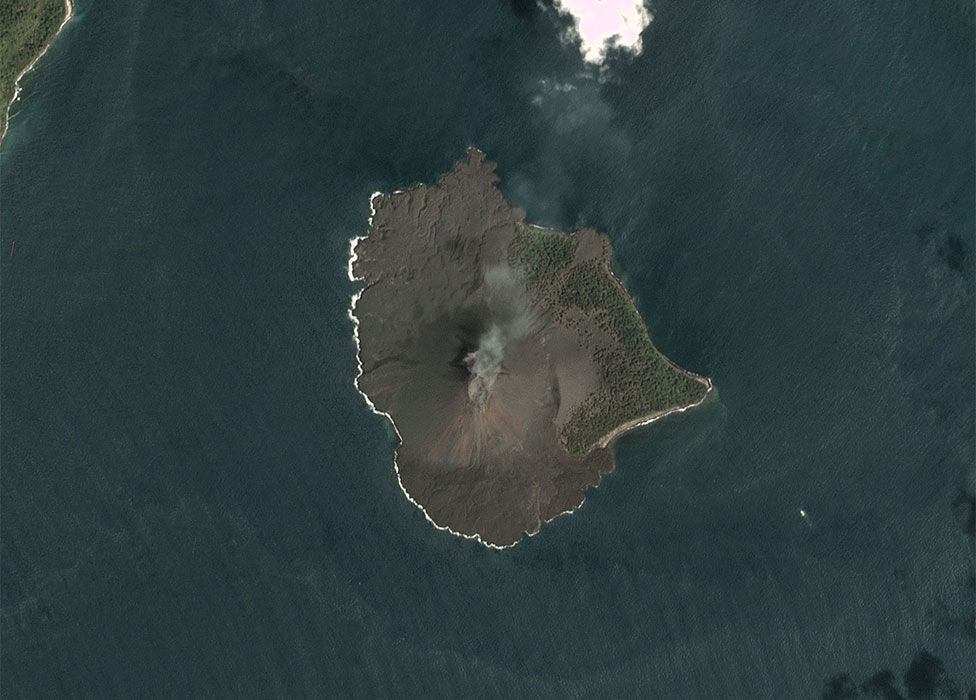
    In late December 2018, a landslide on the island Anak Krakatoa triggered a deadly tsunami in Indonesia. The island (upper left, pre-landslide) lost an estimated 300 meters of height in the landslide, dramatically altering its appearance (upper right; post-landslide). Much of the slide occurred underwater, dumping material into a crater left by the famous 1883 eruption of Krakatoa

    The slide displaced a massive amount of water, creating a tsunami that spread, refracting around nearby islands and reflecting off shorelines in complicated patterns. A new numerical simulation, shown above, models the post-slide tsunami based on terrain data and fluid physics. Its wave predictions match well with the high-water readings from nearby islands. The scientists hope that such models, combined with monitoring, will help save lives should a future eruption trigger more tsunamis.

    For a full picture of both the recent Anak Krakatoa eruption and its famous predecessor, check out this video. (Image credits: satellite views before and after landslide – Planet Labs; simulation – S. Ward, source; via BBC News; submitted by Kam-Yung Soh)

  • Featured Video Play Icon

    Recreating Pyroclastic Flow

    One of the deadliest features of some volcanic eruptions is the pyroclastic flow, a current of hot gas and volcanic ash capable of moving hundreds of kilometers an hour and covering tens of kilometers. Since volcanic particles have a high static friction, it’s been something of a mystery how the flows can move so quickly. Using large-scale experiments (top), researchers are now digging into the details of these fast-moving flows.

    What they found is that the two-phase flow results in a pressure gradient that tends to force gases downward. This creates a gas layer with very little friction near the bottom of the pyroclastic flow (bottom), essentially lubricating the entire flow with air. This helps explain why pyroclastic flows are so fast and long-lived despite their inherent friction and the roughness of the terrain over which they flow. (Image and research credit: G. Lube et al.; video credit: Nature; submitted by Kam-Yung Soh)

  • Featured Video Play Icon

    Even Mountains Flow

    Over about 5 months of 2018, the summit of Mount Kilauea slowly collapsed as the volcano erupted. Seen in timelapse, it’s a remarkable reminder of the ancient Greek philosopher Heraclitus’s observation, “Everything flows.” All things change, so given enough time, just about everything can flow.

    Fluid dynamicists actually capture this concept in a dimensionless ratio known as the Deborah number. Named for a Biblical prophet who states, “The mountains flow before the Lord,” the Deborah number is defined as the ratio between the time needed for a material to respond applied stress and the time over which the process is observed. In practice, a lower Deborah number indicates a more fluid-like material while a higher one represents more solid-like behavior.

    Be sure to check out the full video. There’s some spectacular lava flow footage near the end – definitely a small Deborah number! (Video and image credit: USGS via Science; research credit: C. Neal et al.)

  • Lava Balls

    The continuing eruption of Kilauea is revealing phenomena rarely seen by those of us who are not volcanologists. One of the most surreal examples so far is colloquially known as a “lava boat,” seen above floating its way down a river of lava emanating from Fissure #8. The more technically accurate term is “accretionary lava ball,” but the colloquialism seems rather fitting, as long as this partially-solidified chunk of lava is still floating down the channel. 

    These lava balls form in a’a lava channels, which tend to be faster-moving and more turbulent. As chunks of lava solidify in the channel, they roll and gather more material, allowing them to get larger and larger. When broken open, the lava balls usually have a spiral interior as a result of this rolling formation. It’s essentially the lava equivalent of making a snowball. (Video credit: I. Marzo via M. Lincoln; via Ryan A.)

  • Kilauea’s Lava Lake

    Kilauea’s Lava Lake

    Hawaii’s Kilauea Volcano continues to erupt, sending magma flowing through multiple fissures. The U.S. Geological Survey has sounded a warning, however, that the volcano could erupt more explosively. Hot spot volcanoes like Hawaii’s generally have more basaltic lava, which has a lower viscosity than more silica-rich magmas like those seen on continental plates. That makes Hawaii’s volcanoes less prone to explosive detonations like the 1980 Mt. St. Helens eruption. With less viscous lava, there’s less likelihood of plugging a magma chamber and causing a deadly buildup of pressure from toxic gases.

    But that doesn’t mean that there’s no risk. In particular, officials are concerned by the rapid draining of a lava lake near Kilauea’s summit. As illustrated below, if the lava level drops below the water table, that increases the likelihood of steam forming in the underground chambers through which lava flows. The rapid drainage has destabilized the walls around the lava lake, causing frequent rockfalls into the chamber. If those were to plug part of the chamber and cause a steam buildup, then there could be an explosive eruption that releases the pressure. To be clear: even if this were to happen, it would be nothing like the explosiveness of Mt. St. Helens. But it would include violent expulsions of rock and widespread ash-fall. (Image credits: USGS, source; via Gizmodo)

  • Turbulent Volcanic Plumes

    Turbulent Volcanic Plumes

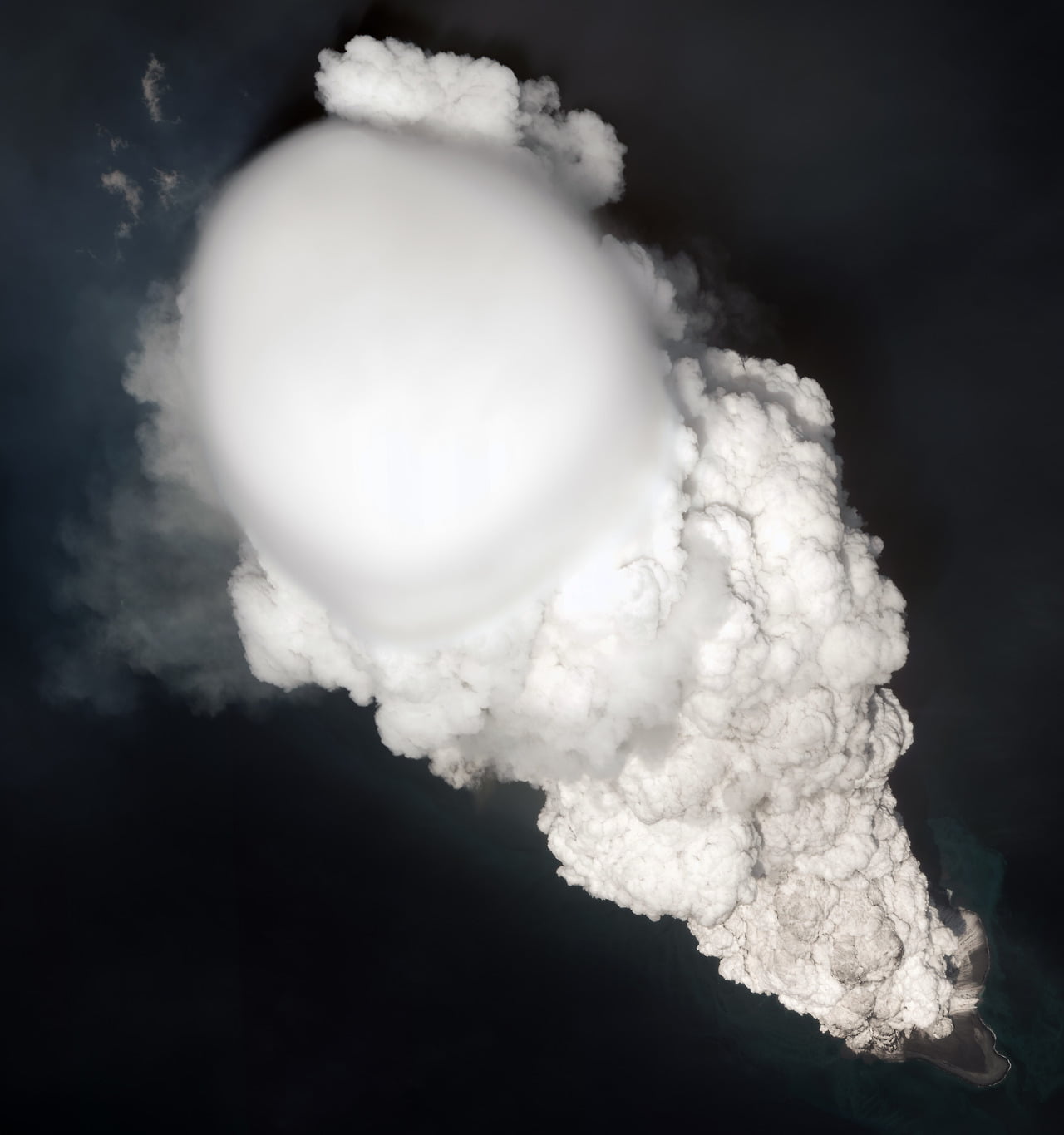
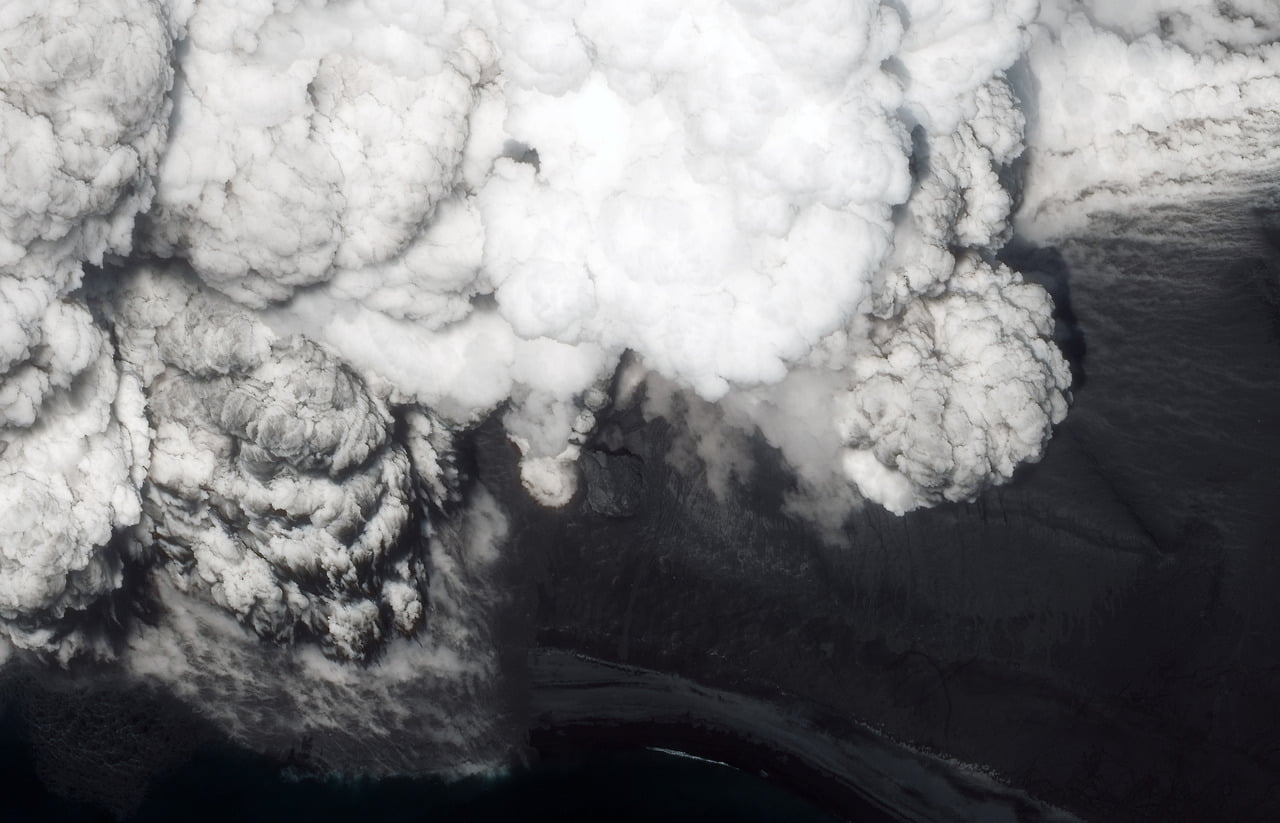
    Volcanic eruptions produce some of the largest flows on Earth. These towering ash clouds were imaged from orbit in May 2017 as an eruption began on Alaska’s Bogoslof Island. The clouds are a beautiful example of a turbulent flow. Turbulence is characterized by its many length scales. Some features in the plume are tens or hundreds of meters across, yet there are also coherent motions down at the centimeter or millimeter scale. In a turbulent flow, energy cascades from these very large scales down to the smallest ones, where viscosity is significant enough to dissipate it. This is part of the challenge of modeling turbulence; to fully describe it, you have to capture what happens at every scale. (Image credit: DigitalGlobe, via Apollo Mapping; submitted by Mark S.)

  • Featured Video Play Icon

    Plate Tectonics

    We don’t typically think of the ground beneath our feet as anything but solid, but over geologically long time scales, even mountains can flow. Buoyant convection inside the Earth’s mantle is thought to drive the plate tectonics that have shaped the Earth as we know it. The video above explains some of the major processes and events that shaped the modern North American continent, including collisions, subduction, volcanism, and erosion. (Video credit: Ted-Ed)

  • Galapagos Week: Lava Flows

    Galapagos Week: Lava Flows

    The Galapagos islands are geologically similar to the Hawaiian islands; both are archipelagos that were born and continue to be formed by lava flows originating from a volcanic hot spot. Lava from this type of volcano is high in basalt content, which affects both its flow properties and the formations it creates. Geologists have actually borrowed words from the Hawaiian language to describe the two main kinds of lava formations seen in basaltic flows: pahoehoe and a’a.

    Pahoehoe formations tend to be relatively smooth and often leave behind a pattern of rope-like coils (below). In contrast, a’a lava features are sharp, rough, and challenging to traverse. Both flows are gravity-driven, and which features a given eruption forms depends on many factors. Many flows will even begin with a pahoehoe section that stretches for several kilometers before transitioning to an a’a structure. Researchers believe the transition occurs when the lava crystallizes enough to develop a yield-strength, meaning that it will behave like a solid until enough force is applied to make it flow again. Toothpaste, ointment, and mud are similar so-called yield stress fluids which will only flow after a critical force is applied.  (Image credits: lava flow – Epic Lava Tours, source; pahoehoe lava – J. Shoer)

    Galapagos Week continues tomorrow here on FYFD. Check out previous posts.