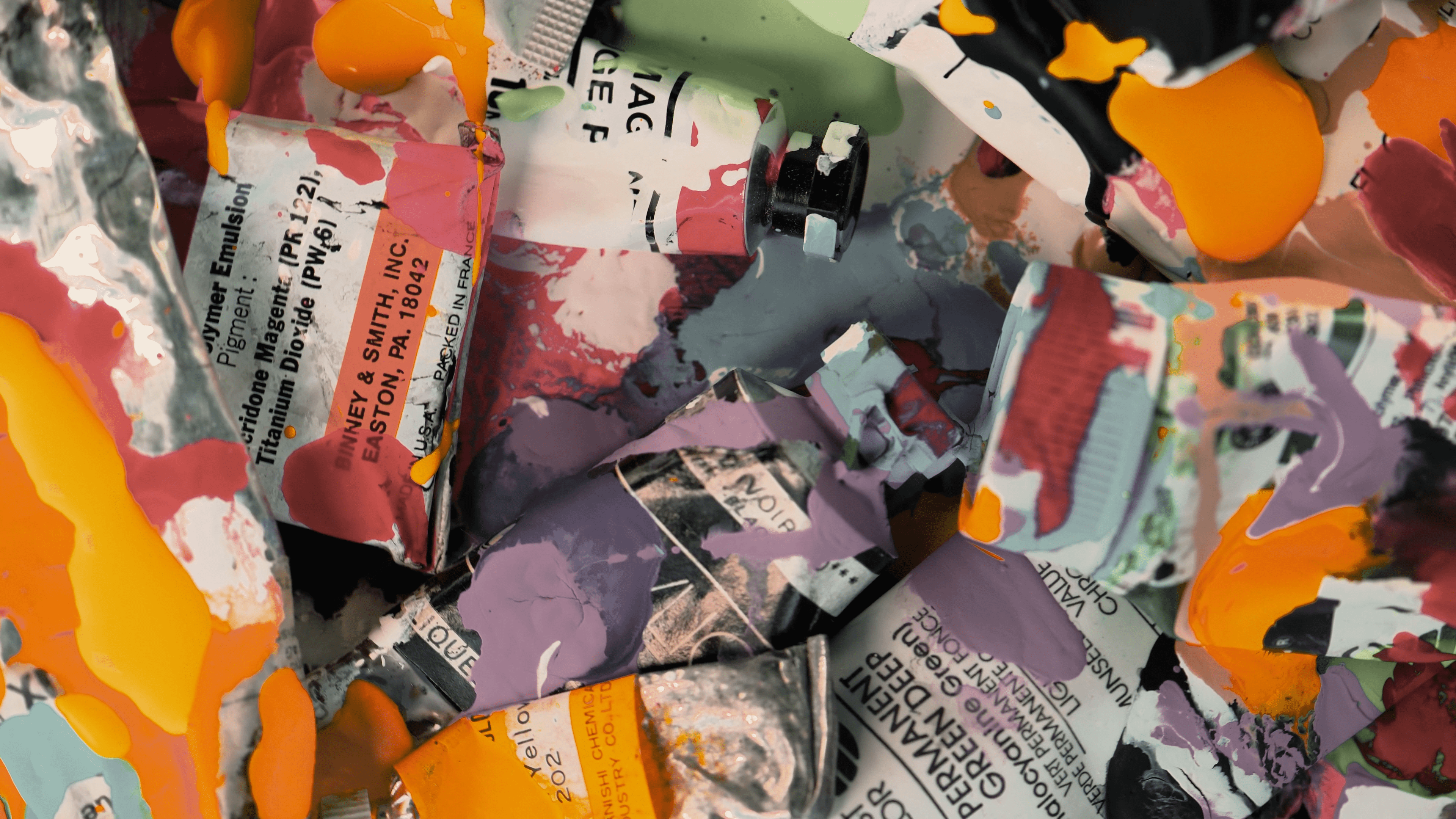
In “Alive,” filmmaker Christopher Dormoy explores acrylic paints and the variety of ways in which the medium can be used. From a fluids perspective, there’s dripping, viscous flow, turbulent eddies, billowing plumes, and “accidental painting” due to density-driven instabilities. It’s a fun tour of fluid phenomena in art. What examples do you spot? (Video and image credit: C. Dormoy)
Tag: viscous flow

Granular Gaps
Push air into a gap filled with a viscous fluid, and you’ll get the branching, dendritic pattern of a Saffman-Taylor instability. Here, researchers use a similar set-up: injection into a narrow gap between transparent planes to explore something quite different. In this experiment, the gap was initially filled with a mixture of air and tiny hydrophobic glass beads. When the team injected a viscous mixture of water and glycerol, new patterns emerged. At low injection rates, a single finger structure formed. But at high injection rates, a whole spoke-like pattern formed. (Image and research credit: D. Zhang et al.; via Physics Today)

Honeybee Feeding
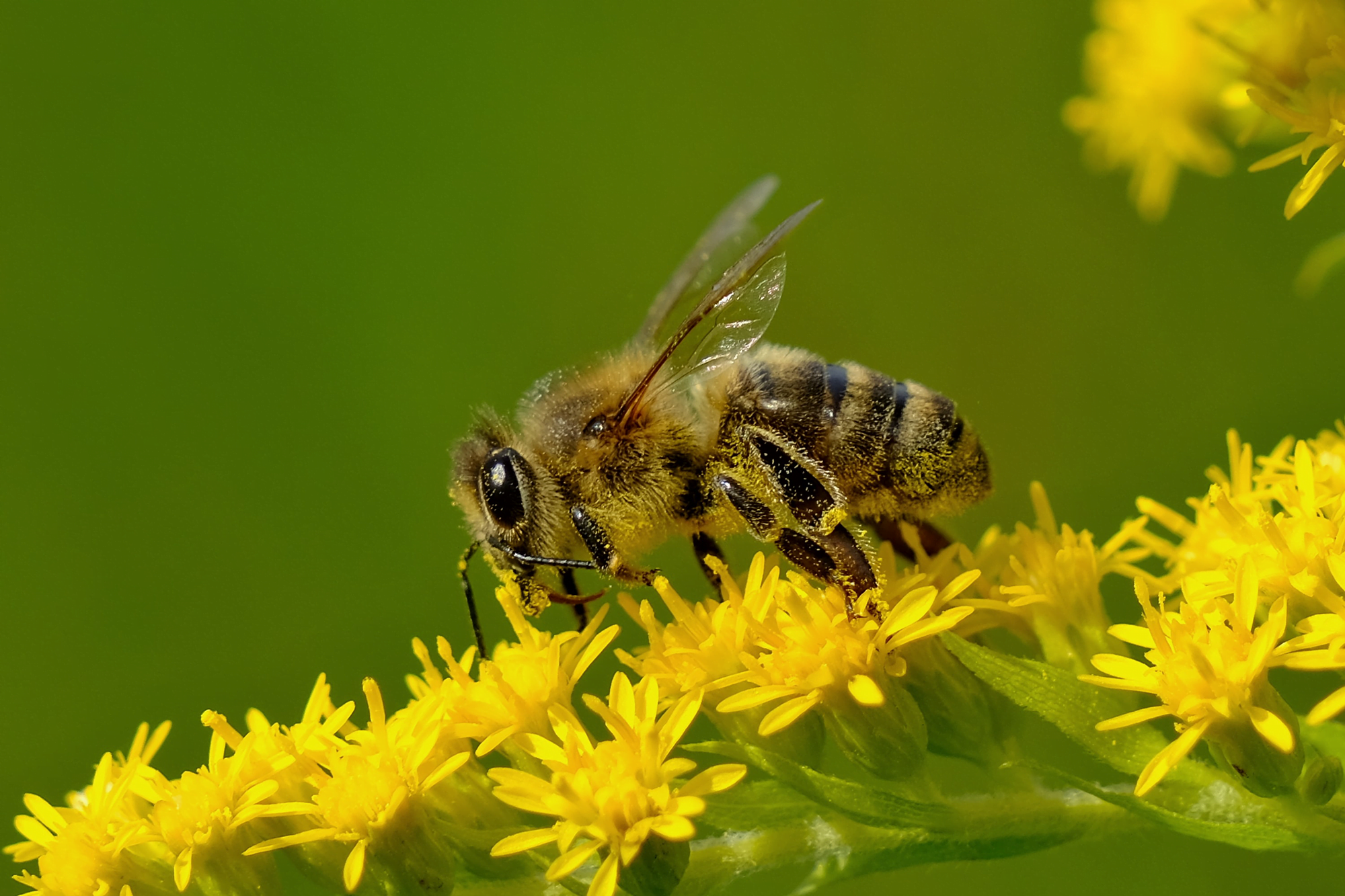
Busy bees feed on millions of flowers for each kilogram of honey they produce. To gather nectar, bees use their hairy tongues, which project out of a sheath-like cover. Protraction (i.e., sticking their tongue out) is relatively fast because all the hairs on the tongue initially lie flat. In the nectar, those hairs flare out, creating a miniature forest that traps viscous nectar and drags it back into the bee during retraction.

Bees feed by projecting their tongues into nectar. Tongue extension is faster because the tongue’s hairs lie flat. During the slower retraction phase, the hairs flare out, trapping nectar and pulling it back into the bee. Through modeling and experiments, researchers found that the time it takes a bee to retract its tongue depends on the bee’s overall mass. Smaller bees are slower to the retract their tongues, likely to allow enough time for their shorter tongues to capture enough nectar. With bee populations on the decline, the team’s predictions may help communities select flowers with nectar concentrations that best fit their local bees’ needs. (Image credits: top – J. Szabó, bee eating – B. Wang et al.; research credit: B. Wang et al.; via APS Physics)

A Bubble’s Path
Centuries ago, Leonardo da Vinci noticed something peculiar about bubbles rising through water. Small bubbles followed a straight path, but slightly larger ones swung back and forth or corkscrewed upward. The mechanism behind this behavior has been a matter of debate ever since, but the authors of a recent study believe they’ve nailed down the answer.
The forces determining a bubble’s path are remarkably complex, which is why it’s taken so long to figure this out. Viscosity acts as a source of drag on the rising bubble, acting across a thin boundary region surrounding the bubble. That boundary isn’t constant, though; the bubble’s shape changes as the flow pushes on it, and the changing shape of the bubble pushes on the flow, in turn. Capturing those subtle interactions numerically and comparing them to careful experiments was necessary to unravel the mystery.
The team found that bubbles above a critical radius (0.926 millimeters) begin to tilt. That tilt causes a change in the bubble’s shape, which increases the flow along one side. This kicks off the wobbling motion, which carries on because of the continuing changes in the bubble’s shape and the flow around it. (Image credit: A. Grey; research credit: M. Herrada and J. Eggers; via Vice; submitted by @lediva)

Saffman-Taylor Instability
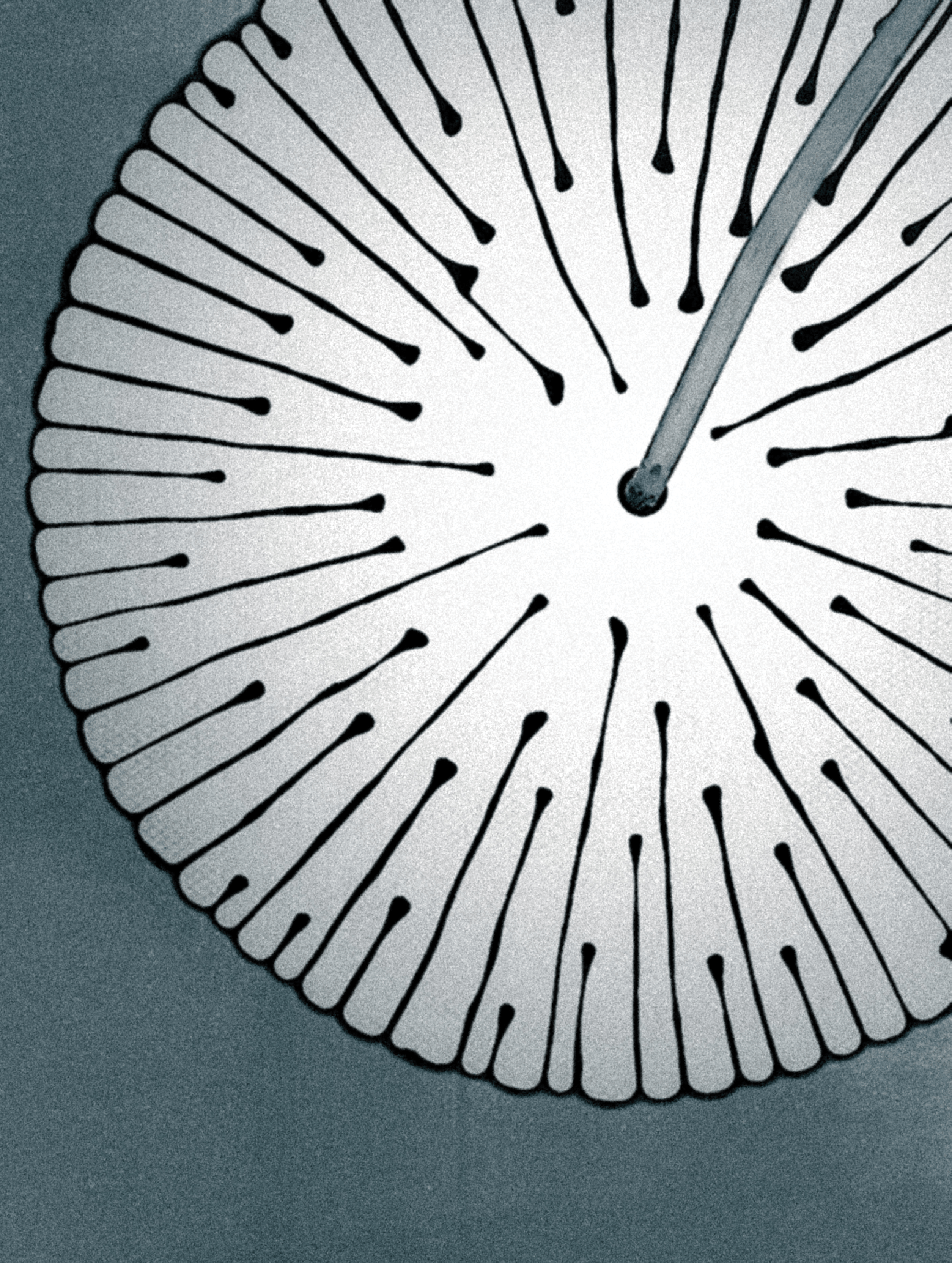
Air and blue-dyed glycerin squeezed between two glass plates form curvy, finger-like protrusions. This is a close-up of the Saffman-Taylor instability, a pattern created when a less viscous fluid — here, air — is injected into a more viscous one. If you reverse the situation and inject glycerin into air, you’ll get no viscous fingers, just a stable, expanding circle. Although you sometimes come across this instability in daily life — like in a cracked smartphone screen — the major motivation for studying this phenomenon historically has been oil and gas extraction. (Image credit: T. Pohlman et al.)

Eruption in a Box
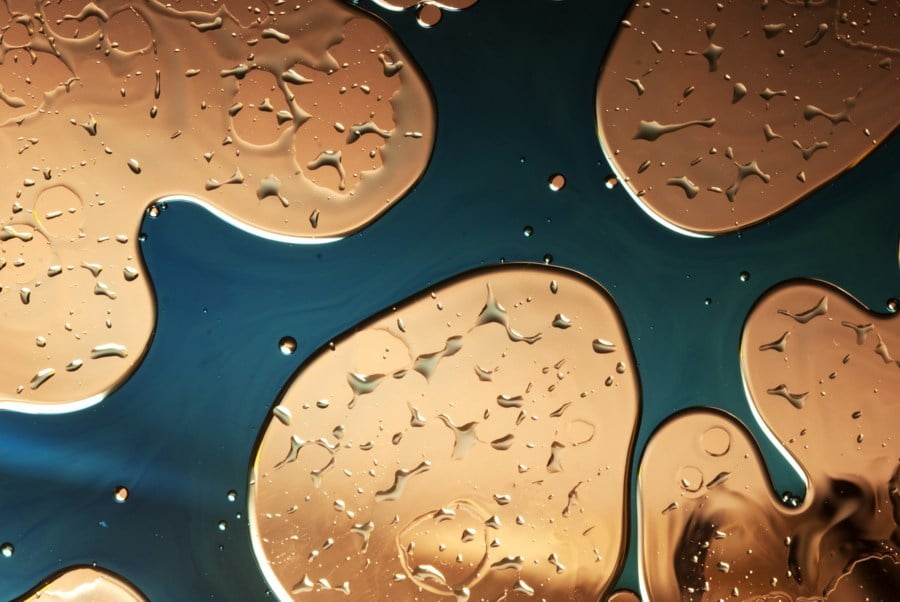
In layers of viscous fluids, lighter and less viscous fluids can displace heavier, more viscous liquids. Here, researchers demonstrate this using four fluids sandwiched between layers of glass and mounted in a rotating frame. (Think of those liquid-air-sand art frames found in museums but bigger!)
In their first example, each layer of fluid is denser than the one beneath it, so buoyancy forces the lowest layer — air — to rise. The air pushes its way through the more viscous layer of olive oil, then slowly makes its way through the even more viscous glycerin before bursting through the last layer in an eruption. As the team varies the viscosity and miscibility of the layers, the movement of the buoyant fluids through the viscous layers changes dramatically. (Image and video credit: A. Albrahim et. al.)

Falling Pancake Drops
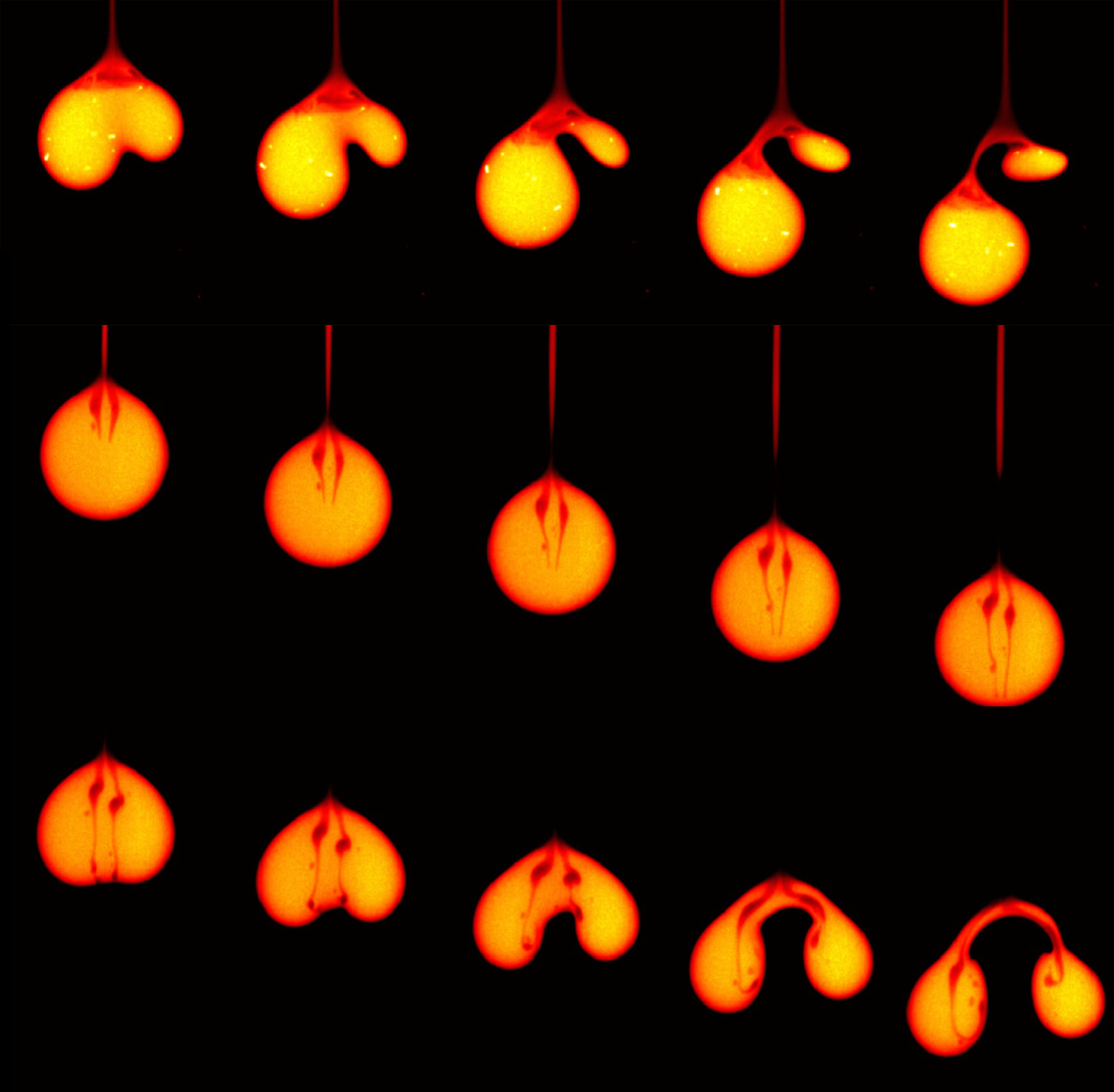
Despite their round appearance, the droplets you see here are actually shaped like little pancakes. They’re sandwiched inside a Hele-Shaw cell, essentially two plates with a viscous fluid between them. As these droplets fall through the cell, some remain steady and rounded (Image 1), while others experience instabilities (Images 2 and 3). By varying the ratio of the ambient fluid’s viscosity relative to the drop, the authors found two different kinds of breakup. In the first type (Image 2), droplet breakup occurred due to perturbations inside the drop itself. In the second type (Image 3), the viscosity of the ambient fluid is closer to that of the drop and intrusions of the ambient fluid into the drop break it apart. (Image and research credit: C. Toupoint et al.)

Contact-Line Dissipation
In the confines of a narrow tube, a flow’s energy gets dissipated in two places: inside the bulk fluid and along the contact line. The former is standard for all flows; viscosity acts like internal friction in the fluid and dissipates a flow’s kinetic energy into heat. Contact line dissipation is trickier. While it isn’t hard to imagine that a moving contact line would dissipate energy, it’s been unclear just how much energy the contact line eats up.
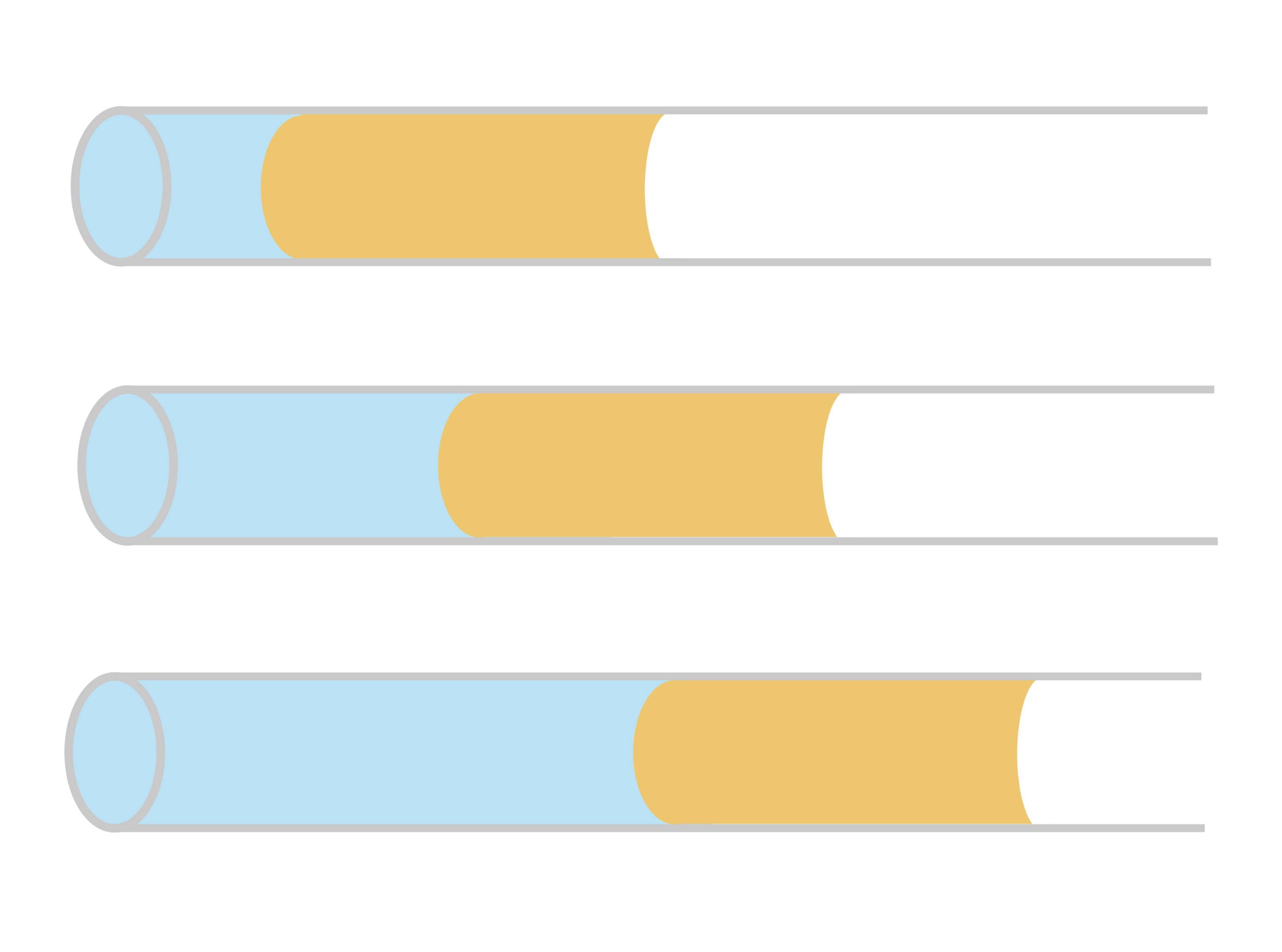
To answer that question, researchers performed a novel experiment using an extremely narrow capillary tube, initially filled with air. By dipping one end of a horizontal tube in an oil reservoir, they sucked some oil into the tube. Then they set the oil-filled end of the tube against a water reservoir, causing it to suck up water. The oil slug then moves along the tube at a constant speed, which enables the team to separate out the two sources of dissipation. They found that contact-line dissipation accounted for a surprisingly large amount of the overall dissipation — between 20 and 50 percent, depending on the length of the oil slug! (Image credit: N. Sharp; research credit and submission: B. Primkulov et al.)

Mud Pots
Mud pots, or mud volcanoes, form when volcanic gases escape underlying magma and rise through water and earth to form bubbling mud pits. I had the chance to watch some at Yellowstone National Park a few years ago and they are bizarrely fascinating. In this Physics Girl video, Dianna recounts her adventures in trying to locate some mud pots in southern California and explains the geology that enables them there. And if you haven’t seen it yet, check out her related video on the only known moving mud puddle! (Image and video credit: Physics Girl)

Tiny Symmetric Swimmers
Microswimmers live in a world dominated by viscosity, and in viscous fluids, symmetric motion provides no propulsion. That’s why bacteria and other tiny organisms use cilia, corkscrew flagella, and other asymmetric means to swim. But a new study decouples the symmetry of a swimmer’s motion from the motion of the fluid, thereby creating a tiny symmetrically-driven swimmer that does swim.
Their microswimmer consists of two beads, which attract one another via surface tension and are repelled using external magnetic fields. This effectively creates a spring-like connection between the two beads, making them move in and out symmetrically in time. But since one bead is larger than the other, its greater inertia makes it slower to start moving and slower to coast to a stop. This inertial imbalance between the two is significant enough for the beads to swim. The key here is that though the beads’ motion relative to one another is symmetric, their motion relative to the fluid is not! (Image and research credit: M. Hubert et al.; via Science; submitted by Kam-Yung Soh)