Tag: viscous flow

  • Lava Barriers

    Lava Barriers

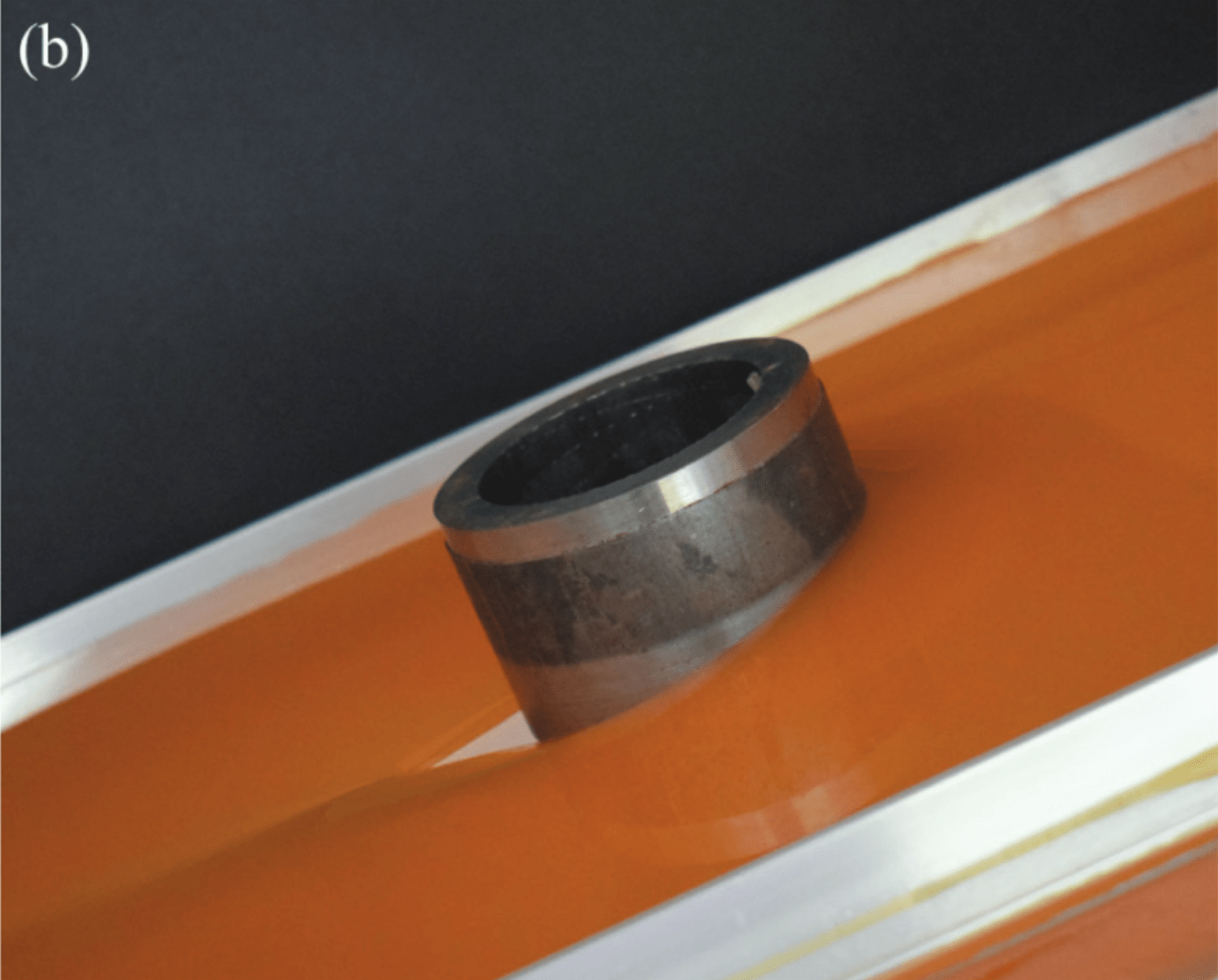
    Inspired by protecting people and property from lava flows, researchers investigated how viscous fluids flow downhill past large obstacles. As seen above, when the obstacle is tall enough that the flow does not overtop it, there’s substantial deflection of the fluid both up- and downstream. Upstream of the barrier, the flow gets deeper, and downstream there’s a dry region left behind.

    The researchers modeled these flows numerically, leading to equations designers can use to predict the necessary height, strength, and shape of barrier necessary to protect areas from encroaching lava. (Image and research credit: E. Hinton et al.)

  • Seeping Sculptures

    Seeping Sculptures

    Drips, blobs, and squishes – that’s how artist Dan Lam describes her recent series of sculptures. The pieces are a mix of polyurethane foam, resin, and acrylic, decorated in bold gradients of neon color. I love the fluidity of each piece, as well as the decorative piping of spikes on many of them. (As a matter of fact, they remind me of this work.) Check out more of Lam’s work on her website and Instagram feed. (Image credit: D. Lam; via Colossal)

  • The Microscopic Ocean

    The Microscopic Ocean

    When you’re the size of plankton, water may as well be molasses. Viscosity rules at these scales, and swimming plankton leave distinctive wakes that are slow to dissipate. Fish that feed on plankton use these trails to find their prey. But this microscopic world is changing as the ocean warms.

    At higher temperatures, water is less viscous, and plankton wakes don’t last as long. To make matters worse for hungry fish, warmer waters have led to an explosion in a species of faster plankton, capable of moving hundreds of body lengths a second. This species is far more difficult to catch, which may explain some of the collapses we’re observing in populations of fish like cod and haddock. (Video and image credit: BBC Earth Lab)

  • Pollock Avoided Coiling

    Pollock Avoided Coiling

    Streaks of black and gray in the Jackson Pollack painting the researchers studied.

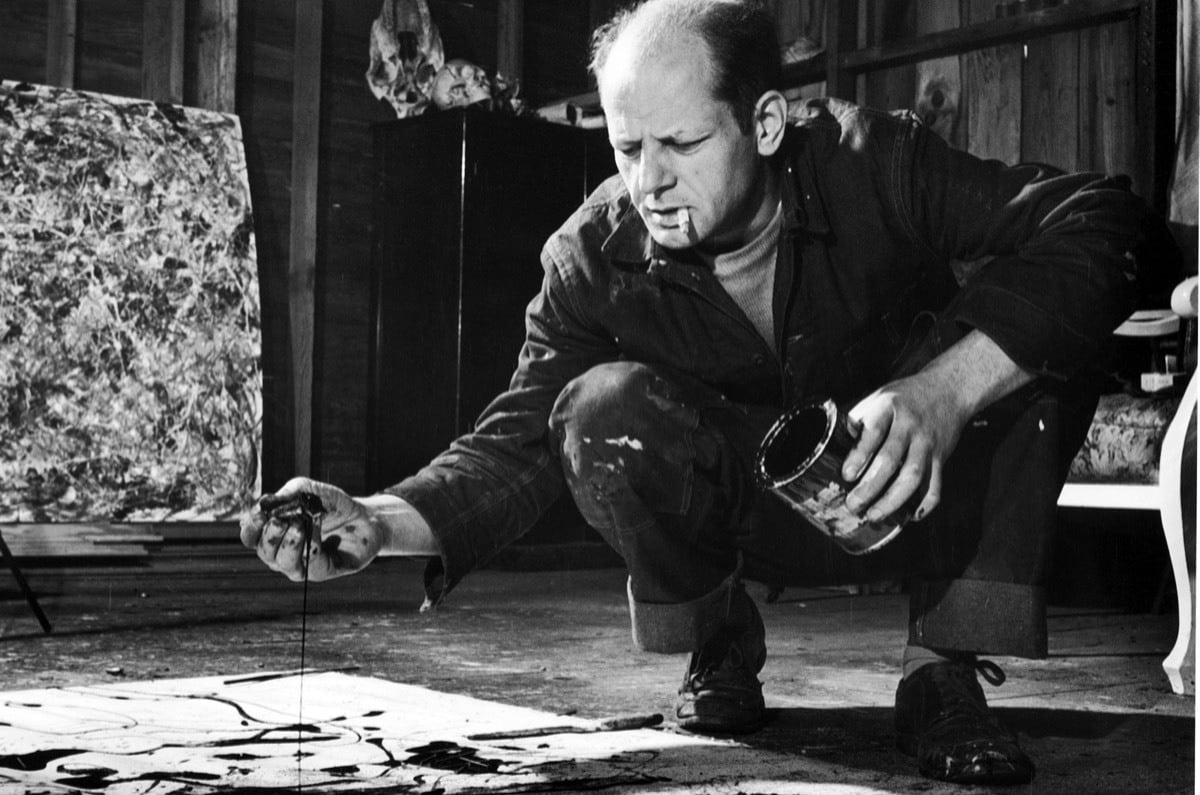
    Artists are often empirical masters of fluid dynamics, as they must be to achieve the effects they want. Jackson Pollock was particularly known for his so-called dripping technique, in which he dropped filaments of paint from brushes, cans, and even syringes as he moved around a horizontal canvas. (Scientifically speaking, this wasn’t really dripping since the paint wasn’t breaking up into droplets for the most part, but that’s another story.)

    What Pollock was doing, fluid dynamically speaking, is the subject of a new study. Researchers analyzed historical footage of Pollock painting to measure the typical heights from which he dropped paint and the speed at which he moved. Then they built their own apparatus to mimic the painting style with modern paints and study the flow regime Pollock’s technique falls into. 

    Since much of the paint falls in a steady stream, like syrup falling onto pancakes, the researchers wondered whether the paint was likely to coil the way other viscous fluids do. What they found, however, is that Pollock’s choice of height and speed when applying paint seems deliberately designed to avoid the coiling instability. That fact suggests that art historians might identify forged paintings in part from the presence of too much coiling among the paint filaments. (Image credits: photo – M. Holmes/LIFE, painting – J. Pollock; research credit: B. Palacios et al; via Ars Technica; submitted by Kam-Yung Soh)

  • Reader Question: Exoplanetary Life

    Reader orbiculator asks:

    I’ve been having this thought regarding biological adaptations to viscous mediums. In a hypothetical exoplanet where the ocean is this thick, aqueous gel – could we assume that the native macroscopic species would have morphologies similar to Earth’s plankton despite their large sizes? That is, instead of being propelled by fins like our fish and whales, they’d go around using large ciliar or flagella?

    Propulsion-wise, that’s a reasonable theory. If the ambient environment were viscous enough that macroscopic creatures would still be limited to laminar flow, then, yes, you could expect them to use something like cilia or flagella to move. They’d be restricted by the same reversibility that microscopic species are here on Earth.

    But there are other factors that could come into play. Many microscopic species rely on diffusion for survival, whether that’s chemical diffusion across their exterior or diffusion within their body. As a species gets larger, the distance diffusion has to occur across grows, and diffusion becomes harder and harder to sustain. 

    So while hydrodynamic constraints might result in an exoplanet’s fauna having features similar to Earth’s microscopic life, it probably wouldn’t be as simple as merely enlarging the species we see here on Earth. Some of the key biophysics that goes on inside cellular life as we know it just doesn’t hold at larger scales.

  • Avoiding Shear Thickening

    Avoiding Shear Thickening

    Many substances – like the cornstarch and water mixture above – exhibit a property called shear-thickening. In these fluids, deforming them quickly causes the viscosity to increase dramatically. That shear-thickening occurs when particles inside the fluid jam together, creating large chains able to resist the force being applied. That’s why the oobleck on this vibrating speaker can sustain these “cornstarch monsters”.

    Shear-thickening is useful in many contexts, but it’s problematic during manufacturing, when pumping these substances can become incredibly difficult due to the fluid’s innate resistance to flowing. A new study, though, finds that it’s possible to temporarily suppress shear-thickening using acoustic waves. The researchers used piezoelectric devices to generate acoustic waves at a frequency around 1 MHz while shearing the cornstarch mixture. The acoustic waves disrupt the formation of particle chains inside the mixture, keeping its viscosity 10 times lower than during regular shear-thickening. (Image credit: bendhoward, source; research credit: P. Sehgal et al.; submitted by Brian K.)

  • Escaping the Limits of Viscosity

    Escaping the Limits of Viscosity

    For large creatures, it’s not hard to feel the evidence of someone else swimming nearby. But to tiny swimmers water is incredibly viscous and hard to move. These creatures have to swim very differently than their larger cousins, and evidence of their motion dies out quickly. But at least one microorganism,  Spirostomum ambiguum, has discovered a method for overcoming the limits of size and viscosity.

    The single-celled swimmer, when threatened, contracts its body in milliseconds, generating accelerations greater than those seen by fighter pilots. That acceleration is strong enough that it generates a burst of turbulence powerful enough to overcome the natural damping of its viscous surroundings. Within their colonies, S. ambiguum seem to use contraction to send out hydrodynamic signals to neighbors, who pass on the call to arms. To see the colonies in action, check out this previous article. (Image and research credit: A. Mathijssen et al.; via Physics Today; submitted by Kam-Yung Soh)

  • Featured Video Play Icon

    “Unity”

    Rus Khasanov’s latest short film, “Unity,” is all about coming together with droplets coalescing, globules bursting, and colors mixing. Take a glittery, paint-filled break and enjoy some macro-filmed fluid dynamics in action. (Video and image credit: R. Khasanov)

  • Featured Video Play Icon

    Fingers of Clay

    Take a mixture of a viscous liquid – like clay mud – and squeeze it between two glass plates and you’ll create a mostly-round layer of liquid. As you pry the two glass plates apart, air will push its way into that layer, forcing through the mud in a dendritic pattern. This is called the Saffman-Taylor instability or viscous fingering. It occurs because the interface between the air and mud is unstable.  (Image and video credit: amàco et al.)

  • Floccing Particles

    Floccing Particles

    Adding particles to a viscous fluid can create unexpected complications, thanks to the interplay of fluid and solid interactions. Here we see a dilute mixture of dark spherical particles suspended in a layer of fluid cushioned between the walls of an inner and outer cylinder. Initially, the particles are evenly distributed, but when the inner cylinder begins to rotate, it shears the fluid layer. Hydrodynamic forces assemble the particles together into loose conglomerates known as flocs. Once the particles form these log-like shapes, they remain stable thanks to the balance between viscous drag on particles and the attractive forces that pull particles toward one another. (Image and research credit: Z. Varga et al.; submitted by Thibaut D.)