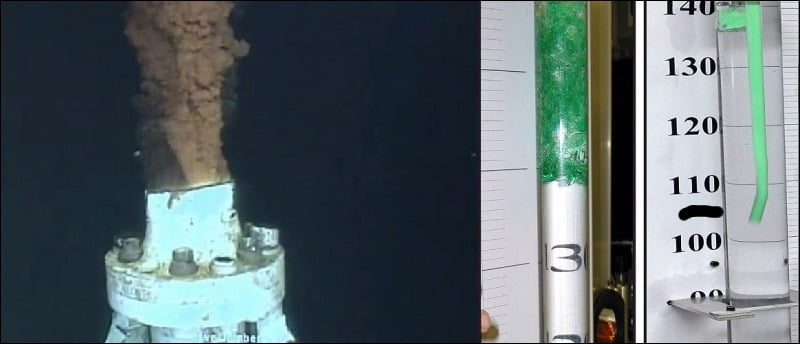
Recent research indicates that adding cornstarch to drilling mud increases the likelihood that a “top-kill” procedure will plug a leaking oil well. Adding cornstarch to water (or mud) turns it into a non-Newtonian fluid with viscoelastic properties that prevent the instabilities that lead to turbulent breakup. On the left, an underwater photo of the Deepwater Horizons leak; in the center, colored water breaks into turbulence when descending into oil; on the right, water with cornstarch maintains its coherence when pumped downward into the oil. # (PDF of research paper)
Tag: turbulence

Saturnian Storm
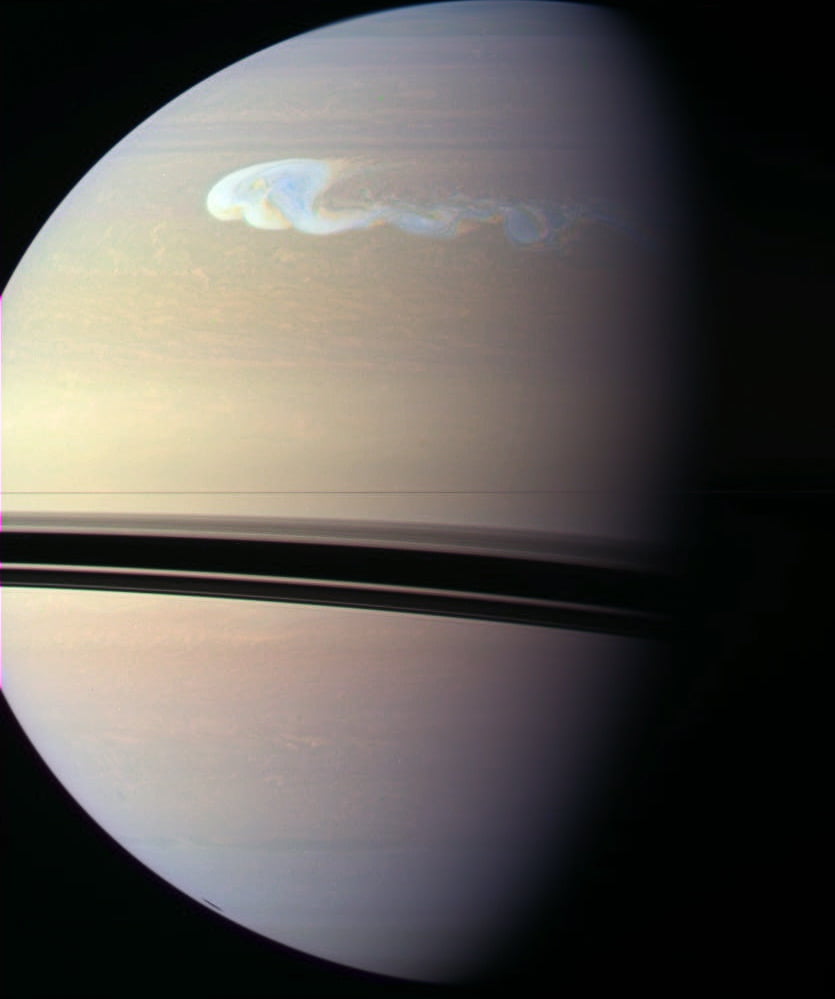
Back in mid-December, amateur astronomers discovered an enormous new storm on Saturn. The Cassini spacecraft captured this image early in the storm’s history (it now stretches farther around the planet). The fluid dynamics of Saturn’s atmosphere are incredibly complex and well beyond our current understanding, but we can certainly appreciate the majesty of a swirling, turbulent storm half the size of our entire planet. (via APOD, Martian Chronicles)

Chaos in Suspension
In science, the term chaotic is used to describe a system whose behavior is highly sensitive to initial conditions. This means that the end state can vary widely based on small changes at the start–also commonly known as the butterfly effect. Many fluid dynamical systems are chaotic, especially turbulent ones. Above are a series of photos showing the suspension of particles in a horizontally rotating cylinder. In parts A-D, the speed of rotation of the cylinder is increased, resulting in dispersion of the particles. As rotation rate is increased further, interesting concentration patterns form. #

Vibrating Fluid Interfaces
The Faraday instability forms when a fluid interface is vibrated. This high-speed video shows the differences in the shapes formed by a vibrated fluid interface when the two fluids are miscible–capable of mixing–and when they are immiscible–like oil and water. Note how the miscible interface breaks down quickly into turbulence, but the immiscible interface maintains a complex shape.

Turbulent Phytoplankton Eddies
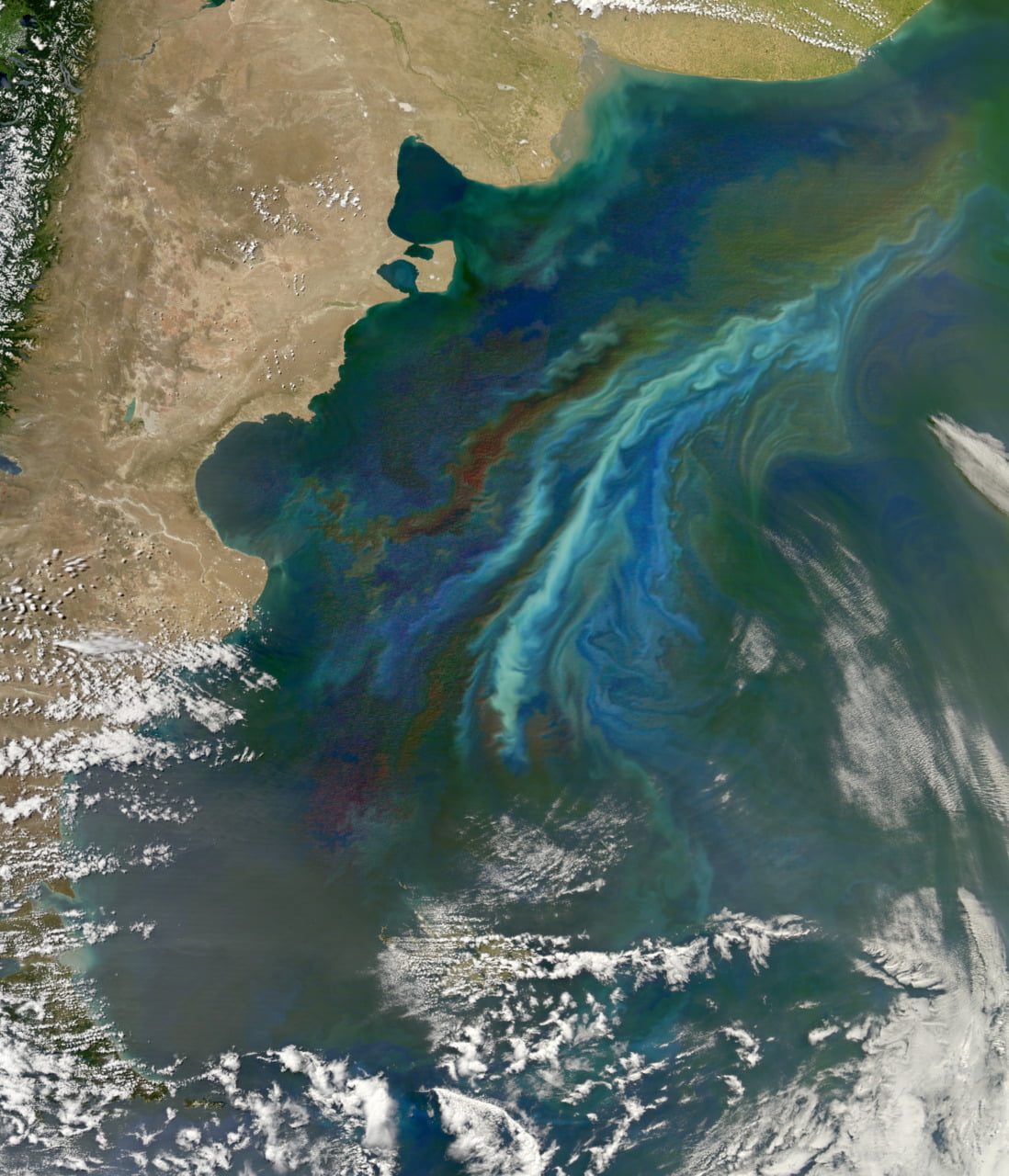
Where warm and cold ocean currents collide, turbulent eddies form and pull up valuable nutrients from the ocean floor. Massive phytoplankton blooms ensue, effectively providing natural flow visualization for the process. #
Thermal Convection
This video turbulent convection in a vertical channel. Buoyancy and the density variations caused by small differences in temperature are what drive the behavior.
Starting a Rocket
This computational fluid dynamics (CFD) simulation shows the start-up of a two-dimensional, ideal rocket nozzle. Starting a rocket engine or supersonic wind tunnel is more complicated than its subsonic counterpart because it’s necessary for a shockwave to pass completely through the engine (or tunnel), leaving supersonic flow in its wake. Here the situation is further complicated by turbulent boundary layers along the nozzle walls. (Video credit: B. Olson)
Microgravity Water Films
In this video astronaut Don Pettit demonstrates some interesting laminar flow effects using a water film in microgravity. By using a film, fluid motion is essentially confined to two dimensions. This is important because it prohibits the development of turbulence, which is a purely three-dimensional phenomenon. Doing the experiment in microgravity allows Pettit to leave the experiment for a long period of time without buoyant effects or similar disturbances. When he first stirs the film, the tracer particles show some signs of what looks like turbulent mixing, but soon the film rotates uniformly with streaks of gray caused by different concentrations of tracer particles. Pettit notes that he allowed the film to rotate overnight and it eventually all turned milky white. This is the effect of molecular diffusion of the tracer particles; without turbulence, the only way for mixing to occur is through the random motion of molecules. See more of Pettit’s Saturday Morning Science videos for additional microgravity fluid mechanics.
Wavy Vortices
Shown above is the flow between two concentric cylinders (Taylor-Couette flow). In the laminar regime, the velocity profile between the two cylinders is linear. As the rate of rotation of the inner cylinder increases, the flow develops toroidal vortices known as Taylor vortices, seen in the video above after 9 seconds or so. This is a fluid instability exhibited by transitional flow. Increasing the rotational rate further can result in wavy Taylor vortex flow. At high enough speeds, the flow will become completely turbulent.

Bristling Scales Give Sharks Speed
The shortfin mako shark is one of the ocean’s fastest and most agile hunters, thanks in part to flexible scales along its body. As water flows around the shark’s body, the scales bristle to angles in excess of 60 degrees. This causes turbulence in the boundary layer along the shark’s body and prevents boundary layer separation which would otherwise increase the shark’s drag. In this respect, the scales serve much the same purpose as dimples on a golf ball. (Abstract, National Geographic article) #