High-speed video of a tank firing at 18000 fps shows shock waves made visible due to light distortion. When the air density changes (due to temperature or compression), it’s index of refraction changes, causing the background to appear distorted. Most of the video shows the subsonic development of the turbulent exhaust plume. Note the speed at which the exhaust moves relative to the airborne shrapnel. (submitted by Stephan)
Tag: turbulence

Coronal Waves
NASA’s Solar Dynamics Observatory has found evidence of Kelvin-Helmholtz waves in the sun’s corona. These waves, which occur between two fluids of different densities or moving at different speeds, are similar to the iconic waves surfers ride. Researchers suspect that this turbulent motion may help explain why the corona is 1,000 times hotter than the surface of the sun. #

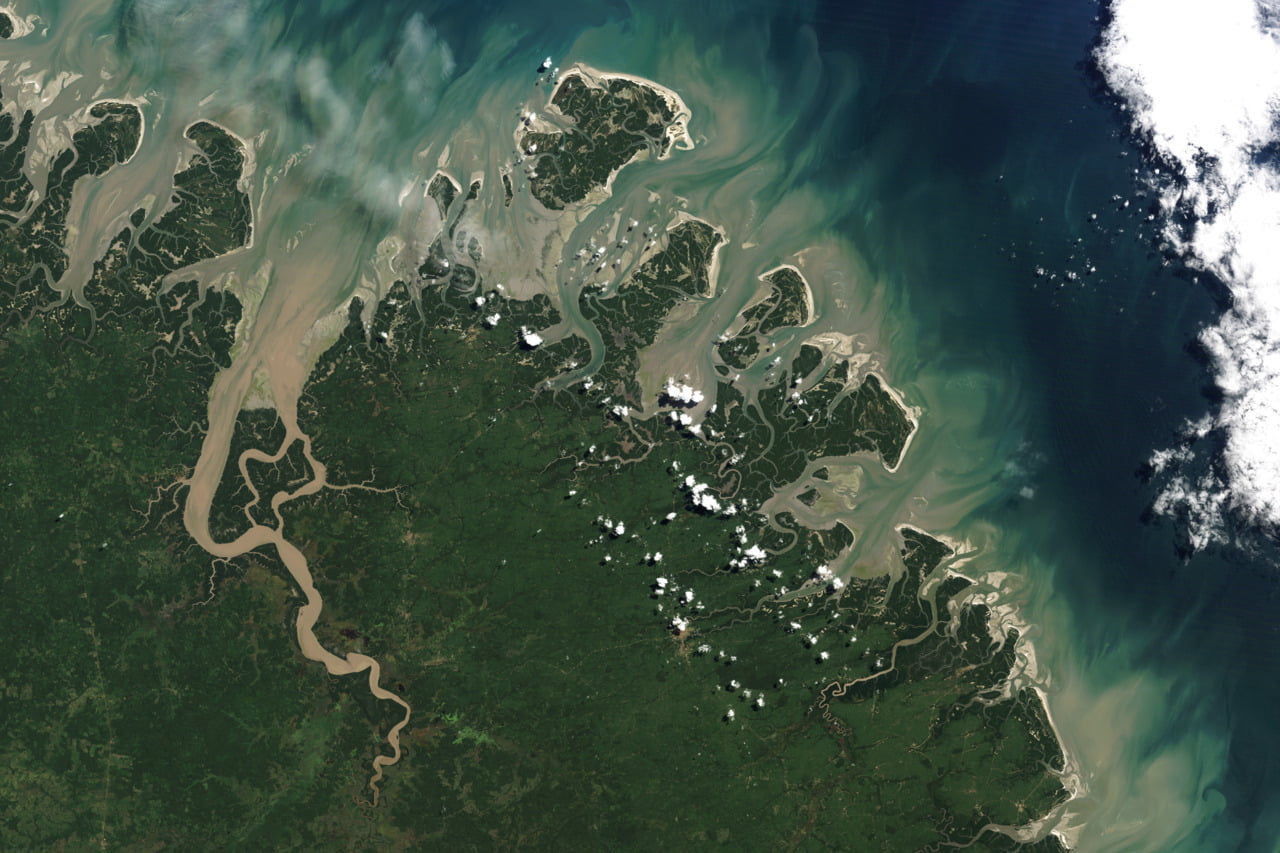
Brazilian Barrier Islands
Barrier islands are in a constant state of flux due to the currents, tides, and winds that surround and shape them. This satellite image of islands off the Brazilian coast shows meandering waterways and the mixing of sediment from the land into the sea. Often, secondary flows are responsible for shaping of these sorts of geographic features. #
Volcanic Ash Plume
Video footage of Iceland’s Grimsvotn volcano erupting shows a massive turbulent plume of ash. The largest scales of the plume are of the order of hundreds, if not thousands of meters, and the eddies of the plume appear to move very slowly, especially far from the base. According to Kolmogorov, however, at the smallest scales of the flow (< 1 mm), the turbulent motions are isotropic. No one has been able to achieve Reynolds numbers high enough to fully prove or disprove Kolmogorov’s hypothesis, but natural events like volcanic eruptions produce some of the largest Reynolds numbers on earth. (See also: interview with videographer; via Gizmodo, jshoer)

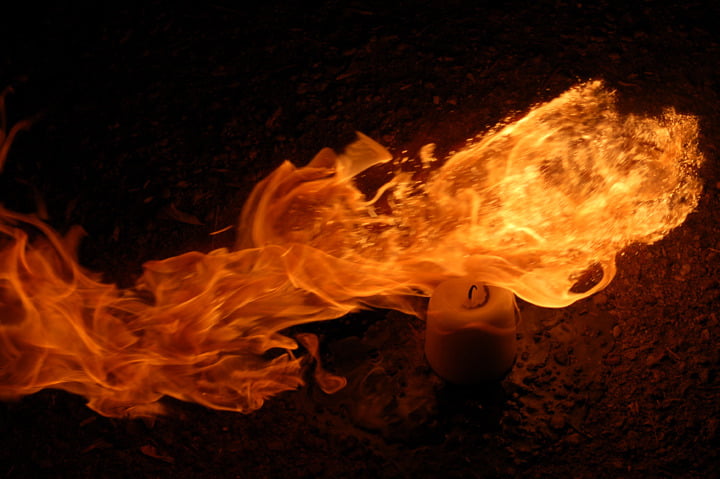
Combustion
Fluid dynamics are vital to combustion. Like here, many practical flames–such as those responsible for internal combustion in automobiles, jet engines, and rockets–are turbulent. The turbulence aids mixing of the fuel and oxidizer, resulting in more complete combustion and greater efficiency. #
Reynolds on Transition
For although only the disciplined motion is recognized in military tactics, troops have another manner of motion when anything disturbs their order. And this is precisely how it is with water: it will move in a perfectly direct disciplined manner under some circumstances, while under others it becomes a mass of eddies and cross streams, which may be well likened to the motion of a whirling, struggling mob where each individual particle is obstructing the others. The larger the army, and the more rapid the evolutions, the greater the chance of disorder; so with fluid, the larger the channel, and the greater the velocity, the more chance of eddies.
High-Speed Cooking
I suspect demonstrating fluid mechanics was not what this cookbook had in mind when they filmed creamer poured into coffee at 2000 fps, but there’s some awesome droplet breakup, crowning, roiling turbulent mixing, and even some deformed Worthington jets here. It’s a reminder that, even though we may not notice it, fluid dynamics are all around.
Godspeed, Discovery!
The space shuttle, despite three decades of service, remains a triumph of engineering. Although it is nominally a space vehicle, fluid dynamics are vital throughout its operation. From the combustion in the engine to the overexpansion of the exhaust gases; from the turbulent plume of the shuttle’s wake to the life support and waste management systems on orbit, fluid mechanics cannot be escaped. Countless simulations and experiments have helped determine the forces, temperatures, and flight profiles for the vehicle during ascent and re-entry. Experiments have flown as payloads and hundreds of astronauts have “performed experiments in fluid mechanics” in microgravity. Since STS-114, flow transition experiments have even been mounted on the orbiter wing. The effort and love put into making these machines fly is staggering, but all things end. Godspeed to Discovery and her crew on this, her final mission!

Volcanic Turbulence
One of the characteristics of turbulence is its large range of lengthscales. Consider the ash plume from this Japanese volcano. Some of the eddy structures are tens, if not hundreds, of meters in size, yet there is also coherence down to the scale of centimeters. In turbulence, energy cascades from these very large scales to scales small enough that viscosity can dissipate it. This is one of the great challenges in directly calculating or even simply modeling turbulence because no lengthscale can be ignore without affecting the accuracy of the results. #

Instability in a Jet
This photo shows the development of a flow instability in an axisymmetric jet. On the left, the jet is smooth and fully laminar, but, by the center of the photo, disturbances in the jet have grown large enough to distort the laminar profile. The jet is then in transition; by the right side of the frame, it has reached a turbulent state, as evidenced by the increased mixing (which causes the smoke to disperse more quickly) and intermittency of the flow. #