Every year Chicago dyes its river green in honor of St. Patrick’s Day. This timelapse video shows this year’s dyeing, including several passes from a boat distributing the green dye. The color is remarkably slow to diffuse. The boat’s passage does little to affect the motion of the dye already in the river. This is because the boat mainly disturbs the surface and most of the color comes from dye spread throughout the water. It’s like if you tried to stir milk into your coffee just by tapping the surface with your spoon. Instead, the slower, large-scale turbulent motion of the river distributes the dye. For more St. Patrick’s Day physics, be sure to check out Guinness physics and why tapping a beer makes it foam. (Video credit: P. Tsai; submitted by Bobby E.)
Tag: turbulence

The Structure of Turbulence
Though they may appear random at first glance, turbulent flows do possess structure. The video above shows a numerical simulation of a mixing layer, a flow in which two adjacent regions of fluid move with different velocities. The upper third of the frame shows a top view, and the bottom frame shows a side view, in which the upper fluid layer moves faster than the lower one. The difference in velocities creates shear which quickly drives the mixing layer into turbulence. But watch the chaos carefully, and your eye will pick out vortices rolling clockwise in the largest scales of the mixing layer. These features are known as coherent structures, and they are key to current efforts to understand and model turbulent flows. (Video credit: A. McMullan)
Hydraulic Jump in the Lab
When fast-moving liquids encounter regions of slow-moving liquids, they decelerate rapidly, trading their kinetic energy for potential energy and creating a hydraulic jump. Flow in the video above is from left to right. The depth difference between the incoming and outgoing water can be directly related to the velocity of the incoming fluid. Hydraulic jumps in rivers and spillways are often extremely turbulent, like the one in this video, but laminar examples exist as well. In fact, with the right height and flow rate, you can create stable hydraulic jumps right in your kitchen sink. The hydraulic jumps formed from a falling jet are typically circular, but with the right conditions, all sorts of wild shapes can be observed. (Video credit: H. Chanson)

Fluids Round-up – 11 January 2014
It’s a big fluids round-up today, so let’s get right to it.
- Over at txchnologist, there’s a great article on controlling combustion instabilities in rocket engines with sound.
- Quanta Magazine asks if knot theory can help unravel turbulence. (submitted by iamaponyrocket)
- SciAm takes a look at how FIFA finally got their aerodynamics right so that their video game football (soccer) balls fly correctly.
- The Smithsonian considers an important question: can you fry foods in space?
- The Navy unveiled a fantastic new facility for simulating ocean waves (via J. Ouellette)
- At SciAm, there’s a nice explanation of the polar vortex and its effects on recent freezing weather. For additional background, check out this excerpt from a presentation by meteorology professor Jennifer Francis. (via Nicholas Travers)
- Cold weather also brings a host of new viral videos; NatGeo explains some of the science behind instant snow, ice fog, and frozen bubbles. See also: our own explanation of the instant snow phenomenon.
- io9 looks at the physics of knuckleballs.
- Over at Wired, Rhett Allain questions whether dwarves should stand in floating barrels. Also on the subject of The Hobbit, here’s an analysis of fire-breathing in dragons.
- At SciAm, Kyle Hill explains how inertia lets one pour a drink toward the sky.
- SciAm reports on a manufacturing process for superhydrophobic paper.
- I don’t know what banking has to do with a pool of non-Newtonian fluids, but this Malaysian ad sure makes it look fun. (via physicsphysics and jmlinhart)
- Wired has a great write-up on the mantis shrimp, which kills its prey with cavitation.
- io9 tackles explaining one of the most vexing brain teasers in fluid dynamics, the Feynman sprinkler.
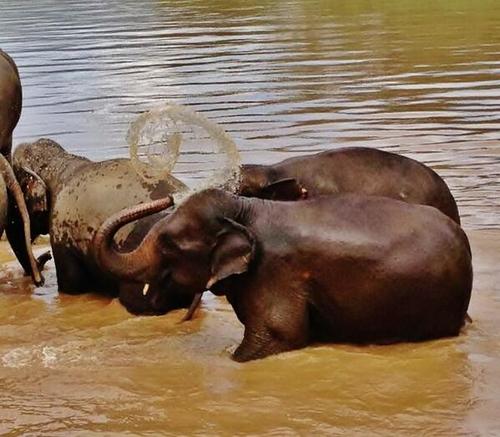
- Finally, today’s lead image comes from our friends at Think Elephants, who study elephant intelligence over in Thailand and occasionally capture the animals’ mastery of fluid dynamics. Be sure to check them out and follow them on Twitter and Facebook.
(Photo credit: Think Elephants International/R. Shoer)

Start Your Rocket Engine
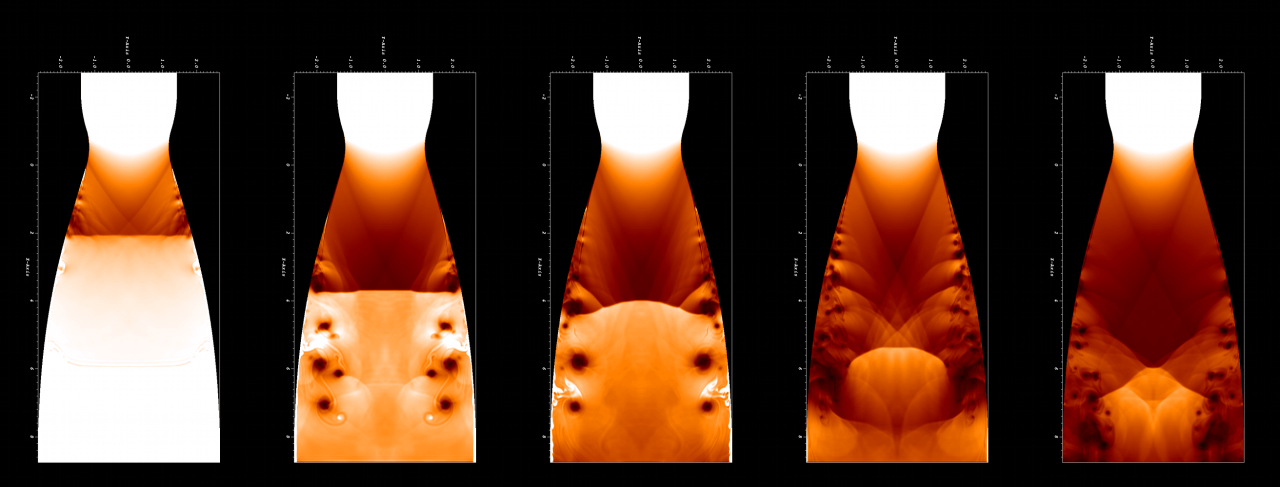
When supersonic flow is achieved through a wind tunnel or rocket nozzle, the flow is said to have “started”. For this to happen, a shock wave must pass through, leaving supersonic flow in its wake. The series of images above show a shock wave passing through an ideal rocket nozzle contour. Flow is from the top to bottom. As the shock wave passes through the nozzle expansion, its interaction with the walls causes flow separation at the wall. This flow separation artificially narrows the rocket nozzle (see images on right), which hampers the acceleration of the air to its designed Mach number. It also causes turbulence and pressure fluctuations that can impact performance. (Image credit: B. Olson et al.)

Flow Behind a Cylinder
Flow over blunt bodies produces a series of alternating vortices that are shed behind an object. The image above shows the turbulent wake of a cylinder, with flow from right to left. Red and blue dyes are used to visualize the flow. This flow structure is known as a von Karman vortex street, named for aerodynamicist Theodore von Karman. The meander of the wake is caused by the shed vortices, each of which has a rotational sense opposite its predecessor. The rapid mixing of the two dyes is a result of the flow’s turbulence. In low Reynolds number laminar cases of this flow the structure of individual vortices is more visible. Similar flow structures are seen behind islands and in the wakes of flapping objects. (Photo credit: K. Manhart et al.)

Mixing Flows
Turbulence is an excellent mixer. Here two fluorescent dyes are injected into a turbulent water jet. Flow is from the bottom of the image toward the top. The dyes are quickly mixed into the background fluid by momentum convection, their concentration decreasing with increased distance from the source. Large-scale structures like the eddies visible in this image drive this convection of momentum in turbulent flows. In contrast, consider laminar flows, where momentum and molecular diffusion dominate how fluids move. In such laminar flows, it’s even possible to unmix two fluids, a feat that cannot be accomplished in the jet above. (Photo credit: M. Kree et al.; via @AIP_Publishing)
How Air Dancers Dance
Air dancers–those long fabric tubes with fans blowing into the bottom–are a popular way for shops to draw attention. They bend and flutter, shake and kink, all due to the interaction of airflow in and around them with the fabric. When the interior flow is smooth and laminar, the tube will stand upright, with very little motion. As the air inside transitions, some fluttering of the tube can be observed. Ultimately, it is when the air flow becomes turbulent that the cloth really dances. Variations in the flow are strong enough at this point that the tube will occasionally buckle. Behind this constriction, the flow pressure increases until its force is enough to overcome the weight of the tube and lift it once more. (Video credit: A. Varsano)

Fluid Dynamics and the Nobel Prize

Last night marked the 2013 Ig Nobel Prize Award Ceremony, in which researchers are honored for work that “makes people LAUGH and then THINK”. Historically, the field of fluid dynamics has been well-represented at the Ig Nobels with some 13 winners across the fields of Physics, Chemistry, Mathematics, and–yes–Fluid Dynamics since the awards were introduced in 1991. This is in stark contrast to the awards’ more famous cousins, the Nobel Prizes.
Since the introduction of the Nobel Prize in 1901, only two of the Physics prizes have been fluids-related: the 1970 prize for discoveries in magnetohydrodynamics and the 1996 prize for the discovery of superfluidity in helium-3. Lord Rayleigh (a physicist whose name shows up here a lot) won a Nobel Prize in 1904, but not for his work in fluid dynamics. Another well-known Nobel laureate, Werner Heisenberg, actually began his career in fluid dynamics but quickly left it behind after his doctoral dissertation: “On the stability and turbulence of fluid flow.”
This is not to suggest that no fluid dynamicist has done work worthy of a Nobel Prize. Ludwig Prandtl, for example, revolutionized fluid dynamics with the concept of the boundary layer (pdf) in 1904 but never received the Nobel Prize for it, perhaps because the committee shied from giving the award for an achievement in classical physics. General consensus among fluid dynamicists is that anyone who can prove a solution for turbulence using the Navier-Stokes equation will likely receive a Nobel Prize in addition to a Millennium Prize. In the meantime, we carry on investigating fluids not for the chance at glory, but for the joy and beauty of the subject. (Image credits: Improbable Research and Wikipedia)

Ink Diffusion


Alberto Seveso’s gorgeous high-speed photos of ink diffusing in water have a dramatic sense of texture to them. Though still delicate, the whorls of fluid seem almost solid enough to touch. Watch the edges, though, and you can see thin wisps of color and hints of instabilities. Like cream poured into coffee, these ink sculptures are short-lived. Some of his works are available as prints or wallpapers (zip file). (Photo credit: Alberto Seveso)