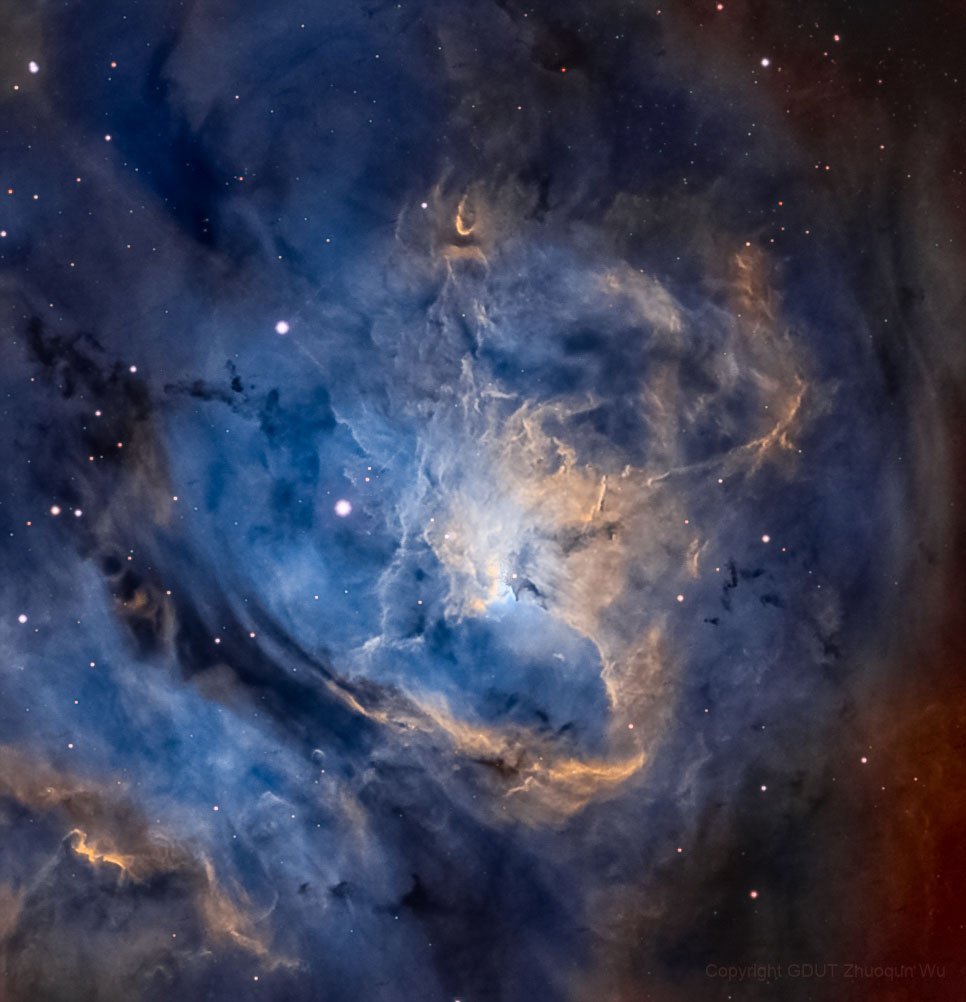
Even on the scale of light-years, fluid dynamics plays a role in our universe. This photograph shows the Lagoon Nebula, where stars, gas, and dust are battling for supremacy. Jets from young stars push the dust left from supernova remnants into a chaotic patterns, and the high-energy particles streaming from the youthful stars illuminate interstellar gases, creating the nebula’s distinctive glow. This section of the nebula is about 50 light-years across, so every picture we capture is only the tiniest snapshot of the true scale of its turbulence. (Image credit: Z. Wu; via APOD)
Tag: turbulence

Bacterial Turbulence


Conventional fluid dynamical wisdom posits that any flows at the microscale should be laminar. Tiny swimmers like microorganisms live in a world dominated by viscosity, therefore, there can be no turbulence. But experiments with bacterial colonies have shown that’s not entirely true. With enough micro-swimmers moving around, even these viscous, small-scale flows become turbulent.
That’s what is shown in Image 2, where tracer particles show the complex motion of fluid around a bacterial swarm. By tracking both the bacteria motion and the fluid motion, researchers were able to describe the flow using statistical methods similar to those used for conventional turbulence. The characteristics of this bacterial turbulence are not identical to larger-scale turbulence, but they are certainly more turbulent than laminar. (Image credits: bacterium – A. Weiner, bacterial turbulence – J. Dunkel et al.; research credit: J. Dunkel et al.; submitted by Jeff M.)

New Details on the Sun’s Surface
As part of its shakedown, the new Inouye Solar Telescope has captured the surface of the sun in stunning new detail. Seen here are some of the sun’s turbulent convection cells, each about the size of the state of Texas. Hot plasma rises in the center of each cell, cools, and then sinks near the dark edges. Also visible within these dark borders are bright spots thought to mark magnetic fields capable of channeling energy out into the corona. Researchers hope the new telescope will help them uncover the physics behind these processes. (Image and video credit: Inouye Solar Telescope)

Editor’s note: Like several other telescopes located in Hawai’i, the Inouye Solar Telescope was built against the wishes of many native Hawaiians. Although FYFD supports scientific progress, it is my personal belief that scientific advances should not come at the expense of indigenous populations. I strongly urge my scientific colleagues to listen to and work alongside those with concerns about future facilities.

Celebrating Turbulence


Laminar flow is easy to love, but turbulence is a far richer phenomenon. That’s the premise behind Veritasium’s new video (and, yes, I agree with him). In the video Derek provides a nice introduction to turbulence, including a checklist of qualities a turbulent flow must have.
Personally, I don’t classify flows as simply being either laminar or turbulent; I view those two states as ends of a spectrum, which means there are many flows that fall somewhere in-between. (For more on what happens between laminar and turbulent, check out my video on transition.)
As neat and eye-catching as laminar flow can be, turbulence is critical to life as we know it. It’s a necessary ingredient in cloud and raindrop formation. It drives the mixing of blood in our hearts. It keeps the leaves on trees from overheating. Without it, your coffee would be cold long before your cream mixes in. Turbulence is even critical to star formation; without turbulence, our entire solar system might have lacked the matter and time necessary to form! (Video and image credit: Veritasium)

New Signs of Turbulence in Blood Flow


Our bodies are filled with a network of blood vessels responsible for keeping our cells oxygenated and carrying away waste products. In many ways, our blood vessels are tiny pipes, but there’s a crucial difference in the flow they carry: it’s pulsatile. Because the flow is driven by our hearts, rather than a continuous pump, every heartbeat creates a distinct cycle of acceleration and deceleration in the flow. And new research has found that this cycle, when combined with curvature or flow restrictions like plaque build-up, can create turbulence in unexpected places.
Specifically, the researchers found that decelerating pipe flows can develop a helical instability that breaks down into turbulence, even in vessels where purely laminar flow would be expected. In the animations above, you can see the flow slow, develop swirls and then break into turbulence. The flow becomes laminar again as it accelerates, but during that brief bout of turbulence there’s much higher forces on the walls of a blood vessel. Over time, that extra force could contribute to inflammation or even hardening of the arteries. (Image and research credit: D. Xu et al.; via phys.org)
The Birth of a Liquor
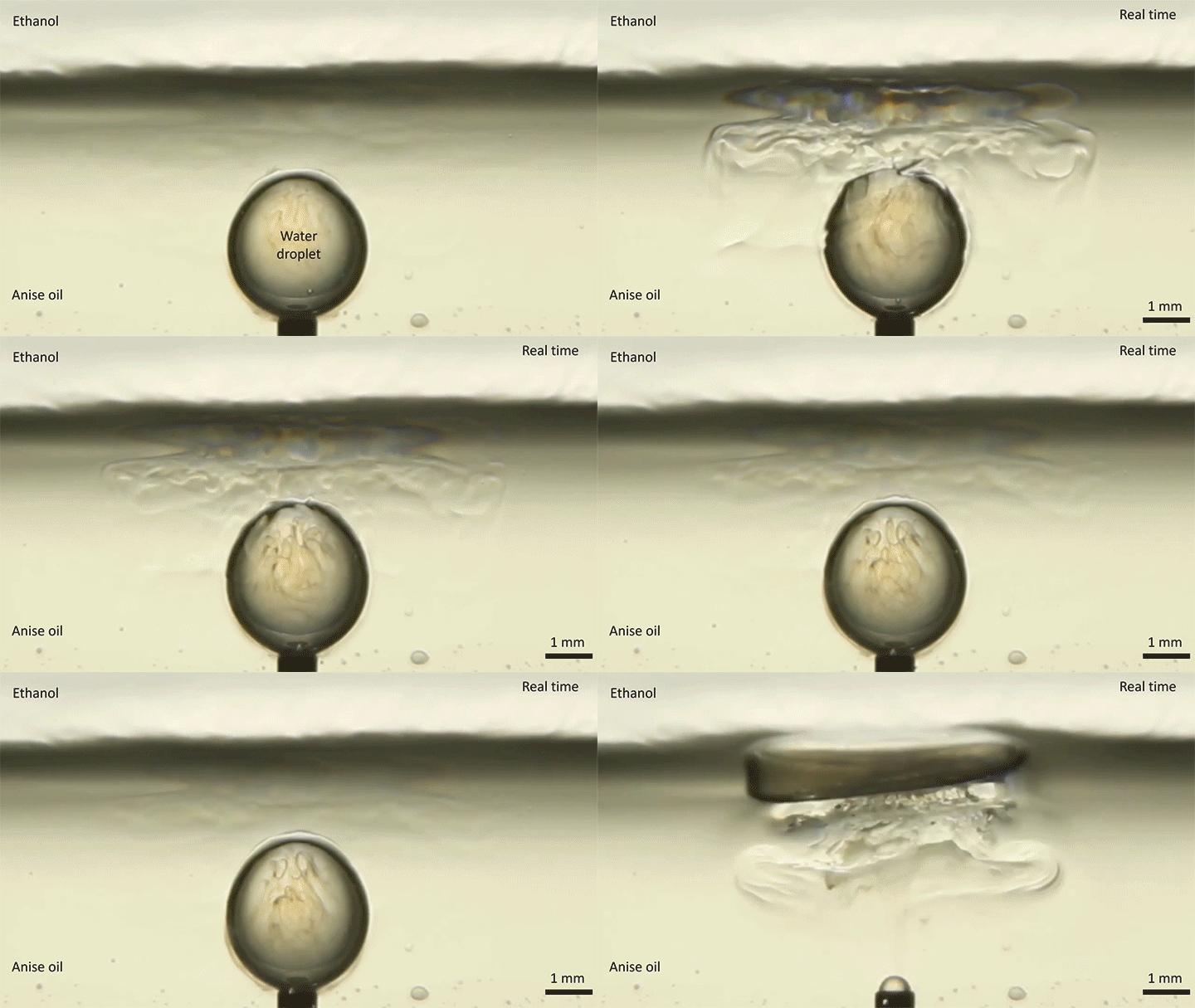
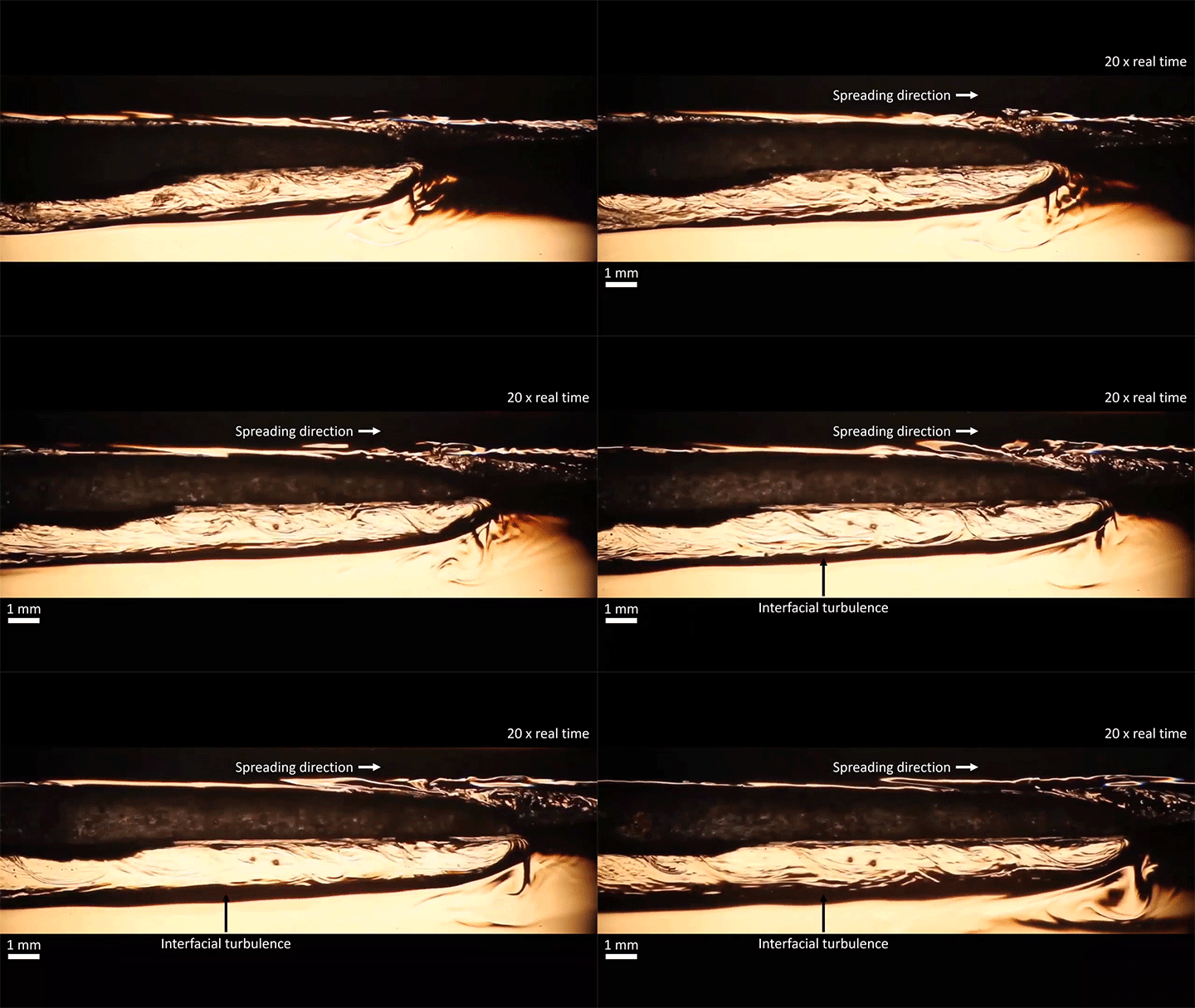

A water droplet immersed in a mixture of anise oil and ethanol displays some pretty complicated dynamics. Its behavior is driven, in part, by the variable miscibility of the three liquids. Water and ethanol are fully miscible, anise oil and ethanol are only partially miscible, and anise oil and water are completely immiscible. These varying levels of miscibility set up a lot of variations in surface tension along and around the droplet, which drives its stretching and eventual jump.
Once detached, the droplet takes on a flattened, lens-like shape that continues to spread. That spreading is driven by the mixing of ethanol and water, which generates heat and, thus, convection around the drop. This not only spreads the droplet, it causes turbulent behavior along the drop’s interface. (Image and video credit: S. Yamanidouzisorkhabi et al.)

Dunes Avoid Collisions


The speed at which a dune migrates depends on its size; smaller dunes move faster than larger ones. That speed differential implies that small dunes should frequently collide into and merge with larger dunes, eventually forming one giant dune rather than a field of smaller separate ones. But that’s not what we observe in nature.
To figure out why dunes aren’t colliding that often, researchers built a dune field of their own in the form of a rotating water tank. Inside the tank, their two artificial dunes can chase one another indefinitely while the researchers observe their interactions. What they found is that the dunes “communicate” with one another through the flow.
As flow moves over the upstream dune, it generates turbulence in its wake, which the downstream dune then encounters. All that extra turbulence affects how sediment is picked up and transported for the downstream dune, ultimately changing its migration speed. For two dunes of initially equal size and close spacing, these interactions push the downstream dune further away until the separation between the dunes is large enough that they both migrate at the same speed. Even between dunes of unequal sizes, the researchers found that these repulsive interactions force the dunes away from collision and into migration at the same speed. (Image credit: dune field – G. Montani, others – K. Bacik et al.; research credit: K. Bacik et al.; via Cosmos; submitted by Kam-Yung Soh)
Colorful Dissipation


Colorful eddies swirl in this short video from photographer Karl Gaff. Formed near the boundary at the bottom of the frame, these eddies act to dissipate some of the energy in the flow. Structures like these are key in turbulent flows, where energy must pass from large eddies to smaller and smaller ones until they reach a size where viscosity can extinguish them. (Video, image, and submission credit: K. Gaff)
P.S. – Today’s post is FYFD’s 2,500th! Crazy, right? That means we have a pretty enormous archive. Want to explore? Click here for a random post.
Fluid Dynamics and Disease Transmission
Right now people around the world are experiencing daily disruptions as a result of the recently declared coronavirus pandemic. There is a lot we don’t know yet about coronavirus, though researchers are working around the clock to report new information. Today’s video, though a couple years old, focuses on an area of medical knowledge that’s historically lacking but extremely relevant to our current situation: the mechanics behind disease transmission through sneezing or coughing.
Lydia Bourouiba is a leader in this area of research. Her studies have focused not on the size range of droplets produced but on the dynamics of the turbulent clouds that carry these droplets and what allows them to persist and spread. If you’ve wondered just why healthcare providers are recommending masks for sick people, keeping large distances between individuals, and frequent hand-washing, the image above hopefully helps explain why. Droplets carried in these turbulent clouds can travel several meters, and the buoyancy of the cloud’s gas components can help lift droplets toward ceiling ventilation. Right now, social distancing is one of our best tools against this disease transmission.
My goal in posting this is not to panic anyone. Rather, I hope you leave better informed as to why these precautions are needed. With coronavirus, our detailed knowledge of its characteristics — how long it remains viable in the air or on surfaces, how much is needed for an infection to take hold, etc. — is limited. But from research like Bourouiba’s, we know that coughing and sneezing are remarkably efficient ways to deliver respiratory pathogens, and that’s why caution is warranted. Stay safe, readers. (Video credit: TEDMED; image credit: Bourouiba Research Group, source; research credit: L. Bourouiba et al., see also S. Poulain and L. Bourouiba, pdf)
Vortex Collisions Leave Clues to Turbulence


Vortex ring collisions have long been admired for their beauty, but they’re now shedding light on the fundamental interactions that lead to turbulence. By dying just the cores of colliding vortex rings (Image 2), researchers observed anti-symmetric perturbations that develop along each core as they interact. These are indicative of what’s known as the elliptical instability.
But the breakdown doesn’t stop there. Instead, as the elliptical instability develops, it generates a set of secondary vortex filaments that wrap around the original cores (Image 3). Just like the original vortex cores, those counter-rotating secondary filaments interact with one another, develop their own elliptical instability, and generate a set of smaller, tertiary filaments (Image 4).
What’s exciting is that this process gives us a physical mechanism for the turbulent energy cascade. Researchers have talked for decades about energy passing from large-scale eddies to smaller and smaller ones, but this work lets us actually observe that cascade in the form of smaller and smaller pairs of vortex filaments interacting. To see more, check out some of our previous posts on this work. (Image and research credit: R. McKeown et al.; via Cosmos; submitted by Ryan M. and Kam-Yung Soh)


