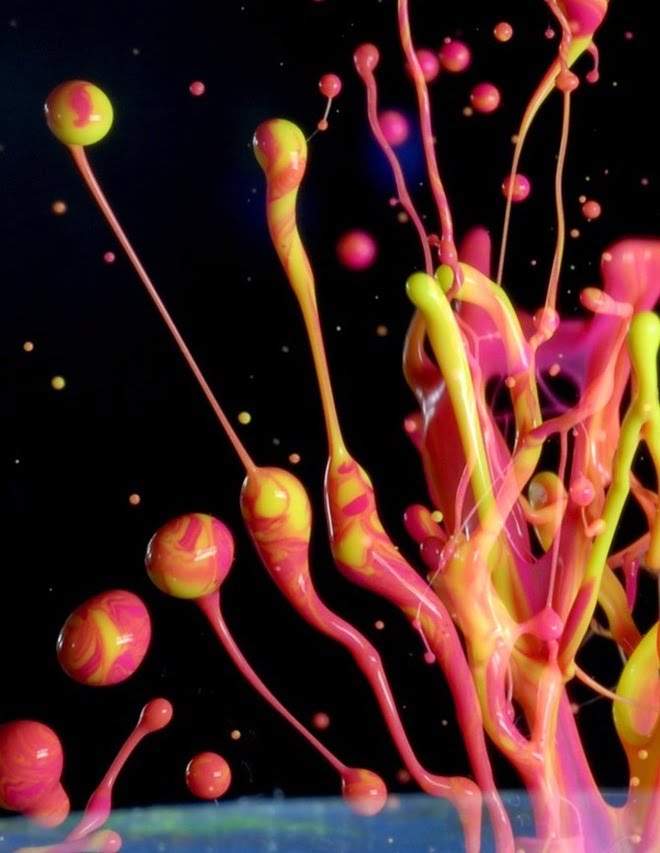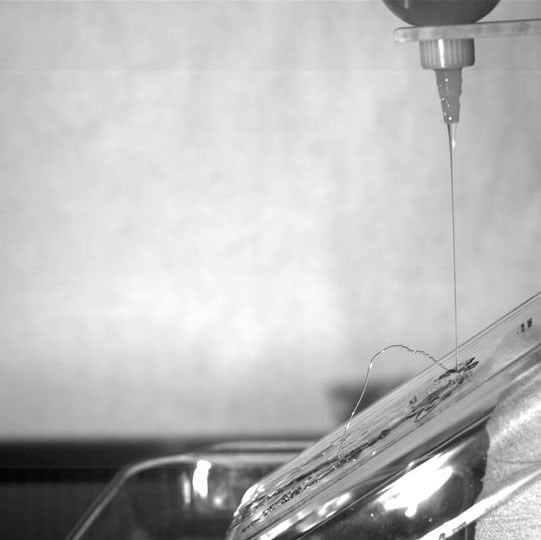
When a viscous fluid falls onto a surface, it will form a heap, like honey coiling. But for shear-thinning liquids like soap or shampoo something a little wild can happen as the heap grows. A dimple can form and, when the incoming jet of fluid hits that dimple, it slips against it and is ejected outward. If you wonder why you don’t see this every day in the shower, it’s because the outgoing jet usually hits the incoming jet, causing the whole system to collapse in less than 300 ms. By dropping the fluid on an inclined surface, one can keep the two jets from colliding, thereby creating a stable Kaye effect. (Photo credit: E. Eichelberger)
Tag: shear-thinning

The Kaye Effect
The Kaye effect is an instability particular to a falling stream of non-Newtonian fluids with shear-thinning properties. When these fluids are deformed, their viscosity decreases; this, for example, is why ketchup flows out of a bottle more easily once it’s moving. Like most fluids, the falling shampoo creates a heap on the surface. The Kaye effect is kicked off when the incoming jet creates enough shear on part of the heap that the local viscosity decreases, causing the streamer–or outgoing jet–to slip off the side of the heap. As the incoming jet continues, a dimple forms in the heap where the streamer originates. As the dimple deepens, the streamer will rise until it strikes the incoming jet. This perturbation to the system collapses the streamer and ends the Kaye effect. This video also has a good explanation of the physics, along with demonstrations of a stable form of the Kaye effect in which the streamer cascades down an incline. (Video credit: Minute Laboratory; inspired by infplusplus)
Getting Ketchup to Flow
Most everyone is familiar with the difficulty of getting ketchup out of its bottle. Part of the trouble is that ketchup is a shear-thinning fluid, meaning that its viscosity decreases with an increasing rate of shear. Thus, a shear-thinning fluid flows better once it starts moving. This is why the ketchup moves much faster once it is initially disturbed. LiquiGlide, a new coating material demonstrated above, has gained a lot of popular attention in the press recently for solving the difficulty of the stuck condiments. It appears that the coating reduces the static coefficient of friction between the food and the bottle, meaning that the ketchup starts sliding down the wall even before an increase in shear stress starts the flow. (submitted by @szescstopni)
Sound Sculptures
This is another fun and artistic use of non-Newtonian fluids (paint) vibrating on a speaker cone for advertising purposes. The shear-thinning viscous properties of the paint vie with surface tension to create lovely instantaneous sculptures of color. Check out Canon’s Pixma ads for similar artwork.
Leaping Shampoo
The Kaye effect is a neat phenomenon associated with falling shear-thinning non-Newtonian fluids like shampoo or hand soap. As the falling liquid piles up after hitting a solid surface, it ejects streams of fluid upwards. The effect usually only lasts for a few hundred milliseconds, but it is possible to see it at home without a high-speed camera if you pay close attention. More detailed physics of the effect are discussed in this previously featured video.

Paint Vibrations
Paint vibrated on a loud speaker explodes in multi-colored jets and droplets. Most paints are shear-thinning non-Newtonian fluids (like ketchup, shampoo, or whipped cream), meaning that their viscosity decreases as they are sheared. This allows them to flow more readily once they are perturbed. #
Shear-Thinning at Home
Shear-thinning isn’t just confined to canned whipped cream. It’s also a feature of such non-Newtonian fluids as ketchup, shampoo, latex paint, and blood. The NASA research on shear-thinning the video author refers to is here and comes from the Critical Viscosity of Xenon-2 (CVX-2) experiment flown on the final mission of Columbia. Surprisingly, almost all of the experimental data was recovered from the crash. #

Venom Properties
Most venomous snakes deliver venom to their prey via grooves in their fangs, rather than through a pressurized bolus through hollow fangs. New research shows that these venoms are shear-thinning non-Newtonian fluids. The surface tension of the venom is such that a drop of venom will tend to flow into and down the groove. Once moving, the shear-thinning properties of the venom decrease the venom’s viscosity, increasing its flow rate down the fang and into the snake’s prey. (via Scientific American; Photo: green mamba, banded snake fang)
Hawaiian Fissures
[original media no longer available]
New fissures opened on Mount Kilauea in Hawaii earlier this month, resulting in some fountain-like eruptions of lava. This molten rock is a non-Newtonian fluid with shear-thinning and thixotropic properties. This is what allows the lava to flow long distances before it cools and solidifies. (via jpshoer)
Pouring Paint
In this artwork by Holton Rower, paint (typically a non-Newtonian fluid) is poured down a rectangular prism; the result is a neat demonstration of shearing in laminar flows. Paint is usually shear-thinning, meaning that its viscosity decreases under shear; this is why the color stripes on the vertical panels expand more than those on the horizontal surfaces do. # (submitted by Stephan)