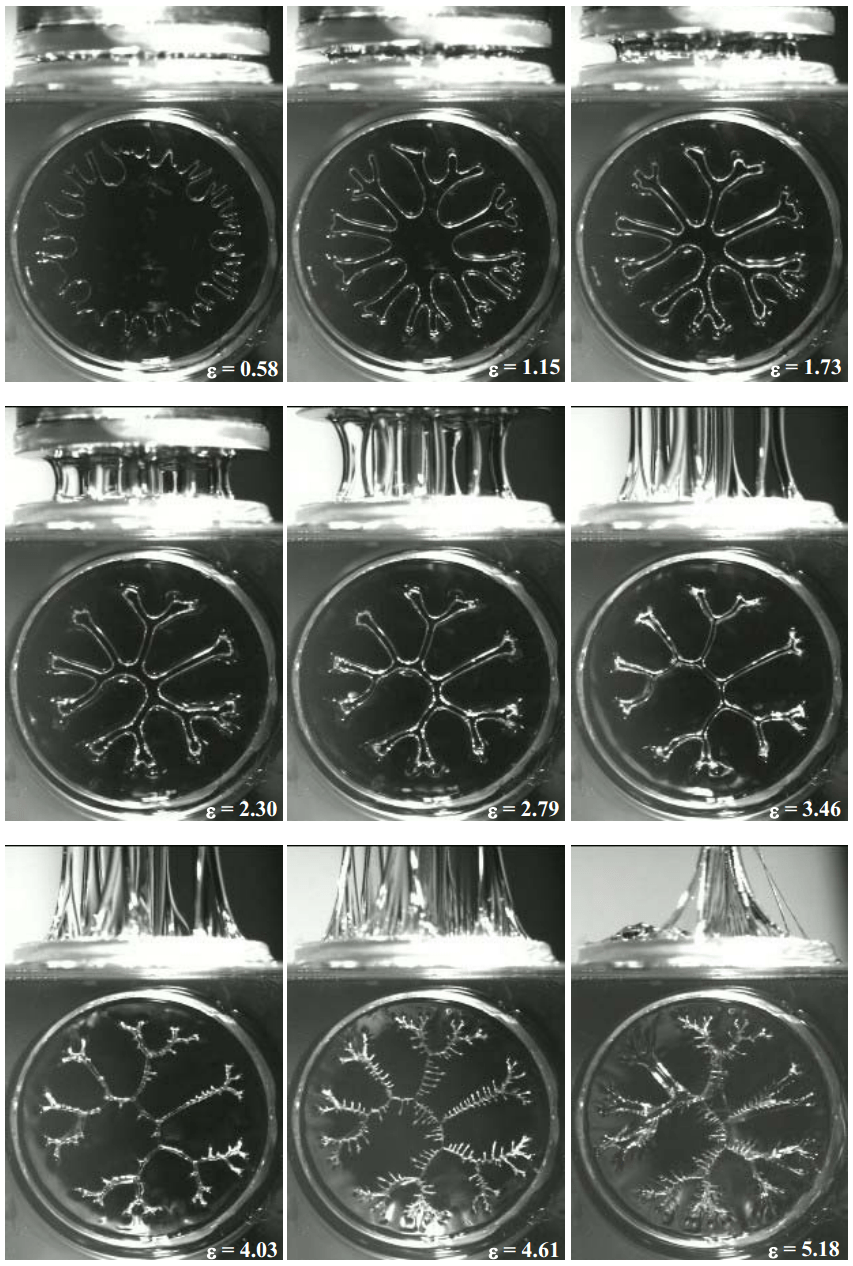
This series of photos shows two plates with a thin layer of polymer-laced, viscoelastic liquid. As the two plates are separated, complex instabilities form. The lower section of each photograph shows the fluid on the plate, with finger-like Saffman-Taylor instabilities forming as air rushes in between the gap in the plates. As the separation increases, the polymers in the liquid stretch under the increased strain, inducing elastic stresses in the fluid that cause the formation of secondary structures. (Photo credit: R. Welsh, J. Bico, and G. McKinley)
Tag: science

Creating Lava
In Syracuse, NY, artists and scientists work together to study volcanic flows by melting crushed basalt in a special furnace before releasing the lava into the parking lot. This particular flow is very prone to boiling behavior, likely because of the cold air and ground temperatures (less than 0 C). The outer layers of rock cool quickly, leaving bubble-shaped chambers which hotter lava can fill before melting out. (via It’s Okay To Be Smart; submitted by @jpshoer)

Homemade Astronomy


Artist Julia Cuddy uses liquids, soaps, and glitter to create photographs that replicate the look of deep space astronomy. By adding soap to the dyes, she uses Marangoni effects to drive surface tension instabilities that cause swirling colors and motions reminiscent of galaxies and nebulae. Although I’ve seen fluid dynamics used in art before, this may be one of the cleverest usages I’ve seen! (Photo credits: Julia Cuddy)
Fireball in Slow Motion
The high-speed video above shows an atomized spray of flammable liquid being ignited using a lighter. It was filmed at 10,000 fps and is replayed at 30 fps. Although uncontained, this demonstration is similar to the combustion observed inside of many types of engines. Automobiles, jet engines, and rockets all break their liquid fuel into a spray of droplets to increase the efficiency of combustion. The turbulence of the flames dances and swirls, with small-scale motions close to the sprayed droplets and larger-scale motions around the vaporized fuel. This variation in size of the scales of motion is a hallmark feature of turbulence and can be used to characterize a flow.

Bubbles and Jets

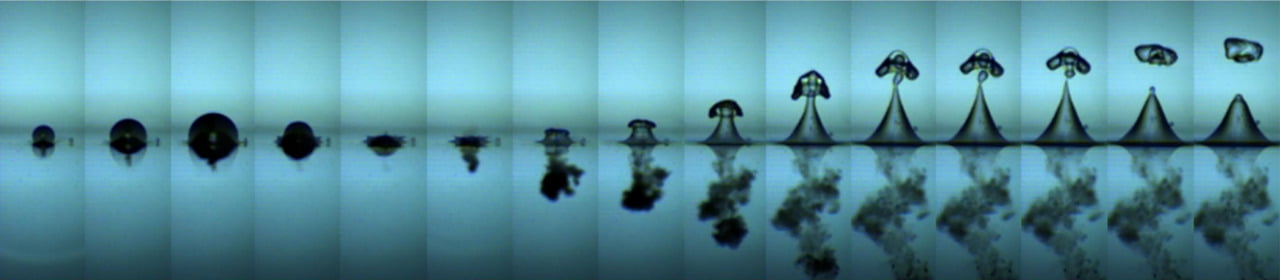
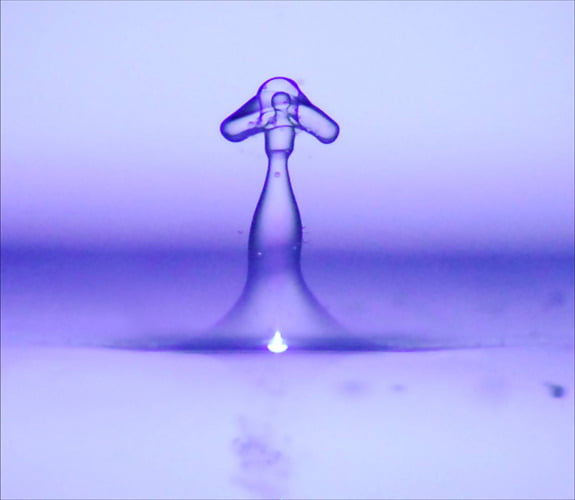
In the photo sequence above, a bubble is created at the interface between two immiscible liquids–water on top and denser hydrofluroether (HFE) below. Initially, the bubble expands explosively due to the vaporization of water generated by a short laser pulse. As the bubble collapses, a jet forms and accelerates into the HFE. After collapse, the bubble remnants injected in the HFE cause the formation of a jet that shoots back into the water above. Surface instabilities make the jet assume a mushroom or crown-like structure that detaches from the jet. Eventually gravity will return the system to its initial undisturbed fluid-fluid interface. (Photo credit: S. Avila et al. 1,2)
Fractal Fluids
Part of the beauty of numerical simulation is its ability to explore the physics of a situation that would difficult or impossible to create experimentally. Here the Rayleigh-Taylor instability–which occurs when a heavier fluid sits atop a lighter fluid–is simulated in two-dimensions. Viscosity and diffusion are set extremely low in the simulation; this is why we see intricate fractal-like structures at many scales rather than the simulation quickly fading into gray. (The low diffusion is also what causes the numerical instabilities in the last couple seconds of video.) The final result is both physics and art. (Video credit: Mark Stock)
How to Escape a Whitewater Hole
One of the perils of whitewater sports is getting stuck in what paddlers call a “hole” or a “hydraulic”. This river feature forms just downstream of large obstacles like rocks or low-level dams. As water pours over the obstacle and into its shadow, the flow forms a recirculating vortex-like zone. Immediately next to the obstacle, water is pulled upstream toward the obstacle and then down toward the bottom of the river. This makes the hydraulic very dangerous and hard to escape. Note in the video how the raft is held in place by the upstream motion of the water at the surface of the hydraulic. The rafters are preventing their craft from flipping over by weighing down the side experiencing the upward flow of the vortex. Escaping a hydraulic usually requires getting near its edge, where its current is weaker. If swimming, the best way to escape is to swim toward the bottom of the river and then downstream with the current of the hydraulic rather than against it at the surface.

Flapping Flags
The flapping of flexible objects like flags have long fascinated mankind. The figure above from Shelley and Zhang 2011 shows several possible flapping states. In (a) a thread immersed in a running soap film displays the standard von Karman vortex street of shed vortices in its wake. Parts (b) and © show the thread in coherent flapping motion; (b) shows an snapshot of the flapping thread in the soap film whereas © is a timelapse of the thread showing its full range of motion. Image (d) shows the effects of a higher flow speed–the flapping motion becomes aperiodic. Image (e) shows a stiff metal wire bent into the shape of a flapping filament; note the strong boundary layer separation around the wire compared to the thread in Image (b). As one might expect, the drag on the unflapping wire is significantly greater than the drag on the flapping thread. (Image credit: M. Shelley and J. Zhang, Shelley and Zhang 2011)
Astro Puffs
Microgravity continues to be a fascinating playground for observing surface tension effects on the macroscale without pesky gravity getting in the way. Here astronaut Don Pettit has created a sphere of water, which he then strikes with a jet of air from a syringe. Initially, the momentum from the jet of air creates a sharp cavity in the water, which rebounds into a jet of water that ejects one or more satellite drops. Surface waves and inertial waves (inside the water sphere) reflect back and forth until the fluid comes to rest as a sphere once more. Note how similar the behavior is to the pinch-off of a water column. Both effects are dominated by surface tension, but on Earth we can only see this behavior with extremely small droplets and high-speed cameras! (Video credit: Don Pettit, Science Off the Sphere)
Pinch-Off
This high-speed video reveals a fascinating bit of kitchen sink physics. When a water droplet pinches off from the nozzle, the thin filament of fluid that connected the droplet to the water on the nozzle often breaks off as well. Surface tension snaps the filament together into a sphere, causing wild oscillations and even ejection of microjets in the tiny satellite droplet. (Video from S. Thoroddsen et al. 2008’s Annual Review)