Mudslides and avalanches typically carry debris of many shapes and sizes. To understand how debris size affects flows like these, researchers use simplified, laboratory-scale experiments like this one. Here, researchers mix a slurry of silicone oil and glass particles of roughly two sizes. The red particles are larger; the blue ones smaller. Sitting in a cup, the mixture tends to separate, with red particles sinking faster to form the bottom layer and smaller blue particles collecting on top. And what happens when such a mixture flows down an incline? The smaller blue particles tend to settle out sooner, leaving the larger red particles in suspension as they flow downstream. (Video and image credit: S. Burnett et al.)
On the heels of his behind-the-scenes introduction, here’s the first volume of artist Roman De Giuli’s “Now I See”. In it, we appear to soar above vast colorful landscapes. Rivers flow past islands. Glaciers creep along valleys. Canyons cut through deserts. It’s like a bird’s eye view of our planet’s terrestrial wonders. (Video and image credit: R. De Giuli)
Insects are masters of a challenging flight regime; their agility, stability, and control far outstrip anything we’ve built at their size. But to even understand how they accomplish this, researchers must manage to capture those maneuvers in the first place. Insects don’t stay in one small area, which is what the typical fixed camera motion capture set-up requires. Instead, one group of researchers has designed a system with a moveable mirror that tracks an insect’s motion in real-time, ensuring that the camera stays fixed on the insect even as it traverses a room or — for the drone-mounted version — a field.
Real-time motion tracking means that researchers can better capture detailed footage of the insect’s maneuvers in a lab environment, or they can head into the field to follow insects in the wild. Imagine tracking individual pollinators through a full day of gathering or watching how a bumblebee responds to getting hit by a raindrop mid-flight. (Video and image credit: Science; research credit: T. Vo-Doan et al.)
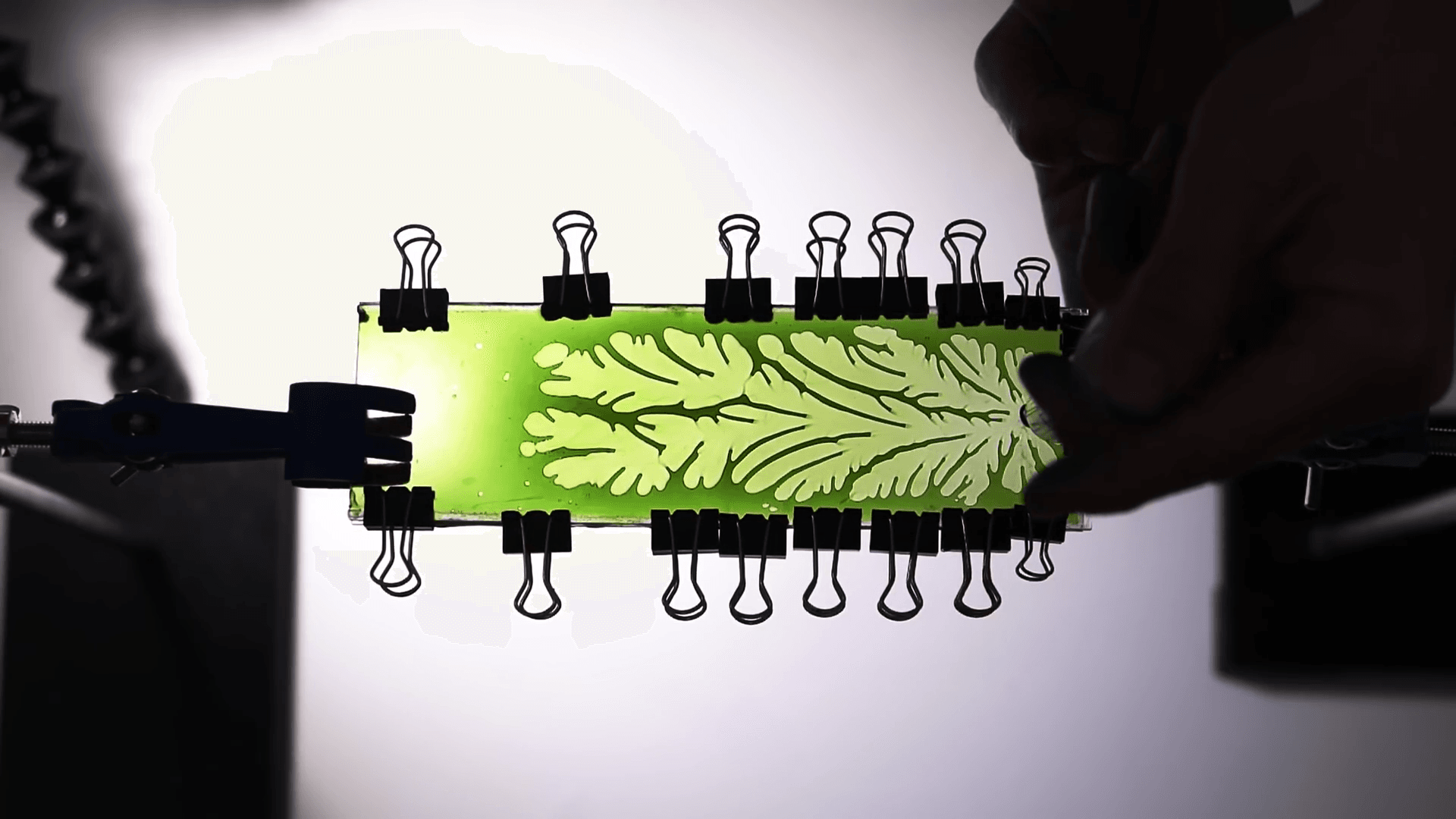
As bizarre as the branching fractal fingers of the Saffman-Taylor instability look, they’re quite a common phenomenon. In his video, Steve Mould demonstrates how to make them by sandwiching a viscous liquid like school glue between two acrylic sheets and then pulling them apart. The more formal lab-version of this is the Hele-Shaw cell, which he also demonstrates. But you may have come across the effect when pealing up a screen protector or in dealing with a cracked phone screen. In all of these cases, a less viscous fluid — specifically air — is forcing its way into a more viscous fluid, something that it cannot manage without the fluid interface fracturing. (Video and image credit: S. Mould)
Fluids labs are filled with many a coffee drinker, and even those (like me) who don’t enjoy coffee, can find plenty of fascinating physics in their labmates’ mugs. Espresso has received the lion’s share of the research in recent years, but a new study looks at the unique characteristics of a pour-over coffee. In this technique, coffee grounds sit in a conical filter and a stream of hot water pours over the top of the grounds. Researchers found that the ideal pour creates a powerful mixing environment in a coffee-studded water layer that sits above a V-shaped bed of grains created by the falling water jet.
The best mixing, they find, requires a pour height no greater than 50 centimeters (to prevent the jet from breaking into drops) but with enough height that the falling jet stirs up the grounds. You also want to pour slowly enough to give plenty of time for mixing, without letting the jet stick to the kettle’s spout, which (again) causes the jet to break up.
That ideal pour extracts more coffee flavor from the grounds, allowing you to get the same strength of brew from fewer beans. As climate change makes coffee harder to grow, coffee drinkers will want every trick to stretch their supply. (Image credit: S. Satora; research credit: E. Park et al.; via Ars Technica)
This JWST image shows a couple of Herbig-Hero objects, seen in infrared. These bright objects form when jets of fast-moving energetic particles are expelled from the poles of a newborn star. Those particles hit pockets of gas and dust, forming glowing, hot shock waves like those seen here in red. The star that birthed the object is out of view to the lower-right. The bright blue light surrounded by red spirals that sits near the tip of the shock waves is actually a distant spiral galaxy that happens to be aligned with our viewpoint. (Image credit: NASA/ESA/CSA/STScI/JWST; via APOD)
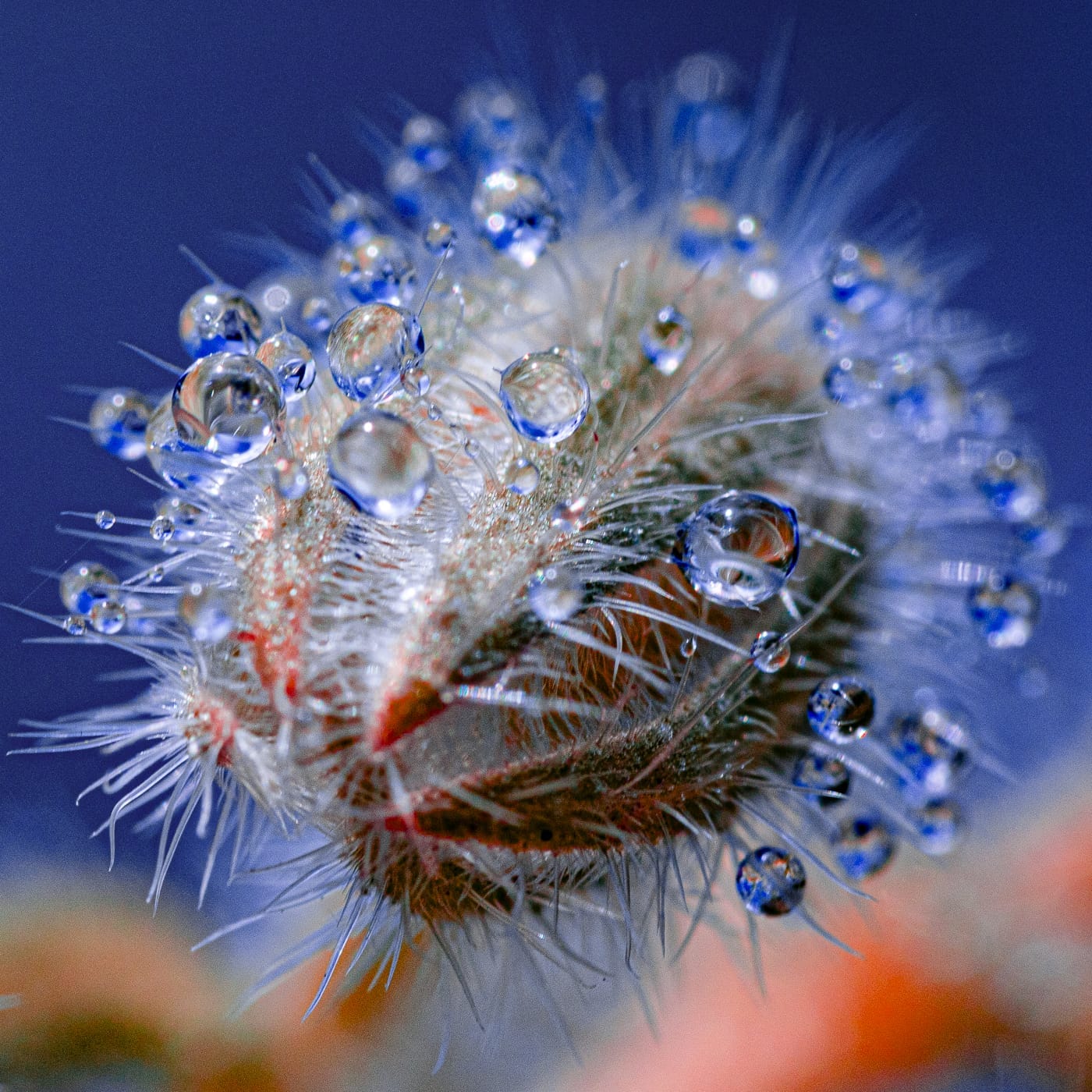
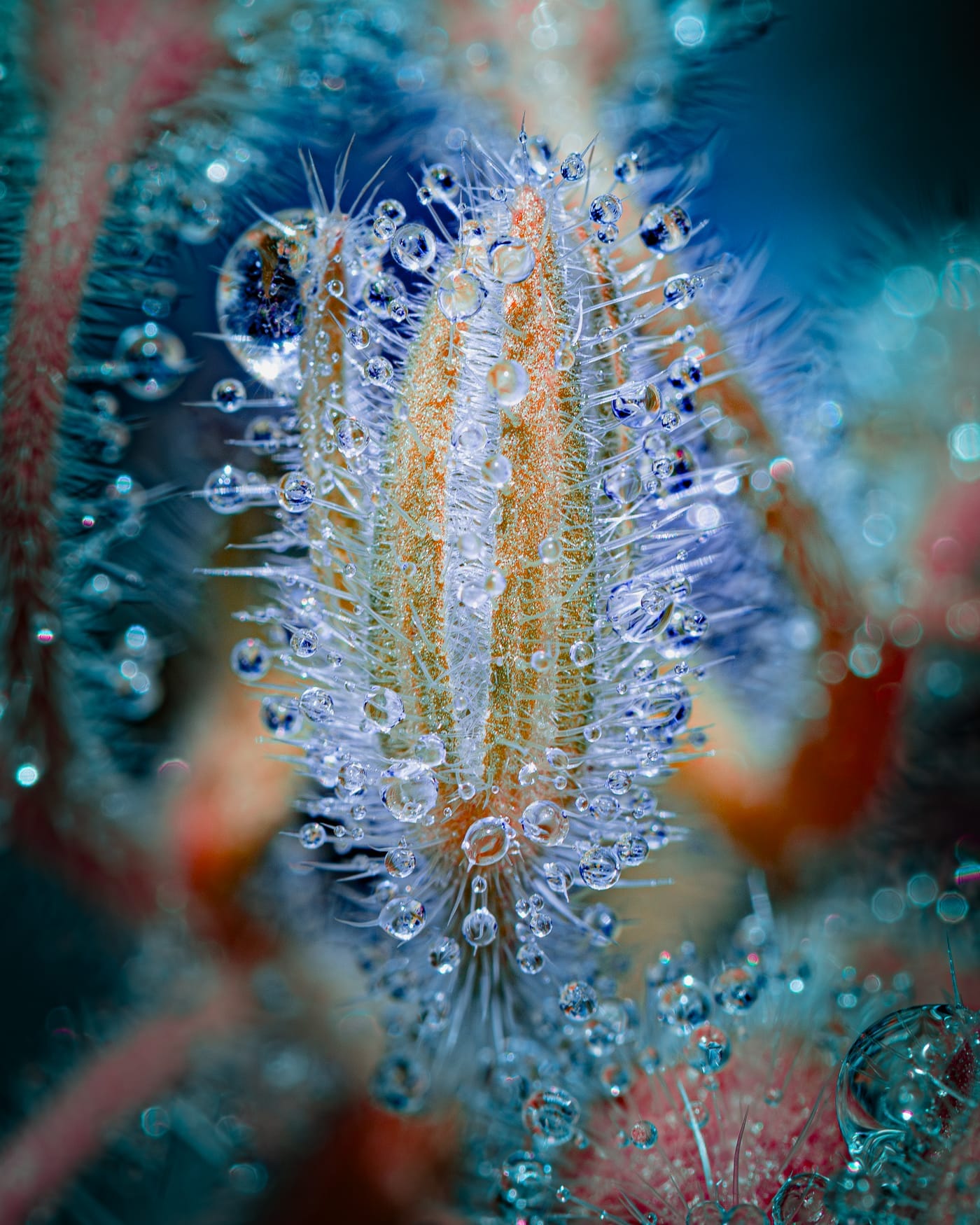
Water droplets cling to spine-covered plant life in this series from photographer Tom Leighton. The hairs are hydrophobic — notice how spherical the drops appear. Many plants make parts of their leaves and stems hydrophobic in order to redirect water toward their roots, where it can be taken in. Others use hair-like awns to collect and draw in dew that supplements their water capture. (Image credit: T. Leighton; via Colossal)
The Mozambique Channel boasts some of the world’s most turbulent waters, driven by eddies hundreds of kilometers wide. Eddies of this size — known as mesoscale — determine regional flows that influence local biodiversity, sediment mixing, and how plastic pollution moves. To better understand the region, scientists measured a mesoscale dipole from a research vessel.
Illustration of flows in the Mozambique Channel. The anticyclonic ring in dark blue rotates counterclockwise and consists of largely uniform water (labeled Ring: R1). To the south, in green, a cyclonic eddy rotates in a clockwise sense (labeled Cyclone: C1). This area is chlorophyll-rich and has varying salinity levels. Between the two is a filament of chlorophyll-rich water being drawn from the near-shore region (labeled Filament: F1).
The dipole consisted of a large anticyclonic ring (shown in dark blue) that rotated counterclockwise and a smaller cyclonic eddy (shown in green) that rotated clockwise. Between these eddies lay a central jet moving up to 130 centimeters per second that drew material out from the shoreline. In the anticyclonic ring, researchers found largely uniform waters with little chlorophyll. The cyclonic eddy, in contrast, was high in chlorophyll and had large variations in salinity. Those smaller-scale variations, they found, helped to drive vertical motions of up to 40 meters per day.
In situ measurements like these help scientists understand how energy flows through different scales in the ocean and how that energy helps transport nutrients, sediment, and pollution regionally. Such measurements also help us to refine ocean models that enable us to predict this transport and how regions will change as climate patterns shift. (Image credit: ship – A. Lamielle/Wikimedia Commons, eddies – P. Penven et al.; research credit: P. Penven et al.; via Eos)
Kirigami is a paper art that combines folding and cutting to create elaborate shapes. Here, researchers use cuts in thin sheets of plastic and explore how the sheets transform in a flow. Depending on the configuration of cuts, the sheets can stretch dramatically in the flow, creating complex, dynamic, and beautiful wakes. I feel like there must be some applications out there that would benefit from kirigami-induced mixing. (Video and image credit: A. Carleton and Y. Modarres-Sadeghi)
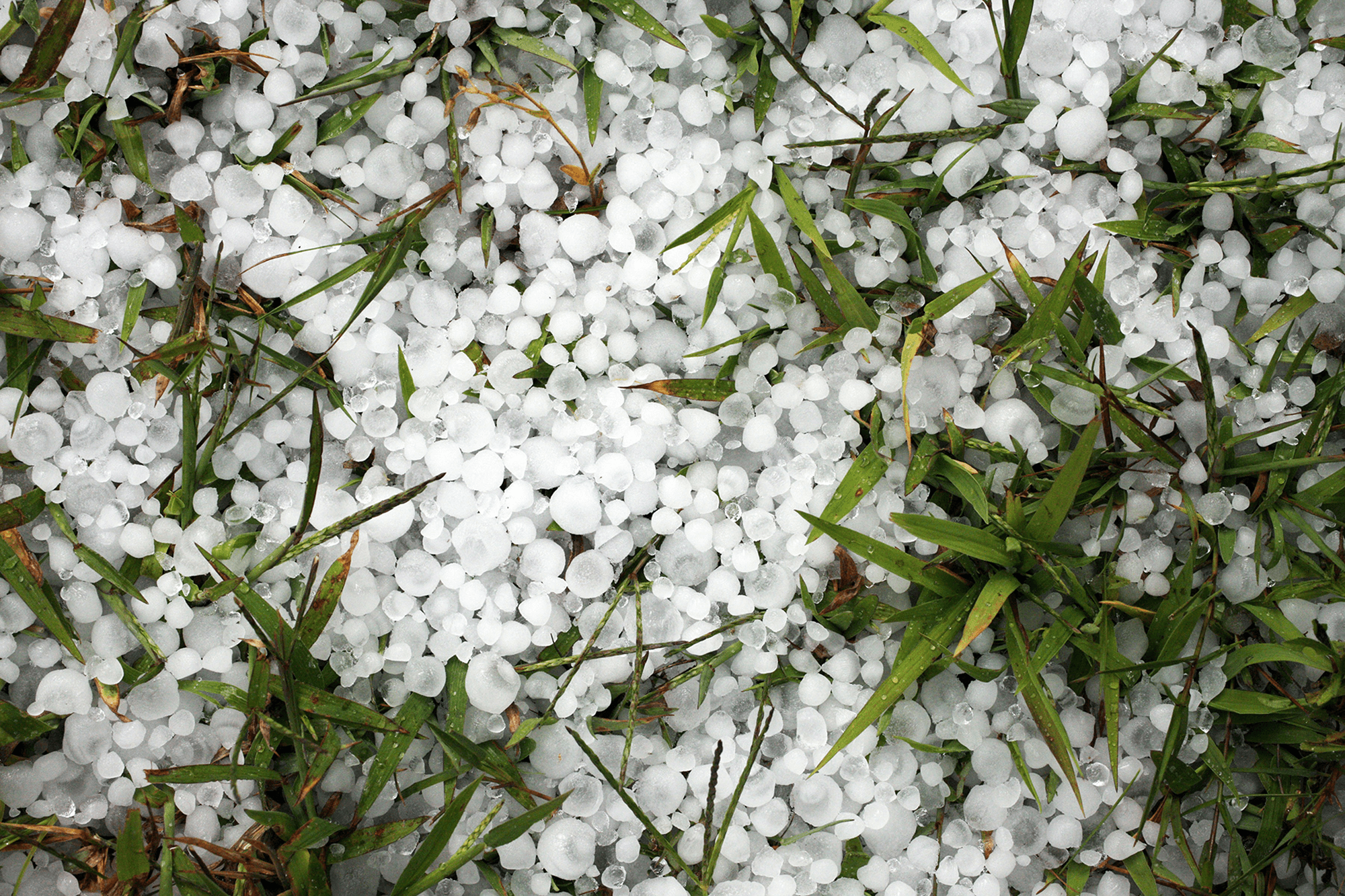
Conventional wisdom suggests that hailstones form over the course of repeated trips up and down through a storm, but a new study suggests that formation method is less common than assumed. Researchers studied the isotope signatures in the layers of 27 hailstones to work out each stone’s formation history. They found that most hailstones (N = 16) grew without any reversal in direction. Another 7 only saw a single period when upwinds lifted them, and only 1 of the hailstones had cycled down-and-up more than once. They did find, however, that hailstones larger than 25mm (1 inch) in diameter had at least one period of growth during lifting.
So smaller hailstones likely don’t cycle up and down in a storm, but the largest (and most destructive) hailstones will climb at least once before their final descent. (Image credit: D. Trinks; research credit: X. Lin et al.; via Gizmodo)