The splashing of a drop upon impact is a remarkably complicated phenomenon. Perhaps surprisingly, the air around the impacting drop plays a major role in determining which drops splash and which don’t. Lowering the air pressure, for example, stops a drop from splashing. The layer of air that gets trapped beneath the spreading edge of a drop during impact seems to be responsible for splashing. As seen in the video above, drops that impact on a leaky surface, where air can escape, do not splash. By varying where leakage is possible on the surface, the researchers can localize where trapping the air matters most. There’s a critical radius during the drop’s spread where, without leakage, air will be trapped and cause the drop to splash. (Video credit: Y. Liu et al.)
Tag: science

Phytoplankton Blooms
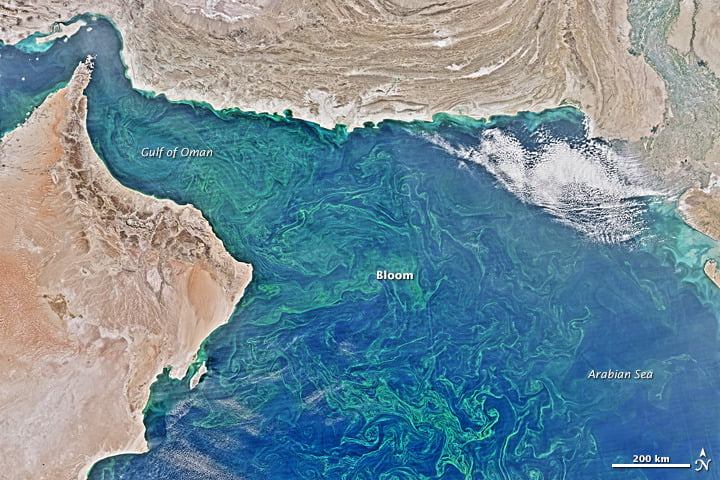
When the right nutrients come together in coastal waters, it can feed a phytoplankton bloom large enough to be visible to satellites. The phytoplankton themselves are microscopic organisms that are easily carried along by oceanic flows. In fluid dynamics terms, they are passive scalars or seed particles–additives that reveal the structure of the flow without altering it. Here the phytoplankton uncover the large-scale turbulent structure of flow in the Arabian Sea. Check the scale in the lower right. Many of the green eddies and swirls in this satellite image are hundreds of kilometers across. Yet, if we could zoom way in, we would still see turbulence acting on scales down to the millimeter length or below. This incredibly large range of length scales–eight or more orders of magnitude here–is a common characteristic of turbulence and part of what makes it such a challenge to understand or model. (Image credit: NASA Earth Observatory)

Hummingbird Hovering
Hummingbirds have a unique way of flying among birds. By flapping in a figure-8 motion, they generate lift on both the upstroke and the downstroke, which enables them to fly forward, backward, and even hover for extended periods. Such mid-air acrobatics are necessary for a species that feeds on flower nectar. What is especially impressive about the birds, though, is how they hold up even in adverse conditions like wind or rain. By placing birds in a wind tunnel and filming with high-speed video, researchers can see how hummingbirds maintain their feeding position even in 20 mph (32 kph) winds. By fanning out their tail feathers like a rudder, they can control their body orientation despite turbulent gusts. Not even rain stops them. The birds will periodically shake themselves dry, much like a dog if a dog could manage to fly while shaking itself. (Video credit: Deep Look; submitted by entropy-perturbation)

The Dance of the Droplets


Milk and juice vibrating on a speaker can put on a veritable fireworks display of fluid dynamics. Vibrating a fluid can cause small standing waves, called Faraday waves, on the surface of the fluid. Add more energy and the instabilities grow nonlinearly, quickly leading to tiny ligaments and jets of liquid shooting upward. With sufficiently high energy, the jets shoot beyond the point where surface tension can hold the liquid together, resulting in a spray of droplets. (Image credit: vurt runner, source video; h/t to @jchawner)
Cloud Formation
Clouds are so ubiquitous here on Earth that it’s easy to take them for granted. But there’s remarkable complexity in the mechanics of their formation. This great video from Minute Earth steps through the processes of evaporation and condensation that drive basic cloud formation. After evaporation, buoyancy lifts warm, moist air upward. That warm air expands and cools until it reaches an altitude where water droplets can condense onto dust particles in the atmosphere. These droplets form the wispy cloud we see. Turbulence mixes these droplets and helps them collide and grow. Interestingly, although we understand the basic process of cloud formation, relatively little is understood about the details, and the subject is still very much an area of active research. (Video credit: Minute Earth; via io9)
Dead Water
Sailors have long known about the “dead water” phenomenon, which can bring ships to a near-standstill, but it was only within the last century that an explanation for the behavior was found. The underlying cause is a stratification of fluids of different densities. As seen in the video above, when a boat moves by exerting a constant force, such as with propellers, it generates an internal wave along the interface between two density layers in the water. As the wave grows in amplitude, it speeds up, chasing and eventually breaking against the boat. The energy that drives the internal wave’s growth comes from the energy the boat expends for propulsion; the larger and closer the wave gets, the slower the boat goes because its energy is sapped by the wave. In the ocean, particularly near sources of freshwater run-off, like melting glaciers, the water can be extremely stratified, with many layers of different salinity and density. The end of the video simulates this with a three-fluid demonstration in which the boat’s motion generates internal waves across multiple density interfaces. (Video credit: M. Mercier et al.)

Why Joints Pop
Joints like our knuckles are lubricated with liquid called the synovial fluid. When manipulated, these joints can pop or crack audibly. For half a century, researchers have thought the cracking sound joints under tension make was the result of bubbles in the synovial fluid collapsing. But a new cine magnetic resonance imaging (MRI) study shows that the sound is generated during bubble inception and that the cavity persists after the sound. When the bones of the joint are pulled, viscous forces resist their separation. With enough force, the joints separate suddenly, causing a pressure drop in the synovial fluid that forms a vapor-filled cavity in the joint. According to the real-time MRI observations, this is when the sound is generated. The cavity does eventually dissipate, they found, but only well after the pop. The whole joint-cracking process is consistent with the tribonucleation mechanism seen in machinery. (Image credit: G. Kawchuk et al.; GIF via skunkbear, source video)

Espresso in Space


The International Space Station resupply mission launched yesterday included a long-awaited fluid dynamics experiment that offers astronauts a taste of home: the ISSpresso espresso machine. Built by two Italian companies, the specially-designed espresso maker contains a non-convectional heating system and high-pressure piping to safely enable proper brewing using real coffee while in microgravity. The machine is also ruggedized to withstand launch forces; prototypes were even dropped in drop towers to simulate microgravity brewing conditions. The machine dispenses the brewed espresso into plastic packets, but another experiment aboard the ISS, Capillary Effects of Drinking in Microgravity, includes 3D-printed cups designed to allow orbiting astronauts to sip their beverages from open containers without spilling. They’re an improvement on a design created by astronaut Don Pettit in 2008 while in orbit. The cup’s sharp interior angle causes surface tension and capillary action to wick liquid upward to the spout. (Image credits: Lavazza; NASA/Portland State University/A. Wollman)

Newtonian and Non-Newtonian Vortices

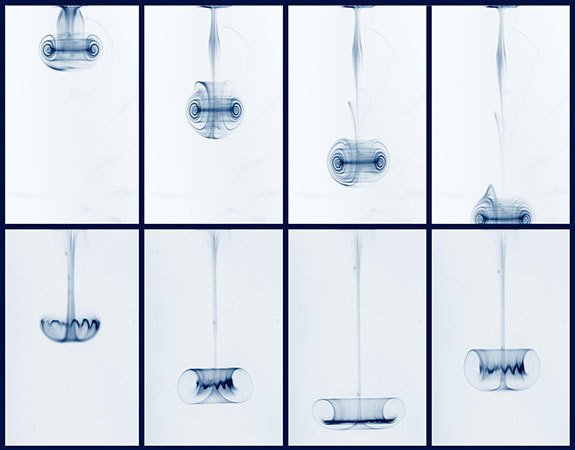
Not all vortex rings are created equal. Despite identical generation mechanisms and Reynolds numbers, the two vortex rings shown above behave very differently. The donut-shaped one, on the top left in green and in the middle row in blue, was formed in a Newtonian fluid, where viscous stress is linearly proportional to deformation. As one would expect, the vortex travels downward and diffuses some as time passes. The mushroom-like vortex ring, on the other hand, is in a viscoelastic fluid, which reacts nonlinearly to deformation. This vortex ring first furls and expands as it travels downward, then stops, contracts, and travels backward! (Image credit: J. Albagnac et al.; via Gallery of Fluid Motion)
Growing Icicles
For those from colder climates, icicles are a familiar part of winter. They come in a multitude of shapes and sizes, many of which have been captured and cataloged in the Icicle Atlas project. The site contains images, videos, and measurements of more than 230 icicles grown in the lab over the course of four years of research into how and why icicles form the way they do. One interesting result of the work was the discovery that the ripples commonly found on icicles are directly related to impurities. Icicles grown with pure water remain smooth, and only those with ionic impurities, like salt, develop ripples. Check out more images and icicle research at the Atlas. (Video credit: A. Chen and S. Morris/The Icicle Atlas; via Discover)