FYFD made it into the February issue of APS News! Click here to read the online version, which is way easier than deciphering my cell phone’s photos.


FYFD made it into the February issue of APS News! Click here to read the online version, which is way easier than deciphering my cell phone’s photos.


For the next week, FYFD is going to be exploring the physics of walking on water. Birds, bugs, and balls can all do it – we’ll look at how! To top off the week, I’ll be holding my first-ever FYFD live webcast on Saturday, March 5th at 1 pm EST (10 am PST; 6 pm GMT). My guests are Professor Tadd Truscott and PhD student Randy Hurd of the Splash Lab! Tadd, Randy, and their Splash Lab compatriots have been responsible for some of my favorite FYFD topics over the past five years and I’m super excited to have them on the webcast.
Normally, my webcasts will be reserved for FYFD’s $5+ Patreon patrons, but since this is a special occasion, we’re going to make the Hangout on Air link live to any FYFD patron on Patreon. Not a patron yet? What are you waiting for? Go sign up! You don’t want to miss this.
As a bonus, here’s Randy demonstrating his research:
(Original grebe image: W. Watson/USFWS; all other photos: The Splash Lab)

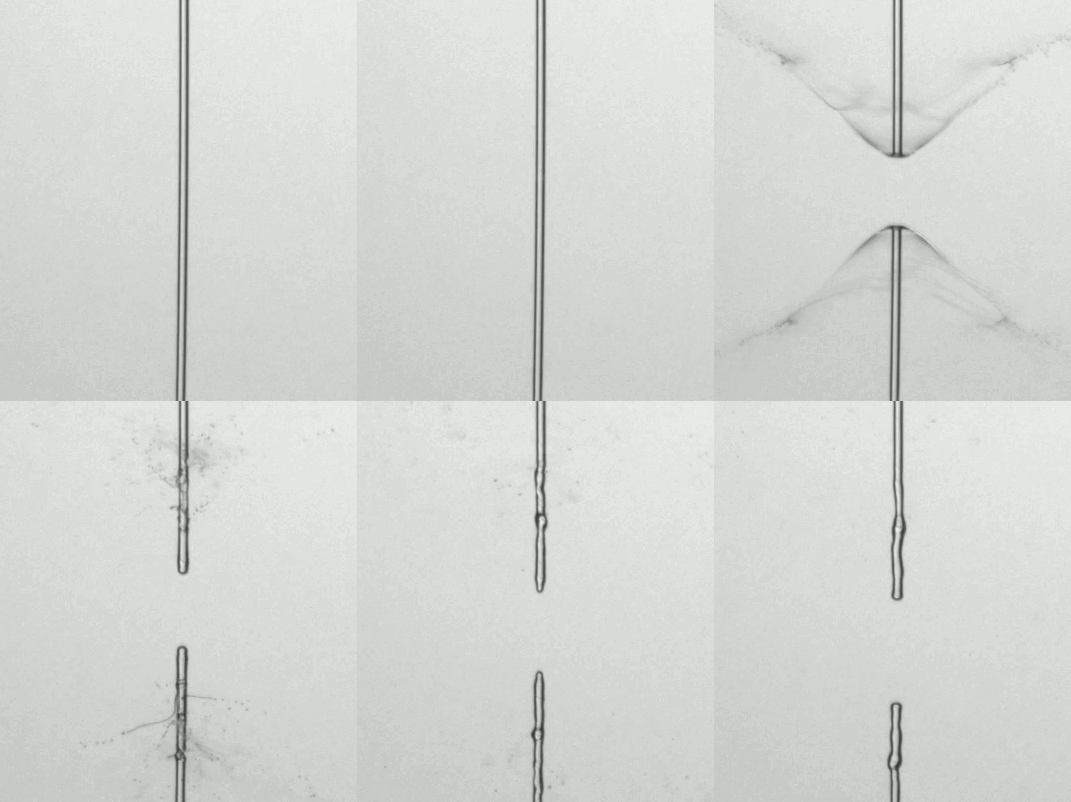
What does a sneeze look like? You might imagine it as a violent burst of air and a cloud of tiny droplets. But this high-speed video shows, that’s only part of the story. The liquid leaving a sneezer’s mouth and nose is a mixture of saliva and mucus, and in the few hundred milliseconds it takes to expel this air/mucosaliva mixture, there’s not enough time for the liquid to break into droplets. Instead, liquid leaves the mouth as a fluid sheet that breaks into long ligaments.
Because mucosaliva is viscoelastic and non-Newtonian, it does not break down into droplets as quickly as water. Instead, when stretched, the proteins inside the fluid tend to pull back, causing large droplets to form with skinny strands between them – the beads-on-a-string instability. The end result when the ligaments do finally break is more large droplets than one would expect from a fluid like water. Understanding this break-up process and the final distribution of droplet sizes is vital for better understanding the spread of diseases and pathogens. (Video credit: Bourouiba Research Group; research paper: B. Scharfman et al., PDF)

Sand, winds, and waves can interact to form remarkable and complex patterns. These sand ripples from the tidal flats of Cape Cod are a testament to such interactions. When a fluid like air or water flows over a flat bed of sand, it can shear and lift grains of sand, moving them to a new location. Very quickly, turbulence within the flow disturbs the initially smooth surface and begins to form the wavelike crests we see. Because the change in surface shape alters the nearby air or water flow, there is a trend toward self-organization and persistence. In other words, once the ripples form, they’re reinforced by their effect on the wind or water that formed them. Once rippled, the surface does not tend to smooth back out. (Image credit: N. Sharp; research credit: F. Sotiropoulos and A. Khosronejad)

A falling jet of viscous fluid–like honey or syrup–will often coil. This happens when the jet falls quickly enough that it gets skinnier and buckles near the impact point. Triggering this coiling typically requires a jet to drop many centimeters before it will buckle. In many manufacturing situations, though, one might want a fluid to coil after a shorter drop, and that’s possible if one applies an electric field! Charging the fluid and applying an electric field accelerates the falling jet and induces coiling in a controllable manner.
An especially neat application for this technique is mixing two viscous fluids. If you’ve ever tried to mix, say, food coloring into corn syrup, you’ve probably discovered how tough it is to mix viscous substances. But by feeding two viscous fluids through a nozzle and coiling the resulting jet, researchers found that they could create a pool with concentric rings of the two liquids (see Figure C above). If you make the jet coil a lot, the space between rings becomes very small, meaning that very little molecular motion is necessary to finish mixing the fluids. (Image credits: T. Kong et al., source; via KeSimpulan)

To the naked eye, glaciers don’t appear to move much, but appearances can be deceiving. Like avalanches and turbidity currents, glaciers flow under the influence of gravity. They typically move at speeds around 1 meter per day, but some glaciers, like those shown above in Pakistan’s Central Karakorum National Park, can briefly surge to speeds a thousand times higher than their usual. The animation above shows 25 years worth of Landsat satellite imagery, enabling one to more easily observe the motion of these slow giants. Try picking out a feature along one of the glaciers and watch it move year-by-year. The glaciers just right of the image centerline are some of the best! (Image credit: J. Allen; via NASA Earth Observatory; submitted by Vince D)
Enjoy FYFD? Consider becoming a patron to help support the site!

Commonly called fire tornadoes, these terrifying vortices often occur in large wildfires and have more in common with dust devils or waterspouts than true tornadoes. They form when warm, buoyant air rises due to the fire’s heat. This creates low pressure over the fire source and draws in fresh, cooler air from the surroundings. If there is any small vorticity or rotational motion to that surrounding air, its spin will be amplified as it gets drawn in. This is akin to an ice skater spinning faster when she pulls her arms in – it’s a result of conservation of angular momentum. That intensification of the air’s rotation is what forms the vortex, which we see here due to the flames it draws upward. This footage was captured yesterday by crews fighting fires in Missouri. (Image credit: Southern Platte Fire Protection District/WCPO 9, source)
Special thanks to FYFD’s Patreon supporters who help support the website!

Time for another fluids round-up! Here’s some of the best fluid dynamics from around the web:
– Band Ok Go filmed their latest music video in microgravity, complete with floating, splattering fluids. Here they describe how they did it. Rhett Allain also provides a write-up on the physics.
– Scientists are trying to measure the impact of airliners’ contrails on climate change. (pdf; via @KyungMSong)
– Researchers observing the strange moving hills on Pluto suspect they may, in fact, be icebergs.
– The best angle for skipping a rock is 20-degrees. Related: elastic spheres skip well even at higher angles. (via @JenLucPiquant)
– Fluid dynamics and acoustics have some fascinating overlaps. Be sure to check out “The World Through Sound” series at Acoustics Today, written by Andrew “Pi” Pyzdek, who also writes one of my favorite science blogs.
– Over at the Toast, Mallory Ortberg explores the poetry of the Beaufort wind scale.
– Could dark matter be a superfluid? (via @JenLucPiquant)
– Understanding the physics of the perfect pancake is helping doctors treat glaucoma. (submitted by Maria-Isabel)
– Van Gogh’s “Starry Night” shows swirling skies, but just how turbulent are they? (submitted by @NathanMechEng)
– The physics (and fluid dynamics!) of throwing a football – what’s the best angle for a maximum distance throw? (submitted by @rjallain)
(Video credit: Ok Go)
Thanks to our Patreon patrons who help support FYFD!


Cymatics are the visualization of vibration and sound. Here photographer Linden Gledhill has taken a simple speaker vibrating a dish of water and turned it into some incredible art. When you vibrate liquids like water up and down, it disturbs the usually flat air-water interface and creates waves on the surface. These Faraday waves are a standing wave pattern that differs depending on which sound is being played. By combining the wave patterns with LED lighting and strobe effects, Gledhill creates some remarkable images that combine sound, light, and fluid dynamics all in one. If you watch the video (make sure to hit the HD button!), you’ll see the patterns in motion and hear the sounds used to generate them. In the last clip (around 0:19), he’s added glitter to the set-up, which highlights the circulation within the vibrating fluid. As you can see, there are strong recirculating regions in each lobe of the pattern, but other areas, like the center region are almost entirely stationary. You can see more photos from the project in his Flickr feed. Special thanks to Linden for letting me post the video of his work, too! (Video and image cred
its and submission: L. Gledhill)
If you enjoy FYFD, please consider becoming a patron to help make sure the Internet keeps getting its daily dose of fluid dynamics!

With a large enough explosion, it’s actually possible to see shock waves. This high-speed camera footage shows the detonation of a car packed with explosives. After the initial flash, you can see the thin membrane of the blast wave expanding outward. This shock wave is a traveling discontinuity in the air’s properties–temperature, pressure, and density all change suddenly over an incredibly small distance. It’s this last variable–density–that enables us to see the effect. Density has a significant impact on air’s index of refraction (which also explains heat mirages). In this case, the shift in refractive index is large enough that we see the difference relative to the background, enabling our eyes to follow an otherwise invisible effect. (Video credit: Mythbusters/Discovery Channel; via Gizmodo)
If you enjoy FYFD, please help support me by becoming a patron!