Glaciers are kind of bizarre. Despite being very solid, they still flow, sometimes on the order of a meter a day. This flow is driven by gravity and the incredible weight of the dense ice. Near the base of the glacier, the pressure is great enough to cause some localized melting. (Very high pressures actually decrease the melting point of water.) Glaciers also move through plastic deformation – this is the internal slippage Joe refers to in the video when he compares glaciers to a deck of cards. Despite their vast differences from typical fluid flows, glacial flows are often still described by the same equations of motion used in the rest of fluid dynamics! (Video credit: It’s Okay to Be Smart; via PBS Digital Studios)
Tag: science

Squishy Impacts

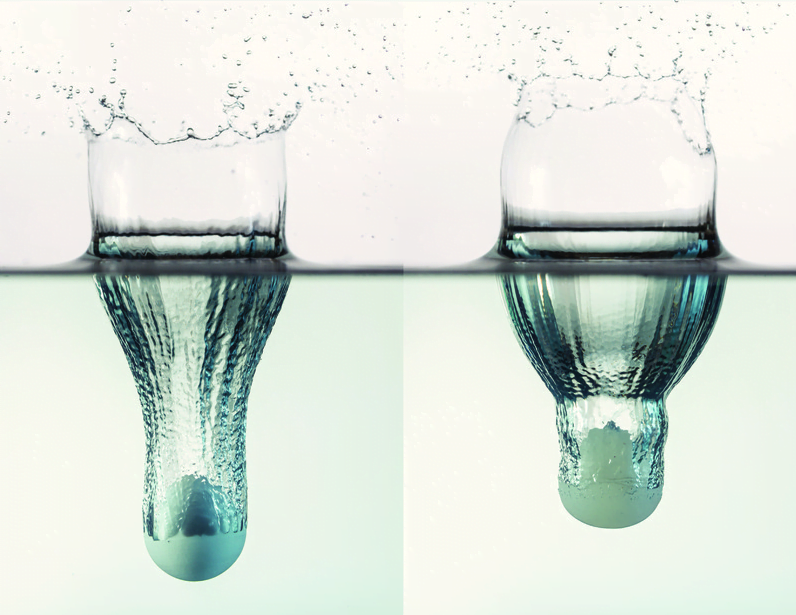


How spheres impact water has been studied for more than a century. The typical impact for a rigid sphere creates a cavity like the one on the upper left – relatively narrow and prone to pinching off at its skinny waist. If the sphere is elastic –squishy – instead, the cavity ends up looking much different. This is shown in the upper right image, taken with an elastic ball and otherwise identical conditions to the upper left image. The elastic ball deforms; it flattens as it hits the surface, creating a wider cavity. If you watch the animations in the bottom row, you can see the sphere oscillating after impact. Those changes in shape form a second cavity inside the first one. It’s this smaller second cavity that pinches off and sends a liquid jet back up to the collapsing splash curtain.
From the top image, we can also see that the elastic sphere slows down more quickly after impact. This makes sense because part of its kinetic energy at impact has gone into the sphere’s shape changes and their interaction with the surrounding water.
If you’d like to see more splashy stuff, be sure to check out my webcast with a couple of this paper’s authors. (Image credits: top row – C. Mabey; bottom row – R. Hurd et al., source; research credit: R. Hurd et al.)

The Mantis Shrimp’s Left Hook
The mantis shrimp is a tiny, clown-colored juggernaut of underwater physics. Some species have modified claws that serve as clubs for punching their prey, and the mantis shrimp swings that club fast – its acceleration is comparable to a bullet’s! Moving that quickly in water causes a drastic drop in local pressure, low enough to form a cavitation bubble. Such low-pressure bubbles themselves are not particularly dangerous, but their collapse is incredibly violent, especially near a solid surface, like the shell of the shrimp’s prey. Collapsing cavitation bubbles can send out shock waves, shatter glass, and even generate light. In the case of the mantis shrimp, it’s more than enough to stun, if not outright kill, its prey. (Video credit: Physics Girl)

Vortex Reconnection
In slow motion, vortex rings can be truly stunning. This video shows two bubble rings underwater as they interact with one another. Upon approach, the two low-pressure vortex cores link up in what’s known as vortex reconnection. Note how the vortex rings split and reconnect in two places – not one. According to Helmholtz’s second theorem a vortex cannot end in a fluid–it must form a closed path (or end at a boundary); that’s why both sides come apart and together this way. After reconnection, waves ripple back and forth along the distorted vortex ring; these are known as Kelvin waves. Some of those perturbations bring two sides of the enlarged vortex ring too close to one another, causing a second vortex reconnection, which pinches off a smaller vortex ring. (Image source: A. Lawrence; submitted by Kam-Yung Soh)
Note: As with many viral images, locating a true source for this video is difficult. So far the closest to an original source I’ve found is the Instagram post linked above. If you know the original source, please let me know so that I can update the credit accordingly. Thanks!
“Pursuit”
Photographer Mike Olbinski has released yet another breathtaking timelapse film of weather over the Great Plains. This one has a little bit of everything: storms, tornadoes, incredible cloud formations, and even sunny days. Olbinski’s work is a reminder that there’s a constant beautiful drama playing out over our heads if we just take the time to watch. Under blue skies, condensation and turbulence are building towering mountains, and even when the sky is gray, it can be churning like the ocean just over your head. The U.S. Great Plains may be home to particularly dramatic examples of this behavior (thanks largely to the atmospheric influence of the Rocky Mountains), but these same phenomena are going on all the time overhead. (Video and image credits: M. Olbinski)


Leaping Droplets
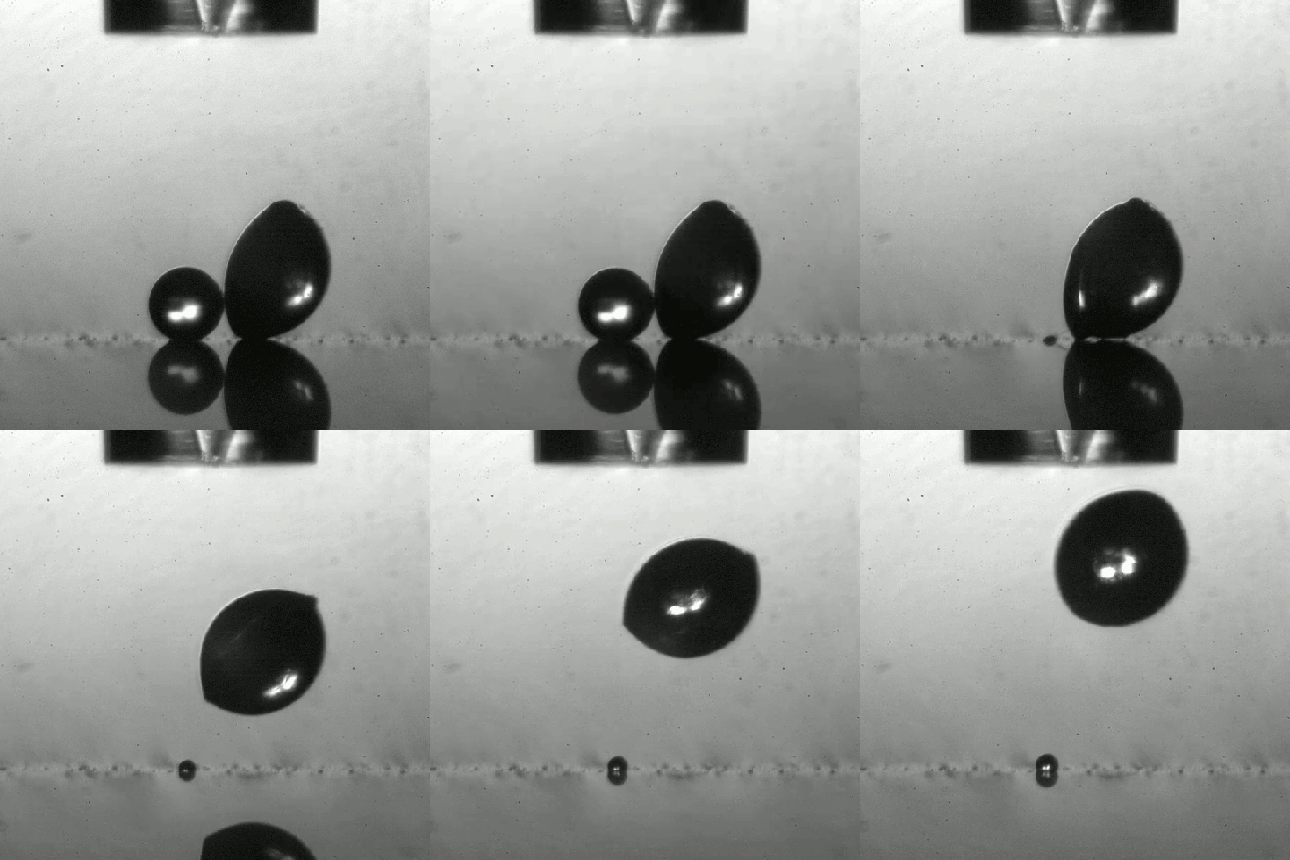
Many fungi use coalescing water droplets to launch and spread their spores. The process is recreated in the laboratory in the animation above. Initially, there is a small spherical drop and a second, flattened drop stuck to the backside of the spore. In the animation, the large object on the right is actually both spore and droplet. The spore is spherical on one side and flattened on the other and starts out tipped up on its edge. When the spherical drop gets large enough to reach the flattened drop, they merge. This reduces the total surface area of the drop and thus releases some surface energy. It’s that surface energy that drives the spore’s jump. Even launching just a centimeter away from the host fungus is enough for a breeze to carry the spore further, allowing the fungus to reproduce. (Image and research credit: F. Liu et al., source; submitted by Kam-Yung Soh)
The Hydraulics Behind a Tuna’s Turns
Tuna are remarkably agile for their size. Many species reach lengths exceeding the height of a human adult, yet they can still make tight turns, especially when hunting. A recent study described one mechanism that aids the fish – a built-in hydraulic system for raising its second dorsal and anal fins. The tuna use fluid from their lymphatic system – which produces and transports white blood cells in both humans and tuna – to pressurize chambers at the base of some fins, causing the fin to rise. The extra support puts the fin in a hydrodynamically advantageous position and helps stabilize the fish when turning quickly, allowing them to change direction without slowing. (Video credit: Science; research credit: V. Pavlov et al.)

Watching Flow Inside Rock
Flow through porous substances has been a major interest in fluid dynamics for the last hundred years because rocks are porous. For most of that period, we’ve used Darcy’s law to calculate how a fluid flows through pores in a rock. (Incidentally, it can also be used for determining the perfect length of time for dunking a cookie in milk.) Often, however, there is more than one fluid in a pore – for example, both a liquid and a gas could be trapped there. In that case, researchers made a few assumptions that allowed them to extend Darcy’s law for these multiphase situations. For a long time, that was the best anyone could do because it was impossible to observe what’s actually happening in the pores inside an actual rock.
Recently, however, scientists have begun observing these multiphase flows inside sandstone pores using x-ray imaging. They’re only able to take an image every 45 seconds or so, but even that is frequent enough to show that the flow is surprisingly unsteady. An example image is shown above. The colored areas show pores filled with nitrogen inside the rock. Brine is also being injected into the rock but not being shown. The colors indicate how connected the nitrogen-filled pores are to other pores nearby. Red areas are highly connected; blue have moderate connections; and green areas are smaller and have fewer connections. The network connections inside the rock change relatively rapidly, even with steady-state injection conditions. That varying connectivity implies that some of the injection energy is going into shifting interfaces around rather than actually moving the fluids through the pores. More work will be needed to unravel what’s really happening inside the porous network, but the results have far-reaching implications for understanding groundwater filtration, fossil fuel extraction, and, in the future, the possibility of carbon sequestration. (Image credit: C. Reynolds et al., source; submitted by Simon D.)

Flow Around a Cylinder
A cylinder standing upright in a flow creates a complicated system of vortices and recirculation. In the photo above, the flow is left to right. The cylinder itself is somewhat hard to see but is located in the center of the image; we see it from above. The colored streaks of dye show the flow path around the cylinder. In yellow, we see a spiraling vortex that forms just ahead of the cylinder and stretches downstream on either side. Because of its shape, this is called a horseshoe vortex. Its sense of rotation is such that it tends to pick up loose material in front of the cylinder; in other words, it can erode that area. This is often seen around the pilings of bridge supports and must be accounted for in designs. You also see the effects of this horseshoe vortex digging out material at the base of trees after snowfalls in areas with a dominant wind direction, and here’s an example with a snow roller. (Image credit: H. Werlé; via eFluids)
Burning a Rocket Underwater
In a recent video, Warped Perception filmed a model rocket engine firing underwater. Firstly, it’s no surprise that the engine would still operate underwater (after its wax waterproofing). The solid propellant inside the engine is a mixture of fuel and oxidizer, so it has all the oxygen it needs. Fluid dynamically speaking, though, this high-speed footage is just gorgeous.
Ignition starts at about 3:22 with some cavitation as the exhaust gases start flowing. Notice how that initial bubble dimples the surface when it rises (3:48). At the same time, the expanding exhaust on the right side of the tank is forcing the water level higher on that side, triggering an overflow starting at about 3:55. At this point, the splashes start to obscure the engine somewhat, but that’s okay. Watch that sheet of liquid; it develops a thicker rim edge and starts forming ligaments around 4:10. Thanks to surface tension and the Plateau-Rayleigh instability, those ligaments start breaking into droplets (4:20). A couple seconds later, holes form in the liquid sheet, triggering a larger breakdown. By 4:45, you can see smoke-filled bubbles getting swept along by the splash, and larger holes are nucleating in that sheet.

The second set of fireworks comes around 5:42, when the parachute ejection charge triggers. That second explosive triggers a big cavitation bubble and shock wave that utterly destroys the tank. If you look closely, you can see the cavitation bubble collapse and rebound as the pressure tries to adjust, but by that point, the tank is already falling. Really spectacular stuff! (Video and image credit: Warped Perception)