Tag: physics

  • Reader Question: Shower Curtains

    Reader Question: Shower Curtains

    Reader thansy asks:

    Why do the bottoms of shower curtains drift in toward the water coming from the shower head?

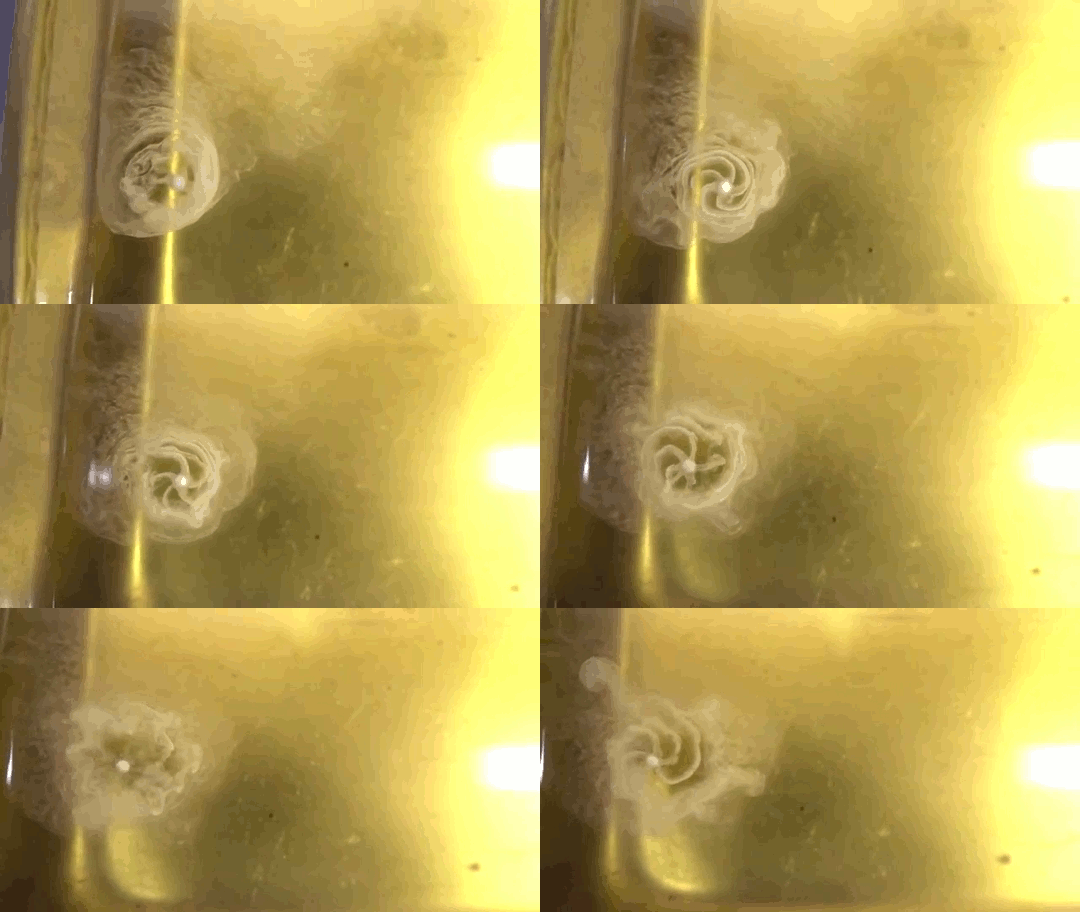
    We all know that moment. You’re minding your own business, scrubbing away, and all of a sudden, the shower curtain billows up and grabs you. Scientists have debated the cause of this behavior for years. Some argued that the curtain billowed due to hot air rising from the shower. Others claimed the fast-moving spray caused lift that pulled the curtain up. But fifteen years ago, one scientist tackled the problem computationally. He performed a numerical simulation of a shower head spraying into a bath and found that this spray of droplets creates a weak horizontal vortex in the shower.

    This shower vortex has a low-pressure core at the middle, which is thought to provide the suction that causes the shower curtain to billow. The scientist, David Schmidt, was awarded the 2001 Ig Nobel Prize for his work. (Image credits: N. Paix, D. Schmidt; research credit: D. Schmidt)

  • Swimming at Microscale

    Swimming at Microscale

    Tiny organisms live in a world dominated by viscosity. There’s no coasting or gliding. If a microorganism stops swimming, friction will bring it to a halt in less than the space of a hydrogen atom! To make matters worse, simply flapping an appendage forward and backward will get them nowhere. As we’ve seen before, these highly viscous laminar flows are reversible, meaning that a backward power stroke is simply undone by a mirrored forward recovery stroke. Instead, microorganisms like the paramecium swimming above are covered in tiny hairlike cilia which beat asymmetrically. They extend to their full length during the power stroke, but they stay bent during the forward recovery stroke. That asymmetry guarantees that they move more fluid backward than forward, thereby letting the paramecium make progress. (Image credit: C. Baroud, source)

  • Shelf Cloud

    Shelf Cloud

    Sydney, Australia was treated to a spectacular meteorological show over the weekend when an impressive shelf cloud swept over the city. These timelapses show the dramatic leading edge of the incoming thunderstorm. Notice how the cloud streams upward along the shelf. The storm is driven by this updraft of warm moist air, which rises until it is capped by the troposphere. At this point, the air spreads, creating an anvil-like shape, and cools. The moisture drawn up at the storm’s front will condense, freeze, and fall as rain or hail. When the updraft weakens, the storm will be dominated by the downdraft of the falling precipitation and eventually peter out. (Image credit: W. Reed and H. Vann, source; via J. Hertzberg)

  • Drawing Up Dew

    Drawing Up Dew

    Desert plants have evolved to efficiently collect and capture whatever water they can. Each leaf of the moss Syntrichia caninervis ends in a hairlike fiber called an awn (seen in white in the top image). Tiny as they are, awns are vital to the moss’s water collection, correlating to more than 20% of their dew collection. Extremely tiny grooves on the surface of the awn provide nucleation sites where dew condensed from fog collects. Once a droplet forms on the awn, it grows larger as more fog condenses (middle image). When the droplet grows large enough, the conical shape of the awn will cause surface tension to draw the droplets along the awn and toward the leaf (bottom image).

    (Credits: Syntrichia caninervis moss image – M. Lüth; videos and research – Z. Pan et al., Supplementary Videos 3 and 4; h/t to T. Truscott)

  • Featured Video Play Icon

    Why Fishing with Dynamite is So Harmful

    In some countries, there are still people using dynamite to catch fish. This practice is incredibly destructive, not just to adult fish but to the entire marine ecosystem. A blast wave traveling through air loses some its energy to the compression of the gas. Water, on the other hand, is incompressible, so the blast wave’s energy just keeps going, expanding its destructive radius. Many fish contain swim bladders, gas-filled organs the fish use to regulate their depth. When a shock wave passes through the fish, the gas in the swim bladder will expand and contract violently, much like the balloons shown underwater in the animation below. This typically ruptures the swim bladder and surrounding tissues.

    Fish without swim bladders will often hemorrhage after being struck by a blast wave. The sudden changes in pressure create bubbles in the dissolved gases collected in their gills. Those bubbles tear apart the fish’s blood vessels.

    Blasting is effective but entirely indiscriminate. It kills adults and juveniles of all species, not just the ones a fisherman can sell. Simultaneously, it destroys the slow-growing coral reefs that are key habitats for these populations. It’s an incredibly short-sighted practice that guarantees there will be no fish to catch in years to come. (Video credit: National Geographic; image credit: M. Rober, source; research credit: K. Dunlap, pdf)

  • Microscale Rockets

    Microscale Rockets

    Shown above are a trio of microscale rockets, each about 10 microns in length. These tiny rockets are roughly cylindrical in shape, with a narrower diameter at the front than the back. Like their space-faring brethren, these microrockets are chemically propelled. They draw in fuel from their surroundings, which reacts with the catalysts coating the interior of the microrocket to produce gases. Those gases bubble out the back end of the microrocket, creating thrust capable of propelling the rockets more than 1000 body lengths/second. Researchers have already demonstrated that these tiny rockets can haul cargo along with them. Scientists hope one day to use these self-propelled microrockets to help deliver drugs or isolate cancer cells. (Image credit: J. Li et al., source)

  • When Lasers Strike

    When Lasers Strike

    Lasers are a great way to deliver a lot of energy very quickly. In this animation, you see a jet of water get struck by a pulse from a powerful X-ray laser. The energy from that laser pulse gets absorbed by the water in a matter of picoseconds – that’s trillionths of a second. All that energy in so little time makes the water vaporize explosively. It’s this vapor explosion that breaks the jet in two. As the vapor expands outward, it forces water from the jet into a thin film that forms a cone. The conical film bends back on itself until it strikes the jet and coalesces. For more, check out this video of a similar experiment that looked at laser impacts on droplets. (Image credit: C. Stan et al., from Supplementary Movie 5; via Gizmodo)

  • 1500 Posts!

    1500 Posts!

    This is FYFD’s 1500th post! Can you believe it? Fifteen hundred posts is a heck of a lot of fluid dynamics. I’ve covered everything from the teeny tiniest scales to the astronomically huge, from events that happen in the blink of an eye to ones that require decades of patience. Today I encourage you to check out the archives whether by scrolling the visual archive, digging in by keyword, or by clicking here for something random.

    Whether you’ve been here for 1 post or for all 1500, thank you! And special thanks, of course, to my Patreon patrons. If you’re a fan and want to help FYFD keep flowing and growing, please consider becoming a patron, too. (There’s cool perks available.) Here’s to the next 1500 posts!

    P.S. Big thanks also to Randy Ewoldt and his lab for their fantastic viscoelastic FYFD timelapse. Isn’t it awesome?! (Image credits: N. Sharp – top image, Ewoldt Research Group – bottom image)

  • Featured Video Play Icon

    Diffraction

    Wave phenomena can sometimes be a little difficult to wrap one’s head around. In this video, Mike from The Point Studios explains wave diffraction and why opening a window can help you spy on the conversation next door. Diffraction occurs when waves encounter an obstacle. If that obstacle is a slit in a wall, the slit becomes a point source, radiating waves outward spherically. The video focuses on acoustics, but diffraction matters in more than just sound – it’s key to water ripples, light and other electromagnetic waves, and, according to quantum theory, the fundamental building blocks of matter.   (Video credit: The Point Studios)

  • Wingtip Vortices Visualized

    Wingtip Vortices Visualized

    In flight, airplane wings produce dramatic wingtip vortices. These vortices reduce the amount of lift a 3D wing produces relative to a 2D one. How much they influence the lift depends on both the strength and proximity of the vortex. The stronger and closer it is, the more detrimental its effect. One way airplane designers reduce the effects of wingtip vortices is by adding an extra section, called a winglet, to the end of the wing. Among other effects, the winglet moves the wingtip vortex further away from the main wing, which reduces its influence and allows the airplane to regain some of the lift that would otherwise be lost. (Image credits: A. Wielandt et al., source)